Deputies recover rafter’s body from American River

The body of man who had been missing for nearly 48 hours was recovered from the South Fork American River on Monday afternoon by El Dorado County search and rescue team members.

Raymond Nocon, 32, of Folsom had been rafting with a friend when both went in the water and became separated about 9pm Aug. 16.

A resident in the area called deputies about 6:30am Aug. 17 saying a neighbor had been camping along the South Fork of the American River when the neighbor was contacted by a male adult walking along the river. The man told the neighbor that he and his buddy’s raft sank somewhere upstream from where he was.

Gorrilla Rock is approximately 13.9 miles down stream from Chili bar, and approximately 7.6 miles upstream from the Salmon Falls bridge. It is just upstream from the river area that is commonly referred to as the South Fork American River Gorge.

Air and land resources were used to locate the rafter. It wasn’t until the afternoon of Aug. 18 that Nocon’s body was found.

An autopsy will be conducted to determine the cause of death.

— Lake Tahoe News staff report


What happens when officers wear body cameras

By Christopher Mims, Wall Street Journal

Sometimes, like the moments leading up to when a police officer decides to shoot someone, transparency is an unalloyed good. And especially lately, technology has progressed to a point that it makes this kind of transparency not just possible, but routine.

So it is in Rialto, where the entire Southern California police force is wearing so-called body-mounted cameras, no bigger than pagers, that record everything that transpires between officers and citizens. In the first year after the cameras’ introduction, the use of force by officers declined 60 percent, and citizen complaints against police fell 88 percent.

It isn’t known how many police departments are making regular use of cameras, though it is being considered as a way of perhaps altering the course of events in places such as Ferguson, Mo., where an officer shot and killed an unarmed black teenager.

What happens when police wear cameras isn’t simply that tamper-proof recording devices provide an objective record of an encounter—though some of the reduction in complaints is apparently because of citizens declining to contest video evidence of their behavior—but a modification of the psychology of everyone involved.

The effect of third-party observers on behavior has long been known: Thomas Jefferson once advised that “whenever you do a thing, act as if all the world were watching.” Psychologists have confirmed this intuition, showing that something as primitive as a poster with a pair of glaring eyes can make test subjects behave better, and even reduce theft in an area.

One problem with the cameras, however, has been cost. Fortunately, fierce competition between the two most prominent vendors of the devices, Vievu LLC and Taser International Inc., which makes the cameras used by Rialto police, has driven the price of individual cameras down to between $300 and $400. Unfortunately, one place where expenses can mount is in the storage and management of the data they generate.

Read the whole stor


Fire near Truckee consumes 75 acres

The Boca Fire east of Boca Dam had grown to 75 acres as of 6pm Aug. 18.

The forward progress of the fire has been stopped and there is no threat to Truckee, according to officials. The fire is burning away from Truckee.

The fire initially made a run up the slopes east of Boca.

Air and ground resources are being used to stop the grass and sage brush fire.

The U.S. Forest Service is the lead agency.

— Lake Tahoe News staff report


Hunger crisis hitting U.S. college students

By Ned Resnikoff, MSNBC

Hungry students don’t enter the on-campus food pantry at New York’s LaGuardia Community College; instead they sit in an office in the college’s financial services center while a staff member or volunteer runs upstairs to get their food, bringing them unmarked grocery bags to take home.

Little more than an unlabeled office, containing a series of unmarked file cabinets, the pantry goes undetected to most – and that’s the point.

Michael Baston, the college’s vice president of Student Affairs, says the whole process is designed to be invisible.

“We did this because we feel like it is a stigma reducing strategy,” he said. “Because we want students to feel like whatever the resource they need to sustain themselves, that would be available to them.”

Battling stigma is a challenge for food pantries of all stripes, but the struggle appears to be especially pronounced on college campuses. After all, universities are supposed to be islands of relative privilege. If you can afford to spend thousands of dollars a year on a college education, the thinking goes, you can’t possibly be hungry enough to require emergency food assistance.

Rhondalisa Roberts, a LaGuardia sophomore and food pantry client, has witnessed that stigma firsthand. She says that when she suggested that a hungry classmate of hers visit the pantry, the classmate told her, “Oh, I’m not going to go there. I’m not poor.”

“It’s very, very alarming,” Roberts told MSNBC. “Most students have a negative stigma when it comes to receiving help for food. Everybody doesn’t want to receive food or seem needy, even when they are in dire need of resources.”

It’s difficult to track just how many college students are in dire need, but new data from the country’s largest emergency food service network suggests that the number is at least in the millions. Feeding America’s 2014 Hunger in America report estimates that roughly 10 percent of its 46.5 million adult clients are currently students, including about 2 million people who are attending school full time. Nearly one-third of those surveyed — 30.5 percent — report that they’ve had to choose between paying for food and covering educational expenses at some point in the last year.

Feeding America, a network of some 46,000 emergency food service agencies in the United States, releases its Hunger in America report once every four years. This latest iteration of the report, which is based on a survey of more than 60,000 Feeding America clients, is the first to include data about college students in need of emergency food services. The new research suggests that America’s chronic hunger emergency has not spared institutes of higher learning.

Maybe that should come as no surprise, given that food insecurity — defined by the Department of Agriculture as lack of ”access … to enough food for an active, healthy life” — has been rising steadily for years. In part that’s due to the Clinton and Reagan administration’s significant revisions to the welfare state. Yet the situation didn’t become a true crisis until after the 2008 financial collapse, which caused food insecurity to rise by 24 percent in the space of a single year, according to USDA figures. In response, the federal government approved an emergency transfusion of funds into the food stamp program; but then it began to roll back those additional funds in November 2013, even though food insecurity had never returned to pre-2008 levels. The result was an unprecedented state of permanent emergency for emergency food assistance programs across the country.

Read the whole story


STPUD customers without water

South Tahoe Public Utility District customers in the States Street area of South Lake Tahoe are without water this morning.

This is because of an emergency line shutdown. STPUD hopes to have service resorted by 12:30pm Aug. 18.

Also without water is the Tahoe Meadows area.

Crew have been working in this area off Tahoe Keys Boulevard all summer replacing water lines and installing water meters.

— Lake Tahoe News staff report


Human remains found in Placerville field

Human remains were discovered in a field Sunday on the West Slope.

El Dorado County sheriff’s deputies said an autopsy will be conducted to determine the identity of the woman and cause of death.

A person walking by the field southeast of Missouri Flat Road near Highway 50 in Placerville found the remains Aug. 17 at 4:30pm.

— Lake Tahoe News staff report


Identities released of men on board downed plane

Two Bay Area brothers were in the plane that crashed just short of the Swansboro Airport near Placerville on Saturday night.

Killed on impact was Perry Nieland, 52, of San Jose. Richard Nieland, 55, of San Jose was injured when the Starduster biplane went down Aug. 16 about 7pm. It is unknown who was piloting the aircraft.

The National Transportation Safety Board and Federal Aviation Administration are investigating.

– Lake Tahoe News staff report


Drought drains recreation revenues at Tahoe

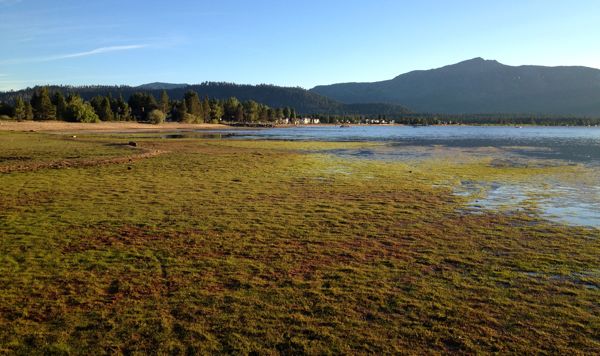
Normally this area at Cove East in South Lake Tahoe is under water. The beach toward the upper left corner. Photos/Kathryn Reed

Normally this area at Cove East in South Lake Tahoe is under water. The beach is toward the upper left corner. Photos/Kathryn Reed

By Susan Wood

With a mere 3 inches of snowmelt adding to the level of Lake Tahoe this year, the dire trickle-down effect of the drought on recreational outlets like Lake Tahoe Balloons has not been overinflated.

By the time the anticipated lake level for Tahoe reaches its natural rim of 6,223 feet by mid-October, businesses and agencies tied to the fun and the sun may see more severe conditions than what is being witnessed now from shore-to-shore.

To many who follow the trends, there’s nothing normal about the weather patterns. And this includes the lake’s experiencing more abnormal monsoonal weather conditions that reduce evaporation and provide heavy downpours. The positive of the whacky weather is that it delayed the lake’s hitting the natural rim.

“I used to be able to get right up there close to shore. Now I have to be a quarter mile out. That makes it difficult,” Harley Hoy of Lake Tahoe Balloons told Lake Tahoe News.

For many years, Hoy has run his company out of the Tahoe Keys Marina. But he may be forced to move if the lake level keeps sinking and the marina operators fail to live up to their pledge of dredging the boat channel. It’s been a tricky situation for boats getting in and out of the popular South Shore marina, and it’s only getting worse.

Hoy said he was told the dredging would occur this summer. Now he’s heard October, and that may be too late for his business. He’s sought another place to run the company.

“If the guy would have the common courtesy, he would see that one day there could be in an accident and someone will find him negligent,” Hoy said of marina General Manager Robert Spinnato, who did not return Lake Tahoe News’ phone calls. Hoy cited the removal of lights once placed outside the channel that have made conditions hazardous going into the Keys.

Paddlers have more area to maneuver because motorboats can't get close to shore without serious consequences.

Paddlers have more area to maneuver because motorboats can’t get close to shore without serious consequences.

Dangerous boating conditions

Between the sand washing out and the rocks exposing themselves in Lake Tahoe, concerns have been rising for the U.S. Coast Guard. The federal agency, which has a station in Tahoe City, was forced to send a crew out to help with an unprecedented call to rescue more than 200 passengers on board the Tahoe Queen paddle-wheeler because it was stuck on a sandbar off shore.

“It’s been awhile since we’ve had any commercial incident like this,” Coast Guard Officer in Charge Daniel Polhemus said.

The matter is under investigation.

“The lake continues to go down, and boaters may not realize how the low lake level is creating hazards. Boulders normally covered up by 5 feet of water are now exposed. It’s a dangerous situation for (those at) marinas not familiar with the drought effects,” Polhemus told Lake Tahoe News.

Sand Harbor, Kings Beach and Camp Richardson have joined the list of closed marinas with El Dorado Beach, which often closes to motor boat traffic. The upside is human-powered vessels such as paddleboards have easier access to the water.

Polhemus described Cave Rock, one of the more promising launching spots, as “extremely dangerous” without local knowledge of the terrain. The Tahoe Keys Marina is characterized “very, very shallow,” while Ski Run Marina – home of the Queen – is considered iffy to negotiate around.

In the Coast Guard’s home-base of Tahoe City, Polhemus has seen owners paddling their boats out as a safer alternative to dealing with bringing the motors down in shallow water.

The Coast Guard warns boaters about driving their trailers down too far on the ramps and urges boat captains to slow down considerably.

“We’re asking people to be extra careful,” Tahoe City Marina Manager Jim Phelan said, adding he’s noticed some boaters have lost use of slips. Some sailboats have experienced more challenges than usual because they can’t use rudders in shallow water. Phelan expects more limitations as the lake nears its natural rim.

“Under normal conditions, we would have hit the rim in a few weeks,” federal water master Chad Blanchard told Lake Tahoe News.

But the downpours and cloud cover from the strange July and first part of August have been “extremely helpful” in slowing the process, he added.

It’s like the summer is struggling with occasional tropical storms to make up for three years of drought given last year’s lackluster winter and dismal snowmelt runoff. In 2012 during the period starting in April, Lake Tahoe rose 7.68 inches. The following year was worse with 5.76 inches. This year marks the fourth worst lake level runoff in 114 years with only 3.48 inches.

This trend has culminated into how more than 80 percent of California continues to suffer extreme drought conditions.

The consequences are far-reaching and dire to some who rely on the health of the environment. Moreover, the concerns have not been limited to those doing business at the lake.

Victor Babbitt of Tahoe Fly Fishing applauds the recent storms that have cooled things off in the waterways based on how fish behave.

“Every time we have a thunder shower, it helps in a huge way,” he said.

Babbitt has been worried about the fish going into shock when the water is too shallow and warm. Catch-and-release fishing in times of elevated temperatures may increase stress and hinder survival of fish populations. Avoiding 70-degree water holes is the key.

“The fish try to move to different parts of the river,” he said.

But they could run out of places to go – especially in the Truckee River that feeds from Lake Tahoe.
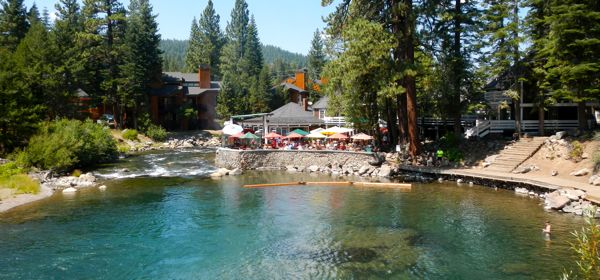
Rafting companies normally fill this expanse of the Truckee River by the River Ranch.

Rafting companies normally fill this expanse of the Truckee River by the River Ranch.

Commercial rafting ran out of water

As of July 24, the Truckee River rafting companies that usually do a banner business in August stopped operating because of the water level. Water officials have been forced to accommodate the lake instead.

Although concessions were made in early spring to give Aaron Rudnick with Truckee River Raft Co. a head start on renting boats, it didn’t help much because the tourists weren’t in the region then like they are now.

The low water level has made conditions dangerous with many rocks exposed like the ones in the rapid called “the pit” near the River Ranch.

The rafting company usually makes up to 40 percent of its revenue in August.

“This is huge. Every weekday in August is like a weekend day, and every weekend day is like the Fourth of July,” Rudnick lamented to Lake Tahoe News. “You miss out on all that.”

Rob Curtis, the general manager at the River Ranch, found it necessary to be creative with making up for at least 60 percent of lost revenue from rafters frequenting the inn located at the end of the rafting companies’ river run. The usual 1,000 lunches served on the deck on most weekend days have been cut in half, prompting the small, boutique hotel to implement the “no rafting event series.” One example is a crawdad festival designed to draw the masses.

When the rafting companies cease operating, the effects span other areas of responsibility.

The two companies located at the heart of Tahoe City clean up the trash in the river – but this requires they run their rafts. Placer County had to step in to establish a partnership with the Tahoe City Public Utility District and the U.S. Forest Service to do the cleanup, especially considering individual raft runners on bottomless inner tubes may have the tendency to dump more in the river, Rudnick pointed out.

“We needed to deal with this because it could be a problem,” Placer County Supervisor Jennifer Montgomery said.

Montgomery added that local government has taken extra steps in conserving water including the turning off of water features and fountains. She estimated Placer County has saved about 15 percent of its water consumption in doing so.

Finding alternatives

From government to industry, most entities dealing with recreation are watching their water use.

Lake Tahoe Golf Course has cut its water use in half, manager Joe Lockwood indicated. Its usual everyday, 11-minute sprinkler rotation is now down to 5 minutes every other day.

“Thankfully, our water comes from a well. And we hand water so that controls the amount of water better,” Lockwood said.

The same goes for Edgewood Tahoe Golf Course, as it was forced to buy water from its so-named Stateline-area water company.

South Lake Tahoe’s Bijou Golf Course is making sure it doesn’t over water.

The city also sweeps its pool patio at the recreation center, so no water is used to clean up debris, Recreation Manager Lauren Thomaselli pointed out.


Roundabout conundrum goes to Placerville voters

By Peter Hecht, Sacramento Bee

An argument blisters amid the weathered storefronts of old Placerville. It boils down to this: When is a traffic circle just a circle? And when is it a conspiracy?

Voters in the town of 10,500 residents are going to the polls in November to decide on a local initiative that would ban the city from constructing anything resembling a “roundabout” or “traffic circle” or “other similar traffic features.”

Measure K would also require a public vote on any project – such as a subdivision or commercial development – if it contains a road with such potentially offensive curvature.

The local initiative has become a curious metaphor for the growth and development battles consuming El Dorado County. Ever since the city announced plans two years ago to build a downtown traffic circle that was to wrap around a 1926 monument erected by the Druids of California, many people suspected ulterior motives.

Federal studies say a traffic roundabout – a circular intersection around a center island – can increase road capacity by 30 percent to 50 percent compared with traditional intersections. They are seen as reducing pollution because vehicles can merge into traffic in the circles and exit on desired streets without idling and spewing exhaust at stop signs or lights.

Read the whole story


Drones a threat to firefighters

By Keith Ridler, AP

BOISE, Idaho – Drones flying over wildfires could lead to firefighter injuries and force retardant bombers to be called off, wildfire managers say.

At least three drones have flown within or near restricted airspace intended for wildfire fighting aircraft so far this year, the National Interagency Fire Center in Boise announced Friday. That’s up from one incident last year.

“We’re seeing an increase in people wanting to film from a distance with hobby aircraft,” said spokesman Mike Ferris, noting wildfires are often buzzing with low-flying planes and helicopters. “If you had one of these would you fly it near an airport?”

In June, a drone was spotted at the Two Bulls Fire near Bend in central Oregon. Drones have also been spotted at a fire in Washington state that destroyed hundreds of homes, and another that went aloft at a Northern California wildfire.

“Anytime that that happens, folks working these fires are going to feel compromised and they’re not going to want to fly until they’re sure the airspace is safe to fly in,” said Aitor Bidaburu, chair of the National Multi-Agency Coordinating Group at the center. “We have enough hazards on the ground.”

Managers said tankers trying to make drops to protect firefighters or homes might have to turn away if a drone is in the area.

The Federal Aviation Administration allows hobbyists to use model aircraft or small drones as long as they keep them away from airports, fly them under 400 feet and keep the aircraft within sight of the remote-controlling operator at all times.

However, wildfires typically have temporary flight restrictions that extend up and out from the fire so helicopters and retardant aircraft can do drops without worrying about other aircraft. The restrictions include small drones.

“If they’re going to be flying these things, they need to educate themselves,” Ferris said.

Those seeking to fly drones near wildfires might be able to do so legally, but they would first need permission from wildfire managers. The center said individuals using drones that interfere with firefighting efforts could face civil penalties and criminal prosecution.

Center spokesman Randy Eardley said some state agencies fly drones over fires to find hotspots, but the operators are communicating with wildfire managers.

“The problem with these hobbyists and recreationists is we have no communication with them,” he said.