EPA recommends significantly lower ozone standard

By Neela Banerjee and Tony Barboza, Los Angeles Times

The U.S. Environmental Protection Agency staff said Friday that the nation should tighten smog rules significantly, a step that would improve air quality in California but force costly new requirements on government and industry.

The EPA staff recommendation is the final step before the rule goes to the agency’s leadership and the White House. As a result of lawsuits by environmental and health groups, the agency must propose a new ozone rule by December and the final rule by October 2015.

Federal standards for ground-level ozone, the main ingredient in smog, have proved deeply contentious because they would compel many states, cities and industries to adopt new measures to cut air pollution at a cost of billions of dollars.

California would be particularly affected because much of the state does not meet the current, weaker standard for ozone that has been in place since 2008.

Read the whole story


El Dorado County drug ring broken up

By Cathy Locke

Six Sacramento-area residents were indicted Thursday in a case involving drug-trafficking in Sacramento, Yolo and El Dorado counties.

A federal grand jury returned a 17-count indictment against Kenneth Tam, 53; Gerald Osborne, 56; Sherlynn Charles, 52; Marco Antonio Borja, 38; Adalberto Valenzuela-Ruiz, 30; and Nelson Gutierrez, 26. They are charged with conspiracy to distribute and to possess with the intent to distribute methamphetamine and heroin, and possession and distribution of methamphetamine and heroin, according to a federal Department of Justice news release.

According to court documents, a seven-month investigation began in January after law enforcement officials received reports that Tam was trafficking large amounts of methamphetamine and heroin throughout Sacramento, Yolo and El Dorado counties.

Read the whole story


4-year degrees at community colleges gain traction

By Alexei Koseff, Sacramento Bee

Driven by shifts in technology and educational expectations across industries, California’s higher education leaders know they face an unexpected economic challenge just six years after the recession ravaged the state’s workforce: a potential shortage by 2025 of 1 million bachelor’s degrees.

As California’s overburdened public universities consider ways to boost middling graduation rates, community colleges see an opportunity to step in and help close the gap.

Traditionally the domain of transfer and career technical education, community colleges are looking to offer bachelor’s degrees in vocational fields, a step that could be the biggest adjustment to the mission of the state’s three-segment system of public higher education since it was laid out more than 50 years ago in the California Master Plan for Higher Education.

“There’s no way the state universities can absorb the … demand or growth,” said Constance Carroll, chancellor of the San Diego Community College District, adding, “In California, the time is right” to follow 21 other states that already offer baccalaureates at the community college level.

Hans Johnson, a researcher at the Public Policy Institute of California who first calculated the often-cited million-degree figure in 2009, said a confluence of factors has driven educational expectations higher and higher, including a shift toward more technically advanced industries in California and a growing sense that college-educated employees are more effective.

Research suggests “there’s something about college itself that leads to these gains,” he said.

Johnson estimates that 40 percent of jobs will require a bachelor’s degree within a decade, up from about a third now. Yet, unless the public universities that educate most Californians improve outcomes or accept more students, the state won’t be able to meet that potential.

If SB 850 is signed, campuses, including Lake Tahoe Community College, will present applications to the California Community Colleges Board of Governors, then the selected degree programs will have to be accredited, said Vince Stewart, the system’s vice chancellor of government relations, so it could be another year or two before any are established.

Read the whole story


STPUD employees may receive 3-year 9% raise

By Kathryn Reed

South Tahoe Public Utility District’s board on Sept. 4 is expected to approve a three-year contract with employees that includes raises each of those years.

The union this week ratified the contract. The deal affects about 100 of the 112 employees.

For the first year workers will receive a raise of 2 percent. This is retroactive to July 3, when the pay period started for the start of this fiscal year.

Raises for years two and three will be based on the Consumer Price Index for Small West Coast Cities All Urban Consumers. However, the minimum the raise can be is 2 percent for each the next two years. The maximum raise for the three years cannot be more than a combined 9 percent raise.

“What took us the most amount of time was to develop protections on the low and high side for workers and the district,” Richard Solbrig, general manager for the district, told Lake Tahoe News. He said there were 12 negotiation sessions.

Another change to the contract includes getting Martin Luther King Jr. off instead of Lincoln’s birthday. This takes effect in 2015.

In the past, employees received 11 set holidays plus three hours of floating holiday pay. That has been increased one full floating day.

The old contract called for an extra day of vacation to be added when employees reached years 20 and 25. That has been changed to years 15 and 20.

The management contract is still under review. It was a four-year contract that stipulated at year two, which is now, the contract could be opened to discuss salaries and the possibility of a market survey. Solbrig said there is no appetite to pay for a survey, but salaries are under consideration.

Medical insurance rates are not going up at the district in the next year.

Any CalPERS increases, per the contract, are split between the district and employees — at least up to the maximum CalPERS allows. After that, the district must pay the bill. This was a requirement carried over from the previous contract.


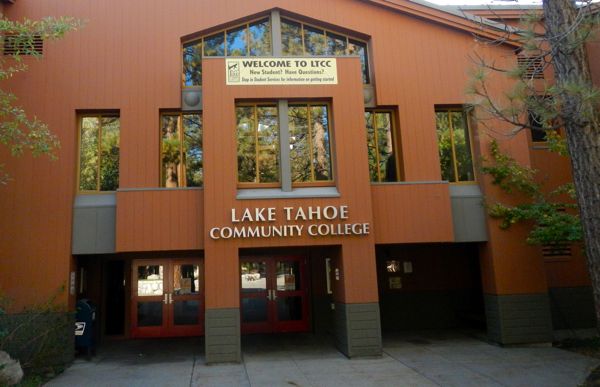
LTCC banking on Measure F to pay for upgrades

Lake Tahoe Community College is seeking its first general obligation bond. Photos/Kathryn Reed

Lake Tahoe Community College is seeking its first general obligation bond. Photos/Kathryn Reed

By Kathryn Reed

Lake Tahoe Community College is going to be different in the coming years. How different depends on voters.

Measure F – as in facilities – is on the Nov. 4 ballot. It is a $55 million general obligation bond that property owners in the district would pay back over the course of about 30 years. The amount owed cannot exceed $25 per $100,000 of assessed valued. That means owners of a house valued at $300,000 would pay $75 per year. To pass, it must receive at least 55 percent approval.

The college expects to deliver $107 million worth of projects over 10 years. The other $52 million will come from matching dollars from the state or other grants.

No argument in opposition to Measure F has been filed with the El Dorado County Elections Department.

The money is entirely for facilities. No money can go toward salaries or benefits.

While the South Lake Tahoe institution has been putting some money away for major repairs, those dollars are not enough to keep up with the major maintenance costs and ongoing technology upgrades that are needed. Nor does it come close to being able to cover expenses associated with new facilities. Plus, LTCC has been contending with five years of budget cuts.

Informational signs are scattered throughout the campus.

Informational signs are scattered throughout the campus.

LTCC, while it turned 40 this year, has been at the current location for 25 years. To the untrained eye, the outside still looks fairly new. But President Kindred Murillo said closer inspection reveals the wear and tear on the facilities through the years, especially because of being located in a harsh climate like Lake Tahoe.

But the college is also contending with science labs that are 25 years old, a campus that doesn’t have adequate wireless capabilities for a generation of students who have their own mobile devices, and safety issues that decades ago were not even on the radar – like protecting people on campus if there were a gunman.

For students coming to LTCC from South Tahoe High School, the facilities are like taking a step backward after the multi-million upgrades delivered from the 2008-voter approved Measure G bond.

The college bond is designed to bring LTCC into the 21st century “to give students and teachers the best environment.”

“I hate to send a highly qualified instructor into a classroom where they have to fight with heating, cooling and technology,” Murillo told Lake Tahoe News.

Plus, some of the upgrades will actually reduce some bills – like electrical and heating.

And if the bond doesn’t pass?

“We will probably have to downsize classes and programs because we will need to shift money to things that need to be fixed,” Murillo said.

She said the vision of the college – to be California’s premier destination college – wouldn’t change. What will change is the time line to accomplish that goal. Murillo wouldn’t say how many years it would put the college behind, but said it would take a lot longer to get to where the staff and board want to go.

With passage of the bond, what people would notice right away is the main building would be modernized, which includes being retrofitted for energy efficient lighting; crumbled sidewalks near the gym replaced; and the patchwork of roof repairs gone.
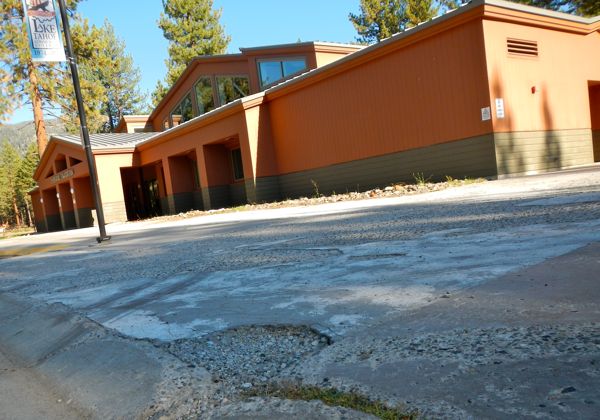
Concrete in front the PE building gives the campus a rundown look.

Broken concrete in front the physical education building gives the campus a rundown look.

The college is seeking matching money from the state to build a public safety training facility. This would tie into the school’s fire academy. This would also act at the community’s office of emergency services.

LTCC is also planning to create a university center. Senate Bill 850 is on the governor’ desk. This would allow community colleges to offer baccalaureate degrees that don’t compete with those that are available in the CSU and UC systems.

Murillo said staff is discussing a program that would be Tahoe specific. The college could either offer its own four-year degree or partner with an established institution.

Friends of Lake Tahoe Community College has been established to be the advocacy group for Measure F. A website will be launched in September with more information.



Tahoe Keys homeowners to dredge channel

Tahoe Keys Property Owners Association plans to dredge the west channel in September.

The Tahoe Keys Marina has yet to file for a dredging permit, even though the lake continues to drop.

Lahontan Regional Water Quality Control Board is taking comments on the TKPOA permit application until Sept. 5. The permit is expected to be granted Sept. 15.

TKPOA plans to dredge no more than 5,600 cubic yards of sand to a depth of 6,217 feet from the west channel and lagoons. This could continue through 2016.

Lahontan is also reviewing an application from Fleur du Lac to dredge. Tahoe City Marina has its permit in hand, but has yet to dredge.

No other applications for dredging at Lake Tahoe have been submitted to Lahontan.

— Lake Tahoe News staff report


Nutting loses latest round in court

The California Supreme Court on Aug. 27 denied former El Dorado County Supervisor Ray Nutting’s request to stop the Sept. 9 special election and block his removal from office.

The election is to replace him on the board.

Nutting was convicted in May on six counts relating to obtaining illegal loans from a county employee.

A Superior Court judge found Nutting’s misconduct in office warranted his removal. That was then upheld by the Third District Court of Appeal.

— Lake Tahoe News staff report


Plastic bag ban headed for approval in Calif.

By Jessica Calefati, San Jose Mercury News

SACRAMENTO — A bill that would ban single-use plastic grocery bags statewide — something California lawmakers have tried and failed to do more than a dozen times before — won approval from the state Assembly on Thursday after failing on the floor earlier this week.

The bill — which would make California the first state in the nation to ban the flimsy bags — still needs Senate approval, but is widely expected to pass in that chamber.

Touted by environmentalists as a way to reduce a pesky form of litter that pollutes the Pacific Ocean, the proposal has faced intense opposition from plastic and paper bag manufacturers who have been working hard to kill the bill.

Earlier this year, debate on the measure centered on jobs and the environment, but in recent days, criticism of the proposal became all about the 10-cent fee stores must charge for paper and thicker plastic bags under the bill.

Read the whole story


Drug policy shifting toward treatment over jail

By Katie Zezima, Washington Post

Over the past few years, the White House has shifted its drug policy away from putting low-level offenders in jail and prison and toward helping them access addiction treatment — an approach that dovetails with the life of acting drug czar Michael Botticelli, a recovering alcoholic.

It’s a strategy has a rare distinction nowadays: it has been embraced by both Republicans and Democrats.

As the nation grapples with fresh waves of prescription drug and heroin abuse, members of both parties are calling for a shift away from using the criminal justice system to address the problem, and toward public health-based approach to drug addiction.

“You just can’t bust enough people to solve this problem,” Republican Ohio Gov. John Kasich said in January. Drug overdose deaths in Ohio increased by 366 percent from 2000 to 2014. “The problem has to be solved at the beginning, which is to keep people from getting involved with these drugs.”

Why are politicians of all persuasions calling for treatment-oriented solutions?

The biggest reason: the spike in drug overdoses isn’t dropping and public opinion has increasingly tilted toward providing treatment to people with addiction issues.

A survey released in April by the Pew Research Center found an overwhelming majority of Americans believe the government’s approach to drug policy should focus on treatment.

Read the whole story


Helicopter crashes south of Gardnerville

The National Transportation Safety Board is investigating a helicopter crash that occurred in Douglas County on Aug. 27.

Douglas County sheriff’s deputies found out about it at 4:45pm after the two occupants sought medical treatment.

Pilot Doyle Holden and friend Karen Cole had flown into the Horsebend area south of Gardnerville to fish the Carson River.

“After fishing, they lifted off of the ground and experienced a malfunction and crashed landed. Holden and Cole suffered minor injuries, and contacted another pilot who flew in and transported them out of the area,” deputies said in a press release.

— Lake Tahoe News staff report