Calif. adds $70 million to firefighting efforts

By Sam Stanton, Sacramento Bee

Firefighters may have finally gotten the upper hand on the massive King Fire, but its legacy continues as the state wrestles with how to pay millions in firefighting costs incurred in what is being called one of the worst fire years in recent history.

On Monday, state Department of Finance officials notified lawmakers that the $209 million set aside in the budget for emergency firefighting already has been exhausted, and that officials are transferring another $70 million from a special account into the emergency fund because of fires in numerous counties.

Read the whole story


Desolation fire 90% contained

Heavy precipitation during the weekend allowed firefighters to nearly contain the Cascade Fire burning close to Snow Lake in Desolation Wilderness.

The 20-acre fire is 90 percent contained as of Sept. 29. It started in the late afternoon Sept. 24

Crews will begin repairing damage from fire suppression activities.

Bayview Trailhead and Campground and Taylor Creek Sno-Park on Highway 89 are open.

The fire was human caused, but is still under investigation.

— Lake Tahoe News staff report


Brown approves community college bachelor’s degrees

By Alexei Koseff, Sacramento Bee

In what could portend a monumental shift in public higher education in California, Gov. Jerry Brown signed a bill Sunday that will allow up to 15 community colleges to launch bachelor’s degrees programs in vocational fields.

While 21 other states offer community college baccalaureates, California’s colleges have traditionally been the domain of transfer students and career technical education, granting two-year associate degrees, as established more than fifty years ago in the Master Plan for Higher Education. Senate Bill 850 will allow colleges to experiment with four-year degrees. The pilot program is set to begin no later than the 2017-18 academic year and end in 2024.

In recent years, advocates have argued that growing industry demand for more educated workers in fields such as dental hygiene and automotive technology could be met by expanding existing programs at community colleges.

Read the whole story


King Fire burning inside containment area

The King Fire scorched trees on both sides of Highway 50 near Fresh Pond. Photo/LTN

The King Fire scorched trees on both sides of Highway 50 near Fresh Pond. Photo/LTN

Crews overnight were able to hold the King Fire to 97,099 acres and 89 percent containment. The active fire continues to burn within the containment area.

More than 4,000 people are still fighting the fire burning east of Pollock Pines. But each day more crews are sent home, which is also reducing the number of apparatuses in the forest. Work is being done on the Eldorado and Tahoe national forests to repair any damage caused by equipment.

Several houses are still threatened, but evacuations have been lifted. Roads, though, are not all open in the burn area. Trail access is off-limits in the area as well.

Since the alleged arson fire started Sept. 13 there have been six injuries, 12 houses destroyed and 68 other structures lost.

The forecast is for warming weather in the region and blue skies in the Lake Tahoe Basin.

— Lake Tahoe News staff report


Calif. limits sales of Confederate flag

By Dan Brekke, KQED-TV

Gov. Jerry Brown has signed a bill that bars state agencies from selling or displaying the Confederate battle flag or any other items that bear the Civil War-era insignia.

The governor signed the bill, AB2444, by Assemblyman Isadore Hall, D-Compton, without comment.

Hall reportedly was inspired to propose the measure after his mother saw replica Confederate currency for sale at a state Capitol gift shop.

Hall’s bill passed easily in the Assembly and Senate. Assemblyman Tim Donnelly, R-Twin Peaks, a tea party conservative, cast the only “no” vote in the lower house, saying the proposal would violate the First Amendment guarantee of free speech.

Read the whole story


King Fire inching toward full containment

Update 7:15pm:

The King Fire is at 89 percent containment, with the help from 1 to 3 inches of precipitation in the last few days. Crews are continuing to hold the spread of the fire, with acreage burned at 97,099.

Now structures on White Meadows Road are being monitored for possible mud and debris flows. However, warmer and dryer weather conditions are expected to return this week. This means smoke and visible fire.

Where fuels remain thick in the Eldorado and Tahoe national forests there is is still more that could burn, but officials say this should be within the fire perimeter.

Structures are still threatened, however evacuations have been lifted.

Several road closures remain in place including Mosquito Road from Wentworth Springs Road to Stope Drive, and Ice House Road at Highway 50. The Tahoe National Forest has issued a route closure that includes Mosquito Ridge Road, Forest Service Road 22, as well as Western States trail, and Tevis Cup trails. Eldorado National Forest is off-limits in the burn area.

While there are still more than 4,400 people working the fire, a substantial number of crews have headed home. Firefighters from as far away as Florida had been fighting this fire that was allegedly started by an arsonist Sept. 13 near Pollock Pines.

In the two weeks it has been burning six people have been injured, 12 houses lost and 68 other structures destroyed.

— Lake Tahoe News staff report


Analysts: Nevada overstating Tesla’s economic benefits

By Chris Kirkham, Los Angeles Times

When Nevada Gov. Brian Sandoval announced a $1.3-billion package of public subsidies to lure a Tesla Motors battery factory, he stressed that the huge sum would be dwarfed by an economic windfall for local residents.

The electric car maker will create $100 billion in economic benefits, he said, and “change Nevada forever.”

“Even the most skeptical economist would conclude that this is a strong return for us,” Sandoval said during a news conference this month with Tesla Chief Executive Elon Musk.

Economists who reviewed Nevada’s economic benefit estimates for the Los Angeles Times concluded something quite different. They pointed to flawed assumptions and inflated projections in the state’s promises of job creation, tax revenue and overall spending created by the $5-billion lithium-ion battery facility.

The projection, for instance, counts all future tax revenue, but makes no allowance for government spending to serve the influx of residents. It counts every dollar of workers’ salaries as if they were unemployed or lived out of state before Tesla arrived. And more than half of the estimated economic jolt relies on the assumption that the bulk of the factory’s supply chain will relocate to Nevada.

Tesla plans to hire 6,500 workers, and the estimate counts a projected 16,000 additional jobs from suppliers and other local business to serve the new workforce.

Read the whole story


Federal judge refuses to halt fracking in Nev.

By Scott Sonner, AP

RENO — A federal judge has refused to block the release of oil and gas leases in Nevada that critics say will be used for hydraulic fracturing that could harm sage grouse and cause more environmental damage than the Bureau of Land Management admits.

U.S. District Judge Miranda Du ruled she has no authority to grant opponents’ request for an emergency order that would prevent the BLM from formally issuing the leases in an area stretching across about 270 square miles of central Nevada.

Glade Hall, a lawyer representing the Reese River Basin Citizens Against Fracking, said this week they are considering refiling their complaint.

The coalition of ranchers, farmers and others says the BLM has abused its authority by limiting public comment and failing to conduct an adequate review of the potential impacts of the fracking.

Fracking involves blasting water, sand and chemicals deep into underground rock formations to free oil and gas.

Some of the drilling could occur near key habitat for the sage grouse, which the U.S. Fish and Wildlife Service currently is considering protecting under the Endangered Species Act.

“The new fracking threat in Nevada further imperils the greater sage grouse, making ESA listing even more needed and likely,” said Dan Patterson, a Nevada-based ecologist for the Center for Biological Diversity, which petitioned for the listing and is protesting the development.

The citizens group based in Battle Mountain says that besides wildlife threats, the fracking could suck millions of gallons of water from Nevada’s high desert and undermine the region’s seismic stability about 160 miles northeast of Reno.

Hall said BLM’s assumptions there will be little impact are based almost exclusively on unrealistic expectations that the little interest shown in Nevada’s oil and gas historically will continue. He said the government is ignoring a recently discovered shale deposit running from southeast Nevada into Utah that some believe could become one of the nation’s most valuable.

BLM argues that while it completed the sale of the leases in July, it retains discretion as to whether it will actually issue any of them.

“There currently is no proposal to engage in hydraulic fracturing,” Justice Department lawyer Dominika Tarczynska told Du in federal court in Reno earlier this month. She said the agency is still considering protests challenging the leases and could place additional stipulations on any development.

“Until that is completed, there is no final agency action,” she said.

Hall insisted BLM’s argument that it may not actually follow through with issuing the leases is a legal smoke screen. He said BLM has supplemented some of the flawed environmental assessment with additional information that was never subject to public comment.

“It is simply a prop for a decision that already has been made,” Hall said.

Du acknowledged in her Sept. 8 ruling the claim that BLM’s actions to date suggest “it is prepared to defend its inevitable decision to issue the leases.”

But “until BLM completes its decision-making process, its decision is not subject to judicial review,” the judge wrote.

Hall told The Associated Press that Du was “correct in her ruling.”

“But the game the BLM played in this case does not serve the public interest in being informed about environmental consequences of federal actions at a point in time when the public can intelligently participate in the decision-making process,” he said.


Jones: ‘I am the most qualified person for the position’

Publisher’s note: Lake Tahoe News asked the two candidates running for District 2 of the South Tahoe Public Utility District board the same questions. The answers are running in the order received by LTN.

jim jonesName: Jim Jones

Profession/work experience: B.S. civil engineer, Cal Poly, 1968
M.S. civil engineering, Stanford University, 1972
Consulting engineer, South Lake Tahoe, 1977 to present
Executive director, Lake Tahoe Research Coordination Board, National Science Foundation, 1974 to 1977, South Lake Tahoe
Sanitary engineer, Environmental Protection Agency, San Francisco, 1972 to 1974
Hydrologist and civil engineer, U. S. Bureau of Reclamation, Sacramento and Denver, 1968 to 1972
Registered civil engineer in California, Nevada and Hawaii
California Community College instructor credential

Age: 71

What organizations, committees or groups are you or have you been involved with?: Member of the American Society of Civil Engineers
Kiwanis Sunrisers of South Lake Tahoe, member and president, 25 years
Tahoe Tallac Association, founding board member, 22 years
South Lake Tahoe Chamber of Commerce, member 28 years.

Why are you running for the South Tahoe PUD board?: The prosperity of our community is directly related to the services provided by the district. With my education, training and experience, I feel that this is where I can best serve the community where I have lived and owned a residence for 40 years. I am deeply concerned about protecting the $1.6 billion investment that we have in infrastructure and improving our fire protection facilities. I have the time, enthusiasm and the energy to carry out the duties of a director.

Why should people vote for you over the other candidate?: With my knowledge and understanding of the “Water World”, I am the most qualified person for the position. I have represented the district on the regional, state and federal level. I have been heavily involved in lobbying and obtaining over $90 million of federal funding to rebuild the wastewater treatment plant in the ’80s, replace the export pipe line in the ’90s and most recently to obtain matching funds for fire protection in the basin. I was the chairman of the MTBE Committee for the Association of California Water Association and testified before Congress in the successful effort to have MTBE banned. We also won $69 million from the oil companies for cleaning up their pollution of our groundwater and wells.
What do you think is the most pressing issue facing the district and how will you deal with it?: As for the water distribution system, we have about 250 miles (1.3 million lineal feet) of waterlines. Most of these lines are more than 50 years old and at least 10 percent are under sized or failing. We desperately need to upsize many of these lines, most of which are in the older parts of town such Al Tahoe and Sierra Tract, for fire protection. The cost of replacing the old water lines about $1 million per mile and we should be replacing at least 1 percent or 2.5 miles per years. Many of sewer and water pump stations are more than 50 years old and need upgrades and significant repairs.

Would you consider merging administrative services with the city of South Lake Tahoe so there would be a reduction in cost to ratepayers? Why or why not?: The jurisdictional boundaries are not the same and the county would not be included. If in the unlikely event that city and the county were to be combined, there might be some benefits. At this point in time, because of the unique mandates of the district, I don’t see any significant benefits in combining STPUD with the city. I don’t think anyone would suggest merging the school district into the city for a similar reason.

The district is seen by some as a cog in the wheel for economic development. Recent examples are charging $50,000 to add a small bathroom to a business and $500,000 for a Laundromat to move. What are your opinions about the district’s fees?: The district is a publicly owned entity by the 17,000 property owners within the district boundaries. The value of the district infrastructure is about $1.6 billion meaning that everyone has about a $100,000 investment in water and sewer facilities. Connections fees for new or expanded projects partially pay for a “buy in” to the existing system. Thus the existing owners are not forced to subsidize new development.

The sewer units go with the property and cannot be moved. When a Laundromat was recently forced to relocate, they were given an estimate of about $250,000 (not $500,000) to buy approximately 50 more sewer units to install the Laundromat in an existing building. They then decided to move into the Raley’s building at the Y where there were already enough sewer units at no cost.

As for the reported $50,000 fee for adding a bathroom, the staff at the district has no idea where that came from as the cost for adding a sewer unit is about $5,000 in an existing residence or commercial building.

Being on the board requires working with four others. Give readers an example of how you work well others in difficult situations with differing opinions: The board works under a long and complicated list of regulation and laws implemented by the state and federal governments. These regulations include not only water quality and environmental issues, but how the district deals with labor issues. Education and experience are necessary in dealing with many issues. When every board member understands the issues and implications, it is easier to come to a resolution. Board members are encouraged to attend meetings, workshops or conferences of the Association of California Water Agencies (ACWA), the California Association of Sanitation Agencies CASA) or the California Special Districts Association (CSDA) to learn the “water business” and how to be the best director as they can be.

What needs fixing at the district and how would you go about fixing it?: The funding mechanism is out of whack! For the last eight years, the majority of the board has not seen ready to raise the rates to cover the cost-of-living increases or to adequately fund capital improvement projects. Because of the lack of funding, staff has constantly had to modify the 10-year master plan, ignore the 20-year plan and scramble to delay repairs, upgrades or replacement of infrastructure.

For years, I have not supported the budget prepared to reflect the lack of increased fees. I have advocated gradual, modest increases to cover the long-term master plan. We are now on a course that will at some time lead to high annual rate increase over multiple years.

We should be building for the future, not stealing from it!

How many board meetings in the last year have you attended?: In the past year, I have attended 22 of the 24 board meetings, missing two meeting when I represented the district at Association of California Water Agencies conferences. Additionally, I have attended monthly Operation Committee and other ad hoc committee meeting. I also represent the district at monthly meetings of the El Dorado County Water Agency of which I am the current chairman.

Do you know what a special district is and how familiar are you with the governance of a special district?: Special districts are created to provide a specific public service for a community under California law. These district boards are often the ones most closely chosen and regulated by the local community when compared to larger state and federal departments. They reflect the flexibility that local communities want that larger state agencies cannot provide.

With a constrained budget, how would you prioritize projects involving the delivery of potable water, the collection and treatment of wastewater, and the export and reuse of treated wastewater?: I have long advocated a long-term master plan of at least 10 and possibly 20 years. Some districts actually plan and save for 50- to 100-year capital improvement master plans. Our staff will establish priorities based upon potential failure factor which is multiplied by the impact of failure. Other factors such as regulatory deadlines and availability of grants are used in the evaluated. Priorities are evaluated annually and may be changed as conditions change.

Because of fiscal restraints, many higher priorities projects have been pushed back or kicked down the road. I have argued against the lack of fiduciary responsibility in protecting the districts assets for our customers.

In order to reduce water and sewer rates would you be a proponent of a reduced level of service by the district? Why or why not?: The district has a list of minimum levels of services which the board will periodically reviewed and revised. At this point, I don’t believe there are any significant changes that we can implement without adversely impacting the environment or the lake. Additionally, we do not want to reduce the services that might impact the tourist industry that the city thrives on.

An example of issues that threatened to impact the tourist industry was the MTBE pollution problem. The district immediately implemented a policy of not providing water with any detection of MTBE even when the state set a higher standard that would allow a possibility of some smelling the pollutant. People were calling the district and the chamber of commerce to see if they should bring their own bottled water.

The district has been criticized for providing a higher compensation package than other entities in Lake Tahoe. Do you believe this package is justified? Why or why not? If not, what is fair and what will you do to change things?: The staff is full of highly trained individual with special skills, training and one or more state certifications. We need to and are required by state legislation to compensate them on a level comparable with the rest of the water/sewer districts in the state. There are legislative mandates that the district adhere to in negotiating with labor union for public agencies. Salaries need to be comparable with similar jobs in similar agencies for recruiting and retaining high quality employees.

It should be noted that the district has never provided post-retirement benefits that have threatened the financial health of many other agencies in California and the nation.

As a board member how would you represent all district customers and not just the small percentage of people who comment or complain to you?: As a civil engineer with 45 years of involvement in water issues, I have always been concerned with doing the right things to make the systems work efficiently and protect the district’s $1.6 billion investment for all of our customer/owners. I look at the whole picture and not to anecdotal stories and the small minority of the usual suspects that don’t represent the 17,000 that we serve.

Tell the voters something about yourself that they may not know: Back in the early 1980s, I was involved in Baja off-road racing and got mixed up with a group in Southern California that were tied into Toyota. They had access to a supply of Toyota mini-truck that they converted to 4X4s before Toyota had factory built 4X4 mini-truck. I was marketing these super trick trucks to Toyota dealers as far north as Portland and east to Denver. I was selling 4X4 trucks to Shehadi Toyota.
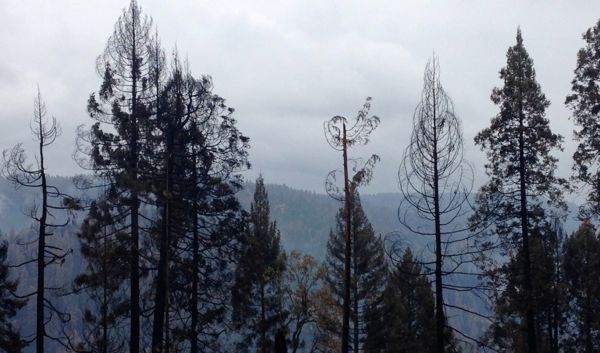


King Fire 84% contained and not growing

Updated 8:40pm:

Winter-like weather is allowing firefighters to continue getting the upper hand on the King Fire.

It is 84 percent contained, with no growth on Sept. 27. The acreage burned remains at 97,099. The arson fire that has been raging east of Pollock Pines since Sept. 13 is burning in mostly rugged terrain, with little threat to population centers.

Officials are monitoring roads in the burn area for the threat of mud and debris flow. Firefighters have put sandbags in front of some homes and other buildings.

Quintette and Volcanoville no longer have any evacuation warnings. The Apple Hill area is also evacuation-free.

However, the fire as of Sept. 27 was still a threat to 289 structures. Twelve houses have been reduced to ash.

More moisture is in the forecast Sunday.

“With hunting season starting [Saturday], we want to remind visitors that the Eldorado National Forest closure is still in effect,” Eldorado Forest Supervisor Laurence Crabtree said in a statement. “Although we are gaining ground, the King Fire is still active, and there are a lot of firefighting resources still in the area. I intend to open more of the forest as soon as it is safe to do so.”

— Lake Tahoe News staff report