SNC moves dirt without TRPA permission

By Associated Press

Environmental regulators at Lake Tahoe say Sierra Nevada College failed to obtain a permit necessary to move dirt and protect plants while building a new home in Incline Village for the school president.

As a result, the Tahoe Regional Planning Agency issued a cease and desist order on Oct. 8 for the college to immediately stop work, except to stabilize the site and prepare it for winter, agency spokesman Tom Lotshaw said.

“It’s a minor violation,” he said, adding that the agency’s Governing Board would have to approve any penalty beyond a possible $1,002 filing fee.

A filing fee for the grading permit costs $501, but agency regulations call for doubling that amount if there’s a violation.

The college plans to submit an application for the house, which will incorporate garden modifications, to the agency and Washoe County in December, said Dianne Severance, the college’s director of grants and sponsored programs.

Lotshaw said the violation will not determine the outcome of the college’s application.

Lotshaw said the college moved and mounded on-site about 20 cubic yards of dirt. Any project within the basin that moves more than 7 cubic yards of dirt requires a grading permit from the agency.

The college currently leases a house for the president about a mile from campus. The planned one-floor, 3,000-square-foot structure will host events for students, faculty and staff, and existing and potential donors.

College president Lynn Gillette said a donation made by an anonymous individual is covering a large majority of the $1.6 million project cost, including garden improvements.


TRPA fines Glenbrook property owners

By Kathryn Reed

Homeowners in Glenbrook are going to have to pay a $55,000 penalty to TRPA and restore the disturbed area of their Snug Harbor property.

The Tahoe Regional Planning Agency Governing Board last week approved the settlement with Jeff McClure, Roy Darrow and Brad Gundel.

According to the staff report, “This violation involves unauthorized grading and dredging activities in the shorezone on the lakefront residence.”

The issue dates to 1997. Fast forward to October 2013. The defendants and TRPA staff meet regarding unpermitted work that was done on the beach involving large boulders.

The staff report says, “They explained that they were protecting their rights under an easement allowing homeowners in Snug Harbor to access the beach area on the Tahoe Estates Property, and that their attorney gave them direction to go ahead with the work without a permit.”

But that work violated TRPA regulations. In addition to the fine, the land must be restored to conform to the 1998 TRPA permit.

The settlement says, “The plan will result in returning some of the disturbed rocks to the area below highwater lakeward of the Tahoe Estates Property to a pattern supportive of fish habitat and reasonable beach access and to prevent beach erosion.”

Attorney Lew Feldman, representing some of the property owners, spoke briefly before the TRPA legal committee on Oct. 22 to voice his displeasure with the settlement agreement.

However, he did not want to talk to Lake Tahoe News. “I don’t believe it ethically appropriate for me to discuss a negotiated settlement,” Feldman said.

The property owners also declined comment.


Mining tax before Nevada voters

By Sandra Chereb, Las Vegas Review-Journal

CARSON CITY — Nevada voters will decide next month whether to give lawmakers the power to raise mining taxes — a revenue source long decried by critics as an under-tapped funding spigot shielded by the state Constitution.

Whether or not passage of Question 2 will lead to more taxes on gold, silver and other minerals remains to be seen. But if history is any indication, lawmakers will seek to capitalize on the new tool in the budget box, should the measure pass, and again turn their eye toward all that glitters to boost state coffers.

State Sen. Tick Segerblom concedes that raising mining levies is the ultimate goal.

“It’s the first time in 150 years that the Legislature will actually have a chance to raise taxes on mining,” said the Las Vegas Democrat. “That is, in my perspective, incredibly significant.

“We’ve finally gotten rid of that stone around our neck.”

Question 2 is the last step in a process that began three years ago to purge a cap on net mining proceeds from the constitution.

Read the whole story


Olympics delays crack down on human rights abuses

By Katie Rose Quandt, Mother Jones

Following widespread allegations of wrongdoing in both the Beijing and Sochi Olympics, human rights protections will be added to the contracts signed by future Olympic host cities. The International Olympic Committee’s president presented this change to Human Rights Watch at an October 21 meeting.

The new language will contractually require host countries to “take all necessary measures to ensure that development projects necessary for the organization of the Games comply with local, regional, and national legislation, and international agreements and protocols, applicable in the host country with regard to planning, construction, protection of the environment, health, safety, and labour laws.”

These changes make the human rights requirements for Olympic host cities more explicit than ever before, particularly with the mentions of health, environmental, and labor concerns. The new “international agreements and protocols” rule makes it clear that hosts will be required to abide by laws like the International Covenant on Civil and Political Rights, which prohibits forced labor, arbitrary arrest or detention, sentence without trial, and protects freedoms of assembly, religion, and opinion.

Read the whole story


Survey: Harassment a common part of online life

By Barbara Ortutay, AP

NEW YORK — A study confirms what many Internet users know all too well: Harassment is a common part of online life.

The first-of-its-kind report by the Pew Research Center found that nearly three-quarters of American adults who use the Internet have witnessed online harassment. Forty percent have experienced it themselves.

The types of harassment Pew asked about range from name-calling to physical threats, sexual harassment and stalking. Half of those who were harassed said they didn’t know the person who had most recently attacked them.

Young adults — people 18 to 29 — were the most likely age group to see and undergo online harassment. Women ages 18 to 24 were disproportionately the victims of stalking and sexual harassment, according to the survey. And people who have more information available about themselves online, work in the tech industry or promote themselves on the Internet, were also more likely to be harassed.

Case in point: Celebrities. Stars such as the actress Jennifer Lawrence had nude photos stolen and posted online recently in a widespread hacking scandal in late August. Lawrence, 24, later told Vanity Fair that she considered looking at the pictures a sex crime.

It can be difficult for police to go after online bullies in part because “our legal system hasn’t quite caught up with technology,” said Elizabeth Dowdell, a nursing professor at Villanova University who studies online aggression. On top of that, adults are generally hesitant to report harassment because they might view it as a “child or teenage problem.”

“But the Internet has no age limits,” Dowdell said. “People look for outlets for aggression and the Internet is a wonderful place because it’s anonymous and you don’t have to be truthful.”

Social networking companies have sometimes been criticized for not doing enough to stop online harassment, even though it’s standard policy to ban threats, bullying and harassment. But they have at least tried to respond to complaints.

Twitter, for example, changed its policy recently after some users sent crude, altered images of Robin Williams to his daughter Zelda following the actor’s suicide in August. The company now says it can remove images of deceased individuals that circulate on its site.

Trendy new social networking site Ello, meanwhile, recently added tools people can use to block or mute users who are bothering them. The ad-free, decidedly anti-Facebook website was criticized early on for not providing blocking features that are standard practice for social networks.

Though online harassment is as old as the Internet itself, the Pew survey is particularly timely as conversations around it have grown louder in recent months — and not just because of the celebrity hacking scandal. Beginning this summer, people involved in an online campaign dubbed “Gamergate” have been harassing several prominent women in the video game industry and their supporters for criticizing the lack of diversity and how women are portrayed in games. One of the targets is Brianna Wu, a software engineer and founder of game developer Giant Spacekat. Wu, who is in her mid-30s, said she has frequently been harassed online, but it’s gotten worse this year.

Earlier this month, people threatened her and her husband with rape, death and castration on Twitter and posted her address online, she said, and they have been trying to impersonate her on the Internet to smear her reputation. She got so frightened that she left her home in Boston.

Wu went to the police, but most people harassed online don’t. According to Pew, just 5 percent of those who were harassed reported the incident to law enforcement, while nearly half confronted the person online. Forty-four percent said they unfriended or blocked the person.

But victims of harassment often don’t know where it’s coming from. Thirty-eight percent of people who were harassed online said a stranger was behind the threats, and another 26 percent didn’t know who the person was.

“You can have many different (personas) online,” Dowdell said. “So you might think ‘I’m going to block Scaryfriend123’ and Scaryfriend says ‘Fine, I’m going to use my other name Superniceguy’ and you just don’t know.”

Among other key findings from Pew:

  • Two-thirds of those who were harassed said the most recent incident took place on a social networking site or app, while 22 percent saw it happen in the comments section of a website. Sixteen percent, meanwhile, said it happened in online gaming.
  • Men were more likely to be called offensive names than women. Of all Internet users (89 percent of the U.S. population), 32 percent of men and 22 percent of women were called names. Men were also more likely to be physically threatened.
  • Not everyone said they were hurt by online harassment. While 14 percent of people found their most recent incident “extremely upsetting,” 22 percent said it was “not at all upsetting.” The rest of the people surveyed had reactions in between.

The telephone and online survey was conducted between May 30 and June 30 among 3,217 respondents. It has a margin of error of plus or minus 2.2 percentage points.

AP business writer Tali Arbel contributed to this report.


Nev. issues 255 gay marriage licenses in 1 week

By Kimberly Pierceall, AP

Of the 2,344 couples who lined up at marriage license bureaus across Nevada in the seven days after courts put an end to the state’s gay marriage ban, about 255 were same-sex couples.

The figures were based on polling by the Associated Press of each county clerk.

The numbers don’t signal a matrimonial jackpot, but those with a stake in the wedding industry, like longtime Reno chapel owner George Flint, say it’s going to take time to see an impact on the state’s bottom line.

“Once the word really gets out that this is available in Nevada, I think we’ll get a lot more business than we’ve seen the last two weeks,” Flint said.

Northern Nevada could use the business. The 8,316 marriage licenses issued last year in Washoe County which covers Reno was the lowest the number has been since 1938.

“We needed the boost,” Flint said. Of the 99 weddings his Chapel of the Bells performed in the last two weeks, 12 were for same-sex couples.

Not surprisingly, the marriage license bureau serving the Las Vegas area in Clark County, open daily from 8 a.m. to midnight, still accounted for more than 80 percent of all the marriage licenses issued in that time, including same-sex marriage licenses. Washoe County issued 37 same-sex marriage licenses in seven days, about 18 percent of all the licenses that week.

“Frankly, we were expecting to issue more licenses than we have following the court ruling,” said Washoe County Clerk Nancy Parent.

In a few rural Nevada counties, not a single marriage license was issued for straight or same-sex couples in that time.

A June study from the Williams Institute at UCLA said the state could expect to see anywhere from 980 to 2,285 Nevada same-sex couples marry in the first year it was legal. The study said the new crop of weddings could bring $14.4 million to $33.5 million in spending in that time.

It’s the long-term impact that will be one to watch, said David Paisely, senior research director with Community Marketing & Insights, a San Francisco-based marketing firm that helps companies and organizations reach lesbian, gay, bisexual and transgender customers.

“You just can’t expect a frenzy anymore,” he said, noting the proliferation of states with marriage equality. What destinations like Las Vegas and others can do now is simply reach out to newly engaged couples in the initial throes of wedding planning, not unlike straight couples.

Sure, California had a bit of a head start on neighboring Nevada when gay marriages restarted in 2013, but it’s not too late for Las Vegas, he said. For a time, same-sex couples married in certain places because they needed to, lacking few options.

Now they can wed where they want to.

“All the old rules are gone now,” he said.


Gaming industry likely to keep expanding

By J.D. Morris, Las Vegas Sun

In the not-too-distant past, Nevada and New Jersey were the only states with casinos.

Now, 39 states have some form of casino gambling — and the industry’s presence continues to evolve this year.

And as Las Vegas’ major gaming companies are considering further domestic growth, states such as Massachusetts, New Jersey and California are themselves debating the expansion — or retraction — of gambling.

At issue is a question as old as the gaming industry: morality versus money.

This year, that debate is playing out most prominently in Massachusetts, where next month voters will determine the outcome of a ballot measure that would ban casinos in the state.

With similar arguments underway elsewhere, too, it’s no surprise that this year the American Gaming Association launched a “Get to Know Gaming” campaign aimed at promoting the industry’s impact on communities.

The trade association is trying to boost the industry’s public perception by drawing attention to things like its $240 billion economic impact, which is touted in a recent study released by the AGA.

Read the whole story


Nev. judge puts brakes on ridesharing Uber

By Michelle Rindels and Kimberly Pierceall, AP

It didn’t take long for Uber to come to a screeching halt in Nevada. District Court Judge James Russell in Carson City has blocked Uber from offering any rides in the state through at least Nov. 7. A hearing is set for Nov. 6.

The state’s attorney general sought the temporary order late Friday afternoon.

The car company — whose smartphone app remained active late Friday — responded to the order with a statement calling on state officials to “embrace innovation, support powerful job creation, and stand with the people of Nevada who need them most.”

“For far too long, the people of Nevada have been denied access to the reliable, safe and affordable transportation options millions of other Americans are enjoying. We’ve already received overwhelming demand and support from thousands of residents who have downloaded the app, and drivers looking to meet that need,” company spokeswoman Eva Behrend said in a statement.

Uber launched its service in Las Vegas, Reno and Carson City on Friday after months of rumors that included recruitment posts on Craigslist and cryptic front-page newspaper advertisements.

The company contends it’s not a taxi company but rather a technology company facilitating a way for drivers and would-be passengers in need of a ride to meet.

The company faces a fierce battle with the state’s highly regulated and influential taxi industry.

Four cars driven for Uber had been impounded statewide for not being licensed as of midafternoon and faced fines of up to $10,000, said Teri Williams, a spokeswoman for the Nevada Taxicab Authority.

Uber spokeswoman Eva Behrend called the impoundments “unjust” and said the company will have its drivers’ backs financially and legally. Uber is the only ridesharing company now operating in the three metro areas. Las Vegas has been among the few metropolitan cities in the country to not be served by the company.

The company tiptoed around Nevada until its Friday launch. A multitude of regulations govern the state’s taxicab industry, and there are limits on the number of cabs that can operate and where they can pick up passengers. In Las Vegas, unlike other metropolitan cities that draw tourists, cabs can’t be hailed from the sidewalks along the Strip, for example. They have to pick up and drop off passengers at the individual hotel properties.

Behrend said that hundreds of drivers in the state have already signed up and passed background checks and vehicle inspections that clear them to respond to requests for rides via smartphone. Before the court order, drivers could pick up passengers from anywhere in the service areas, except from the Las Vegas Strip between the Mandalay Bay and SLS casinos and from McCarran International Airport. They can drop off customers anywhere.

Uber rides are generally 10 to 20 percent cheaper than taxi fares — a competitive advantage especially in light of an 8 percent cab fare hike approved earlier this week in Las Vegas.

An early afternoon Uber ride from downtown Las Vegas to Mandalay Bay at the south end of the Strip cost $22.50. Drivers don’t accept tips, just a ranking of one to five stars. A taxi ride back to downtown Las Vegas cost $28.50, including a $3 fee for a credit card charge. The cost didn’t include a tip.

Uber has often been met with strident opposition from taxi companies, and heavily regulated Las Vegas is no exception.

Bill Shranko, an executive at Yellow Checker Star taxi company in Las Vegas, asked regulators with the Nevada Taxicab Authority in April to warn Uber and similar companies that the city has hefty fines for operating unlicensed cabs and maintained that the company was operating illegally.

About 2,000 cabs fill the streets of Clark County, including the Las Vegas Strip, Shranko said.

He criticized Uber for picking and choosing customers, saying, “They’re taking all the cream off the top.”

As of early Friday afternoon, just a few cars were visible on Uber’s app.

Marco Falchi’s Mazda 6 was among them. He excitedly picked up some of the company’s first Vegas passengers, greeting them with a “Ciao” text. The chatty Italian has never driven a traditional cab before, but six months ago, he applied to be a driver for Uber, submitting his license, insurance and driving record.

His first customers were two young men heading from a suburban condo to downtown Las Vegas for the three-day Life is Beautiful music festival that starts Friday.

“Here the politics are really tough,” Falchi said, referring to the Vegas area’s taxi industry. But he’s undeterred. “If you work more, you make more money.”

Sun reporter Pashtana Usufzy contributed to this report.



Tahoe Paradise Park board struggles with professionalism, how to get anything done

Tahoe Paradise Park's internal workings are becoming a bit dysfunctional. Photos/LTN file

Tahoe Paradise Park’s internal workings are becoming a bit dysfunctional. Photos/LTN file

By Jessie Marchesseau

MEYERS – Thirty-five community members were in attendance at the Tahoe Paradise Resort Improvement District board meeting on Thursday night, but by the time the meeting adjourned three and a half hours later only a few remained.

The larger than usual turnout may have been the result of some topics currently circulating through the community. One woman said she was there because of a notice she found on her door which said the park was closing. Someone else was concerned about what the new Assembly Bill 2762 would mean for the TPRID. Another person voiced concern over rumors that the county was taking over the park.

The board members assured attendees the park is not in danger of closing. Only one board member had even heard of AB2762 with no answers as to what it meant for the future of the district. And Norma Santiago, El Dorado County supervisor and board member, denied any plans for El Dorado County to take over the park.

“The county does not want this park,” she said, “this is a community park, this is your park.”

However, she did reveal that the governance committee has considered the possibility of asking El Dorado County for administrative support. This is still at the committee level and has not been discussed by the TPRID board. However, the committee reported there is a possibility the county could help with administrative tasks such as invoicing, insurance policies, legal services, personnel policies and so on for a year or so until things get back on track, possibly at no cost to the RID.

Currently, all administrative duties in addition to maintenance are handled by Steve Dunn, the park manager who lives on site. All the board members as well as Dunn agreed this was too much for one person to handle, but a previous attempt to hire a part-time administrative person was unsuccessful.

In his first meeting as a board member, Peter Nelligan voiced his concern about the complete lack of any sort of bylaws or policies and procedures for the RID. In its current operational and administrative state, Nelligan said he believes the park will not be able to sustain itself for more than a few years.

Nelligan and Victor Babbitt are new to the board this year and appear anxious for change.

“We have a park, we have assets, we have a budget, we have projects that need to get done,” Babbitt said Oct. 23.

He reviewed the short-term priority projects for the park, including painting the gate, cleaning up the planter boxes at the entrance, and restaining the recreation center and the residence among a numerous other maintenance items. Some of the projects have already been completed; others are still in the planning process.

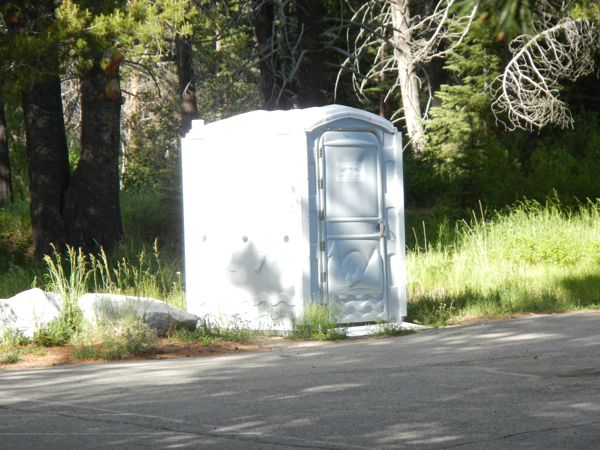
Park users will be using porta-potties for the foreseeable future.

Park users will be using porta potties indefinitely.

One of the larger projects in the works over the summer was installing a restroom at the south end of the park. The project was approved by the county, but then TRPA shot it down, according to those at the meeting. However, after the meeting, TRPA told Lake Tahoe News that no application to build the bathroom was ever filed. With the restroom off the table, the board now has to find other projects on which to spend their grant money before the March deadline. Without a qualifying project, the RID could face losing a big chunk of the $60,000 grant.

Board members bickered amongst themselves throughout the evening, with board Chairperson Judy Clot expressing the most disdain about being excluded from budget discussions and individual committees not keeping her in the loop. More than once attendees took the floor to ask members to take their arguing elsewhere.

Board and community members alike expressed concerns about adhering to the Brown Act which outlines requirements for open meetings, public input and accessible information. Clot said she has received several complaints recently. The fact that the only place meetings are consistently announced is on the park bulletin board and the only place one can get meeting minutes is by going to the park and asking Dunn to make them a copy, and that is assuming he has had time to transcribe the audio recording, suggests there is room for improvement. The board agreed to look into getting further Brown Act training from the county.

The meeting concluded with Babbitt making a motion to schedule a special meeting before the regularly scheduled meeting in January. He said there was too much to be done for them to take the next three months off. His suggestion was met with objections and scowls from some of the others. But in the end, a special meeting was tentatively scheduled for Dec. 11. An announcement will be posted on the park bulletin board at least 24 hours in advance.


Placer County deputy gunned down

By Sam Stanton, Ryan Lillis, Ed Fletcher, Darrell Smith and Richard Chang, Sacramento Bee

Danny Oliver’s last shift ended with the veteran Sacramento sheriff’s deputy doing something he would have done countless times before in his career, walking toward a car to see what the occupants were doing on his beat.

The 47-year-old father of two never made it to the driver’s window Friday. At about 10:30am, a man armed with an AR-15 rifle aimed out of the car from the parking lot of a Motel 6 at Arden Road and Ethan Way and opened fire, killing Oliver with a shot to the forehead.

Over the next six hours, authorities say, 34-year-old gunman Marcelo Marquez eluded hundreds of officers from Sacramento to Auburn in a crime spree that left Oliver and Placer County sheriff’s Detective Michael David Davis Jr. dead. A third Placer deputy, Jeff Davis, was wounded and later treated and released from a hospital. A motorist was in serious condition from a gunshot to the head.

The carnage ended around 4pm Oct. 24 when Marquez meekly surrendered to deputies who converged on a home in Auburn where he had been hiding for hours as one of the largest manhunts in Sacramento history unfolded.

Marquez, who public records indicate is from Salt Lake City, was expected to be transferred to the Sacramento County Jail late Friday along with a woman who authorities say had accompanied him on part of his rampage.

Authorities say the couple were responsible for a drama that forced thousands of schoolchildren to spent the day either in lockdown or sheltering in place, left neighborhoods evacuated and forced sheriffs from Sacramento and Placer counties to step forward with somber announcements that they both had lost deputies.

Read the whole story

Read more here: http://www.sacbee.com/news/local/crime/article3348287.html#storylink=cpy