App could make government access easier

By By Alexa Capeloto, Columbia Journalism Review

Navigating government bureaucracy is painful, but filing Freedom of Information requests can be downright torturous—for journalists and members of the public alike. Requests might be ignored, bounced around, pegged with impossible price tags, or subject to other machinations while requestors wait (and wait) for a response.

Save a little sympathy, though, for the civic staffers inside the walls of government who face their own struggle: floods of FOI requests, many of them overly broad or duplicative, outdated paper-based processing, and no real communication or tracking across departments. The torture can go both ways.

So, too, can the tech-minded attempts to alleviate it. Open-source web applications like FOIA Machine and Alaveteli have built followings among records requestors. Now, another web app is drawing notice for its potential to help government agencies process, track, and release requested information through a public online portal—creating a new level of transparency for governments willing to embrace it.

Called RecordTrac, the system officially launched a year ago in Oakland, and is getting noticed in cities around the country, on up to the White House.

Read the whole story


Calif. AG: 18.5 mil. residents’ info exposed

By Associated Press

LAGUNA BEACH — Personal information about more than 18.5 million Californians was hacked, stolen or otherwise exposed last year and as many as one-third of those people will become victims of fraud, California Attorney General Kamala Harris said Tuesday in a report on data breaches in the nation’s biggest state.

Retailers, banks, health care providers and other organizations reported 167 different breaches in the state during 2013. That’s six times more than the 2.5 million accounts hacked in 131 breaches in 2012, and represents nearly half of the state’s 38 million residents. The alarming increase in malicious hacking and accidental leaks due to poor information security was mainly due to breaches at Target stores and Living Social, an online marketplace. Even without those two incidents, the number of customer accounts exposed by hacking, lost and stolen hard drives and accidental data leaks, jumped 35 percent last year.

Kamala Harris

Kamala Harris

As many as one-third of people whose information is exposed in a data breach will subsequently suffer some kind of fraud, Harris adds in the report, citing estimates by Javelin Strategy and Research, a California firm that tracks financial industry trends.

More than half of the breaches reported in California involved malicious attempts by hackers or cyber-criminals who were determined to steal customer data, according to the report, which said “trans-national criminal organizations” appear to be responsible in many cases.

“Increasingly, highly sophisticated criminal organizations and state-sponsored entities — located as far away as Russia, China and Eastern Europe — are responsible for breaches,” Harris said. The report cites one federal prosecution of an overseas hacker group. It doesn’t provide any new details on a multi-state investigation, announced earlier this year, in which officials from California and elsewhere said they were looking into Target Corp.’s response to its breach.

State law requires businesses to notify consumers when their data is exposed in a breach affecting more than 500 accounts. They also must file a report with Harris’s office. While there is no similar requirement at the federal level, the figures from California may provide insight into broader trends nationwide.

Retailers were the largest category of businesses that were hacked, followed by financial institutions and then health care providers. Health care organizations were more likely to report the loss or theft of laptop computers or other electronic storage devices containing patient files. What was taken? Social Security numbers were exposed in nearly half of the breaches; 38 percent of breaches involved account information for credit or debit cards.

Criminals can use both to commit financial fraud: The average amount of fraud linked to a stolen social security number is $2,330 and the average for a credit card is $1,251, according to estimates that the attorney general attributes to Javelin.

A new state law that goes into effect next year will require companies to offer at least one year of free theft-prevention assistance, such as credit monitoring, to consumers affected by data breaches. While many companies already do this, the report says that kind of help was only offered in half of the breaches reported over the last two years.

Harris is recommending additional changes, including legislation that sets stricter notification requirements and provides financial aid to help small businesses adopt data safeguards. She also urges companies to use stronger encryption and other protective methods, although she noted that a recent legislative effort to require encryption was unsuccessful.

Harris also is urging companies to notify consumers about data breaches more promptly and to make their notices easier to understand, with less legal jargon. She notes that the purpose of such notices “is undercut if the recipients cannot understand them.”


El Dorado Savings’ profits increase

El Dorado Savings Bank’s third quarter profits were 17 percent than a year ago.

The Placerville-based bank, which has branches in South Lake Tahoe reported profits this week of $2,704,532.

Earnings for the first nine months of  this year total $8,606,106, compared to $6,145,993 in 2013.

CEO George L. Cook, Jr. attributes this to strong performance of the investment and real estate loan portfolios.

El Dorado ended the quarter with $1.88 billion in total assets and savings deposits of $1.68 billion.

— Lake Tahoe News staff report


Supes delay decision on Meyers plan

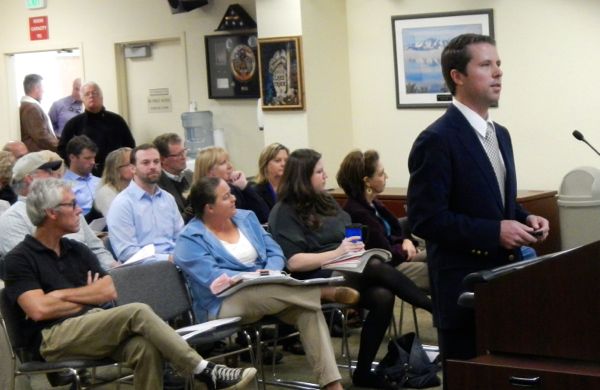
Brendan Ferry with the El Dorado County Planning Department briefs the Board of Supervisors about the Meyers Area Plan on Oct. 28. Photo/Kathryn Reed

Brendan Ferry with the El Dorado County Planning Department briefs supervisors about the Meyers Area Plan on Oct. 28. Photo/Kathryn Reed

By Kathryn Reed

El Dorado County supervisors are not ready to sign-off on the Meyers Area Plan. Instead, they want the community to weigh in at one more public meeting.

The Meyers issue was the main item on board’s agenda during their annual meeting in Lake Tahoe on Oct. 28. It was clear the supervisors, except for Norma Santiago, were unfamiliar with this unincorporated area to the west of South Lake Tahoe. They asked about demographics, boundaries of the area, didn’t understand what a TAU (tourist accommodation unit), or CFA (commercial floor area) were.

Supervisor Brian Veerkamp asked more substantive questions pertaining to how things are working with Caltrans and water concerns. In response to one of the 18 people who spoke, Veerkamp cautioned people about wanting a traffic light on Highway 50. He said all they do in Placerville is create a greater backup, and that once they are in it’s near impossible to get one removed.

The four (Supervisor Ron Briggs was absent) agreed to have a board workshop in December in the basin to hash out the remaining issues concerning the area plan. Those include height limitations for new construction, how much can be built per acre (density), the ability to transfer commercial floor area square footage (looking at economic and environmental concerns), and the creation of an advisory council that would report to the supervisors and have to follow open meeting laws.

The county Planning Commission when it met last week went against staff’s recommendation and said the local working group should be more casual and not have to adhere to the Brown Act.

However, everyone who spoke to this concern on Tuesday said they wanted the group to have transparency. After all, some of the reason for Meyers’ becoming splintered of late is because of the perceived backroom deals made at meetings that were not publicized. Going forward all sides want the ability to hear what is being discussed before it seems to be a done deal.

The supervisors agreed.

Most of the public comments centered on the process for the past 32 months.

Brendan Ferry, planner with the county, gave a brief history to the board about the process that started in February 2012.

He had hoped to have a final draft of the area plan done in November. That won’t happen now that there will be a workshop. Also delayed is the start of the CEQA environmental review process.


Stateline casinos score in September

While the state gaming numbers were down in September compared to 2013, in Stateline they were up.

The Nevada Gaming Control Board released the figures Oct. 28.

The statewide win was $901.7 million last month. This is a decrease of 5.96 percent from last year.

At Stateline, the win was $23.8 million, an increase of 7.2 percent from a year ago.

— Lake Tahoe News staff report


SUV goes from All-American to global star

By Dee-Ann Durbin, AP

DETROIT — Once a hulking symbol of American excess, sport utility vehicles are quickly becoming the world’s favorite way to get around.

It’s a surprising rebirth for a vehicle that was the subject of obituaries when gas prices spiked in 2008. Automakers won back customers by making smaller, more fuel-efficient SUVs that also appealed to newly wealthy buyers in Asia and South America and former skeptics in Europe.

Indian drivers want SUVs to navigate rough roads. In China they’re a status symbol. European and American Baby Boomers buy SUVs because they’re easier to climb in and out of. Upwardly mobile Brazilian families like their spaciousness. Cheaper subcompacts like the Renault Duster are bringing in customers who couldn’t afford SUVs before.

Earlier this year, SUVs overtook four-door sedans for the first time as the most popular vehicle for individual buyers in the U.S. By 2018, analysts expect China to be the biggest market for SUVs in the world.

“The SUV genie is out of the bottle. They’ve been discovered by enough people that you’ll never put them back,” says Karl Brauer, a senior analyst with the car buying site Kelley Blue Book.

Global SUV sales rose 88.5 percent between 2008 and 2013, to 15.7 million, according to IHS Automotive. That was three times faster than auto sales as a whole. By 2016, IHS predicts annual SUV sales will total 20.1 million, or about one of every five vehicles sold.

Automakers are finding some surprising converts. France — where environmentalists used to roam the streets slashing SUV tires — is second only to China in the growth of SUVs, with sales up 220 percent since 2008, according to Ford. Turkey is third.

Parisian Laurent Azoulai, 58, bought an all-electric subcompact SUV — the BMW i3 — in July.

“I used to have Mercedes and Renaults but I liked this because I only need it for city driving,” he said. “It’s small, and it’s electric, and I can’t stand pollution.”

Shrinking the SUV — and making it more fuel efficient — was the key to saving it. In 2008, less than half of SUVs sold worldwide were small, and customers had fewer choices. Twenty percent were large SUVs like the eight-passenger Cadillac Escalade, which defined the segment decades ago but had limited audiences outside North America.

Seeing the unmet demand, companies started making small SUVs that were even more nimble and efficient. Subcompact SUVs like the Chevrolet Trax — which is shorter than a Toyota Corolla — were born.

It worked. Sales of small and subcompact SUVs like the Toyota RAV4, Buick Encore and Ford EcoSport have more than doubled worldwide since 2008. New subcompact SUVs from Jeep, Honda, Fiat and others will arrive in showrooms soon and keep the growth going. Small SUVs now make up 58 percent of all SUV sales worldwide; the share of large SUVs has fallen to 12 percent.

The new crop of tiny SUVs is small enough to appeal to buyers in emerging markets but nice enough for downsizing buyers in Europe and North America. That’s good for automakers, who save money by designing one vehicle that suits many different customers.

Owners who switch have a hard time going back to cars. Mo Mard, 56, a retired investment banker who lives in O’Fallon, Missouri, drove a 2003 Toyota RAV4 for 11 years. Six months ago, she traded it in for a Honda Accord sedan, thinking she’d like something a little sleeker.

She was immediately sorry. Mard missed sitting up high, and she wanted more room for her garage sale treasures. She also found it harder to ferry around her 90-year-old mother, who has trouble getting in and out of cars. In September, she traded the Accord for a Honda CR-V.

“I’m back up higher, so I feel better,” she says.

With smaller size comes better fuel economy, another lure for buyers. The Trax is expected to get 34 mpg on the highway, which is better than many midsize cars. The diesel-powered version of the Ford Escape, called the Kuga, gets better fuel economy than a Toyota Prius hybrid.

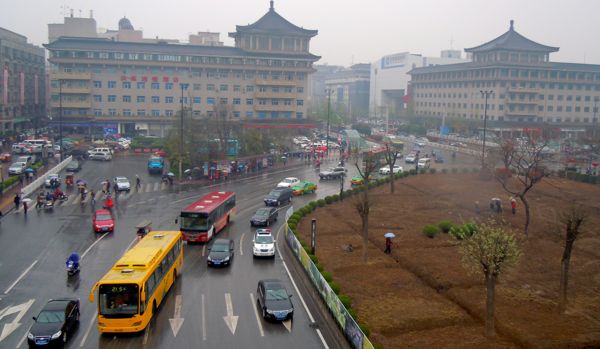
SUVs are growing in popularity in China. Photo/LTN file

SUVs are growing in popularity in China. Photo/LTN file

China is seeing the fastest growth by far, with SUV sales up 480 percent since 2008 to 3.7 million last year, or around 20 percent of China’s total vehicle sales.

Chinese customers are increasingly using their vehicles for travel beyond their daily commutes, and they need vehicles that can handle rough roads.

Beijing businessman Luo Ge drives an Audi sedan or a Mercedes SUV to work. But on weekends, he runs a car club with 11 Jeeps, which he takes into the desert so members learn to drive on rough terrain.

Luo, 45, who runs several businesses, bought his first SUV, a Jeep Cherokee, in 1995.

“It was quite cool,” he said. “Most men have a complex for military stuff and the real outdoors. The Jeep met that need.”

More typical is Zhang Xinyao, 32, an IT worker in Beijing. She used to drive a small car, a Chinese-made Suzuki Alto, but wanted something bigger and safer after having a child. In 2012, she bought her first SUV, a Kia Sportage, for $28,600.

That’s more than U.S. buyers pay, since China has higher import duties. But it’s not unusual for SUV buyers to pay a premium. U.S. buyers stretch their finances more to buy an SUV than any other kind of vehicle, says Jim Farley, Ford’s marketing chief.

“It means adventure and freedom, even a sense of optimism,” Farley says. “That emotion of owning a utility, for me, is as intense as owning a luxury product.”

Three decades ago, bare-bones SUVs like the Toyota 4Runner and Ford Bronco were mostly used by off-roaders. They had more utility — and less refinement — than most drivers needed.

The seven-passenger Ford Explorer, introduced in the 1991 model year, changed that by emphasizing style and comfort. It was the first SUV that was equally at home navigating mountain trails or grocery store parking lots, Brauer says.

Europeans were slow to accept SUVs, which guzzled too much gas and were harder to maneuver on narrow streets. The subcompact Nissan Qashqai changed their minds after it went on sale in late 2006, says IHS analyst Carlos DaSilva. The Qashqai was designed in London for Europeans who wanted something spacious but less aggressive than a big SUV.

In China, SUV sales took off a few years later. In 2010, the first year Chinese automaker Great Wall’s popular H5 was on the market, SUV sales topped 1 million in China for the first time. This year, IHS expects China’s SUV sales will top 4.8 million.

The Explorer — prematurely laid to rest by some critics last decade — is now Ford’s most-exported vehicle. Ford expects to make around 280,000 Explorers this year at its 90-year-old plant in Chicago. Around 40,000 of those will be exported to Canada, Mexico, China, South Korea and the Middle East. Last year, Ford started making Explorers in Russia to meet growing demand there.

“It’s the common link,” DaSilva says. “It’s the car everybody wants.”



Nev. ranks among worst states for domestic violence

By Jackie Valley, Las Vegas Sun

When most people think of domestic abuse, they picture the victim as a young woman.

But here’s the reality: The abused person very well could be a wealthy neighbor who keeps the beatings a secret for fear of social repercussions. Or the quiet husband who’s ashamed to admit his wife throws punches behind closed doors. Or the celebrity whose megawatt smile belies the shoving she endures. Or the woman who confides in police that her female partner loses her temper too often. Or the grandmother who gets pushed around by her impatient son.

On Oct. 20, a 52-year-old man stabbed his ex-wife to death in their home with their children nearby, according to Metro Police. Jodi Joyce suffered a fatal wound to her chest. James Joyce then stabbed himself in the stomach, inflicting critical injuries, police said.

Domestic abuse, which includes emotional and verbal abuse, is all around us, and the number of occasions it rises to physical violence is stunning. Metro Police fielded nearly 60,000 calls last year from people saying they were being assailed by someone in their household.

The actual number of victims is likely much higher still, because many are too scared or ashamed to admit they’ve been abused. For nine of the past 10 years, Nevada has ranked among the top 10 states for the rate of women killed by men, according to the Violence Policy Center. The center’s most recent report, based on 2012 data, ranked Nevada sixth.

Because domestic violence is a shadow crime without a national database tracking numbers, estimating its scope in Las Vegas as it compares with other cities is difficult. But we certainly don’t lack catalysts — booze, drugs, clashing work schedules, gambling, sex and a tough economy.

Read the whole story


Proposed rate hike dismays Lukins’ customers

By Kathryn Reed

Where has the money gone? Why was the maintenance deferred? How can people be expected to pay more?

Those were just a few of the questions asked Oct. 27 by some of the approximately 30 customers of Lukins Brothers Water Company. The meeting at Lake Tahoe Airport was an opportunity for people to voice their opinion and ask questions about the 55.6 percent general rate increase the company is seeking that could take effect next year.

Taking down the comments was Adam Thaler of the California Public Utilities Commission. The CPUC is the decider if any increase will be granted.

This type of increase is for operations. This includes plant operation supplies, employee salary and benefits, postage, liability insurance, utilities and other costs.

Several people were angry at the prospect of Lukins adding a retirement plan for the employees when so many companies are doing away with them.

Lukins has not had a general rate case increase in more than six years. That is why the company is billing this as a 9.2 percent increase for each of the last six years.

But ratepayers whose monthly bill would go from a flat rate of $36.41 per month to $55.84 are not seeing it that way.

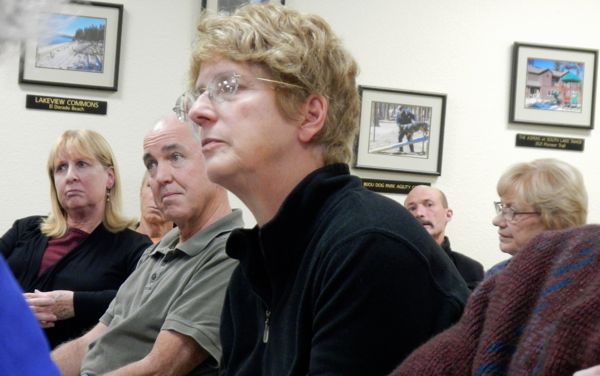
Theresa Brown voices frustration with Lukins water service on Oct. 28 as others listen. Photo/Kathryn Reed

Theresa Brown voices frustration with Lukins water service on Oct. 27 as others listen. Photo/Kathryn Reed

“I feel robbed. I can’t afford it,” Theresa Brown said. She said for 50 years there has been sand in the water. She doesn’t want to pay more for this service.

Thaler said service is one of the criteria the CPUC looks at when it investigates whether a rate increase should be granted.

Jen Lukins, who runs the company, admitted this was the worst summer for sand coming out of spigots. She attributed it to the drought.

“We are now doing monthly flushings,” she said.

Ratepayer Carolyn Meiers said things are “deplorable” – and questioned why there is so much deferred maintenance.

Gary Norton said, “It should have been cleaned up a long time ago when things were cheaper.”

While the South Lake Tahoe water company is privately owned, it is regulated by the state. Nearly everything it does is controlled by the state. It was explained that the state prevents a district of this size from offering low-income discounts because then a disproportionate number of the 963 ratepayers would be subsidizing the others.

Lukins said she would prefer timelier rate increases, but the process for applying for them makes it too cumbersome to do so.


S. Tahoe motel burglary suspect caught

A South Lake Tahoe man was arrested Monday in connection with the Oct. 23 burglary at the Trailhead Lodge.

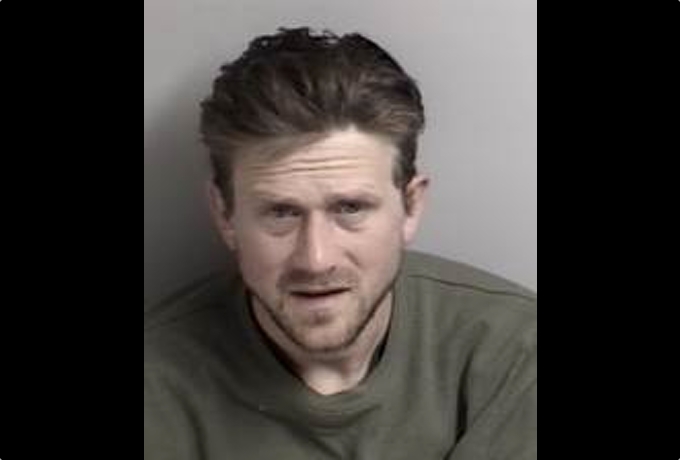
Louis Fiori Jr.

Louis Fiori Jr.

The theft at the South Lake Tahoe motel occurred after business hours in the locked, unattended front lobby. Surveillance footage shows the suspect entering the lobby by forcing open the locked front door and stealing money from the cash drawer.

The suspect was carrying a McFlurry ice cream container from McDonald’s. Surveillance footage showed the suspect filling out a job application for McDonald’s. Officers collected the job application as evidence and identified the suspect as 29-year-old Louis Fiori Jr.

Officers located Fiori at McDonald’s on Oct. 26.

This burglary is not believed to be related to the ones at the Y last week.

— Lake Tahoe News staff report


Quality of U.S. Hospices varies, patients left in dark

By Peter Whoriskey and Dan Keating, Washington Post

More than a million times a year, a terminally ill patient in the United States is enrolled in hospice care. Each time, the family confronts a decision that, while critical, often must be made almost blindly: Which hospice to hire?

A boom in the industry allows patients to choose from an array of hospice outfits, some of them excellent. More than a thousand new hospices have opened in the United States in the past decade. But the absence of public information about their quality, a void that is unusual even within the health-care industry, leaves consumers at a loss to distinguish the good from the bad.

Though the federal government publishes consumer data about the quality of other health-care companies, including hospitals, nursing homes and home health agencies, it provides no such information about hospices.

After years of public pressure, Congress in 2010 required that the government publish information about hospice quality, but the Medicare agency said in May that such consumer information would not be forthcoming until 2017 — at the earliest.

Similarly, state records of hospice inspections are often unpublished, sparse, and, when they are available, difficult to find and understand. Government inspections of hospices have typically been scheduled about every six years, though Congress in September called for more frequent checks.

Read the whole story