How to spend water bond could be contentious

By Scott Smith, AP

LOS ANGELES — Passing a $7.5 billion water bond may turn out to be the easy part. Agreeing on how to spend all the money could be much harder.

California voters overwhelmingly approved Proposition 1, which aims to expand the state’s water storage capacity to better weather droughts like the one that has gripped the state for three years. Much of the money already is earmarked for specific uses.

But $2.7 billion is not and so the debate to decide what to do with it now starts in earnest. One option is to spend it all on two new reservoirs. Other possibilities include desalination plants and underground storage facilities.

“Now that we have the money, the challenge begins of expeditious and effective implementation of the bond,” said Lester Snow, executive director of the California Water Foundation, an advocacy group that pushes for sustainability for communities, farms and the environment.

Jay Ziegler, the Nature Conservancy’s director of external affairs, said he expects a variety of new ideas to emerge during discussions among state officials and a variety of special interests, including environmentalists and farmers.

“We’re hoping to have a genuine dialogue,” he said. “We don’t really know today what the right project mix is and how to optimize the system.”

The spending plan is intended to make more water available and to stabilize California’s water supply, even during drought periods Gov. Jerry Brown, who campaigned hard for the ballot initiative, said the margin of passage underscores that Californians want something done.

“Water is fundamental to life itself, to our economy, to our wellbeing,” he said Wednesday. “Proposition 1 is about investing in vital resources that make California the state it is.”

Some $725 million of Proposition 1 will be spent on water recycling and treatment projects, and $900 million will go toward cleaning up contaminated groundwater. Residents in poor California communities where wells have gone dry may be among the first to see some relief. Communities would have to apply for grants and be responsible for paying for a portion of the projects.

Central Valley farmers favor building the Sites Reservoir in Colusa County north of Sacramento and the Temperance Flat reservoir northeast of Fresno.

Mark Borba, 64, who tends 9,000 acres of almonds, tomatoes, melons and cotton in the Fresno County community of Huron, said he doesn’t expect to see any benefits of the ballot measure in his lifetime but nonetheless was glad it passed. Farmers like him rely on water pumped south from the Sacramento-San Joaquin Delta.

Borba said he is confident that contentious issues such as levee repairs and salmon restoration in the delta can be addressed with the bond money, enabling farmers to get the water they need for crops.

“Unless we can pump water, we’re dry,” Borba said. “All of those issues internal to the delta have to be addressed. There’s lots of money in that bond to help do that.”

The California Water Commission, a nine-member board appointed by Brown, ultimately will decide how the money is spent. It plans to take comments from the public as it weighs options.

Richard Stapler, a spokesman for the California Natural Resources Agency, said it could take 18 months to two years to determine which water storage projects will be funded.


Scientists studying life below Tahoe’s surface

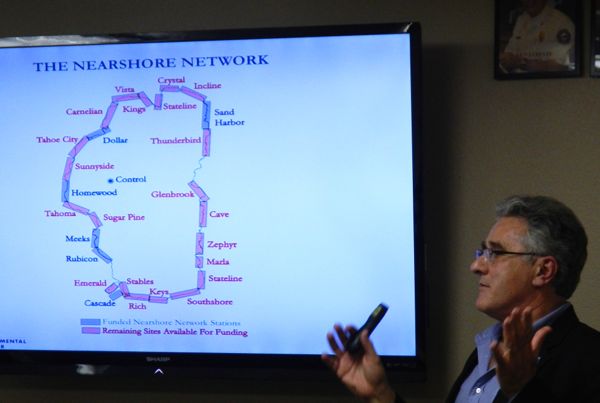
Geoff Schladow talks Nov. 6 about what is happening below the surface of Lake Tahoe. Photo/Kathryn Reed

Geoff Schladow talks Nov. 6 about what is happening below the surface of Lake Tahoe. Photo/Kathryn Reed

By Kathryn Reed

ROUND HILL – What is going on beneath the surface of Lake Tahoe?

Scientists don’t really know. Geoff Schladow, director of the Tahoe Environmental Research Center, said everything that is known could be told in a 45-minute presentation.

He gave two talks this week – one in Kings Beach, the other Round Hill – about what affects the water actions of Lake Tahoe. Tahoe’s circulation patterns are detailed in the NDEP-Tahoe Water Suppliers Association 2014 Risk Assessment Report.

Wind is the No. 1 driver.

“We all think wind is from the southwest,” Schladow told the packed room at the Tahoe Douglas fire station in Round Hill on Nov. 6. “And it is when it is measured at the airport.”

He showed a model depicting the wind movement on the lake and it is anything but the same across the whole water body. Farther north it swirls counterclockwise, while near the south it moves clockwise. And sometimes it is blowing straight across the water.

Thermal stratification and velocity are other factors.

“You may look at the lake and it is calm and placid, but it is always moving,” Schladow said.

Researchers are using a variety of tools to calculate that movement. Drogues are instruments that act like a big sail with a GPS device that measure where the wind current is carrying it.

Scientists did studies involving the intakes for Kingsbury General Improvement District and Edgewood Water Company. Part of this was to analyze how pathogens move from beaches on the Nevada side to the pipes taking water out for consumption by the South Shore districts.

While Schladow’s research showed the contaminants were well below the federal levels for concern, he said if the intakes were deeper, the threat of pathogens would be reduced.

One of the tests scientists did was to release particles at the Tahoe Keys to see where they would move. This was done over a 10-day period.

Some went west, others traveled deeper into the lake, and others hugged the shoreline going north.

The purpose of this study was to get a glimpse of where an herbicide might spread if it were to be used to rid the Keys of milfoil.

But Schladow stressed this experiment did not take into account several factors such as dilution of the chemical.

The least amount of knowledge is known about the near shore movement. This in large part has to do with the middle of the lake getting most of the attention in regards to any studies, but especially with water clarity.

A near shore network has been created to gather data. However, only five locations are in the study area, with a sixth expected to come on board in the next couple weeks.

An instrument about 3-feet-long is placed in the water. Every 30 seconds data such as temperature, turbidity and dissolved organic material are being sent back to TERC.

Turbidity, or the cloudiness of the lake, is not always associated with storms. Schladow said that is something that needs to be investigated more.

With little data available regarding what is going on beneath the surface of Lake Tahoe, the whys of those occurrences are even more elusive. But more research is in the works.


UC on offensive to sell tuition increase

By Larry Gordon, Los Angeles Times

University of California administrators went on an offensive Thursday to sell their proposal to raise tuition by as much as 5 percent in each of the next five years but faced opposition from Gov. Jerry Brown, legislative leaders and student activists.

UC President Janet Napolitano sent out emails and other messages to alumni, faculty and donors seeking their support for her plan, which would end a three-year-long freeze on UC tuition, help pay for higher pension and salary costs and increase the enrollment of California students.

Unless state funding for UC rises enough to offset those increases, her plan calls for tuition for California undergraduates to rise next year to $12,804, not including room, board and books. By the 2019-20 school year, that could increase to $15,564.

Her plan won the support Thursday of UC chancellors and faculty leaders while important state legislative leaders such as Assembly Speaker Toni G. Atkins and Senate President pro tem Kevin de Leon expressed deep reservations.

Read the whole story


Growth-control measures rejected in EDC

By Peter Hecht, Sacramento Bee

El Dorado County has long roiled with bitter political battles over new housing developments and perceived threats to the rustic Sierra foothills environment.

But Tuesday night, voters overwhelmingly rejected initiatives that proponents argued would protect rural community boundaries and ban new subdivisions that threaten to gridlock Highway 50 with traffic. They also elected two new county supervisors, Michael Ranalli and Sue Novasel, who both campaigned against the initiatives and “land use planning through the ballot box.”

Measures M, N and O went down to ignominious defeat in the face of more than $1 million in campaign spending by real estate and development groups, including building interests proposing thousands of new homes for western El Dorado County. The political media blizzard – costing more than $20 per vote based on Tuesday’s turnout – broadcast a message that the county’s pastoral landscape was imperiled by the growth-control measures themselves.

“It means that even a good ballot argument and proposition is hard to win against $1 million,” said Bill Center, a former county supervisor and co-sponsor of Measure M. “It was basically an electoral carpet bombing with signs and mailings and robocalls and World Series ads. They ran the best campaign that money could buy.”

Read the whole story


Vote narrows between SLT council candidates

As more absentee ballots were counted since election night, South Lake Tahoe City Council candidate Austin Sass is now one vote behind third place finisher Angela Swanson.

Three positions are up on the five-member board.

More ballots are outstanding and these numbers will change.

The numbers as of Nov. 6:

  • Wendy David — 1,271 votes
  • Tom Davis — 1,094
  • Angela Swanson — 989
  • Austin Sass — 988
  • Brooke Laine — 939
  • Matt Palacio — 907
  • Bruce Grego — 864.

— Lake Tahoe News staff report


Nonstop flights to lure UK skiers to Tahoe

With the United Kingdom being a huge market for Lake Tahoe ski resorts, a goal has long been to have a direct flight into the Reno-Tahoe International Airport.

It was announced Tuesday that a deal has been struck with Thomas Cook Airlines to provide nonstop service between London and Reno starting Dec. 19, 2015. The service will run between December and April.

Ski Lake Tahoe helped bring this to fruition.

— Lake Tahoe News staff report


Financing delays Cal Neva renovations 1 year

By Dale Kasler, Sacramento Bee

The Lake Tahoe casino resort once owned by Frank Sinatra will likely stay closed for another year as financing for a major renovation has taken longer than expected.

The Cal Neva Resort & Casino, which has been closed since September 2013, just finished lining up $49 million in financing for its makeover, the property’s lender said this week.

“It took more time than they had expected,” said Mike Jaynes, president of Hall Structured Finance, a Texas investment company that approved a loan for the Cal Neva renovation.

Criswell Radovan, a St. Helena investment firm, bought the old north shore property in April 2013 and closed it for renovations five months later. The firm’s principal, Robert Radovan, has said he wanted to reopen the Cal Neva in December 2014, in time for what would have been Sinatra’s 99th birthday. Sinatra died in 1999.

Read the whole story


Mixed results on North Shore school bonds

Two North Shore-Truckee area school bonds on the Nov. 4 ballot had different outcomes.

Voters in the Tahoe-Truckee Unified School District said no to a $114 million school bond. Measure U  would have raised money to improve facilities on the district.

A 55 percent yes vote was needed for approval. The measure received 52.27 percent favorable votes.

Measure E was a $62 million bond that would improve lake area schools. Voters in Placer and El Dorado counties said yes to it with a 58.62 percent approving it.

— Lake Tahoe News staff report


Lake Valley fire regrouping after crushing vote

Proper defensible space spared this house in the Angora burn area. Photo/Lake Valley Fire

Proper defensible space spared this house in the Angora burn area. Photo/Lake Valley Fire

By Kathryn Reed

Lake Valley Fire Protection District’s desire to tax property owners for fire prevention went up in flames Nov. 4.

Voters overwhelming said no. Nearly twice as many people voted no (66.48 percent, 1,323 votes) compared to those who said yes (33.52 percent, 667 votes.)

“Basically people don’t want a tax increase,” Dave Huber, chair of Lake Valley’s board of directors, told Lake Tahoe News. “We are going to regroup and see where we go from here.”

The next board meeting is Nov. 13.

Measure H would have replaced Measure M with a $120 fee tied to the consumer price index. Projections were that it would bring in $1 million a year. It would not sunset.

Measure M, which has existed since 1986, remains in effect. Property owners pay $20 year, it is not tied to the CPI, and it has no expiration date. The $150,000 raised each year goes to the general fund.

While the bulk of Measure H would have gone to fuels reduction projects, allocations also called for upgrades to facilities and equipment.

“The district still has a difficult future ahead of it financially,” fire Lt. Martin Goldberg told Lake Tahoe News.

He believes the measure didn’t pass because of the CPI, no expiration date and people paying the CalFire tax that they see no benefit from.

Goldberg believes residents care about wildland fire prevention, but they don’t want to pay for it.

Private property owners are not doing their part to be fire safe, he said.

“You are only as safe as your closest neighbor. If there is fuel to burn on their property, then yours is likely to catch fire as well,” Goldberg said.

But residents have said they don’t want to pay for their neighbors’, that it should be that person’s burden and should not be shared.

California has defensible space laws on the books that allow local fire departments to take punitive action against property owners who aren’t in compliance. Until now, Lake Valley has gone the passive route – namely through education. It would be up to the board if fines were to ever be issued.

Also, likely to go by the wayside is the chipping program. People could limb trees and take out small ones, then have the matter chipped. That could then be used as mulch.

The fire district is applying for a grant from CalFire that could extend the chipping program another year. The $10 million the state is offering is from the fee that has been collected. Lake Valley is in the running for $25,000.


Reno man accused of sex crimes in Truckee

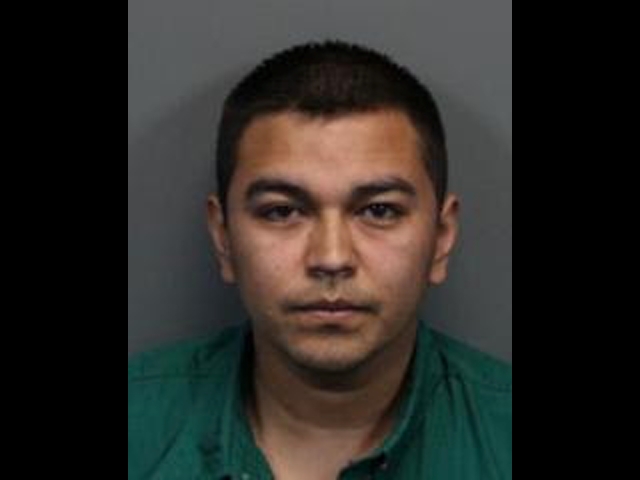
A yearlong investigation culminated in the arrest of Reno resident Ricardo Antonio Vasquez on sex crime charges.

Ricardo Vasquez

Ricardo Vasquez

In November 2013, the Truckee Police Department conducted a joint investigation with Placer County Sheriff’s Office regarding a case involving an adult male engaged in lewd and lascivious acts with a minor.

Officers attempted to locate the 28-year-old Vasquez only to discover he had fled the United States to El Salvador. In September, officers learned Vaszquez was back in Reno. In October,  a warrant for Vasquez was issued with a bail set of $100,000.

Vasquez is being held at the Washoe County Sheriff Correctional Facility awaiting extradition to California.

— Lake Tahoe News staff report