SLT council to tackle public beach access
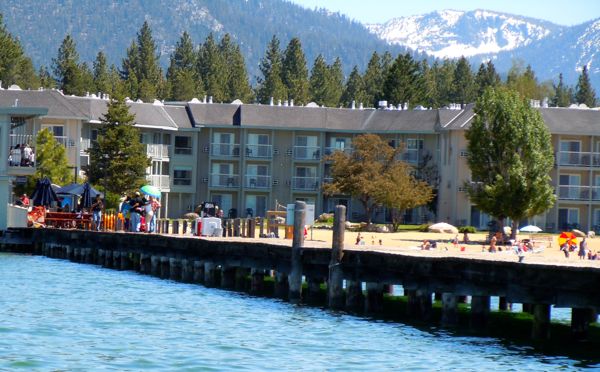
Timber Cove Pier is private, but the beach is public and private. Photo/LTN file

Timber Cove Pier is private, but the beach is public and private. Photo/LTN file

By Kathryn Reed

The beach by Timber Cove Marina is not as public as some would like it to be and is too public for the hotel-pier owners.

This stretch of sand in South Lake Tahoe is going to be the subject of discussion by the City Council when it meets Nov. 18 at 9am at Lake Tahoe Airport. City Attorney Tom Watson, who will be making the presentation Tuesday, was not available for comment.

Public access has been a battle for decades. And the state Supreme Court has been involved.

Problems arose again this summer and continued into the fall as the Beach Retreat & Lodge cut off access to parking at the marina and therefore the beach while some construction was taking place on the property.

Owners believe the beach is for their guests. And the public parking spaces they believe can be used by their employees.

City staff has done extensive research to sift through the legalities, to know who owns what, and when the public gets to play there without being a guest of the lakefront hotel.

Connolly Beach, which is the official name, was open to the public – including the pier – before South Lake Tahoe incorporated in 1965. It was in 1972 that a 261-room hotel was proposed.

“Initially the city’s Architectural Review Committee approved the project, requiring only a 15-foot wide pedestrian easement along the beach, measured from the high water mark,” the staff report says. “This decision was approved on a 2-1 vote. John Cefalu and Larry Muston in favor, Patricia Lowe against.”

The council at the time changed things a bit to accommodate concerns of local residents. Added were 18 public parking spaces and free use of the beach by the public. HKM, the owners of the property, sued the city in 1974 because of the public access.

The case languished in the court system for 11 years. South Lake Tahoe and the Tahoe Regional Planning Agency were the defendants.

In April 1975, the state Lands Commission decided it had a vested interest in the shoreline of Lake Tahoe. Then the state Attorney Generals Office took over as well. The case was now about public access to the beach and the state’s interest in the shoreline.

Eventually the state Supreme Court got involved. The justices ruled in August 1985.

The final outcome:

• The state of California owns the land below the historic low water mark. The public has the right to be on that section at any time.

• Property owners may use the beach for commercial purposes by temporarily sectioning off part of the beach in the 100-foot mark from high water, but cannot exclude the public from the entire beach. The state is the only entity that can enforce this provision.

• The public can use 100 feet of beach during daylight hours from June through September.

• The state owns a public trust easement that allows access for the public year-round between the high water mark (6,229 feet) to low water mark and below.

• There must be 18 parking spaces for the public.



Garbage rates on South Shore increasing

Garbage rates on the South Shore are going up Jan. 1.

The Waste Management Joint Powers Authority on Nov. 14 approved rates in South Lake Tahoe and Douglas County to increase by 2.88 percent and 2.66 percent in El Dorado County. This board is made up Nancy McDermid from Douglas County, JoAnn Conner of South Lake Tahoe and Norma Santiago with El Dorado County.

The respective jurisdictions still need to approve the increases requested by South Tahoe Refuse. South Lake Tahoe City Council doesn’t have it on an agenda, though. The only December meeting is on the ninth when the new council is sworn in.

The rates are lower than the garage company originally requested. The independent review of STR’s proposal said to lower the increase in part because of a disagreement about increasing retirement benefits.

Also at Thursday’s meeting it was agreed that STR after the first of the year will survey customers about curbside recycling as well as other service issues.

— Lake Tahoe News staff report


Audit: S. Tahoe’s paid parking was profitable

An item on Tuesday’s South Lake Tahoe City Council agenda shows that the now defunct paid parking program made money.

Vavrinek, Trine, Day & Company, a certified public accounting firm, conducted an independent review of the parking program and found that had the program existed for five years, it would have had net revenue of more than $1.8 million. In the 15 months of the program’s existence the net revenue was $285,002.

Opponents to the program convinced city officials to put parking to a vote of the people. In June, voters said abolish paid parking near beaches inside the city limits. The kiosks went away at the end of August.

The meeting starts at 9am Nov. 18 at Lake Tahoe Airport. The parking item is on the consent agenda, which means there will be no discussion about the topic unless someone pulls it off the consent agenda.

— Lake Tahoe News staff report


Calif. leads by example on climate change

By Associated Press 

SACRAMENTO — As the U.S. and China — the world’s top two polluting nations — turn to implementing new rules aimed at curbing climate change, the countries can look to the most populous U.S. state as an example of the costs and challenges of fighting global warming.

California already has imposed some of the world’s toughest air quality standards as it moves aggressively to lower emissions.

The state’s cap-and-trade program, launched nearly three years ago, offers one of the few real-world laboratories on how to reduce carbon emissions. The state has opted to impose extra costs on businesses that emit pollutants.

Next year, the program will be expanded to include companies that produce gasoline and other fuels, prompting predictions that consumers will see a spike in prices to cover the costs.

Gov. Jerry Brown, a Democrat, has been unapologetic about the program, saying there needs to be a completely new way of thinking if the world is going to curb carbon emissions.

“California has the most integrated response and strategy to deal with climate change of any political jurisdiction in the world,” Brown said in an interview with the Associated Press before he was re-elected this month. “What happens here doesn’t stay here, it goes all around the globe.”

Brown also said he intends to push for even tougher greenhouse gas emission reduction goals that will be far more difficult to meet by 2030. The current goal is to reduce emissions of heat-trapping gases to 1990 levels by 2020.

California’s carbon emissions law already has cost industrial polluters nearly $2.3 billion in permit fees. Starting next year, the law will include fuel distributors in the same cap-and-trade marketplace as utilities and major manufacturers.

“California is the living experiment right now,” said Jay McKeeman, a California Independent Oil Marketers Association vice president. “They are, as far as I know, the only government entity that’s fully engaging on a variety of fronts regarding greenhouse gas reductions.”

The state is also a leader in setting building and appliance energy efficiency standards, requiring the use of renewable energy and setting low carbon fuel standards.

The state’s cap-and-trade program has grabbed the most recent attention. It limits, or caps, the amount of heat-trapping gases companies can emit by requiring companies to pay for each ton of pollution emitted. The price is set at an auction. Polluters that cut emissions below the cap can sell their leftover pollution permits to companies that produce more pollution.

Including fuels such as gasoline, natural gas, propane and heating oil under the program has McKeeman and others predicting it will bump prices at the pump next year, though estimates vary widely and gasoline prices otherwise have been on a steep decline.

Mary Nichols, chairwoman of the California Air Resources Board, which regulates the cap-and-trade law, has said oil companies are not required to pass on the costs to consumers and should absorb the cost of the allowances.

Cap-and-trade is a key component of AB32, the landmark law signed by former Gov. Arnold Schwarzenegger, a Republican, in 2006. But other provisions, such as requiring energy efficiency, renewable energy and lower-carbon fuels, also are intended to promote changes in Californians’ transportation and energy consumption habits.

Adrienne Alvord, California and western states director of the Union of Concerned Scientists, said California’s success has happened at the same time the economy is growing.

“There was a prediction that our energy costs would be prohibitive and industries would be leaving the state,” she said. “We just haven’t seen that.”

Brown has tried to be a leader in promoting the state’s climate change programs internationally, signing agreements with China and officials in other nations.

China this week set a target for its emissions to peak by about 2030, while President Obama set a goal to cut U.S. emissions.

Catherine Reheis-Boyd, president of the Western States Petroleum Association, was pleased with the international agreement in part because she is concerned that California’s go-it-alone policies will harm consumers and businesses while having little practical impact.

She noted the state produces less than 1 percent of the world’s greenhouse gas emissions. But she warned that widespread adoption of some California requirements, like low-carbon fuels, could lead to shortages of products that meet those standards.


Caesars to trim workforce by less than 1%

By Howard Stutz, Las Vegas Review-Journal

Casino giant Caesars Entertainment Corp., attempted to clarify planned cost-saving measures Thursday, saying it will reduce its 68,000-person workforce nationwide by less than 1 percent.

The company, which operates nearly 40 casinos in 14 U.S. states and the Canadian province of Ontario — including Harrah’s Lake Tahoe and Harveys, is attempting to restructure its gaming industry-high $22.8 billion debt.

The company has held private talks with its banks and lenders since September and is reportedly planning a prearranged bankruptcy filing for Caesars’ largest unit as soon as January.

Caesars said this week it hopes to create an extra $250 million to $300 million in cash flow next year through various cost-savings measures.

In a statement Thursday, Caesars spokesman Gary Thompson said the company would eliminate jobs but the numbers would be small.

Read the whole story


Governors working on coping with drought

Govs. Jerry Brown, left, and Brian Sandoval at the Aug. 19 Lake Tahoe Environmental Summit. Photo/Kathryn Reed

Govs. Jerry Brown, left, and Brian Sandoval are dealing with drought in their respective states. Photo/LTN file

By Associated Press

The governors of California and Nevada met Thursday at a forum aimed at coming up with the best ways to cope with the unprecedented drought affecting the Western U.S., now in its third year.

“I think the drought will test our imagination and our science, our technology and our political capacity to collaborate,” California Gov. Jerry Brown, a Democrat, said in opening remarks.

Nevada Gov. Brian Sandoval, chairman of the Western Governors’ Association, initiated the yearlong series of meetings that include senior water, energy and agriculture policy leaders from government and the private sector. The meetings will lead to a report of best practices to be released next June.

This week’s meeting in Sacramento is focused on how to manage the drought’s effect on agriculture.

“These farmers … they come to me and they feel really helpless. They don’t know what to do. And their livelihood is at stake,” said Sandoval, a Republican.

California voters last week approved a $7.5 billion water bond measure that will allow the state to expand storage and develop water management plans.

Brown noted that the proposals for addressing California’s water problems will be controversial, including his contested $25 billion plan to build twin tunnels underneath the Delta that would make it easier to pump water from the Sacramento River to Central Valley farms and Southern California cities.

In another contentious move, Brown recently signed into law the first regulations governing the use of California’s groundwater, bringing it in line with other states.

Brown said a recent flight over Northern California gave him a view of the hundreds of canals and tunnels that help the state move water. Brown’s father, former Gov. Pat Brown, built the State Water Project, an extensive system of reservoirs and canals that was considered an engineering marvel in its day but was built for a population of half the current 38 million.

“There are a lot of people who think somehow engineering water from point A to point B is somehow unnatural,” he said. “Well we long ago passed the unnatural in California.”


Census: Nearly 8 in 10 in U.S. have access to high-speed Internet

An estimated 78.1 percent of people in U.S. households had a high-speed Internet connection last year, according to a report released Thursday from the U.S. Census Bureau. However, digital divides exist among the nation’s metropolitan areas and demographic groups.

These statistics come from the American Community Survey, which collected data on this topic for the first time in 2013 and is the largest survey used to examine computer and Internet use in the U.S.

Although most Americans have access to computers and high-speed Internet, differences in high-speed Internet use were as large as 25 percentage points between certain age and race groups, while divides between specific income and educational attainment groups were as large as 45 percentage points.

Boulder, Colo., had one of the highest rates of high-speed Internet use at 96.9, while Laredo, Texas, had one of the lowest rates at 69.3 percent.

The report shows 75.2 percent of metropolitan area households reported high-speed Internet use, compared with 63.1 percent of nonmetropolitan households. In addition, 85.1 percent of metropolitan households reported owning a computer, compared with 76.5 percent of nonmetro households.

Some states, such as California, Florida and Washington, had a variety of high and low performing areas, often very near one another.

The most common household connection type was cable modem (42.8 percent), followed by mobile broadband (33.1 percent) and digital subscriber line (DSL) (21.2 percent).

About a quarter of all households had no paid Internet subscription (25.6 percent).

Only 1 percent of all households reported connecting to the Internet using only a dial-up connection.

— Lake Tahoe News staff report


Million dollar fire truck back in the shop

By Kathryn Reed

The last time anyone saw the South Lake Tahoe Fire Department’s ladder truck it was on a flatbed headed east on Highway 50.

This specialized piece of equipment that cost the city more than $1 million has never seen one day of service since it arrived in town at the beginning of this year.

It is in Reno having the power take off assembly repaired. This connects the engine to the ladder. It disintegrated while an outside trainer was in town to show the troops how to use the rig.

This is the second time since the city took possession of the nearly 48-foot truck that something serious has gone wrong. The first was when a driver for the manufacturer drove it from Louisiana to Tahoe in six-wheel drive for part of the trip.

That took a while to fix because the part had to be manufactured outside the United States. The differential had to be rebuilt.

South Lake Tahoe's ladder truck has not been operational since arriving in February. Photo/Provided

South Lake Tahoe’s ladder truck has not been operational since arriving in February. Photo/Provided

It will be a few more weeks before the ladder truck returns from Reno. When does it will be tested to make sure everything is working, and then training will resume.

While the parts that are failing are under warranty and new warranties are issued when they are fixed, the city is not satisfied with this being enough.

“We as a city have gone after the manufacturer trying to get some money back,” Fire Chief Jeff Meston told Lake Tahoe News. The City Attorneys Office is handling that aspect of the matter.

Meston said the state Lemon Law does is not a factor because it is not the same part that keeps failing.

The need for the ladder truck comes into play for tall buildings and those that are set back a ways.

“You don’t want a fire truck right on top of a building in case it would collapse,” Meston said.

To get the original Chateau project approved the city needed a working ladder truck.

The old ladder truck was so decrepit it was taken out of service in 2012.

The city has been relying on Tahoe Douglas for its ladder truck.

South Lake Tahoe’s truck does not have a tank, pump or hose bed. Adding them would have made the apparatus too heavy to be driven on California roads. Meston said it is common at larger fire departments for there to be separate engine and truck companies.

Besides the cost of the truck, the city also remodeled Station 2 across from South Tahoe Middle School so the truck will fit there. In the winter it will most likely be stored at Lake Tahoe Airport. The goal is to not have equipment sitting outside during the winter.


Gas prices continue to decline

Gas prices keep going down — and it’s not just in Lake Tahoe.

AAA says the average price nationwide of $2.93 is the lowest since 2010 and that this is the longest consecutive decline in six years. Prices have been dropping for the last 46 days.

Prices in California have dropped by 40 cents. However, it does not have the cheapest fuel. That designation goes to South Carolina at $2.67. The most expensive is in Hawaii at $3.99.

— Lake Tahoe News staff report


Voters approve raise for Placer County supes

By Richard Chang, Sacramento Bee

Voters in fiscally conservative Placer County last week overwhelmingly approved an initiative that will more than double county supervisor salaries, a reversal of two previous elections in which they handily rejected modest raises.

While supporters praised the result as a fair compensation boost, opponents said voters mistakenly believed they were installing another pay restriction.

“It used words like ‘limit’ and ‘restrict,’” said Tom Hudson, a Roseville activist and executive director of the California Taxpayer Protection Committee. “Based on that, a person who wasn’t familiar with the county charter would get the impression this was putting limits. They wouldn’t have realized this was a 139 percent increase.”

Supervisor pay had been capped at $30,000 annually after voters approved a 1992 initiative sponsored by a local taxpayers group. Placer County voters had twice turned down proposals to increase that amount, first in 1998 for $35,000 annually and again in 2008 for $48,000 a year. Nearly 75 percent of voters rejected the 2008 proposal, according to the Placer County Office of Elections.

But last week, Measure B won with more than 62 percent of the vote.

Read the whole story