Nevada online poker company shuts down

By J.D. Morris, Las Vegas Sun

Ultimate Gaming, one of Nevada’s three legal online poker providers, announced last week that it’s ending operations in the state.

The move comes about two months after Ultimate Gaming withdrew from New Jersey.

In a news release, the company referenced some of the online gaming industry’s overall struggles as reasons for its closure: namely, sluggish revenue and a limited pool of players.

“As has been the case in other jurisdictions, online poker revenues in Nevada have fallen far short of original projections,” Ultimate Gaming Chairman Tom Breitling said in the release. “Moreover, the state-by-state approach to online gaming has created an extremely cost-prohibitive and challenging operating environment. These factors have combined to make the path to profitability very difficult and uncertain. Consequently, we have decided to cease operations.”

The closure is effective immediately upon complying with regulatory requirements, according to the news release.

Read the whole story


FCC aims to bolster Internet in schools

By Edward Wyatt, New York Times

WASHINGTON — With a goal of fiber-optic lines reaching to every school and a Wi-Fi connection in every classroom, Tom Wheeler, chairman of the Federal Communications Commission, is expected on Monday to propose a 62 percent increase in the amount of money the agency spends annually to wire schools and libraries with high-speed Internet connections.

Wheeler will propose that the annual cap on spending for school Internet needs be raised by $1.5 billion, to $3.9 billion, according to an F.C.C. official who spoke on condition of anonymity but was authorized to release details of the proposal. The initiative is part of a continuing overhaul of the Universal Service Fund and its educational component, known as E-Rate.

The new spending would lead to an increase of roughly 16 percent in the monthly fee on consumers’ phone bills. The fee is used to finance the Universal Service Fund, an $8.7 billion effort that provides phone and broadband connections for low-income populations, rural areas, and schools and libraries.

Read the whole story


Tahoe fire agencies explain prescribed burns

By Kathryn Reed

Thinning the forest and controlled burns are never going away. Those were two of the messages that were delivered by fire officials last week during an open house at the Forest Supervisors office in South Lake Tahoe.

The Tahoe Fire and Fuels Team has been created to put out a coordinated message to the public about what is happening in the basin in regards to fire – including prescribed fire.

In addition to the fire departments in the basin, other stakeholders like the Tahoe Regional Planning Agency, state parks from California and Nevada, and other public landowners are part of the group.

Representatives from county and state air districts also attended the Nov. 12 meeting.

One of the most common questions the public asks is: Why are the controlled burns occurring on a windy day?

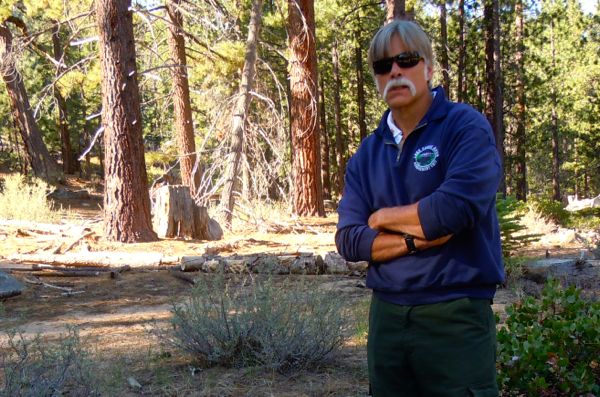
Kit Bailey is the fire guru for U.S. Forest Service in the Lake Tahoe Basin. Photo/LTN file

Kit Bailey is the fire guru for the U.S. Forest Service in the Lake Tahoe Basin. Photo/LTN file

“It’s a lot better fire effect when the wind is blowing. You get less scorch and mortality,” Kit Bailey, Lake Tahoe Basin Management Unit fire management officer, told Lake Tahoe News. “And it gets the smoke out.”

It’s also common to start the fires before precipitation falls.

Bailey said a successful burn requires a great deal of preparation and planning.

There are still critics of the Forest Service for how the Glenbrook burn a couple years ago was handled. Driving east up Spooner Summit the scar from that burn on the left side of the road is still visible.

“Had it burned in an uncontrolled manner, we would have lost the whole canyon,” Bailey said. “That area is still overstocked.”

The thinking is that a good winter will help that hillside look better. The drought is putting stress on all trees because the groundwater is being depleted.

Public questions centered on how much longer burns would be occurring (seasonally, but forever) and if it’s normal to see flames (yes).

The open house was a way for the various agencies to all be in one room and for the public to get their questions answered.


California officials ponder all-mail voting

By Christopher Cadelago, Sacramento Bee

When all the ballots are finally tallied from this month’s election, the proportion of Californians voting by mail is expected to break the record set in 2012, the first time more than half of the state’s electorate voted absentee.

The uptick has more Californians pushing for the state to go all the way and ditch traditional polling places. Washington, Colorado and Oregon require all of their elections to be run entirely by mail, and at least 19 others permit some of their elections to be all mail, according to the National Conference of State Legislatures.

County elections officials have touted the potential increase in voter interest and significant savings from avoiding the task of recruiting and training polling place workers. And some believe an all-mail system could even help speed up and avoid some overtime ballot-counting.

“I say, ‘yes, please,’” said Jill LaVine, the registrar of voters in Sacramento County. “I would love to go all vote-by-mail.”

Read the whole story


Nevada: No need for court to rehear gay marriage

By Ken Ritter, AP

LAS VEGAS – A federal appeals court should reject a request by the Coalition for the Protection of Marriage for a full-court rehearing of a landmark decision allowing gay marriage in Nevada, the state’s governor and an advocacy group representing eight same-sex couples said.

In strongly worded filings submitted on a Wednesday deadline to the 9th U.S. Circuit Court of Appeals, Gov. Brian Sandoval declared the same-sex marriage question settled in Nevada, and Lambda Legal lawyer Tara Borelli said the coalition had no standing to mount what she called a “final act of desperation” to prolong the case.

“While the question whether same-sex marriage can be prohibited remains in controversy elsewhere, it is not here,” Sandoval, a former U.S. District Court judge, said in a 10-page filing submitted by the Nevada state attorney general’s office. “The legal resolution of the matter in Nevada is in the public interest and should not be deferred by further proceedings.”

Hundreds of couples have married since a three-judge appeals court panel in San Francisco struck down Idaho and Nevada bans on gay marriage last month as a violation of equal-protection rights, Lambda Legal said in a 28-page document.

The ruling generated a wave of same-sex marriages in Las Vegas, which bills itself as the marriage capital of the world, but no tsunami. Same-sex couples made up a little more than 10 percent of about 2,300 couples who obtained marriage licenses around the state in the week after the gay marriage ban was dissolved.

Borelli derided the coalition’s involvement in the case as the architect of a Nevada state constitutional amendment passed in 2002 to prohibit same-sex marriage, but not a named party in the case Lambda filed in 2012. The case challenged the state law as a violation of the Equal Protection clause of the U.S. Constitution.

Monte Neil Stewart, lawyer for the Boise, Idaho-based coalition, didn’t immediately respond Thursday to messages.

“Intervenor has no direct stake in the outcome of this appeal,” Borelli wrote, “it has no standing to petition for rehearing en banc. Intervenor’s final act of desperation — attacking this court’s integrity — is wholly devoid of merit and should be rejected.”

The coalition filed documents last month claiming bias by Judges Stephen Reinhardt, Marsha Berzon and Ronald Gould; alleging that Reinhardt and Berzon weren’t randomly appointed to hear gay-marriage cases from Nevada, Idaho and Hawaii; and accusing Reinhardt and Berzon of favoring the rights of gay men and lesbians.


Study: Regular pot smokers have shrunken brains

By Melissa Healy, Los Angeles Times

Experimental mice have been telling us this for years, but pot-smoking humans didn’t want to believe it could happen to them: Compared with a person who never smoked marijuana, someone who uses marijuana regularly has, on average, less gray matter in his orbital frontal cortex, a region that is a key node in the brain’s reward, motivation, decision-making and addictive behaviors network.

More ambiguously, in regular pot smokers, that region is better connected than it is in non-users: the flow of signal traffic is speedier to other parts of that motivation and decision-making network, including across the superhighway of “white matter” that connects the brain’s hemispheres.

The researchers who conducted the study speculate that the orbital frontal cortex’s greater level of “connectedness” — which is especially pronounced in people who started smoking pot early in life — may be the brain’s way of compensating for the region’s under-performing gray matter.

Read the whole story


Highway 28 to receive nearly $24 mil. in upgrades

Eleven miles of Highway 28 will be getting about $24 million worth of improvements.

Washoe County commissioners on Nov. 12 approved a $12.5 million Federal Lands Access Program agreement for the corridor from Incline Village to the Highway 50 junction.

The funding will be targeted toward safety advances, expanded transportation options, an enhanced visitor experience, increased economic vitality and improved water clarity.

“This is the single most significant project on the Nevada side of Lake Tahoe in decades,” Marsha Berkbigler, Washoe County commissioner and Tahoe Transportation District board member, said in a press release.

The Federal Lands Access Program was established to improve transportation facilities that provide access to high-use federal recreation sites.

The remaining comes from: $2.3 million from Nevada Department of Transportation; $3.5 million from Nevada Question 1 – voter-approved funding for the Lake Tahoe Bike Path; $1 million from State Lands Tahoe Bond Act; $800,000 from Tahoe Fund for the Lake Tahoe Bike Path; $2 million Federal Scenic Byways; $150,000 Federal Recreation Trails Program; $650,000 Federal Transportation Alternative Program; and $1 million from Washoe County Tahoe Air Quality Mitigation funds and Washoe County Question 1 – voter-approved funding for the Lake Tahoe Bike Path.

Highway 28 segments in Washoe, Carson and Douglas counties will feature three miles of new off highway bike path from Lakeshore Drive to Sand Harbor, additional and improved East Shore Express transit stops, expanded off-highway parking, a park-n-ride lot near U.S. Highway 50, guardrail improvements, emergency pullouts, and environmental improvement projects such as storm water collection and filtration. Construction of these improvements will begin with the first mile of off highway bike path in summer 2015.


Incorporate Olympic Valley faces uphill battle

By Melissa Siig, Moonshine Ink

The struggle between Squaw Valley Ski Holdings and Incorporate Olympic Valley over the future of the valley may be playing out publicly in newspaper ads and editorial pages, but behind the scenes another battle is brewing — one that involves hundreds of thousands of dollars, multiple attorneys and consultants, and a complex political process that pits a grassroots effort against a million dollar corporation.

In the latest chapter of this saga, the ski resort and the anti-incorporation group it funds, Save Olympic Valley, won out in their request that an environmental impact report (EIR) be conducted for the proposed town. Incorporate Olympic Valley, which will have to pay for the study, claims this is part of an ongoing strategy by SVSH to draw out the incorporation process and force it to exhaust its financial resources. The ski area, however, states that it is merely exercising its legal rights and abiding by state laws, unlike IOV. Whether you see this story as a modern day David versus Goliath or the majority protecting itself from minority interests, Squaw Valley Ski Holdings is making incorporation supporters work hard to achieve their goals.

“We are moving forward but against strong headwinds,” Fred Ilfeld, chairman of the IOV Foundation, told Moonshine Ink.

Squaw Valley Ski Holdings has been pushing since April for the Placer County Local Agency Formation Commission to require an EIR as part of the incorporation process. An EIR, as required by the California Environmental Quality Act (CEQA), identifies a project’s significant environmental impacts and ways to avoid or mitigate those impacts. The ski area believes that an EIR is necessary because the proposed town would result in a change of wildfire fighting responsibility from the state to the new town, as well as shift transit occupancy tax (TOT) dollars away from public transportation.

“The IOV incorporation may result in a potentially significant adverse impact by reducing wildland fire response times and thereby exposing people and structures to a significant risk of loss, injury, or death,” wrote law firm Remy Moose Manley, on behalf of SVSH, in an April 4 letter to LAFCO.

“Incorporation could also result in a reduction in TOT revenue needed to ensure continuation of basic TART [Tahoe Area Regional Transit] levels of service.”

Additionally, SVSH hired Environmental Science Associates, which stated in an Aug. 11 letter to LAFCO that an EIR is needed because of the vagaries of climate change. The environmental science and planning firm claims that because the town’s income would be dependent on the ski industry, the town will have to diversity its economy, which would result in ”additional development and land use changes.”

IOV, on the other hand, argues that an EIR is not necessary because no land is being disturbed in the decision to form the town of Olympic Valley.

“We are not turning a spade of dirt,” Ilfeld told Moonshine Ink. “It has no effect on the environment.”

IOV points to a 2008 article written by lawyer Julie Biggs, who has represented numerous California community incorporation attempts — some successful, some not — such as Goleta, Caramel Valley, Wildomar, and East Los Angeles. Biggs argued that, as decided by the Monterey County Superior Court in 2008, an EIR is not required when forming a city because incorporation of a new city alone does not constitute a project under CEQA. In other words, the decision is who should govern, not what will be constructed.

Read the whole story


California pension funds running dry

By Marc Lifsher, Los Angeles Times

A decade ago, many of California’s public pension plans had plenty of money to pay for workers’ retirements.

All that has changed, according to a far-reaching package of data from the state controller. Taxpayers are now on the hook for billions of dollars more to cover the future retirements of public workers, with the bill widely varying depending on where they live.

The state’s pension goliath, the California Public Employees’ Retirement System, had $281 billion to cover the benefits promised to 1.3 million workers and retirees in 2013. Yet it needed an additional $57 billion to meet future obligations.

The bill at the state teachers’ pension fund is even higher: It has an estimated shortfall of $70 billion.

The new data from a website created by state Controller John Chiang come at a time of growing anger from taxpayers over the skyrocketing cost of public workers’ retirements.

Until now, the bill for those government pensions was buried deep in the funds’ financial reports. By making this data available, Chiang is bound to stir debate about how taxpayers can afford to make retirement more comfortable for public workers when private-sector employees’ own financial futures have become less secure. For most non-government workers, fixed monthly pensions are increasingly rare.

Read the whole story


El Dorado water official accepts Calaveras deal

By Betty Martin, Calaveras Enterprise

Despite numerous pleas from residents to postpone the vote, David Eggerton is the new general manager at the Calaveras County Water District. Directors approved the move on a 3-0-2 vote at Wednesday’s board meeting, which saw Director Jeff Davidson and Don Stump away on vacation.

The controversial vote drew particular criticism from ratepayers and newly elected board members on Eggerton’s contract.

“No one gets this type … of benefits package (in Calaveras County),” Marti Crane said, adding that residents had no opportunity to review the contract, which wasn’t available until the beginning of the meeting.

In fact, according to board President Scott Ratterman, one reason for Eggerton’s move from El Dorado County Water Agency is that, while he’s making less than past general managers at CCWD, he’s making more than he was getting at El Dorado as general manager.

Read the whole story