Nevada college advisory boards draw criticism

By Bethany Barnes and Francis McCabe, Las Vegas Review-Journal

The Board of Regents last week created local advisory councils for the community colleges in the state, a move some education watchdogs fear is just window dressing to appease advocates who want local communities to have more say in the colleges.

The unanimously supported establishment of the Community College Institutional Advisory Councils on Friday comes in the wake of a heated battle to restructure the governance of higher education in the state.

In a showdown this summer, a panel of lawmakers rejected the idea of taking the community colleges out from under the Board of Regents.

Advocates argued the state needed a two-tier system that that would separate the University of Nevada, Las Vegas, the University of Nevada, Reno and the Desert Research Institute from the state’s two- and four-year colleges.

The concept was that community colleges should be rooted in their communities. Oversight and advocacy end up neglected when the colleges are bundled in with the universities, proponents of local control argued.

Read the whole story


10 people evacuated from burning hotel

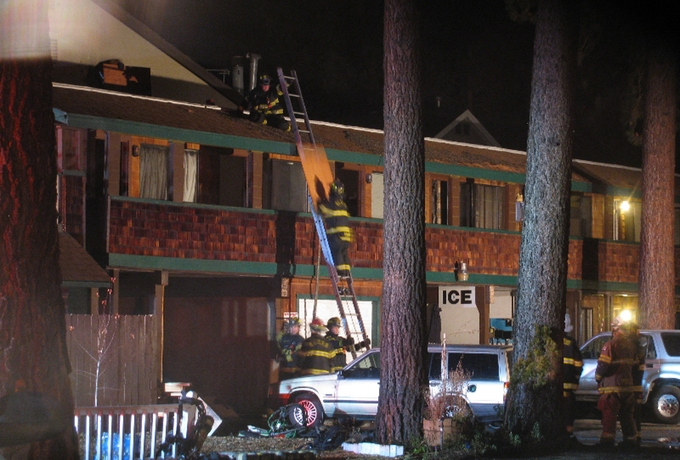
A fire Dec. 8 at the Tahoe Pines Lodge in South Lake Tahoe displaced 10 people. Photo/Jonathan Moore

A fire Dec. 8 at the Tahoe Pines Lodge in South Lake Tahoe displaced 10 people. Photo/Jonathan Moore

By Kathryn Reed

A South Lake Tahoe hotel fire Monday night displaced 10 people.

The 10:10pm blaze at Tahoe Pines Lodge started in a utility closet that contained a hot water heater and belongings from former guests, according to Fire Chief Jeff Meston.

“The fire investigators are going through that,” Meston said. An exact cause has not been determined.

This is a residential hotel, with many people living only on Social Security or disability checks.

“I believe most of these are an underserved population who live there, so it’s pretty devastating for those folks because they don’t have much in the first place,” Meston told Lake Tahoe News.

With the temperature dipping into the 20s, a Tahoe Transportation District bus was brought in as a means to keep people warm. Red Cross arranged for them to have a three-night stay at Howard Johnson, which should protect them from the storm that is moving into the basin. Many of the occupants also had dogs and cats that needed shelter.

The fire started on the first floor, moved to the second and got into the attic space. The ladder truck was deployed to the fire. Lake Valley and Tahoe Douglas also assisted with knocking down the fire.

“The fire was in concealed spaces so it was difficult. We had to cut a hole in the roof,” Meston said.

Three hotel units were damaged, with an entire wing of the Modesto Avenue hotel off limits. Part of the hotel remains open.


S. Tahoe groundwater contamination improving

By Kathryn Reed

Owners of Tahoe Tom’s on Dec. 8 were issued a letter by the Lahontan Regional Water Quality Board allowing the South Lake Tahoe gas station to shut down the onsite remediation system during the winter.

Tahoe Tom’s has long been a source of contaminating the groundwater and affecting wells. Even though MTBE (methyl tertiary butyl ether) has been banned for years as a gasoline additive, it is still in the water system. Last summer it was found in a nearby well.

“Significant cleanup at the site occurred April through November and concentrations of petroleum products reduced significantly,” Lauri Kemper, Lahontan assistant executive officer, told Lake Tahoe News.

Testing the hydrocarbon concentrations will continue. If numbers are higher than the October results, the onsite remediation system will be turned back on.

Groundwater samples will be taken at the Mark Twain Lodge. In the past it had been contaminated, which required the gas station to provide the hotel with bottled water.

“(A) decision on further enforcement such as a penalty for the past violations (of) not providing bottled water or a plan is still pending,” Kemper said.

Beginning in 2015 water samples from the Best Western Station House and Alpenrose Motel wells also must be collected.

A more permanent solution to the problem is still being worked out.

“We are also waiting for final decision from county health on the treatment system design and plan submitted by Tahoe Tom’s. Once they have county approval, then we would expect Tahoe Tom’s to provide a schedule for implementation or the water board may impose a schedule,” Kemper said.


Calif. water at-risk from abandoned Sierra Nevada mines

By Ed Joyce, California Public Radio

Along the western slopes of the Sierra Nevada, runoff pollution from abandoned mines in “Gold Country” could threaten California’s primary water supply. A pilot project at one mine site is intended to prevent contaminated runoff from reaching the Yuba River.

The Sierra Nevada Conservancy said more than 60 percent of California’s water supply comes from forests in the Sierra Nevada. The state agency says the health of many of those forests is in decline.

Joan Keegan, Conservancy assistant executive officer, said abandoned mines with contaminated soil are a “huge problem.”

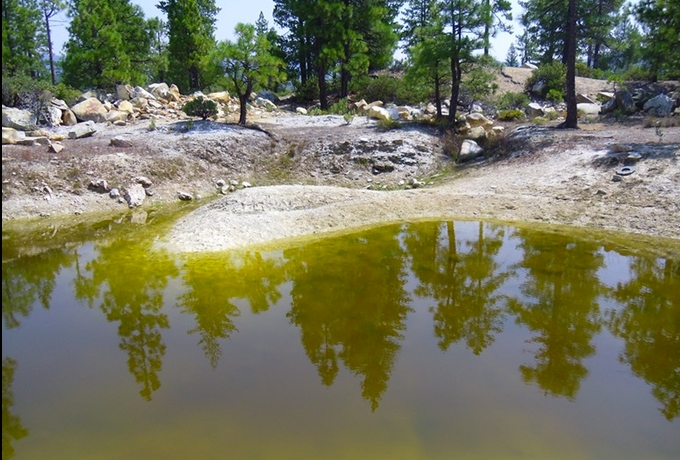
A Sierra Nevada Conservancy pilot project is intended to reduce contaminated runoff from an abandoned mine in Nevada County. Bob Kingman / Sierra Nevada Conservancy

The Sierra Nevada Conservancy is working to reduce runoff from an abandoned mine in Nevada County.
Photo/Bob Kingman/Sierra Nevada Conservancy

“There are 47,000 abandoned mine lands in California that have been inventoried and over half of those are in the Sierra Nevada,” said Keegan. “And of those, there are 3,000 that are known to contain chemical hazards, including mercury.”

Keegan said there are probably more mines in the Sierra Nevada with chemical hazards that haven’t been assessed.

She said contaminated soil from abandoned mines drains in waterways that flow to the Sacramento-San Joaquin River Delta.

“Basically, a lot of the mercury and other toxins, that are a result of abandoned mine lands in the Sierra, have and continue to make their way downstream into the Delta,” said Keegan.

Keegan said the majority of those abandoned mines are in “Gold County” including El Dorado and Placer counties.

Read the whole story


Affordable Care Acts cuts down on ER visits

By Phillip Reese, Sacramento Bee

Fewer uninsured Californians are seeking treatment in the state’s emergency rooms, a decline that experts say is a direct result of the federal Affordable Care Act.

The trend represents welcome news for previously uninsured patients who had trouble affording a trip to the emergency room. But it has not brought down ER treatment costs for everyone else, health care experts said, nor has it slowed a years-long increase in overall emergency room traffic.

The Affordable Care Act required most Californians to obtain health insurance by April 15, 2014, or face a penalty. The new figures, reported by hospitals to the Office of Statewide Health Planning and Development, show that about 337,000 uninsured patients visited California emergency rooms between April and June, down by 90,000, or 20 percent, from the same quarter in 2013. Put another way, 12 percent of emergency room patients lacked insurance this year, down from 16 percent in 2013.

Read the whole story


Vail Resorts misses revenue forecasts

By Associated Press

BROOMFIELD, Colo. — Vail Resorts Inc. today  reported a fiscal first-quarter loss of $64.3 million.

On a per-share basis, the Broomfield, Colo.-based company said it had a loss of $1.77. Losses, adjusted for non-recurring gains, came to $2.05 per share.

The results met Wall Street expectations. The average estimate of analysts surveyed by Zacks Investment Research was also for a loss of $2.05 per share.

The ski resort operator posted revenue of $128.3 million in the period, which missed Street forecasts. Analysts expected $133 million, according to Zacks.

Vail Resorts shares have increased 22 percent since the beginning of the year. The stock has risen 22 percent in the last 12 months.


Snow-day alternative creates new challenges

By Adam Beam, AP 

FRANKFORT, KY — Public school students in 13 districts across Kentucky will be home schooled — mainly via the Internet — during some snow days this year as part of an experiment aimed at keeping students learning amid the growing number of weather-related closings.

The state’s solution has caused a new set of challenges for some districts in one of the country’s most impoverished areas. Some students don’t have computers or home Internet access. And the school district might lose some state and federal aid.

Nonetheless, the snow day problem is too significant for Kentucky to ignore. Schools across the state had nearly four times as many snow days last year as they did the previous year. Some districts canceled school for more than a month.

To make that time up, schools had to cancel spring breaks and shorten summer vacations, creating low attendance days that hurt their state funding. The legislature had to pass an emergency law letting five districts cut their school years short.

Educators fear they might face a similar problem this year. Some schools have already used snow days.

Coping with fierce winter weather by teaching over the Internet has become more common in recent years, but it’s harder in states like Kentucky, which ranks 46th out of 50 states for availability of high speed Internet. The problem is most pronounced in rural counties, which is why the state is moving forward with a $200 million plan to lay 3,000 miles of fiber-optic cables.

Thirteen school districts are part of an expanded program allowing students to complete assignments from home either by downloading them or working from packets prepared and sent home ahead of time. In exchange, the state will forgive up to 10 makeup days.

“If you could make this work, you would never have a snow day,” said David Cook, director of innovation and quality management for the Kentucky Department of Education. “You would just have kids doing this kind of instruction and learning anytime you have snow.”

Schools in Owsley County, where 90 percent of the students qualify for free or reduced lunch, missed 30 days because of snow last year. Owsley officials say they embraced the program because interrupting schooling takes a disproportionate toll on high-risk students.

Districts that opt to use the home school option would lose state transportation dollars and federal money for free and reduced lunches.

Though school buses might not be able to ply all the county’s side roads to bring kids to school on snow days, education officials might still be able to deliver meals to the students at some central locations, such as community centers.


Climate change affecting Lake Tahoe

By Susan Wood

INCLINE VILLAGE – If a tree grows submerged in a lake, will anyone notice?

That’s the prevailing question posed during a lecture at Sierra Nevada College last week by Benjamin Hatchett, who studies climate models for the Nevada State Climate Office of UNR.

The talk, which brought out almost 100 people who were interested in the topic, covered changes to the landscape of what’s considered the Great Basin. Its series of lakes provide a picture of the past and perhaps the present and future of the climate’s effects on Walker, Convict, June and Mono lakes, as well as Emerald Bay and other areas of Lake Tahoe.

From tufa and tree stumps to shorelines and slow-moving glacial movements, Hatchett’s slide show demonstrated a much different-looking western front surrounding Tahoe.
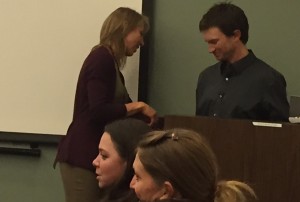
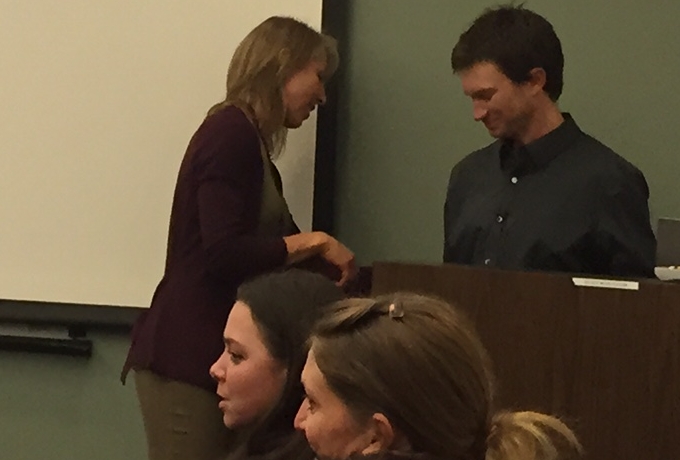
Benjamin Hatchett gives at talk Dec. 4 at Sierra Nevada College. Photo/Susan Wood

Benjamin Hatchett gives a talk Dec. 4 at Sierra Nevada College. Photo/Susan Wood

And as much science as there was, Hatchett made the subject somewhat light with his reference to Bonneville Lake being more known now for giant desert parties and speed races.

Scientists like Hatchett are now able to make the connection between moisture availability with outgoing evaporation and incoming precipitation – a subject near and dear to California and Nevada residents enduring one of the worst droughts in a century.

Tahoe-area researchers have been able to discover 200-year-old trees submerged in Walker Lake, just like those they’ve found in Fallen Leaf. And Mono Lake’s high shorelines that make the tufa rock formations so unusual are “an indicator of how dry it can be here,” Hatchett pointed out.

How do these dry spells affect the web of life?

Walker Lake’s low level has already jeopardized Hawthorne’s famed Loon Festival, a mainstay for the small Western town. When the lake drops, the food chain is disrupted and therefore the birds reduce their visitation.

The best scientists can hope for is moisture because we’re all at the mercy of Mother Nature. Beyond using historical maps, they can also count on solving equations upon geographic grid cells on charts using components such as snowpack, snowmelt, temperature, precipitation, evaporation and water storage.

So at least we’ll have a heads up if we face a “modern mega drought,” which is the worrisome equation at work here.

From 2012 to 2014, the Great Basin experienced the similar level of precipitation to other mega droughts based on the models.

“We could end up with lakes drier than the time when we had trees growing in them,” Hatchett said, adding that the scenario could lead to “massive socioeconomic and ecological implications.”

As it is, Hatchett cited a $2 billion expense reported by UC Davis of the three-year drought. It’s difficult to imagine a long-lasting mega drought.

So, Hatchett put up pictures that showed Emerald Bay and Fallen Leaf Lake as a series of moraines during the Ice Age more than 14,000 years ago. These extreme climate conditions result from large-scale swings in hydrologic history.

The ice flowed down Eagle Creek into Emerald Bay “leading to a nice place to go have tea,” he said, referring to Fanette Island situated in the middle of the bay. The resident of Vikingsholm, Helen Knight, took her guests out there for the English staple.

“Desolation Wilderness is one of the best examples of the Ice Age,” he said.

So the next time you walk in the wilderness and notice a few rock formations that either seem thrown there or out of place in terms of other nearby rocks – think ice movement.

“We can blame glaciers for a lot of weird geologic finds,” he said. What’s the big picture? “Natural or manmade (climate conditions) – if it gets drier, we’re all in big trouble,” he clarified.

And with that, the audience was hushed with keen interest.

Bob Richards, Tahoe researcher Charles Goldman’s understudy for years, was on hand for the talk. Afterward, he told Lake Tahoe News that he wanted to know if Hatchett could say how the 5,000-year-old submerged trees out from Taylor Creek on the South Shore fit into the climate picture of other submerged forests such as the Walker Lake drainage.

After the talk, Hatchett confirmed it’s all a part of the same dry picture. All the studying was food for thought for those wanting to “appreciate a lot of the features around us and how they’re a product of a long-term state of our climate,” Hatchett said. “This can be helpful in what we would do now for the ‘what if’ we’re three years into a 10-year drought.”

More observing is on the horizon. This includes studying the submerged forest off shore from Kings Beach next.

Cameras circling Lake Tahoe would warn of fires

By Associated Press

RENO — Nevada scientists working to expand early earthquake warning systems around Lake Tahoe are developing new plans to eventually ring the mountain lake’s basin with a network of cameras to help alert authorities to potentially disastrous wildfires.

Researchers are seeking private funding to substantially expand the system after a pilot program conducted by the University of Nevada’s Seismological Laboratory was determined to be an encouraging success.

“In the end, we envision encircling the basin so you can see the entire basin,” Graham Kent, director of the seismology lab, told the Reno Gazette-Journal. “We feel this is a very important thing.”

Like an automated version of the manned fire lookouts used for decades to protect vulnerable forests from fire, the cameras are designed to alert officials that a fire has started, allowing them to send firefighters to the scene before it gets big.

The first device, also outfitted with a seismometer, was installed in July 2013 as part of an effort to expand the seismology lab’s seismic network. Two more were installed last summer, and a fourth should be installed near Homewood in a week or so.

The stations employ a wireless, digital microwave communication system that can also be useful in obtaining weather data and in atmospheric and other environmental studies, Kent said.

Their potential usefulness in detecting fire was evident last August when a U.S. Forest Service official was testing one installed in the mountains above Tahoe’s east shore to scan an area that had been hit by lightning over a span of several days.

Mac Heller of the Lake Tahoe Basin Management Unit of the U.S. Forest Service spied thin wisps of smoke and contacted firefighters, who found and contained a half-acre wildland fire near Spooner Summit. “Who knows how big the Spooner fire would have been if it had been reported later or the next day or so?” Heller said.

There’s no way to know for sure, but Kent suspects that had the camera system been in place in June 2007, the Angora Fire might have been stopped before it whipped into an inferno that destroyed 254 homes on the South Shore.

“The fire this system is built to detect is the Angora Fire,” Kent said. “That fire smoldered for hours before it took off. Even the smallest fire is super-apparent, and that thing would have been super-apparent for much of the day.

“This system will have the potential of jumping on fires and the majority, if not all, will be discovered early.”

Lake Tahoe’s fire chiefs have been briefed on the program and are impressed with what they learned, said Mike Brown, chief of the North Lake Tahoe Fire Protection District.

“What they have to offer is awesome when it comes to early detection,” Brown said, agreeing that the cameras might have made a big difference during the Angora Fire.

Officials at REMSA, a paramedic and ambulance service in the region, say the cameras could also be useful in providing a real-time look at Tahoe weather conditions prior to flights of Careflight medical helicopters, Kent said. The cameras — which are controlled remotely by computer and can tilt, pan and zoom — have been used this fall to monitor controlled burns and the smoke they create.

Kent and colleagues envision installing the camera stations at 15 additional locations at a cost of about $2 million. While grants might cover some of the cost, they are hopeful private donations could provide needed money at an accelerated schedule. The lab’s fundraising campaign is called, “AlertTAHOE.”


Caesars Entertainment wants Delaware lawsuit tossed

By Randall Chase, AP

GEORGETOWN, Del. — A Delaware judge is weighing whether to grant a motion by Caesars Entertainment Corp. to dismiss a lawsuit by bondholders accusing the company of fraudulently transferring assets of its debt-laden operating unit in order to shield them from creditors.

Lawyers for Caesar’s argued Friday that the second-lien bondholders are bound by an intercreditor agreement with first-lien noteholders to bring such claims in New York, where the company is involved in related litigation, including a suit that the company filed against certain investors just hours after the Delaware action was filed in August.

“They have a contractual obligation to bring this case in New York,” said Caesar’s attorney Eric Seiler.

But attorneys for the bondholders, who are represented by Delaware-based Wilmington Saving Funds Society as successor trustee, contend that Caesars is not a party to the intercreditor agreement, and that its provisions do not apply to their lawsuit against the company. They also argue that the asset transfers in dispute involved entities that were formed in Delaware and are controlled by Caesars officials in Nevada.

Caesars is the parent company of Harrah’s Lake Tahoe and Harveys

“The important and central witnesses are going to be the business people who signed off on these transfers,” said Bruce Bennett, an attorney for the bondholders.

Vice Chancellor Sam Glasscock said he had expected to rule at the conclusion of Friday’s hearing but told attorneys that they have raised complex issues that he needs time to consider. He said he would rule promptly but gave no timeline

The lawsuit is one of two filed in Delaware against Caesar’s, which was saddled with debt since a 2008 highly leveraged $30 billion buyout of Harrah’s Entertainment Inc., as the company formerly was known, by private equity investors led by TPG Capital and Apollo Global Management.

Last week, UMB Bank, a trustee for first-lien noteholders owed more than $1 billion, sued Caesars in Delaware, with allegations of misconduct similar to those made by the junior bondholders. The plaintiffs allege that Caesar’s officials have stripped Caesar’s Entertainment Operating Co., or CEOC, of assets including trademarks, real estate and interactive gambling operations, transferring them to affiliates that are not liable for CEOC’s debt. UMB, on behalf of the first-lien noteholders, is asking the court to impose a receiver for CEOC.

Meanwhile, Caesars is working to restructure its debt and has sued certain institutional investors in New York court, claiming they are trying to push CEOC into default and thwart its restructuring efforts. The complaint names certain investors holding CEOC second-lien notes, as well as Elliott Management Corp. which holds first-lien notes.

Caesars CEO and chairman Gary Loveman said in August that the company refuses to be “held hostage” by speculators who seem to be betting against its long-term health.