Digital security a growing concern

By Nicole Perlroth, New York Times

Paul Kocher, one of the country’s leading cryptographers, says he thinks the explanation for the world’s dismal state of digital security may lie in two charts.

One shows the number of airplane deaths per miles flown, which decreased to one-thousandth of what it was in 1945 with the advent of the Federal Aviation Administration in 1958 and stricter security and maintenance protocols. The other, which details the number of new computer security threats, shows the opposite. There has been more than a 10,000-fold increase in the number of new digital threats over the last 12 years.

The problem, Kocher and security experts reason, is a lack of liability and urgency. The Internet is still largely held together with Band-Aid fixes. Computer security is not well regulated, even as enormous amounts of private, medical and financial data and the nation’s computerized critical infrastructure — oil pipelines, railroad tracks, water treatment facilities and the power grid — move online.

In a speech two years ago, Leon Panetta, the former defense secretary, predicted it would take a “cyber-Pearl Harbor” — a crippling attack that would cause physical destruction and loss of life — to wake up the nation to the vulnerabilities in its computer systems.

Read the whole story


EDC planners deny South Shore cell tower

El Dorado County planning commissioners denied the request by Cingular Wireless/AT&T to erect a cell tower on the south side of Skyline Drive about one mile northeast of the intersection of Highway 50 and Pioneer Trail on the South Shore.

Residents in the area had voiced concerns about the tower. Because of all the houses the commissioners said no.

The applicant could appeal the Dec. 11 decision.

The proposal was for a 113-foot monopine tower with nine panel antennas, equipment shelter, related ground equipment, HVAC units, sound barrier walls, and solid wood fence.

In April 2007, the Tahoe Regional Planning Agency denied a similar application.

“TRPA would have to approve the tower. That could be done at the hearings officer level – but back in 2007 it got elevated to the Governing Board and voted down,” TRPA spokesman Tom Lotshaw told Lake Tahoe News.

At that time it was a Verizon proposal. Minutes from the TRPA meeting show residents were concerned about health and safety issues, similar to what was voiced before the Dec. 11 county meeting in Placerville.

Prior to the county meeting Cingular Wireless/AT&T was working on an application with TRPA, but nothing had been submitted.

— Lake Tahoe News staff report


U.S. birthrate hits new low

By Karen Kaplan, Los Angeles Times

American women gave birth to 3,932,181 babies in 2013 as the nation’s birthrate fell to another record low, federal researchers reported.

The total number of births declined for the sixth straight year, with only 62.5 babies born for every 1,000 women between the ages of 15 and 44. The birthrate has dropped 10 percent since peaking in 2007.

The continuing baby bust comes courtesy of women under the age of 30, who are increasingly delaying motherhood until they are older. The birthrate for women ages 20 to 24 fell 3 percent between 2012 and 2013, and dipped 1 percent for women ages 25 to 29. Last year, there were 80.7 babies born for every 1,000 women in their early 20s, along with 105.5 babies born per 1,000 women in their later 20s.

Read the whole story


Tahoe recovers from wind damage; snow coming

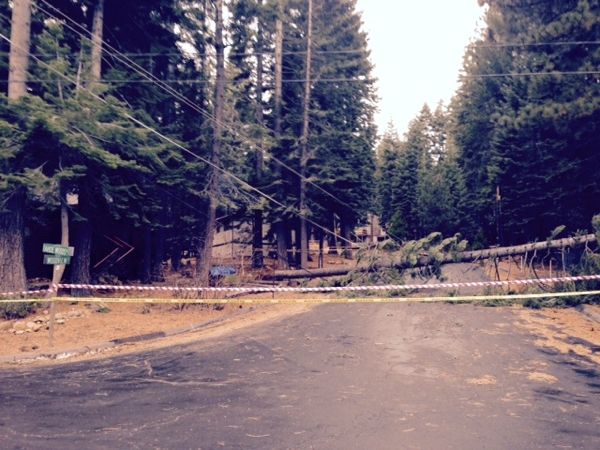
Downed power lines Dec. 11 on the South Shore. Photo/Provided

Downed power lines Dec. 11 on the South Shore. Photo/Provided

Lingering effects of the storm that roared through Lake Tahoe are subsiding.

Heavenly Mountain Resort resumed operations today after being closed for the last three days. Thursday it was wind, Friday and Saturday it was power issues that kept the resort from opening.

Power also affected operations at Squaw Valley and Alpine Meadows on Dec. 13.

Liberty Utilities services all three of these ski resorts.

Services resumed at St. Theresa Catholic Church on Dec. 13 after a tree fell on Globin Hall. A city building inspector on Dec. 12 said the church was safe to enter.

At the 5:30pm Mass on Saturday the Rev. Ben DeLeon expressed relief that the sanctuary was protected.

While the storm did not bring the massive amounts of snow that had been forecast, the North Shore did end up with much more snow than the South Shore. What all regions had was a ton of wind that brought trees and power lines down, causing much of the region to be in the dark last Thursday.

Snow is in the forecast again starting today and continuing through Wednesday. Highs are going to be in the 30s and lows in the 20s. But no devastating winds are predicted this go-round.

— Lake Tahoe News staff report


South Tahoe teen killed by falling tree

A missing South Lake Tahoe teenager was found dead Dec. 13, having been struck by a 50-foot tree during the storm.

Dejon Smith, 14, had been reported missing Dec. 11 from his Wildwood Avenue home.

Officers on Dec. 12 spoke to someone who had seen the teen late the night before in the wooded area behind Rancho Way. Officers searched the area to no avail.

A resident on Saturday reported finding a body about a half-mile from where officers had been looking the day before.

“There is some indication other people may have been present and we are investigating that,” Police Chief Brian Uhler told Lake Tahoe News.

Anyone with information about this case is asked to call the South Lake Tahoe Police Department at 530.542.6100.

— Lake Tahoe News staff report


Sleep deprivation hurts your career more than it helps

By Deborah Sutton, Deseret News

Burning the midnight oil implies working overtime, long into the night, to get something done and ultimately to get ahead. But the belief that sacrificing a few hours of sleep for a few more hours of work will lead to higher achievement has been debunked by science.

“According to the Division of Sleep Medicine at the Harvard Medical School, the short-term productivity gains from skipping sleep to work are quickly washed away by the detrimental effects of sleep deprivation on your mood, ability to focus, and access to higher-level brain functions for days to come,” wrote Travis Bradberry for Forbes. “The negative effects of sleep deprivation are so great that people who are drunk outperform those lacking sleep.”

On Sunday, the National Geographic Channel in collaboration with the Public Goods Project and National Institutes of Health, aired a documentary about the silent and dangerous epidemic of sleep deprivation in America. “Sleepless in America” revealed that 40 percent of all Americans and 70 percent of adolescents are sleep-deprived.

Read the whole story


Caesars lenders reveal plan as debt talks unravel

By Kimberly Pierceall, AP

Looking for cash, Caesars Entertainment officials looked no further than the company’s flagship Las Vegas Strip hotel-casino Caesars Palace and saw $2.6 billion that could be raised by mortgaging the 4,250-room resort modeled after Ancient Rome.

The proposal was revealed this week after the company’s bank lenders were the latest creditors to walk away from talks with the hotel-casino giant to restructure a sizable amount of its debt in order to avoid a messy bankruptcy case.

Bank lenders with a first-lien on Caesars debt posted the company’s proposals online Thursday after a confidentiality agreement expired. The Caesars Palace proposal was one part of a larger proposal made to lenders to restructure Caesars’ debt during talks that began in September.

Caesars is the parent company of Harrah’s Lake Tahoe and Harveys at Stateline.

Financial analyst Alex Bumazhny with Fitch Ratings said he had never seen anything like it, but the document dump was likely indicative of how upset creditors might be by the process.

Caesars had previously revealed the general terms of its pitch, splitting Caesars Entertainment Operating Company division into two real estate investment trusts, one to own hotel-casinos and the other to lease and manage them.

The documents posted online provided more detail including the plan to make Caesars Palace its own real estate investment trust using it to raise $2.6 billion in cash in new financing. Documents also revealed how much Caesars offered to make its creditors whole through cash, debt and equity: bank lenders would recover everything owed, $5.4 billion, and noteholders would recover 93.8 percent or $5.9 billion.

Caesars Entertainment was bought in 2008 with its new owners Apollo Global Management LLC and TPG issuing billions in debt to raise cash for the purchase. As of the company’s last quarterly filing, $22.8 billion in long-term debt weighed down Caesars.

Its operating division holds most of the debt making it the focus of recent lawsuits filed by some creditors claiming the company has drained that division of assets — except Caesars Palace — by moving of its money-making hotel-casino properties to other divisions, cutting guarantees to creditors and allowing debt to mount. The creditors have claimed the company is in default on its agreements.

The company has responded in financial filings calling the claims meritless.

Bumazhny said he thought the idea to raise $2.6 billion in cash by essentially mortgaging Caesars Palace represented a hefty amount of debt to saddle one property with, saying it represented 10 times the amount of the hotel-casino’s earnings before interest, tax depreciation and amortization.

He said it was hard to say why the creditors may have walked away, except to say that the process has been complex and contentious with multiple parties involved at varying levels.

Some of the operating division’s junior creditors are owed a $223 million interest payment Monday.

Fitch Ratings has speculated that the company may skip that payment in order to keep the cash it has left to pledge to its creditors first-in-line to be paid.

“It all depends on how much time Caesars wants to buy itself,” Bumazhny said.

The company said in a financial filing Friday that it’s still in discussions with its remaining bondholders.

Bumazhny said if the company feels it’s near a deal, it may pay the $223 million it owes Monday.

Caesars spokesman Gary Thompson offered no comment on the filings or whether Caesars would pay its $223 million interest payment Monday.


Cops scan social media to assess ‘threat rating’

By Brent Skorup, Reuters

A national spotlight is now focused on aggressive law enforcement tactics and the justice system. Today’s professional police forces — where officers in even one-stoplight towns might have body armor and mine-resistant vehicles — already raise concerns.

Yet new data-mining technologies can now provide police with vast amounts of surveillance information and could radically increase police power. Policing can be increasingly targeted at specific people and neighborhoods — with potentially serious inequitable effects.

One speaker at a recent national law enforcement conference compared future police work to “Minority Report”, the Tom Cruise film set in 2054 Washington, where a “PreCrime” unit has been set up to stop murders before they happen.

While PreCrime remains science-fiction, many technology advances are already involved with predictive policing — identifying risks and threats with the help of online information, powerful computers and Big Data.

New World Systems, for example, now offers software that allows dispatchers to enter in a person’s name to see if they’ve had contact with the police before. Provided crime data, PredPol claims on its website that its software “forecasts highest risk times and places for future crimes.” These and other technologies are supplanting and enhancing traditional police work.

Read the whole story


Volunteers helping Tahoe water quality

By Kathryn Reed

A lot of gunk flows into Lake Tahoe, causing the clarity to decline and algae to grow. Most of it comes in the winter and spring via storm runoff. But the lasting effect is making the water near the beaches less inviting, especially in the summer.

None of this is news.

What is new is the concerted effort that is under way to study all of that water that is flowing to the lake. Instead of just having the states mandate that the jurisdictions reduce the amount of fine sediment reaching the lake, there is actual monitoring going on to know what is mixed in with the water and which corrective measures are or are not working.

The jurisdictions around the lake are mandated to reduce their pollutant loads. That is what all the “erosion control” projects are about. The Lahontan Regional Quality Control Board’s total maximum daily load mandate is a 65-year program with the goal of returning the lake clarity to 100 feet – the depth a white dinner plate-like disc could be seen in the 1960s.

Tahoe Resource Conservation District is the lead agency of the Regional Stormwater Management Program. TRCD is seen as a neutral third party between those dictating what must be done and those who must carry out the orders. All sides are part of the program.

“We are providing consistent data collection, management, analysis and reporting methods,” Sarah Bauwens of TRCD told a group of nearly 50 people on Dec. 10 at Lake Tahoe Community College.

A dozen urban catchments are being monitored. Data is being collected from 10 to 12 precipitation events a year, including rain, snow, rain on snow and thunderstorms.

Turbidity, or the cloudiness of the water, is being measured. Data is showing sediment doesn’t just come down with the first rush of water.

“We’ve only done one full year of monitoring. Over time we want to see if there is a downward trend in pollutant load,” Bauwens said.

She said it would take five years’ of data to detect a trend.

Water flows from the pipe  below the old Alta Mira building in South Lake Tahoe. Photo/LTN file

Water flows from the pipe below the old Alta Mira building in South Lake Tahoe. Photo/LTN file

In addition to fine sediment, nitrogen and phosphorous are other pollutants that are cause for concern.

The volume of water is measured.

Water samples are sent to labs.

Some of the monitoring occurs at the end of the pipes that carry runoff to the lake, some involves seeing if erosion control measures (best management practices) are working, and then there is the rapid assessment method that tests if things are working based on what the models said would happen.

This program will ideally help the stakeholders be able to make changes sooner if need be.

All of the information is being put in to a dedicated database. There is a scientific advisory group assisting with the program as well as a technical advisory committee to keep everyone up-to-date.

Also assisting with data collection are the pipe keepers, a group of volunteers working for the League to Save Lake Tahoe.

Nephelometric turbidity units, or NTU, are how turbidity is measured. The pipe at Timber Cove measured 150 NTU on Aug. 11. Before this week’s storm no water had come out of that pipe since then. South Lake Tahoe’s multi-million dollar Bijou erosion control project is being credited with the turnaround, according to Aaron Hussmann with the League.

At the end of Wednesday’s gathering there was a panel discussion with representatives from the League, Lahontan, South Lake Tahoe, TRCD and Tahoe Regional Planning Agency.

They said:

• Regular maintenance of erosion projects is having better benefits than expected.

• As technology improves, more improvements can be made.

• The first 20-years of the TMDL will shed a lot of light on what is working.

• Looking at how nature worked before all the development came is critical.

• Controlling sediment at the source is ideal.

• Requiring infiltration systems be part of development or redevelopment projects will help.

——

Notes:

  • More info about Tahoe Resource Conservation District is online.
  • More pipe keepers are needed. Info is online.


Heavenly to be closed for third straight day

Updated 7:50pm

Heavenly Mountain Resort will be closed Saturday — the third consecutive day.

Due to a variety of complications from the storm, Heavenly will not open on SaturdayWe expect to restore power to the mountain for operations on Sunday,” Sally Gunter told Lake Tahoe News.

Wind forced the closure on Thursday, power was the problem Friday. The resort had issues with power at the top of the gondola and on the Nevada side. The Nevada side is where all the open terrain is.

“We are still battling some power issues on the California side, but are working to resolve those. No terrain is open on the California side yet so that should not impact operations,” Gunter said.

The resort also was contending with storm damage that included a tree falling onto the Dipper Express lift line as well as one on Olympic Express.

The tree on the Dipper chairlift was removed Dec. 12. Olympic is not open and the damage is still being assessed.

— Lake Tahoe News staff report