Fining parents may stop teen drinking

By Patti Neighmond, NPR

When it comes to teenage drinking, the typical venue is a party — where some teens play drinking games and binge. It may surprise you to learn that the majority of parents are aware that alcohol is flowing at these events.

On any given weekend, some teenagers receive three to four text messages about parties, says Bettina Friese, a public health researcher at the Prevention Research Center in Oakland.

Friese recently conducted a study on teen drinking. She interviewed 1,100 teenagers living in Northern California. Most did not host parties with alcohol. But of the 39 percent who did, 70 percent said their parents knew kids at the party were drinking. Twenty-four percent said their parents “probably” knew, leaving just a handful of parents in the dark.

Now some communities across the United States are trying to hold these parents accountable and fine them for allowing underage drinking in their homes.

Read the whole story


Nev. No. 2 in U.S. for mortgage fraud

By Eli Segall, Las Vegas Sun

Mortgage fraud is rising nationally and remains more active in Nevada than in almost every other state, a report shows.

Some 74 percent of U.S. home loans last year involved some kind of fraud or misrepresentation on the application, up from 69 percent in 2012 and 61 percent in 2011, according to LexisNexis Risk Solutions.

The most notable jump, the report said, was in fraudulent or misleading credit documentation, with 17 percent of loans investigated for that, up from 5 percent in 2012.

Read the whole story


S. Lake cemetery to honor military, public safety

An artist's rendering of what the memorial niches will be like at Happy Homestead Cemetery.

This is what the memorial niches will be like at Happy Homestead Cemetery. Rendering/Gabriel Hydrick

By Kathryn Reed

Plans are drawn, permits are being sought and the construction bid process is under way for what will be a memorial at Happy Homestead Cemetery for veterans and public safety.

“We are trying to make it as good as Arlington or better,” cemetery manager Mike Warren told Lake Tahoe News.

It will certainly be smaller. The entire area is about 30 feet by 40 feet.

The new feature will be in front of the office of the South Lake Tahoe cemetery where the annual Memorial Day ceremony is conducted.

The $120,000 project is expected to begin next building season, with completion in the summer.

It will be comprised of three niche banks, with a total of 178 niches. Each niche has enough room for two sets of ashes. There will also be an area for in-ground cremations.

Happy Homestead is already the final resting place for many veterans – about 1,000.

A black granite wall will have engraved badges from the public safety members.

While normally a requirement to be buried at Happy Homestead is to have been a resident of the district – which is roughly the same as the Lake Tahoe Unified School District boundary – Warren said any member of the military, police or fire services who dies in the line of duty will be able to be interred in the new area.

Warren said the district is looking at changing the residency rule for the whole cemetery, but added it is a complex process. It has to do with the state Health and Safety Code. The current rule means people who die on the Nevada side of the South Shore don’t have a local cemetery to use.

To help pay for the upcoming improvements the cemetery district is selling $100 memorial bricks that will be the paving stones at the site. They may be in honor of or in memory of a person in public safety or the military.

A new flagpole will also be erected.

People are already reserving a space in the memorial niche. They are also buying bricks.

For more information, call the cemetery at 530.541.7070.


8th-grader accused of bringing gun to school

A Truckee eighth-grader was stopped Tuesday morning by police officers when he got off the bus at school because they had been tipped that the youth had a gun in his backpack.

“(The 14-year-old) had brought a .40-caliber semiautomatic handgun to the campus (Monday) during school hours. The student had the handgun in his backpack and showed it to at least four other male students throughout the day,” officers said in a press release.

Truckee police officers received a call at 7:15am Dec. 15 from a parent about the Alder Creek Middle School student possibly having a gun on him. When officers met him at the bus they took him into custody and subsequently learned he had brought the weapon to school the previous day. The weapon was located at his home on Tuesday.

“The firearm was found to be unloaded at the time, but had unsecured ammunition in close proximity to the unlocked storage location in the home,” the press release said. “The student had found the unsecured firearm while looking for his mobile phone that had previously been taken from him by his parents for discipline purposes.”

Officers believe the student brought the handgun to school to show it off, not to do harm.

He was arrested and released on a juvenile citation of felony charges of bringing a firearm on a school campus. This case remains under investigation as to whether the parents will face any criminal charges for not securing the firearm and ammunition.

— Lake Tahoe News staff report


Congress ends federal ban on medical marijuana

By Evan Halper, Los Angeles Times

Tucked deep inside the 1,603-page federal spending measure is a provision that effectively ends the federal government’s prohibition on medical marijuana and signals a major shift in drug policy.

The bill’s passage over the weekend marks the first time Congress has approved nationally significant legislation backed by legalization advocates. It brings almost to a close two decades of tension between the states and Washington over medical use of marijuana.

Under the provision, states where medical pot is legal would no longer need to worry about federal drug agents raiding retail operations. Agents would be prohibited from doing so.

The Obama administration has largely followed that rule since last year as a matter of policy. But the measure approved as part of the spending bill, which President Obama plans to sign this week, will codify it as a matter of law.

Pot advocates had lobbied Congress to embrace the administration’s policy, which they warned was vulnerable to revision under a less tolerant future administration.

Read the whole story


Caesars misses $225 million interest payment

By Associated Press

Caesars Entertainment Corp. on Monday missed a $225 million interest payment it owes some of its creditors, giving the company 30 days to pay it or default.

A company official said in a financial filing that the company wouldn’t pay the $225 million its debt-heavy operations division owes because it was still negotiating with senior creditors for a deal that would restructure the division’s debt.

The missed deadline didn’t come as a surprise. Analysts and those watching the company’s financial situation had predicted the likelihood Caesars wouldn’t pay.

Caesars is the parent company of Harrah’s Lake Tahoe and Harveys in Stateline.

Alex Bumazhny with Fitch Ratings said days before that it was likely the company would miss it since it’s a payment to the operating division’s junior creditors. The company’s decision was predicated on how much time it wanted to buy to keep negotiating a deal with its first-in-line creditors to restructure finances ahead of a potentially messy bankruptcy filing, he said.

This gives the company 30 days.

Caesars had been talking with senior creditors for months in hopes of resolving its dire financial situation outside of potentially messy bankruptcy court proceedings. Some of those creditors had stopped negotiating and revealed the company’s proposal to split its operations division into a real estate investment trust with one entity owning the casinos and hotels and another paying to lease and manage them.

Among the ideas, Caesars officials proposed turning its flagship casino-hotel Caesars Palace into its own real estate investment trust and essentially mortgaging the property for $2.6 billion to raise cash to pay off lenders and bondholders.

Caesars had $1.5 billion in cash and $22.8 billion in debt as of Sept. 30.


Electrical fire damages South Tahoe house

A fire Sunday night caused more than $30,000 in damage to a South Lake Tahoe cabin.

An electrical outlet shorted out, Fire Chief Jeff Meston told Lake Tahoe News.

All of the contents and the second floor of the Marjorie Street house were destroyed Dec. 14. The bottom level is still livable.

Lake Valley and Tahoe Douglas assisted. The hard part was how far away the fire hydrant was – it meant laying down 900 feet of hose.

South Lake Tahoe firefighters have been busy. The day/night of the Dec. 11 storm they responded to 40 calls, including five structure fires and two wildland fires. The structure fires were small – a chimney fire, kitchen fire and heater overheating. The wildland fires were in response to a controlled burn and power lines going down.

— Lake Tahoe News staff report


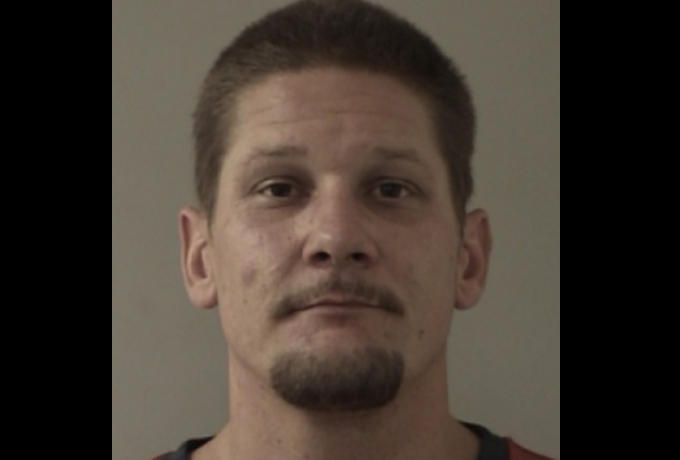
King Fire suspect indicted

Wayne Allen Huntsman

Wayne Allen Huntsman

The man accused of starting the devastating King Fire near Pollock Pines in September has been indicted on one felony charge.

Wayne Allen Huntsman was arraigned Dec. 15 in El Dorado County Superior Court in Placerville. Huntsman’s attorney filed a motion to recuse the judge. A trial setting conference is scheduled for Jan. 23 with Judge Ken Melikian.

The grand jury handed down the indictment Dec. 3, accusing Huntsman of arson of forestland with five special allegations of arson with aggravating factors. This includes causing great bodily injury because a firefighter was hurt, and an enhancement because of the 12 houses and 68 outbuildings that were destroyed at a loss of $6.5 million.

Huntsman’s bail remains set at $10 million.

The fire took nearly one month to contain. It burned 97,717 acres northeast of Pollock Pines, mostly in the Eldorado National Forest.

— Lake Tahoe News staff report


Collaborative effort to monitor groundwater

By Kathryn Reed

Despite a multi-year drought, the amount of groundwater in the basin is still more than what is extracted every year — at least for now.

But overdrafting – the name for when more groundwater is used compared to what is replenished – is a problem in the Central Valley. When overdrafting occurs the groundwater level as measured by a monitoring well would get lower and farther from the ground surface.

California, until this year, did not regulate groundwater. Now a regional approach is being taken to better manage use, understand how much is being used as well as know the quality of that water. And if the regions don’t create a plan, the state will come in and do so.

“California was the Wild West of groundwater rules, where most other Western states manage groundwater on a state or regional basis,” explained Richard Solbrig, general manager of South Tahoe Public Utility District.

The entity with the longest straw was able to tap the groundwater, is how Solbrig described groundwater rules until this year.
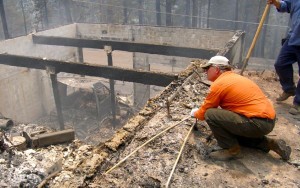
District crews crimping water supply lines in burn area. Photo/STPUD

South Tahoe PUD crews crip water supply lines in the Angora burn area. Photo/STPUD

The district was ahead of the state’s mandate and for the last year had been convening a stakeholders advisory group to come up with a plan. South Tahoe PUD’s board on Dec. 4 approved the Groundwater Basin Management Strategy Plan.

The district at the start of this century created a Groundwater Management Plan in the wake of the gasoline additive MTBE contaminating its wells. In many ways, the new plan is an extension, revision and update of the 14-year-old document.

Participants in the regional plan included Lukins Brothers Water Company, Tahoe Keys Water Company, Lahontan Regional Water Quality Control Board, South Lake Tahoe, El Dorado County, Tahoe Regional Planning Agency, Barton Health, Lake Tahoe Unified School District, a local gas station owner, and Harold Singer (former head of Lahontan) as the public member.

“(The goal was to) formulate a plan and a path forward in appropriately managing groundwater, including land use elements, monitoring, legacy contaminants such as PCE and MTBE, and pursuit of grant funding from Proposition 1 just passed, among other items,” Solbrig told Lake Tahoe News.

As Lake Tahoe's level drop, so goes the wells used by water companies. Photo/LTN file

As Lake Tahoe’s level drop, so goes the wells used by water companies. Photo/LTN file

The state is requiring a groundwater sustainability agency be created within two years. Having a plan is the first step to forming the agency.

The state is ranking regions on a low, medium and high priority for dealing with groundwater issues. The South Shore is rated medium because of ongoing contamination issues related to gas stations and dry cleaners.

The local group is hoping to receive Proposition 1 – the state water bond passed in November – money to deal with some of the issues as well as to help form the agency.

STPUD, Lukins and Tahoe Keys all use well water. The U.S. Forest Service has a well to service the Valhalla-Tallac area. Lakeside Water Company, near the state line, uses water directly from the lake. It has one well for emergency purposes.

Most water company wells are 300 to 500 feet deep. With the drought, the wells closer to the lake are seeing a change of water depth of about 5 feet and the wells farther way, say in Christmas Valley, have about a 10-foot difference. That, according to Solbrig, does not affect production.

“We still have 500 to 600 private wells in the basin,” Solbrig said. “They might be 50-years-old and 50- to 75-feet deep. A change of 5 to 10 feet could make the difference of producing no water.”

The plan is considering private and public wells.

There is a direct correlation in well level fluctuation with the level of Lake Tahoe.
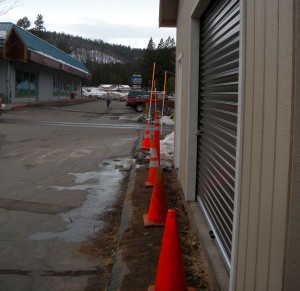
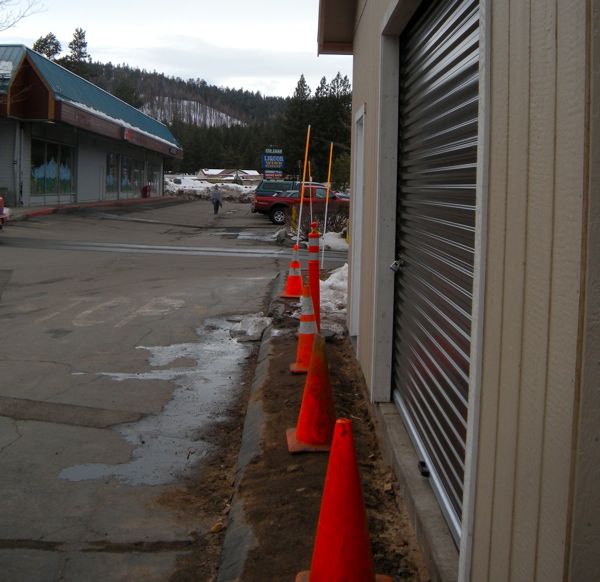
This structure will house remediation equipment to cleanup soil and groundwater contamination at the other end of the parking lot. Photo/Kathryn Reed.

This structure houses remediation equipment to cleanup soil and groundwater contamination in South Lake Tahoe. Photo/LTN file

STPUD will be the lead on the groundwater plan for the South Shore, in large part because it is the largest groundwater user in the basin. The group will meet once a year or more often if needed.

Various components are included in the plan, like paying attention to where any new wells would be drilled. The goal is to not influence the water table so it would have a negative environment impact by altering stream environmental zones or vegetation.

“One thing we will do is collect production data, and file regional based reports and estimates of the recharge,” Solbrig said.

Precipitation will be monitored and it will be compared to usage.

That type of data has long been required of surface water users. It’s a first for those tapping the groundwater.

It is better if moisture comes in the form of snow – even locally. Rain just means it all rushes to the lake faster. Snowpack means it gradually seeps back into the water table. Plus, then the water is distributed more uniformly underground and there won’t be dry pockets in outlying areas.

South Tahoe PUD supplies Heavenly Mountain Resort with water for snowmaking. Solbrig said about 85 percent of what is used returns to groundwater. The other 15 percent is lost in the process and to evaporation.

This compares to irrigation that is mostly consumed by the vegetation the water is being applied to.

“Why we do the turf buyback is because a majority of water property owners put on is gone. It goes into the grass or evaporates off into the environment,” Solbrig said.



Internet has made shoppers smarter

By Shelly Banjo and Sara Germano, Wall Street Journal

OCONOMOWOC, Wis.— Elisabeth Hoffman and fiancé Josh Loeser paused by a display of artfully decorated cakes and pastries while shopping recently at a Pick ‘n Save grocery store here. But after a split second of interest, their expressions faded.

“They’re not on the list,” said Hoffman, a 35-year-old interior designer and remodeler, as they pushed on to pick up chicken breast and diced tomatoes for a chicken chili recipe.

She and Loeser, a 30-year-old heating and ventilation repairman, have adopted a series of habits to make sure they buy only what they came for. They shop together, for instance, and when possible they avoid grocery carts, which come with the temptation to fill them up.

Retailers wondering what’s gone wrong with their business could learn a lot from the couple—and from other Milwaukee-area families The Wall Street Journal spent time with this fall. Observations of their carefully executed shopping plans identified what may be an endangered species in the retail landscape: the impulse buy.

A new intentionality has taken hold of shopping. Many Americans have the money and the will to spend. But they are time-pressed and deal savvy, visiting stores only when they run out of items like cereal or toilet paper and after doing extensive research on purchases online and with friends. They buy what they came for—and then leave.

Those habits threaten more than just gum sales at checkout. Impulse is why stores offer deep discounts on loss leaders, why they put the milk in the back corner and why marketers spend heavily to pile up products in displays at the ends of the aisles. If shoppers just target the deals and don’t let their eyes wander, long cherished models for boosting sales fall apart.

Read the whole story