FedEx, UPS confront record holiday season

By Heather Somerville, San Jose Mercury News

The next week will be a 24/7, backbreaking, sleep-deprived haul for couriers such as FedEx, the United Parcel Service and the U.S. Postal Service, the last connections to deliver many much-anticipated Christmas gifts. And there is no room for mistakes.

Last year’s fiasco — when retailers over-promised on deliveries and bad weather snarled courier services, causing millions of gifts to arrive long after Santa’s visit — is still a painful memory, and everyone is working hard to avoid repeating the same mistakes.

With e-commerce sales up 8 to 11 percent this holiday season, delivery services face record-high volumes of packages that must get from warehouses to beneath Christmas trees before next Thursday. And with more retailers promising Christmas delivery to last-minute shoppers — and some ill-prepared to make good on those promises — holiday shipping has become a massive and challenging undertaking. For everything to go smoothly, analysts say, retailers must accurately forecast how much inventory they will sell and when, and courier services must run their planes and trucks like clockwork.

Read the whole story


Douglas County water rate drama heating up

Douglas County commissioners on Dec. 18 discuss water issues. Photo/LTN

Douglas County commissioners on Dec. 18 discuss water issues. Photo/LTN

By Kathryn Reed

STATELINE – Mark Twain was on to something when he said, “Whiskey is for drinking, water is for fighting over.”

And when it comes to Douglas County, the fighting has been going on for years.

“I’m sure that I speak not only for myself when I say that if we are expected to pay for the most expensive little water system on the lake, then we expect something in return. We want to have a say in how our money is spent,” Jim Wire told the county commissioners at the Dec. 18 meeting. “What we expect is more accountability and more control. I propose that you establish a water advisory board with more power.”

Ratepayers are furious about having to continually pay exorbitant prices for water, not get adequate service and being left with an uneasy feeling about where all of their money has gone. The county has been operating the water systems for 25 years, but takes no responsibility for why things are the way they are and ratepayers feel they are being blamed for problems they did not create.

Resident Dana Tibbetts pointed out that Skyland is paying $100 less a month for water.

“Why?” she asked. “They are using the same water, the same pumps and getting the same service.”

No one answered her question.

No matter how many customers of the Cave Rock/Uppaway Water System spoke, the commissioners were resolved to vote for the staff’s recommendation on that and the Skyland Water System rate structures.

The vote was 4-1 on the Cave Rock plan, with Commissioner Barry Penzel dissenting. He wanted an advisory board. It was a 5-0 vote for Skyland.

Cave Rock/Uppaway customers will see rates drop from $202.46 per month to $172.68 in fiscal year 2015 and rise to $195.37 the following year.

In Skyland the monthly water bill for fiscal years 2015 and 2016 will drop by nearly 26 percent to $84.56.

While a couple people spoke against the Skyland proposal, most of the testimony was against the Cave Rock/Uppaway plan.

Most ratepayers anywhere would welcome a drop in rates. But when the reality is rates are projected to be $300/month for Cave Rock in the coming years, the ratepayers want a solution so their water bill is not equivalent to their property tax.

They were practically begging the commissioners to come up with a more permanent solution and not just a Band-Aid, as well as to let them have a seat at the table for a resolution. They got neither.

John McCall, after the meeting, told Lake Tahoe News that residents hired an engineer years ago to come up with a plan. It reportedly would have cost one-third of what the county implemented and would have been half paid for at this point.

Residents want commissioners to listen to them – not just to county staff because they believe staff isn’t relaying the whole story.

Water rates have been on commission agendas for years. The problem at the lake is that there are multiple agencies with their own budgets, so the cost of maintenance and other items is greater than it would be if expenses were shared with a larger pool of customers.

In the spring commissioners agreed to consolidate the lake water districts. But that unraveled when others protested in having to pay for debt that wasn’t theirs.

Commissioners agree a long-term solution needs to be created. Commissioner Nancy McDermid believes meters would be one solution – at least to get people to pay for what they use.

But there will always be fixed costs no matter how much one uses so the base rate could still be high.


STHS student died from blunt force trauma

By Kathryn Reed

An autopsy of 14-year-old Dejon Smith ruled the cause of death blunt force trauma.

The South Tahoe High School freshman died immediately, according to the Dec. 18 forensic autopsy conducted in Sacramento.

Dejon Smith

Dejon Smith

The results came hours before family and friends gathered Thursday night near the site where he died. A tree struck Smith during last week’s powerful windstorm.

While there is no question about how Smith died, there are plenty of unknowns about what led up to the tragedy and who might have more information.

“As in any kind of death investigation, we want to piece together the last hours of what happened,” Police Chief Brian Uhler told Lake Tahoe News.

Even if someone had seen the tree fall on Smith, no crime would have been committed by not reporting what happened. Civil charges could be a different situation.

Police said in the last week a friend of Smith’s admitted the two were “checking out houses” prior to the tragedy. No burglaries were reported.

“We are not sure what exactly was about to happen. There is no indication of other crimes in the area,” Uhler said.

Smith went out Dec. 11, knowing the next day had been deemed a snow day so there would be no school. But he didn’t come back and his parents reported him missing.

As is protocol, his information was entered into the Missing Unidentified Persons System because nearly one-quarter of the juveniles who run away from South Lake Tahoe are located in other jurisdictions. Police searched his neighborhood to no avail.

On Dec. 12 the boy’s parents received a call telling them about someone who may have information. Police say this is the youth who was with Smith looking at the houses for what are still unknown reasons.

“The juvenile described hearing a very loud crash, but denied seeing a tree fall. He was frightened and ran away. He believed Dejon likely did the same, but he had not seen him since,” a police press release states.

Searchers eventually found the body Dec. 13 under a large pine tree, almost completely concealed by branches. The pine tree was approximately 4 feet in diameter at its base. Firefighters had to use chain saws to section the tree into pieces to remove the body.

The investigation is not over. Officers have a list of people they intend to question. Tips may be called into the SLTPD at 530.542.6100 or to Secret Witness at 530.541.6800.


Fire plus rain plus drought equal mud

By Amy Quinton, NPR

Less than an hour west of South Lake Tahoe, trucks carrying burned timber from the Eldorado National Forest roar down the canyon as chain saws buzz in the distance.

But U.S. Forest Service ecologist Becky Estes says besides humans, not much else in this forest seems alive.

“We’re standing in an area that … is going to be probably 100 percent mortality of the trees,” Estes says.

Rainstorms continue to pound drought-stricken California, where dangerous mudslides have caused serious damage in areas burned by wildfires. This year, the state had one of its worst wildfire seasons on record.

Starting in September, the King Fire burned nearly 100,000 acres in the Eldorado. In this steep river canyon, 50,000 acres burned in one day. Now the pine trees are black and lifeless, and not one pine needle remains on the branches.

Read the whole story


Tax fraud lands Placerville man in prison

A Placerville man is going to prison for tax fraud.

Thomas W. Stringfellow, 55, was sentenced Dec. 18 to 18 months in prison and ordered to pay $687,182 in restitution for willfully making false tax returns.

According to court documents, from 2006-10, Stringfellow underreported his business income on tax returns by more than $1.1 million, and underreported his personal income on tax returns by more than $1 million.

Stringfellow owned New Horizon Painting, and rather than depositing all of the business checks into the appropriate accounts, he cashed some of the checks and did not report those amounts as income.

In total, Stringfellow’s underreporting of his business income and his personal income led to a tax loss of more than $687,000.

— Lake Tahoe News staff report


Ski towns worry pot is bad for tourism

By Kristen Wyatt, AP

BRECKENRIDGE, Colo. — Business is booming in Colorado’s mountain resorts, and the addition of recreational marijuana stores this year has attracted customers curious about legalized pot. But there’s mounting anxiety that ski towns have embraced stoner culture a little too much, potentially damaging the state’s tourism brand.

That worry flared up in two resort towns last week. In Breckenridge, residents voted overwhelmingly to force downtown’s lone dispensary off Main Street to a less-visible location. And just up the road in Granby, town officials used a property annex to prevent a dispensary from opening.

The fear is that some families — a mainstay of the ski tourism industry — will stop vacationing here.

“It’s not a morality issue, or that we think marijuana is bad,” said Breckenridge Councilman Gary Gallagher, who supported legal marijuana but also voted to force the Breckenridge Cannabis Club out of downtown. “Marijuana, it is not in this country’s DNA yet. It’s a little bit too early.”

So far, there’s no indication that legal pot has damaged tourism, Colorado’s No. 2 industry. The state notched a record $17.3 billion in tourism spending the year after legalization, with a record 64.6 million visitors, and state tourism officials say 2014 is poised to top last year’s record.

But it’s an open question whether pot has anything to do with it. Officials cite the improving economy and the weather, with healthy snow totals historically being the most significant driver for mountain visits.

The state and its marijuana industry are barred by law from advertising weed out of state, and the head of the Colorado Tourism Office says the state isn’t tracking the role of marijuana in tourist behavior.

“It’s all anecdotal,” Al White said. “I have heard from some angry parents who said they’ll never come back to Colorado because of marijuana. And I’ve also heard from people who say they came to Colorado just to see the marijuana.

“At the end of the day, it may be having a modest effect, but it’s not huge either way.”

The recent friction isn’t the first time officials have moved to lower marijuana’s profile.

The nation’s largest ski operator, Vail Resorts, made headlines over the last year tearing down makeshift shelters built illicitly in hard-to-reach areas and used by stoners to “get safe,” mountain slang for toking up out of the cold and away from ski patrollers. Resorts across the state are dotted with the so-called smoke shacks, and some of them are decades old.

“We will continue to communicate that consumption of marijuana is illegal in public and on federal land,” Vail Resorts’ Russ Pecoraro said in a statement about destroying the shacks in its four areas, Beaver Creek, Breckenridge, Keystone and Vail.

Still, at rates greater than their urban neighbors, mountain communities backed marijuana legalization in 2012, including Breckenridge, an early and enthusiastic support base, and there’s no doubt that recreational pot has had an effect on ski towns.

A state-produced July report on the new marijuana industry concluded that 90 percent of recreational sales in mountain resort communities go to out-of-state visitors.

The influx of shoppers — and camera crews that have become frequent sights as they work on pot-themed news stories and documentaries — has prompted a lively debate among residents about how pot is changing their resorts.

“Whether you’re pro-marijuana or against marijuana, you have to be concerned about how tourists react to seeing it,” said Bob Gordman, a Breckenridge retiree who voted to move the dispensary.

Others say the marijuana novelty will die down naturally and that resort towns shouldn’t worry about dispensaries or the souvenir shops that put “Rocky Mountain High” puns on T-shirts.

“In five or 10 years, it’ll be no big issue,” said Bill Kiser, a Breckenridge retiree who voted to keep the dispensary on Main Street.

“Why don’t families get turned off when they go on vacation and see a bar and people drinking alcohol? Because they’re used to it,” Kiser said. “People will eventually get used to this, too.”



Unions preparing for assault in Nev. Legislature

By Kyle Roerink, Las Vegas Sun

Public employee unions are gearing up for a battle against Republicans in the 2015 legislative session.

Conservative lawmakers and activists are rallying to upend some of the state’s collective bargaining laws, the rules that guarantee unions the right to negotiate pay and benefits for their membership.

For union workers employed by schools, cities or counties, changes to the laws could mean a shift in how labor leaders negotiate pay raises, benefits and working conditions with local governments. The state’s unionized employees do not have the right to collective bargaining in Nevada.

Three Republican lawmakers have submitted bills aiming to change the laws, and the right-leaning Nevada Policy Research Institute has issued a Top-10 list of union reforms that has collective bargaining as a high priority. With the GOP in control of the Legislature and NPRI executive director Geoffrey Lawrence an Assembly policy adviser, unions are not taking any threats lightly.

The Republican push is the latest chapter in a decades-long debate that’s carved a divide in American politics. Organized labor says the proposed legislation and NPRI agenda is an attempt to diminish the power of unionized public employees who work in Nevada’s schools, cities and counties. Danny Thompson, executive secretary treasurer for the AFL-CIO, said the focus on collective bargaining is a “right-wing, tea party agenda” based on bill models that are shipped across the country from think tanks like NPRI and the American Legislative Exchange Council.

Read the whole story


Stateline Post Office being repackaged

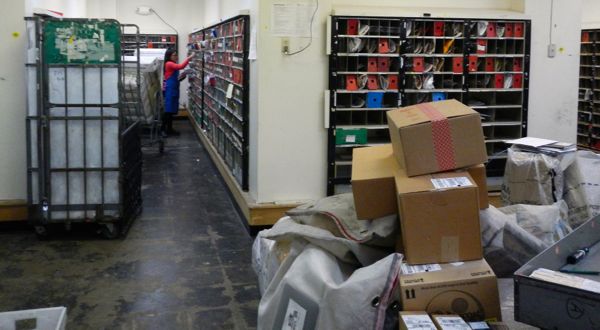
The back of the Stateline Post Office is in the process of being renovated. Photos/Kathryn Reed

The back of the Stateline Post Office is in the process of being renovated. Photos/Kathryn Reed

By Kathryn Reed

STATELINE – Boxes are scattered about, the floor is torn up, one person is putting mail into individual boxes, construction crews are out front.

A tree blocks the direct route to the loading dock, the roofline is crumbling from being hit by trucks, concrete is in need of repair.

This is the Stateline Post Office.

It is finely receiving some attention after years of neglect.

“It’s 36-years-old and it seems like it is older than that,” Suzanne Phillips said as she walked through the facility.

Phillips’ normal job is postmaster in Boulder City in Southern Nevada. Right now she is interim manager of postal operations, which encompasses 90 offices in California and Nevada. She is spending several weeks just at the Stateline office so it will function better – personnel-wise and aesthetically.

“Once we get someone in here and get consistency, people will notice a change,” Phillips told Lake Tahoe News.

This office has not had a regular postmaster for a number of years. That postmaster is also responsible for the Zephyr Cove and Glenbrook post offices.

Construction crews are a common sight at the post office.

Construction crews are a common sight at the post office.

While there was a time when the Stateline office was slated to close, that is no longer the case. Higher ups figured out it would be hard to displace the 2,000 boxholders. Plus, this office makes money.

The next closest office is 1½ miles away in Zephyr Cove. It is a leased facility, whereas the Postal Service owns the Stateline building. To accommodate the Stateline boxholders it would require significant renovating.

(No one on the Nevada side of the South Shore has home delivery.)

Most of the improvements are cosmetic in nature – paint, cleaning, new floors. The floor in the back – where the public is not allowed – will be replaced after the holiday rush.

The lobby has been revamped. All the writing tables were removed and new cabinets installed.

Juniper out front is gone and more landscaping improvements will come in the spring. The plan is to take out the pine out front so trucks have a direct shot to the loading dock. Some concrete is also slated to be removed.

Phillips is hoping sprucing things up will make the building better appealing from the curb and bring a little pride to the Lower Kingsbury Grade area.

“You drive by and you don’t know it’s a post office,” she said.

Part of this has to do with signage, the loading dock being in the front and the parking lot being in the rear.

A solution for the parking lot is still being sought.

A solution for the parking lot is still being sought.

The big unknown is what to do about the parking lot, which is in the back. It slopes down toward a ditch. There are no erosion control measures in place.

A three-year Tahoe Regional Planning Agency permit expired in 2010. Now the price to replace the drive and put in the best management practices is about $900,000.

But it’s not just the post office’s runoff that is a problem. The building is attached to offices on the east, plus there are commercial entities all around it. Those properties also have runoff that is not being filtered.

Phillips said postal workers are investigating a more comprehensive approach to come into compliance with TRPA regs instead of going about it solo.


ADA lawsuit attorney still targeting businesses

By Tim Day, News10

STOCKTON — On the very day Stockton business owners were invited to a workshop on how to avoid ADA-related lawsuits, the attorney responsible for filing so many of those lawsuits was across town shopping, and reluctantly, interviewed.

Scott Johnson doesn’t deny filing thousands of lawsuits against businesses with disability access issues. Even if those businesses make changes to meet the Americans with Disabilities Act, Johnson also alleges personal damages into the many thousands of dollars.

Johnson was insistent on getting into his van and avoiding News10 questions when spotted Wednesday, but he offered a few comments.

Johnson has targeted South Lake Tahoe and North Shore businesses in the past.

Read the whole story


NASA: 11 tril. gallons of water would end drought

By Mark Berman, Washington Post

The historic, horrendous drought in California continues to be historic and horrendous. Even as rain continues to fall over parts of California, the drought is still ravaging much of the state.

To give you an idea of just how brutal this three-year drought has been, NASA decided to use its satellites (it is NASA, after all) to take measurements and figure out the amount of water needed to recover. The answer is 11 trillion gallons, which is a lot of water.

NASA came up with this number by using its Gravity Recovery and Climate Experiment satellites to eyeball the water storage in the Sacramento and San Joaquin river basins. This data showed that the water storage in these basins was 11 trillion gallons below normal seasonal levels at the peak of the drought earlier this year, according to the NASA announcement.

The volume of water in these basins has dropped by 4 trillion gallons each year since 2011, with most of this loss due to the lack of groundwater under the state’s Central Valley.

Read the whole story