Calif. school builders seek 2016 bond

By Jim Miller, Sacramento Bee

School-construction and home-building groups Monday launched an effort to qualify a $9 billion school bond for the November 2016 ballot, only days after Gov. Jerry Brown released a budget plan that minimized the state’s role in paying for building new classrooms and modernizing existing ones.

The last state school bond was in 2006, and the pot of new construction and modernization money is virtually empty, with a $2 billion backlog in applications for assistance. Besides putting students in aging or overcrowded classrooms, officials warn that the situation could trigger a 1998 state law that would double developer fees on new homes.

“Every child deserves access to safe, secure, modern learning environments,” Joe Dixon, the chairman of the Coalition for Adequate School Housing and an assistant superintendent at the Santa Ana Unified School District, said in a statement Monday from the pro-bond Californians for Quality Schools. “This is an investment in the development of our state’s future workforce, and will help ensure our children are prepared to compete in a 21st Century global economy.”

Read the whole story


TAU battle looming between Placer County, SLT

By Mark Anderson, Sacramento Business Journal

There may be a duel this winter over hotel rooms around Lake Tahoe.

Placer County is interested in paying about $3.7 million to buy hotels from private owners and demolish them in South Lake Tahoe, which is in El Dorado County.

South Lake Tahoe doesn’t wantto lose the hotels, along with the important associated sales and room taxes.

Placer County wants the hotels so it can open development of new lodging along Placer County’s north shore of Lake Tahoe, which hasn’t had a new hotel built since 1959.

Read the whole story


Parvo outbreak forces SLT dog park closure

By Kathryn Reed

A rash of parvo cases in South Lake Tahoe has forced the city to shutdown the dog park for the next 10 days.

The Lake Tahoe Humane Society has reported 11 cases of the potentially fatal virus in the last 10 days.

“The fatality rate is huge if it goes untreated – almost 100 percent,” Niki Congero, executive director of the South Shore humane society, told Lake Tahoe News. “The earlier someone catches it, the better chance the dog has to survive.”

The initial signs are lethargy, diarrhea – including blood in it, loss of appetite, then vomiting.

“It is like the worst kind of stomach flu,” Congero said.

Because the incubation period is seven to 10 days, that is why the dog park will be off limits that long. The city will thoroughly clean everything to ensure the transfer of the virus is not possible. One of the dogs with parvo had been at the dog park on Al Tahoe Boulevard.

It is easy for dogs to transfer the virus to one another. Usually it is through feces, just by sniffing it and getting a little on their nose, or stepping in it.

“You could go to one house, get a dog hair, go to another house and the dog hair comes off and that dog could get it,” Congero said in describing the ease with which parvovirus spreads.

“If everyone picked up their poop, this problem would not exist.”

It can spread to the coyote population, too. It is not, however, transmittable to cats or people.

Treatment includes fluids and antibiotics.

But Congero stresses it’s a lot cheaper to spend money to vaccinate dogs. Puppies should get a series of shots starting at 8 weeks, then again at 1 year, which is good for three years. Adult dogs need to keep up with the vaccinations just like other preventative care.

At boarding facilities in the area they all make sure a dog’s vaccinations are up-to-date before they are allowed in. Parvo, distemper and rabies are the big three for doggie day care centers.

“Anyone that comes in with any sickness, we turn them back away,” Paige Rice, owner of Tahoe Best Friends, told Lake Tahoe News.

People suspecting their dog has parvo should immediately call their vet. Do not go in with the dog because the vet will want to take precautions so other animals are not put in harm’s way.


LTCC board to vote on faculty raises

By Kathryn Reed

Faculty and some administrators at Lake Tahoe Community College are expected to see fatter paychecks.

The college board tonight is being asked to approve raises for full-time and adjunct faculty, as well as give one-time bonuses to three interim deans.

“Many employees on this campus work harder than they ever have because we have cut costs, reduced staffs, and combined job duties,” LTCC President Kindred Murillo told Lake Tahoe News. “They have done this repeatedly over the budget cuts, loss of (full-time equivalent students), and other issues, and we believe a 2 percent increase is reasonable and fair.”

The last raise for full-time instructors was in 2008. This salary increase is retroactive to July 1, 2014. The contract is for three years.

Scott Lukas, chair of the Faculty Academic Senate, told Lake Tahoe News, “We were interested in a raise that would get us to our comparable pay levels with the other schools in our small school list. The 2 percent that we agreed to was not at the level that we wanted, but I think that the district would not go anywhere above this 2 percent. So, in a sense, it was 2 percent or nothing.”

He said the union is not done with seeking salaries that are “fair compared to other schools”.

The salary boosts will cost LTCC about $100,000 a year. With adjunct instructor numbers not constant, the savings will fluctuate.

“LTCC, as typical of many small districts, has some of the lowest salaries in the state, so we have to be very thoughtful about recruitment of employees overall. While these are very good salaries for our local area, they are not attractive statewide,” Murillo said.

What remains to be seen is if this raise will do anything to improve morale at the South Lake Tahoe two-year school.

“I have heard that morale is low, but I would be wrong to comment on others and their perceptions. Probably, if I had to guess, this could relate to pay, increased workload, loss in benefits and the like,” Lukas said. “The bottom line is that the faculty at LTCC are really great faculty and they deserve a fair salary.”

One thing the faculty brought to the table is an early retirement incentive. For this to occur at least four people have to retire and there has to be a cost savings to the college.

Even though raises have not taken place for six years, negotiations have been ongoing, with changes to the faculty contract along the way.

“We moved our benefitted employees from 100 percent paid premier plan to a 100 percent standard plan that saved the district approximately $200,000 for FY 2014-15, and will save the district in the future as health benefit costs continue to increase,” Murillo said.

Because most employees are not full time they do not receive the health and welfare benefits.

In years past, the classified staff usually received what the faculty negotiated for. But a few years ago those workers formed a union. Negotiations with the Classified Employees Union have yet to begin.

In the next few months LTCC officials will be conducting meet and confer sessions with confidential classified, directors, and administrators. Those first two groups don’t have contracts, while administrator contracts are tailored to the individual.

Also on the Jan. 13 board agenda is an item to give Executive Dean of CTE & Instruction Virginia Boyar, interim Executive Dean of Student & Academic Support Services Suzanne Gochis, and interim Executive Dean of Instruction Michelle Risdon each an annual pay increase of $10,000 effective Jan. 1.

These are one-time salary spikes to compensate the three for the added workload because the positions of vice president of Academic Affairs and Student Services and executive director of Institutional Research, Planning, and Advancement remain vacant.

The college is saving $155,000, before bonuses for the deans, by not filling those jobs. But the plan is to eventually fill them.

“I plan on recruiting again (for the vice president job) once we finalize working on some issues around enrollment management, and the timing to recruit in the state system is right,” Murillo explained. “There is going to be a lot of movement in administrators this year because of retirements and president openings. This movement will trickle down and it will play into our strategy for recruitment.”



Job growth fails to help paychecks of workers

By Dionne Searcey, New York Times

The nation’s economy is entering 2015 in its best shape since the recession, but the improving job market has so far failed to help most Americans earn significantly more at work.

On Friday, the Labor Department reported that employers added another 252,000 workers to their payrolls in December, capping a year in which total employment rose by 2.95 million, the largest advance since 1999.

The unemployment rate also improved, edging down last month to 5.6 percent from 5.8 percent in November. The rate plunged just over a full percentage point between 2013 and 2014, the largest decline since 1984.

But a drop in average hourly earnings last month, after a healthy gain in November, sidetracked hopes that a tighter labor market was beginning to lead to broader wage gains.

Read the whole story


Courts benefit from Brown’s budget

By Howard Mintz, San Jose Mercury News

Gov. Jerry Brown’s latest spending plan appears to further treat the California judiciary’s wounded budgets, adding about $180 million to court systems trying to recover from years of financial cuts.

The governor’s 2015-16 budget bumps the state court system’s budget from last year’s $3.29 billion to $3.47 billion, with most of that increase headed to the 58 trial courts around California hit hardest by past cutbacks.

Under the governor’s budget, the judiciary’s budget would inch closer to the $3.7 billion allocated in 2007-08. In fact, with the use of trial court reserve money required under previous budgets, the governor’s staff pegs spending on the judicial branch at about $3.7 billion in the 2015-16 fiscal year.

Read the whole storyC


Nev. has most divorced people in the country

By Kristen DeSilva, Las Vegas Review-Journal

Sure, Las Vegas is the marriage capital of the world, but Nevada is also number one when it comes to divorce.

In fact, 13.9 percent of Nevadans over 15 have been divorced, or about 30,000 people. The average in the United States is 10.8 percent.

With Nevada at No. 1, we fall ahead of Maine, with 13.5 percent of their population divorced. Neighbors California and Utah are at 9.6 and 9.2 percent, respectively.

Read the whole story


Annual Nev. casino revenues keep declining

By Richard N. Velotta, Las Vegas Review-Journal

The state’s largest casinos lost $743.7 million in the 2014 fiscal year, nearly cutting their losses in half from the previous year.

The state Gaming Control Board’s 2014 Nevada Gaming Abstract, published Friday, said the 270 Nevada casinos that generated $1 million or more in gaming revenue reported total revenue of $23.9 billion. In the 2013 fiscal year, 263 casinos that generated $1 million or more lost $1.3 billion on revenue of $23.1 billion.

“Total revenue” is the money spent by patrons on gaming, rooms, food, beverage and other attractions. “Net income” or “loss” is the money retained by casinos after expenses have been paid but prior to deducting federal income taxes and prior to accounting for extraordinary expenses.

It was the sixth straight year that casinos collectively showed a loss, but it was the smallest loss since 2009 when the recession began crushing casino finances.

Read the whole story


Fire cameras could prevent devastation in basin

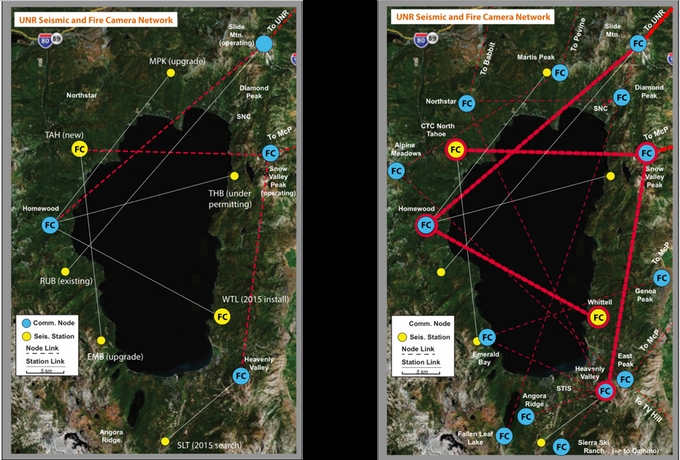
Left: Pilot program cameras; right: build out. Images/UNR

Left: Pilot program cameras; right: camera network when the system is built out. Images/UNR

By Kathryn Reed

INCLINE VILLAGE – If the fire alert system that is in its infancy in the Lake Tahoe Basin had been in place in 2007, the Angora Fire might not have wiped out 254 homes on the South Shore.

That is the prediction of Graham Kent, a South Tahoe High School graduate who is now the state seismologist for Nevada. He gave a talk Jan. 8 at the Tahoe Center for Environmental Sciences about AlertTahoe, the fire camera system that is being developed in Tahoe.

That same day the newest camera – at Homewood Mountain Resort – came online. Other cameras are at Snow Valley Peak, Angel’s Roost at Heavenly Mountain Resort, and on California Tahoe Conservancy property in North Lake Tahoe. A permit is secured to place a camera above Whittell High School, but there is no money to do so.

“Angora would be easy to control under a system like this,” Kent told the group.

The problem with Angora was dispatchers in Truckee believed it was a controlled burn and didn’t direct resources to the wildland fire in a timely manner. These cameras would have shown that smoke was no control burn. Plus, officials are working to put information on the website that identifies prescribed burns.

There was a time when people said a massive fire could not burn in the Sierra. The Rim and King fires prove that theory wrong. Had the winds changed, last September’s King Fire would have easily entered the basin at Tahoma.

Kent showed time lapsed images of the King Fire smoke that was captured on one of the cameras.

“You’re looking at stands of trees blowing up,” he said, as there would be a burst of smoke.

At one point flames are visible. (Video is in HD and 4K, with infrared capability.) The cameras can be moved to get a wider or zoomed in view.

On July 29 a camera picked up smoke on Mount Pluto at Northstar that neither CalFire nor the U.S. Forest Service was aware of. A storm came through to douse those flames. On Aug. 9 a tree was on fire north of Spooner. Officials knew about it because of a camera. The fire was kept to a half acre.

“That’s the point of the system. We find them, knock them down and make them small,” Kent said.

The Sept. 24 Cascade Fire allowed officials to see what a small fire looks like at night.

The U.S. Forest Service used to use fire lookouts to spot fires. These cameras are the modern day version of those lookouts – only much better. Fire agencies and the public may view them online.

The cameras are also used by UNR scientists to study earthquakes and floods. But as Kent pointed out, the cameras cannot change the size of those disasters. The cameras can help contain a fire.

An effort is under way to raise $2 million – in public and private dollars – in the next decade to be able to install more cameras, as well as to keep up with the maintenance and operation.

It cost $160 million to fight the Angora Fire, and at just more than 3,000 acres, that was a small fire. Angora was 1 to 3 percent of the size of the Rim and King fires.

With the snowpack diminishing in the Sierra and climate change taking hold, Kent said, “It is a very poor time to sit back and let fire happen.”

He said one fire could wipe out all of the $3 billion in environmental improvements that have been made in the basin since the 1990s.

The program continues to evolve. AlertTahoe is working with BLM to show two weeks worth of lightning strikes. If people think they see smoke from a fire, that location could be matched with where the lightning occurred. A Twitter feed, that will be activated this spring, will be geared toward spreading AlertTahoe info to the masses. The ability to show longitude and latitude identifiers for fires is in the works. And the website interface is being expanded.

—–

Notes:

• For more info or to help fund the project, go online.


Traffic stop ends with arrest of murder suspect

suspectsA routine traffic stop in Truckee led to the arrest of a man wanted on murder charges in Fresno and Florida.

California Highway Patrol officers stopped a vehicle going west on Interstate 80 about 10:30pm Jan. 10. Officers were suspicious and asked for Truckee officers to bring in K-9 Trax.

Officers said a search of the vehicle revealed a small amount of marijuana as well as more than 100 credit cards in an unidentified female’s name, multiple pre-paid gift cards, altered debit cards, pre-paid cash cards and numerous receipts of recent transactions for high-end apparel from different states across the country.

During the booking process, it was confirmed that the driver, 33-year-old McKinley Williams, had falsely identified himself during the traffic stop. Williams had two outstanding warrants for murders.

The passenger, 23-year-old Karion Bickham, had correctly identified herself to officers during the traffic stop. However, during the initial search, officers located a second Florida driver’s license with her picture and a fictitious name that matched the name on the numerous credit cards found in the vehicle.

Williams and Bickham were booked into the Truckee jail on several fraud related charges.

— Lake Tahoe News staff report