Charges filed in 2006 EDC murder case

Three people have been arrested in connection with the November 2006 murder of El Dorado County resident Tobias Kaiser.

Eric Mehlmauer of Placerville was arraigned Jan. 20 on first degree murder charges and Ronald Garcia of Sacramento was arraigned on accessory after the fact.” Brian Daly was also arrested as part of this investigation but has not been charged with any offense.

Mehlmauer is accused of shooting Kaiser, who was a Somerset resident at the time, to death.

This case is still under investigation and anyone with any information is asked to contact Paul Moschini or John Gaines at 530.621.6472.

— Lake Tahoe News staff report


Study: Water stress takes toll on Calif.’s large trees

By Taylor Goldenstein, Los Angeles Times

Drought, fire-suppression techniques and changes in land use have made California forests denser with smaller trees and more susceptible to fast-moving wildfires, a study to be released Tuesday has found.

Researchers at UC Berkeley, UC Davis and the U.S. Geological Survey compared tree surveys conducted between 1929 and 1936 with surveys conducted between 2001 and 2010. They found that large tree density fell across California, with declines of as much as 50% in the Sierra Nevada highlands, the south and central Coast Ranges and Northern California. At the same time, the density of smaller trees increased dramatically.

The firemen are faced with this notion of when a fire is reported and started, do they go out and … put the fire out, or do they let it burn?
– Mark Schwartz, professor of environmental science and policy at UC Davis
Drier conditions caused by drought reduce water available for trees to grow while making it easier for fires to start and spread. Scientists say the changes raise crucial questions about how California manages its forest land to prevent and control wildfires as temperatures increase.

“The current drought in California highlights our need to understand the role of water balance in these systems and how it will be affected by global temperature rise,” said the study’s lead author, Patrick McIntyre. “Forests and woodlands cover a third of California, so this has important implications for our state.”

Read the whole story


Brine on Tahoe roads the new norm for storms

Brine leaves streaks on the road Jan. 1 at 3pm at the end of North Upper Truckee Road toward Highway 50. Photo/John Adamski

Brine leaves streaks on the road Jan. 1 at the end of North Upper Truckee Road on the South Shore. Photo/John Adamski

By Kathryn Reed

While there hasn’t been much snow to clear from roads this winter, crews in the Lake Tahoe Basin have been busy putting brine on streets when the threat of weather has been in the forecast.

This salt-water solution that is designed to prevent icing on the roads leaves a white film behind. It’s been more noticeable this season than in the past because more entities are using it.

Nevada Department of Transportation was one of the first agencies to go in this direction. They have more issues with snow storage so the less snow that sticks to the road, the less that has to be cleared.

“In the Tahoe basin we’ve done a lot of changes to winter maintenance,” NDOT spokeswoman Meg Ragonese told Lake Tahoe News. “We reduced the use of sand for winter road traction quite a bit since the 1990s. In the Tahoe basin specifically, NDOT has reduced winter road maintenance-related sand use from 4,300 cubic yards per year in 1990 to approximately 850 cubic yards, and reduced salt usage by 70 percent.”

Brine is a preventative treatment. If cars pack the snow down before a plow gets to it, the snow is released easier and doesn’t form a thick layer of ice.

Brine allows agencies to use less sand and salt, two substances that are deemed harmful for the environment.
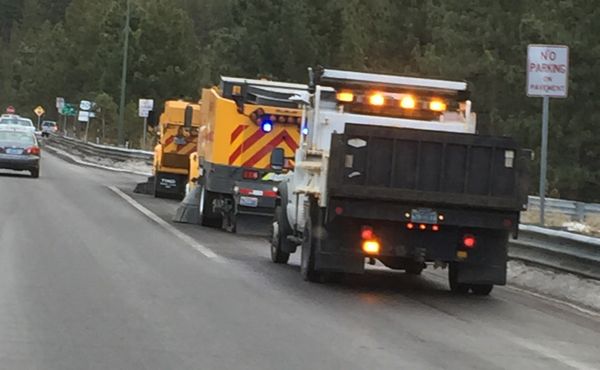
NDOT street sweepers remove salt and sand from roadways within four days of storm end in urban areas, dependent on weather. Photo/Kathryn Reed

NDOT street sweepers strive to remove salt and sand from roads within four days after a storm. Photo/Kathryn Reed

Through the years road crews have experimented with different products to keep the roads safe.

“When the snow begins, the brine is also mixed with a 75 percent sand and 25 percent salt combination to produce a wetter, heavier sand that will not as readily be thrown off roadway surfaces,” Ragonese said.

Agencies say improved equipment, mixture of products and weather forecasting allows for better application of all materials, and less need for the more harmful products.

“Brine would go on before a storm, sand during storm for traction, then salt or brine after to help melting process,” Steve Nelson with Caltrans told Lake Tahoe News. “Salt brine treated highways and bridges will resist frost for several days per application, reducing the time chain controls are in effect and the amount of traction sand used, significantly reducing chain control and sweeper employees’ exposure to moving traffic. Salt brine anti-icing techniques save time, are cost-effective and safer for workers and motorists, and they are more environmentally friendly than other methods.”

This report shows the increased use in brine for Caltrans’ Tahoe City and South Lake Tahoe maintenance yards. Brine is typically applied by tanker trucks at a rate of 50 gallons per lane mile.

When salt is applied, its rate is 200 to 500 pounds per lane mile, according to Caltrans. Caltrans went from averaging about 16,000 tons of sand in the basin each winter in the 1990s to 2,953 tons in 2012-13. Here is a chart of the amount of sand used from 1993-94 through 2012-13.

Tahoe Regional Planning Agency officials said they have no policy for what is applied to roads. Lahontan Regional Water Control Board takes a big interest on the California side. This is because they care about ends up in the lake.

Lauri Kemper with Lahontan said her agency supports the use of brine. Salt does not adversely affect lake clarity. But scientists don’t know what the affect on aquatic life is.

While road crews don’t want to hurt the lake or trees, the whole purpose of putting anything on the roadway is to help drivers.

“Public health and safety trumps everything,” Brendan Ferry, principal planner with El Dorado County, told Lake Tahoe News.

His people must balance safety with environmental concerns when it comes to deciding what goes on the roads.

Two years ago the county switched from using volcanic rock to decomposed granite. That switch has meant a 90 percent reduction – or 50,000 pounds – in fine particles reaching the lake, Ferry said.

South Lake Tahoe aims to have sweepers out two days after a storm. Photo/Kathryn Reed

South Lake Tahoe aims to have sweepers out two days after a storm. Photo/Kathryn Reed

With granite being a native material, if it does reach the lake, it isn’t as detrimental as the coarser, foreign volcanic material.

“We focus a lot on roadway maintenance strategies. It’s one of the bigger things that is linked to Lake Tahoe’s clarity loss – ultra fine particles,” Ferry said. “Roadway abrasives are a primary source of those types of materials.”

The abrasives are used to help with traction. The county uses brine – which is usually a 27 percent salt, 73 percent water solution – on primary roads like Pioneer Trail and North Upper Truckee.

“We use that so we don’t need to use as many abrasives,” Ferry explained.

For years salt was applied to roads in and around the basin. But as the trees along the highways became tinged with a rust color it was determined the salt was the cause. It was distributed in hoppers, with much of the product ending up on the edge of the road and not having any affect on making the driving surface safer.

Then volcanic rock started to be used. Nearly everyone has followed El Dorado County’s lead and is using decomposed granite.

South Lake Tahoe doesn’t use brine because it has not seen the need nor does it have the equipment to do so. The city’s two sander trucks come out to drop Washoe sand at key intersections, routes to Barton Hospital and schools during storms.

The city is shopping for a sander truck that will likely cost about $350,000. It is a multiuse vehicle.

“The new one will have computerized distribution system. It will calculate how much sand to put down and where,” Jim Marino, assistant public works director, told Lake Tahoe News. “From the seat of the vehicle you will know how much you’ve put down. Two days later we’ll determine how much is picked up from an intersection.”

That’s the other environmental component. As part of Lahontan’s regulations, jurisdictions must report how much abrasive material is put down and then how much is collected either from sweeping or by cleaning storm drains. This way everyone knows how much was left in the environment or tracked into garages via tires.


Police continue investigation into Villalobos death

By Dale Kasler, Sacramento Bee

The Nevada businessman facing charges in the CalPERS bribery case apparently shot himself to death with a 9mm semiautomatic handgun.

Reno police released new details  in the death of Alfred Villalobos, 71, who died about a month before he was due to go on trial in California on charges of bribing the former chief executive of the California Public Employees’ Retirement System.

Villalobos is believed to have died from a single, self-inflicted gunshot wound to the head, police said. His body was found about 3:30pm Tuesday at an indoor shooting range south of Reno-Tahoe International Airport. Medical personnel were unable to revive Villalobos at the scene.

Read the whole story


Water heads list of top 10 global risks

By Randall Hackley, Bloomberg

International conflict and water crises lead the list of top 10 global risks, according to a survey by the World Economic Forum ahead of this week’s meeting in Davos.

The 2015 report published last week highlighted the most significant threats expected over the next decade, according to almost 900 WEF members surveyed from July to September. Deemed the likeliest risk was interstate conflict followed by extreme weather events; the top global risk as ranked by impact was water crises, then infectious diseases.

With almost 2 billion of Earth’s 7 billion people lacking access to clean drinking water, about 14 percent of the population still defecating outdoors and a child dying every 20 seconds due to poor sanitation, water was also eighth on the likelihood list. Conflict was fourth on the impact ranking followed by failure to adapt to climate change. Joblessness or underemployment was fifth for likelihood, ninth on impact.

Read the whole story


Accused Placer County eco-terrorist out of prison

By Denny Walsh and Sam Stanton, Sacramento Bee

Eric McDavid was running late for his interview Wednesday, unavoidably delayed when a detective asked to chat with him after he stopped at the Placer County Sheriff’s Office to register as an arsonist.

After nine years in federal custody, McDavid, 37, had been out of prison just six days and was still adjusting to life on the outside.

Later that day, he sat in his parents’ home, a large rustic cabin tucked among tall pines overlooking a ridge outside Foresthill in the Placer foothills. Balding and gaunt, he sat on a leather couch, beside his mother and girlfriend, as the morning sun streamed in through large picture windows and logs burning in the fireplace warmed the room.

“It’s surreal,” McDavid said. “It took at least the first few days. I was waking up in the middle of the night just trying to figure out if it’s real still. I mean, how many times at night I’d wake up like, ‘This is real. I’m not dreaming.’”

Until earlier this month, McDavid was scheduled to remain in prison another eight years – until Feb. 10, 2023 – following his 2007 conviction for conspiring to blow up and burn the Nimbus Dam, a U.S. Forest Service genetics lab and cellphone towers.

But in a twist described as unprecedented by the judge overseeing the case, McDavid won his release on Jan. 8 after agreeing to plead guilty to a lesser charge: a single count of conspiracy to attack a government facility that, had he made the same deal nine years earlier, would have cost him, at most, five years in prison. That guilty plea, which came with a promise by McDavid not to appeal or sue the government, resulted in his immediate release. His previous conviction and sentence were wiped out by an order of the court.

Read the whole story


Truckee-North Lake Tahoe trying to address socio-economic inequities of residents

By Kathryn Reed

TRUCKEE – Gated communities with manicured golf courses and spas – home to people who may have multiple addresses. A couple miles away much lower end housing inhabited with people living check-to-check.

While this dichotomy of the haves and barely hanging ons seems to becoming the norm throughout the Lake Tahoe Basin, the stark contrasts were pointed out in a presentation last week at the Truckee Donner Chamber of Commerce meeting.

“Living in Tahoe is the tale of two cities,” Alison Schwedner, director of the Community Collaborative of Tahoe-Truckee told the group gathered at Truckee Tahoe Airport. “It’s important to balance the two. We need to create an environment where families can live and thrive.”

Her group of 45 agencies is trying to address the needs of community members in the North Lake Tahoe-Truckee areas.

“Data shows a lot of families are struggling,” Schwedner said as she went over stats from the just released Community Report Card.

Kings Beach opened an affordable housing complex in 2014. Photo/LTN

Kings Beach opened an affordable housing complex in 2014. Photo/LTN

She talked of how people line up at the Family Resource Center because it’s warm and they may not have heat at home or be able to afford it. Project MANA provides food to half the people who live in Kings Beach. The waiting list for the more than 400 affordable housing units in the region is more than two years. Tahoe Truckee Unified School District provides 1,000 free breakfasts each day; 37 percent of the students receive a free or reduced lunch.

Getting help is a problem for many because of the state line and three counties – Nevada, Placer and El Dorado. Donner Creek Mobile Home Park is in Placer and Nevada counties. That means neighbors could be seeking help from different agencies. And sometimes that help is not right in town, and without a personal vehicle the aid may be out of reach.

Two contributing factors to what is keeping people down are low wages and the high cost of living. With most jobs being tourist oriented, they are minimum wage or about $11 an hour at most.

In 2011, the ACCRA Cost of Living Index put Truckee at ninth most expensive place to live in the United States.

Schwedner said it costs more to live in Truckee than the California and national averages. This means housing, food and everything combined costs more in Truckee.

“A lot of people technically live in poverty, but they don’t qualify for federal aid,” Schwedner said.

This in turn means people are turning to nonprofits for assistance.

Housing can be an issue. Schwedner showed a picture of affordable housing in Kings Beach that could be described as squalor. Then she showed the facility that opened last year – new, clean and a place people are proud to call home.

Tahoe Forest Hospital did a recent Community Needs Assessment that found while most people are healthy, with heart disease-obesity-tobacco use all being on the low side; there is an abnormally high use of alcohol in the area.

“We tend to be binge drinkers. We drink more than the state and country,” Schwedner said.

A question on the survey asked if people had a drink in the last 30 days. The hospital found that 81.1 percent of the people said yes. This compares to the state average of 55.5 percent and national average of 54.5 percent.

Mental illness is also something nonprofits are seeing as an issue and something the collaborative wants to address.


Sandoval puts focus on education

By Kyle Roerink, Las Vegas Sun

In his third and most ambitious State of the State speech, Gov. Brian Sandoval unveiled a litany of education initiatives and tax reforms he wants the Legislature to tackle in the upcoming session.

He set the stage for a session that will harbor intense debates about Nevada’s outdated revenue structure and bottom-tier education system.

Speaking for nearly an hour, he devoted more than 30 minutes to education reform, highlighting a plan to invest $882 million in education funding in the next two years. He outlined the plan as the beginning of a “new Nevada” and the foundation for education reform.

He didn’t hesitate to say that Nevada’s high school graduation rate and preschool enrollment were among the worst in the country.

Read the whole story


What Caesars’ bankruptcy means for company, consumers, workers

By J.D. Morris, Las Vegas Sun

When the largest operating division of casino giant Caesars Entertainment filed for bankruptcy protection on Thursday, it was just the most recent piece of what has already been an intense and controversial path toward financial restructuring.

Expect more drama as the process moves forward.

For years, Caesars has struggled with a massive debt load, most of which is concentrated in the cash-strapped operating division called Caesars Entertainment Operating Company, or CEOC, which includes Harrah’s Lake Tahoe and Harveys. That division is now seeking to reduce its $18.4 billion debt load by nearly $10 billion.

The bankruptcy plan voluntarily put forward by Caesars is complex on its own, but the situation is further complicated by a dueling involuntary bankruptcy case filed by junior creditors.

“This is going to be a long and contentious, protracted process,” said Alex Bumazhny, a financial analyst for Fitch Ratings.

Read the whole story


Tahoe real estate picked up steam in 2014

By Mark Glover, Sacramento Bee

The Lake Tahoe real estate market continued its post-recession improvement last year, according to Nevada-based Chase International.

The 2014 median sales price of a Lake Tahoe home increased 7 percent year-over-year to $475,000; the average price was $807,088, up 4 percent from the previous year.

Unit sales, however, were down around the lake, with overall sales volume dipping 8 percent. Homes selling for more than $1 million were down 6 percent.

Read the whole story