Liquor licenses exceed limits in Calif.

By Brad Branan, Sacramento Bee

Communities across California have exceeded state limits for the number of businesses selling alcohol, raising questions about the approval process for liquor licenses.

A Sacramento Bee analysis of data from the California Department of Alcoholic Beverage Control found that 49 of 58 counties have exceeded limits for on-sale licenses, off-sale licenses or both. On-sale licenses cover bars and restaurants where alcohol is consumed on site; off-sale covers stores where alcohol is bought for consumption elsewhere.

In the capital region, El Dorado, Yolo and Placer counties have exceeded at least one of the limits, which allow one on-sale license for every 2,000 residents and one off-sale license for every 2,500 residents.

Read the whole story


States seek alternatives for highway, bridge funding

By David A. Lieb, Associated Press

JEFFERSON CITY, Mo. — Touted as one of the first interstate highways, a 200-mile span of Interstate 70 between suburban St. Louis and Kansas City stands as a prime example of the challenges facing the nation’s roads.

Built in the 1950s and ’60s with a 20-year-life expectancy, the four-lane highway is crumbling beneath its surface and clogged with traffic as it carries more than 30,000 vehicles a day on many of its rural stretches, requiring more frequent repaving. The cost to rebuild and widen it is estimated at $2 billion to $4 billion — as much as five times the projected yearly construction and maintenance budget of Missouri’s transportation department.

And there is no easy way to pay for it. The state fuel tax hasn’t risen in about 20 years, and voters defeated a 1-cent sales tax for transportation. Gov. Jay Nixon has since floated the idea of hiking the gasoline tax and reviving a previously failed plan to turn I-70’s reconstruction over to a private entity that could charge tolls estimated at up to $30 per car.

As legislatures convene across the country, lawmakers and governors are confronting similar realities in their own states: how to address an aging network of roads, highways and bridges during an era in which federal money for such projects has remained stagnant or declined.

Figures compiled by the Associated Press show the total amount of money available to states from the Federal Highway Trust Fund has declined 3.5 percent during the five-year period ending in 2013, the latest year for which numbers were available. During that span, the amount of inflation-adjusted federal highway money dropped in all states but Alaska and New York.

In response, states have tried to devise ways to fill the gap. Governors and lawmakers in several states are proposing new taxes, tolls and fees to repair a road system whose historical reliance on fuel taxes no longer is providing enough money to cover its costs.

“You’re seeing states all across the country that are looking to do something, because they realize you can’t count on the federal government,” said Missouri state Rep. Dave Hinson, a Republican who supports the idea of raising the state sales tax for road improvements.

Roads, highways and their bridges form the basic framework of everyday life in America. They provide the crucial underpinning of daily commutes, the trucking industry’s transfer of food, computers and other goods from seaports to suburban strip malls, and summertime trips to beach towns and mountain getaways. They also are generally an afterthought until they no longer are up to the task.

Governors, lawmakers, local elected officials and engineers across the country say that is where the country has arrived, with a decades-old highway infrastructure that is not receiving enough money to match its needs.

About 20 percent of the nation’s 900,000 miles of interstates and major roads are in need of resurfacing or reconstruction, according to federal data analyzed by the American Road & Transportation Builders Association. A quarter of its 600,000 bridges are in such poor condition that they are rated as structurally deficient or are considered to be functionally obsolete because they have narrow lanes or other features not designed for today’s traffic.

The funding shortfall has led to rougher roads requiring more frequent, short-term repairs and jammed commuter routes that simply have more vehicles than the roads were designed to carry.

On Missouri’s I-70, the surface remains relatively smooth, but its weakening foundation means the state must pay to repave it more frequently. Whenever a lane closes, traffic backs up for miles.

On one fairly typical recent afternoon, the congestion forced Tom Crawford to drive his Dodge Durango about 10 miles under the speed limit. Behind him, two trucks with oversized loads were backing up traffic. In front of him was another long line of blinking red tail lights.

“We’ve got trucks and cars that are just bumper to bumper — people hitting their brakes,” Crawford, president and chief executive of the Missouri Trucking Association, said in a cellphone interview from the highway.

The increased congestion on I-70 often makes trips longer for truckers, he said, potentially raising their costs.

Calls for greater funding have been getting louder in state and local governments. This year, transportation funding increases could be on the agenda in as many as one-third of state legislatures. That comes after roughly one-fourth of the states increased transportation taxes or fees during the past two years.

The state proposals stand in stark contrast to the inaction in Congress, where a temporary funding patch is scheduled to expire in May and lawmakers have been at odds over a long-term highway plan. A federal fuel tax increase appears unlikely.

Earlier this month, President Obama proposed a six-year, $478 billion program to pay for highway, transit and infrastructure upgrades, with funding roughly split between the current fuel taxes and a tax on the foreign profits of U.S. corporations. How much of that plan survives Congress, where majority Republicans seek to limit government spending and reduce taxes, will not be determined for months.

Obama’s 2009 stimulus act provided a brief spike in transportation funding. But the annual amount available to states from the Federal Highway Trust Fund has hovered around $40 billion since 2007 while the needs have continued to mount.

Even though total state and federal road funding exceeded the general rate of inflation over the past decade, the pace has tapered off in recent years as the amount coming from the federal government declined. The American Association of State Highway and Transportation Officials estimates that annual road and bridge spending by all levels of government is falling $32 billion short of what is needed.

The flat federal funding is having an impact because states rely on federal dollars for an average of about half their capital expenses for roads and bridges, according to the American Road & Transportation Builders Association. The rest is covered with state money, which comes predominantly from fuel taxes.

Gasoline tax revenue has grown little since 2007 — and actually declined on an inflation-adjusted basis, according to some analysts — as vehicles have become more fuel-efficient and people cut back on driving.

“The method that we use to fund transportation — the primary method, the motor fuels tax — is a model that doesn’t work anymore,” said David Ellis, the top infrastructure investment analyst at the Texas A&M Transportation Institute.

To compensate, lawmakers in Maryland, Massachusetts, New Hampshire, Pennsylvania and Wyoming passed gasoline tax increases during the past two years. But about half the states have not raised their gasoline taxes in at least a decade, and the federal gas tax has remained at 18.4 cents a gallon since 1993.

Although some members of Congress have expressed a willingness to consider an increase, House and Senate Republican leaders have said there aren’t enough votes to pass a gas tax hike. Many states are now considering alternative ways of paying for roads.

Virginia recently scrapped its per-gallon gasoline tax in favor of a new tax on the wholesale price of gas and a higher tax on other retail sales. The state also has turned to public-private partnerships to build projects.

Among them are new express lanes that opened in December on Interstate 95 in northern Virginia, a $925 million project financed partly by private investors who have a long-term contract to collect tolls.

Lawmakers in Minnesota, Utah and Missouri also are expected to consider proposals this year that could levy a sales tax on fuel, allowing the states to reap more money when the price of gasoline rises. And Michigan voters will decide in May on a 1 percent general sales tax for transportation.

In his inaugural address last month, California Gov. Jerry Brown cited $59 billion of needed maintenance on roads and bridges in the nation’s most populous state. He said the state was falling “further and further behind” but did not offer specifics on how to address the deficit.

Most state are simply looking to maintain their current highway system rather than add to it, said Jim Tyman, director of policy and management at the American Association of State Highway and Transportation Officials.

“A lot of those facilities are in need of really massive rehab, almost reconstruction from the ground up,” he said.


Why it’s hard to punish drivers who kill pedestrians

By Henry Grabar, Salon

What makes it hard to walk in your city?

Is it the quality of sidewalks, buckled by tree roots and submerged in puddles, appearing and vanishing like a disused deer trail? The foreboding urban-renewal landscapes? How about the zoning requirements that set storefronts behind tremendous fields of permanently vacant parking spaces, or ban shops and cafes from residential areas? Is crossing the street a prohibitive inconvenience, a near-death experience? Or is it simply illegal?

Such is the legacy of a century of planning for automobiles. Enshrined in laws and codes, American urban design has made driving easy. As a consequence, it made walking hard.

But design is only half the problem. Less obvious, but no less consequential, was the legal shift through which society absorbed and dismissed the hazards of urban driving, exonerating individual drivers for crashes, even when they killed pedestrians. (In New York City, for example, 95 percent of traffic fatalities do not lead to arrests.)d riding a bicycle) legally vulnerable.

Read the whole story


Placer introduces video-teleconferencing for the public

By Rocklin-Roseville Today

The geography of Placer County stretches from the flatlands of western Roseville to the mountains surrounding Lake Tahoe. This presents difficulties for all citizens to participate in local government.

When the Placer County Board of Supervisors meets in Auburn this week, the meeting will feature something that’s never been done before — video teleconferencing for the public.

The pilot effort to take place Feb. 24 will allow Tahoe area residents to remotely participate in the board’s Auburn meeting through video teleconferencing. Members of the public will be able to address the board during public comment and offer their views during public hearings. This pilot will test the possibility of making this a permanent feature of board meetings. All comment and testimony that is offered remotely will become part of the official record.

Read the whole story


Nev. pays for deaths, dentures, fender benders and more

By Kyle Roerink, Las Vegas Sun

What do a lost pair of dentures, damaged windshields and disgruntled inmates have in common?

Lawsuits against the state.

Since 2013, the state paid $5.07 million to claimants alleging they were victims of wrongdoing brought on by the government.

The 379 tort claims are a mishmash of bizarre, grisly and mundane cases with a wide range of payouts: Four wrongful death claims that vary from $375,000 to $2,500. A civil rights violation that cost $920,000. A $976 fender bender caused by a state employee swerving to avoid a cat. An $80,000 payout for a state employee rear-ending a private citizen. A $750 liability for losing a mental health patient’s dentures.

Those are just a snapshot of the cases and liabilities. But the sum of payouts and number of cases are relatively small compared with other states.

Washington paid $48 million in claims in 2014. California paid out more than $123 million annually, according to a 2007 state report.

Read the whole story


Bill would alleviate Nev. teacher shortage

By Ana Ley, Las Vegas Sun

A bill that would make it easier for some immigrants to teach in Nevada’s classrooms is gaining momentum in the Legislature because it would help alleviate the state’s crippling teacher shortage.

Assembly Bill 27, which has broad support and cleared its first legislative hurdle on Wednesday, has special significance for the state’s immigrant community. The bill’s success would be a small victory for advocates who are reeling from a blow dealt by a court decision this week that temporarily halted a federal program that would have spared tens of thousands from deportation in Nevada.

AB27 would benefit people who have work permits through the Deferred Action for Childhood Arrivals program, which grants deportation relief to undocumented immigrants who entered the United States as children.

Existing law lets the state superintendent give teaching licenses to those who aren’t citizens but have work permits only if there’s a teacher shortage for the subject that person can teach. Otherwise, only U.S. citizens and legal residents can apply.

Read the whole story


DCSD board hears how to make WHS better

By Kathryn Reed

ZEPHYR COVE – A roadmap to Whittell High School’s future has been laid out to the school district board and staff by a committee of concerned parents and staff.

“This work you’ve done is a living document,” Douglas County School District Superintendent Lisa Noonan said at the end of the special board meeting Feb. 19.

The committee that came about nearly a year ago because of frustration with the district and the board by those at the lake culminated this week with a path to go forward. And while it’s understood the recommendations by the committee may not all be implemented, it was an amiable meeting that showed both sides could talk and listen to one another. That in and of itself is progress from last spring.

Noonan said when the board meets at the lake in April she hopes to bring forward some ideas that could be implemented.

The committee proposed having the school calendar and bell schedule be more aligned with Lake Tahoe Unified School District than the valley schools. This would allow for students across the state line to have easier access to individual classes in the neighboring district.

That is another idea – to allow students to take specific classes rather than just attend the other district.

As it is now, DCSD students may pay to attend LTUSD, but the reverse is not true.

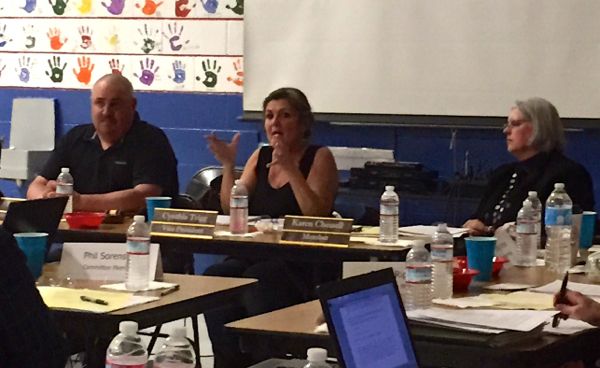
Douglas County School District board member Cindy Trigg, center, makes a point Feb. 19 as colleagues Ross Chichester and Karen Chessell listen. Board member Neil Freitas was absent Feb. 19. Photo/LTN

Douglas County School District board member Cindy Trigg, center, makes a point Feb. 19 as colleagues Ross Chichester and Karen Chessell listen. Board member Neil Freitas was absent. Photo/LTN

Committee members reached out to LTUSD administrators who are open to discussing a possible memorandum of understanding to bridge the education divide. They would like the district staff to continue the dialogue.

Working with the state Legislature to recognize Lake Tahoe Community College is really the two-year institution WHS students would attend rather than Western Nevada College in the valley is another goal. The problem is LTCC is in California.

Delving into distance education or online classes is another goal of the committee’s. This could open up more elective options to Whittell kids. That is an area that is lacking because of the small student population.

As with most things in public education, laws and money govern what can happen. It’s possible the district would lose some funding if this were to occur.

Board member Tom Moore was the most vocal about money being a constraint. He said it’s necessary for spending to be equitable among all the schools.

Committee member Greg Felton said, “Part of it is how do you judge equity? Cost is one way. Opportunities for students is another. We need to find some way to judge what is equitable.”

He pointed out how Douglas High students have so many more course offerings — questioning whether that is equitable.

Taking a formal survey of students and parents to gauge what electives they would like was presented to the board. That could then be the basis for future course offerings.

Offering incentives to teachers to obtain additional qualifications to be able to teach a broader spectrum of classes was brought up. This would help with curriculum choices as well as not be a financial burden to teachers.

The committee would like Whittell to have more autonomy. Exactly how that would look still needs to be ironed out.

All signs are pointing to enrollment increasing in the future. This has to do with the economy on the South Shore improving. It was pointed out that Lake Tahoe Hard Rock hired about 25 percent of its work force from out of the area. The presumption is some of those people are bound to have school-age kids. And other businesses are opening or expanding.

This led the committee to believe discussion of further consolidation of the lake schools is a moot point.

Committee members also foresee their work not being finished and that a group like this could always have a role.


Reid on a course to run for re-election

By Amber Phillips, Las Vegas Sun

WASHINGTON — Will he or won’t he?

That’s the question entertaining Nevada and Washington’s political class this winter as they debate whether Harry Reid will run for a sixth term to represent Nevada in the U.S. Senate.

The case for the doubters: Despite the fact he’s said publicly and privately he’s running, the 75-year-old would be 84 by the time he finishes the term. His latest approval ratings barely pass 41 percent in Nevada, and polls show he’s got an uphill battle to win re-election against any number of opponents. The $1.4 million sitting in his campaign account today is relatively low. Couple all that with a brutal exercise accident on the first day of 2015 that could leave him partially or totally blind in one eye, and it’s easy to see a path for Reid to retire.

But those close to the Democratic leader say that argument completely misses a fundamental understanding of what drives Harry Reid — and why he’s almost definitely running for a sixth term in 2016.

Read the whole story


Cause of SLT house fire under investigation

Update: Feb. 20 5:49pm

No official cause has been determined in the Thursday night fire that destroyed a residence in South Lake Tahoe.

“We are curious” is how police Lt. Brian Williams put it to Lake Tahoe News. This is because police are “familiar” with the man who sustained severe burns to his face and hands. The name of the victim has not been released. He is being treated at UC Davis Medical Center in Sacramento.

While the initial call came in as drug lab explosion, officers now do not believe that is the case.

Fire Chief Jeff Meston told Lake Tahoe News that the occupant told first responders that he used the gas stove to light a cigarette, he walked away and something on or near the stove ignited.

Liberty Utilities did not find any leaks in the system or with the appliances, according to Meston.

The police department is in charge of the investigation of the fire at the two-story house on William Avenue that started about 9:30pm Feb. 19.

The six people who were living in the two-unit structure are not able to do so now because of the amount of damage. The upstairs is considered a total loss by the fire department, while the lower unit sustained considerable water damage. The property loss is estimated at $350,000.

Also injured was a firefighter. He was treated for smoke inhalation.

— Lake Tahoe News staff report


Nev. considering tax breaks for aviation industry

By Bill O’Driscoll, Reno Gazette-Journal

If Nevada is going to compete for aviation services and the emerging, potentially lucrative commercial drone industry, it must be more business-friendly in terms of tax relief surrounding states already offer.

That was the message Thursday to a joint legislative hearing to consider Senate Bill 93, which would offer partial tax abatement for aviation-related businesses and is being pushed by the Governor’s Office of Economic Development as well as the Reno-Tahoe Airport Authority.

“This is a game-changer. We can do this in a way that’s very bipartisan. We stand shoulder to shoulder today,” Lt. Gov. Mark Hutchison, a Republican sitting alongside Assemblywoman Irene Bustamante Adams, a Democrat from Clark County, told the Senate Revenue and Economic Development and Assembly Taxation committees.

Read the whole story