Hackers cut in line for Burning Man tickets

By Oscar Raymundo, Wired

Burning Man has practically gone mainstream. The once-fringe desert camping festival is now cultural fodder for The Simpsons and Taco Bell commercials. Celebrities and CEOs routinely attend. So it’s no surprise that 40,000 Burning Man tickets sold out in less than an hour last Wednesday when they went on sale.

But software engineers in Silicon Valley hacked into the Burning Man ticketing system powered by Ticketfly to cut to the front of the queue. Who needs luck when you have engineering skills and you’re willing to use ‘em for your advantage?

Well, apparently everyone. Burning Man officials, not ones to let cosmic karma pass them by, announced on Friday that they will find and cancel the hacked ticket orders.

“The good news (for us, not them) is that we can track them down, and we’re going to cancel their orders,” according to Megan K. Miller, Burning Man’s director of communications. “Steps are being taken to prevent this from happening again in future sales.”

While 80,000 would-be Burners all over the world waited their turn in a so-called “first come first serve” online queue to purchase tickets, 200 software-savvy engineers discovered a design flaw on the ticket page that allowed them to generate a spot ahead of everyone else in line. 1Jonathan Hart, a software engineer at Idle Games in San Francisco, tweeted that he had somehow navigated Ticketfly’s web servers and “crawled out” with two tickets to Burning Man.

Read the whole story


EDC exploring idea of upping snow removal tax

The El Dorado County Board of Supervisors on Feb. 24 directed staff to look into the possibility of raising the snow removal tax. This would affect people living on the south and west shores in the unincorporated areas of the county.

Today those on the South Shore pay $20 a year, on the West Shore it is $50 per developed parcel. This tax was approved in 1983.

Supervisor Sue Novasel, who represents Lake Tahoe, made the motion Feb. 24 for staff to look into the feasibility of a ballot measure for November 2016 as well as to explore all the funding options.

The money collected from the tax pays for equipment.

“The cost of a motor grader in 1983 was $60,000, today a motor grader is close to $400,000. That $20 you pay on the South Shore has not kept up,” Tom Halverson with the county transportation department told Lake Tahoe News.

Halverson said the county does not have a dollar amount set yet as to what the tax should be increased to.

— Lake Tahoe News staff report


Life sentence for man who killed SLT teen

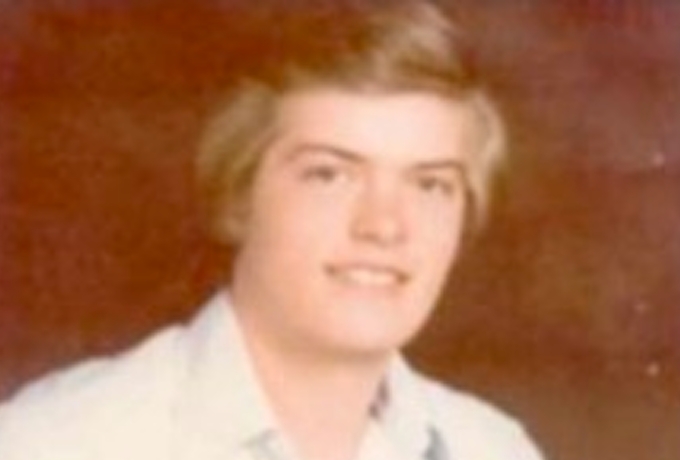
Richard Swanson was killed in 1980 in South Lake Tahoe. Photo/Provided

Richard Swanson was killed in 1980 in South Lake Tahoe. Photo/Provided

Andrew Sanford on Monday was sentenced to life in prison without the possibility of parole for the first-degree murder of a South Lake Tahoe teenager.

Richard Swanson, 16, was killed in 1980 while working at was a Shell Station at the Y. He had been beaten, wrapped in duct tape and left to die in a back room.

El Dorado County Superior Court Judge James Wagoner on Feb. 23 denied Sanford’s request for a new trial and handed down the sentence.

Sanford, 53, was found guilty in April 2014.

Sanford, who was 19 at the time of the murder, had a small criminal record that included auto theft, and breaking and entering.

“As in this case, every family who has lost a loved one to violent crime finds that moment and their loss frozen in time. Nothing can bring their son Richard back, but it is my hope that Richard’s parents and family members may find some peace knowing that the person responsible for their son’s death has finally been held responsible for his actions,” District Attorney Vern Pierson said in a statement.

— Lake Tahoe News staff report


Markleeville man dies in car crash

A 29-year-old Markleeville man died Sunday in a two-car accident on Highway 88.

The names of the people involved in the accident are not being released pending notification of family.

A 32-year-old woman from Shingle Springs was going west on Highway 88 when her Ford crossed the double yellow lines for unknown reasons, according to officers. Her vehicle collided head-on with a Subaru going in the other direction. That vehicle was driven by a 31-year-old woman from Markleeville.

“The weather and road conditions were not a factor,” California Highway Patrol spokeswoman Ruth Loehr told Lake Tahoe News.

The passenger in the Subaru was pronounced dead at the scene. The drivers sustained minor injuries.

Because the accident is still under investigation it is not known if any charges will be filed.

The accident occurred at 4:55pm Feb. 22 about one mile east of Hope Valley Resort.

— Lake Tahoe News staff report


Hotel component of Chateau in design phase

This is an original rendering of what the hotel and pool at the Chateau were to look like.

This is an original rendering of what the hotel and pool at the Chateau were to look like.

By Kathryn Reed

A 32-room four-star caliber hotel is being designed in what will be the next phase of the Chateau project in South Lake Tahoe.

Accompanying it will be a swimming pool, spa, nearly 19,000-square-feet of retail and open space. The pool will be designed to accommodate what will eventually be two hotels. This first one is permitted for 115 units, while the larger one is for 365 rooms. The bulk of the commercial will be completed in the next phase.

No price is being put on what the next phase will cost, though it is in the tens of millions of dollars range. The opening date could be winter 2017.

Design plans have been submitted to the city. Lew Feldman, attorney for the project owners, says construction could start this fall.

“It really is a testament to where the community is headed,” City Manager Nancy Kerry told Lake Tahoe News. She added that it is especially significant so soon after the initial retail phase of the Chateau opened.

This adds to the 10-year goal, with this being year two, of having $1 billion of private and public money invested on the South Shore. To date $300 million has been spent on upgrading the built environment.

Tahoe Stateline Ventures, the company formed to develop the 11-plus-acre site near the state line, is incrementally building out what was to be a convention center, two hotels and a retail complex. That was the plan that was permitted by the Tahoe Regional Planning Agency in 2008, but which got derailed because the original developer filed for bankruptcy. With the dissolution of redevelopment and the city’s not having a role in the project anymore, the likelihood of a convention center’s ever coming to fruition is slim to none.

What that aspect of the project might become remains to be seen.

Still, Owens Financial, the parent company of Tahoe Stateline Ventures, is continuing to believe in South Lake Tahoe. The completion of the next phase could mean the project would be in a better position to attract investors to complete the plans.

The first hotel project will be 32 rooms of what could become a 115-room hotel. It will be a hotel-condo project, with full ownership and the possibility of rooms being put into a rental pool.

Feldman told Lake Tahoe News it is too soon to know if the lodging property will have a well-known flagship or be independent.

This next phase will be adjacent to the Chateau retail that exists on Highway 50. The electric bike rental shop will be demolished. The retail will be on the first floor and the hotel-condo complex on the second and third levels. Rooms will be one-, two- and three-bedroom.

The streetscape along Highway 50 will be completed. For people not wanting to use Stateline or Friday avenues to access the property, a route via Cedar Avenue will be created. This will give guests better pedestrian access to Lakeside Beach, and those staying elsewhere greater access to the retail center.


Calif. farmers bracing for less water

By Mark Grossi, Fresno Bee

The next train wreck in California’s drought is headed for the San Joaquin Valley this week when federal leaders forecast how much river water farmers can expect to irrigate nearly 3 million acres this summer.

Most folks in farm country are expecting the same number as last year — zero for both east and west sides of the Valley. Consecutive years of no river water would be another unprecedented body punch from a drought dating back to the winter of 2011-12.

After one of the driest Januaries on record, a fourth drought year seems inevitable, say many water leaders. In response, manic planning and big spending are spreading quickly in the Valley’s $37 billion farm belt. One farmer drills a $1 million well, another pays $1,400 an acre-foot for scarce extra water — five times the cost in an average year.

More rain has fallen this year than last, so why is the winter turning into another dud? Storms have been warm and mostly focused in Northern California. The Sierra snowpack is actually slightly smaller overall than it was last year.

Read the whole story


Study: Pot may be even safer than previously thought

By Christopher Ingraham, Washington Post

Compared to other recreational drugs — including alcohol — marijuana may be even safer than previously thought. And researchers may be systematically underestimating risks associated with alcohol use.

Those are the topline findings of recent research published in the journal Scientific Reports, a subsidiary of Nature. Researchers sought to quantify the risk of death associated with the use of a variety of commonly-used substances. They found that at the level of individual use, alcohol was the deadliest substance, followed by heroin and cocaine.

And all the way at the bottom of the list? Weed — roughly 114 times less deadly than booze, according to the authors, who ran calculations that compared lethal doses of a given substance with the amount that a typical person uses. Marijuana is also the only drug studied that posed low mortality risk to its users.

These findings reinforce drug safety rankings developed 10 years ago under a slightly different methodology. So in that respect, the study is more of a reaffirmation of previous findings than anything else. But given the current national and international debates over the legal status of marijuana and the risks associated with its use, the study arrives at a good time.

Read the whole story


2015 could be year of the gun in Nev. Legislature

By Sean Whaley, Las Vegas Review-Journal

CARSON CITY — A flurry of firearm and Second Amendment related bills introduced in the Legislature have already generated plenty of controversy even though none of the major proposals have even had hearings yet.

First there was a dust-up between Senate Democrats and Republicans over a GOP gun measure that includes domestic violence provisions that Democrats said fell short of what is needed.

Firearms are making some noise in the Nevada Legislature this session.

This could be the year of the gun, as Republicans, who are in the majority in the Legislature for the first time in decades, see a chance to enact Second Amendment measures supported by many of their constituents.

Assembly Judiciary Chairman Ira Hansen, R-Sparks, said the large number of bills is in part a reflection of concerns that there is a strong movement to curtail gun rights nationally.

At least nine bills directly relating to firearms have either been introduced or are being drafted.

Read the whole story


Medical pot spawns other Nev. businesses

By Andrea Domanick, Las Vegas Sun

It has been a busy weekend for lawyer Alicia Ashcraft.

For the past few days, the managing partner at Ashcraft & Barr, a local firm specializing in business regulation, has been unpacking boxes and putting the finishing touches on its newly expanded office. In December, Ashcraft & Barr partnered with Colorado-based marijuana law experts Vicente Sederberg to form a practice dedicated to serving the needs of Nevada’s budding medical marijuana industry.

The firm is one of several ancillary businesses cropping up throughout the state that are capitalizing on the growing demand for cannabis-related products and services. With the arrival of commercial producers and dispensaries comes a new set of market needs, from accessory vendors to greenhouse manufacturers and security officers to lawyers.

Legal cannabis sales in the United States ballooned 74 percent in 2014, to $2.7 billion from $1.5 billion in 2013. The market in Nevada is expected to grow 341 percent in 2015, according to ArcView Group, a market research firm and investment network specializing in legal cannabis.

Read the whole story


S. Tahoe officials strategize about the future

By Kathryn Reed

Recreation is going to be the economic driver for South Lake Tahoe. One way to do this is to stop letting county and state lines be a roadblock. Another is to invest in facilities so they become moneymakers that could provide dollars for other city needs.

But more opportunities besides or in addition to being a recreation mecca are possible based on the ideas that were elicited Feb. 21.

Councilmembers, department heads and other key staff spent 3½ hours Saturday talking about what the city could be. Barely touched on was how to turn the ideas into reality, but that will be flushed out at another meeting as well as when the midyear budget review is presented in April.

“Until we know who we are, we won’t know why we are doing it,” City Manager Nancy Kerry said. “There is no shared agreement of who we are.”

But she added, “One South Shore is starting to take hold.” This is the philosophy of realizing what happens throughout the South Shore impacts everyone and that working together instead of against each other is better for everyone.

And while the city is accountable to the residents within its boundaries, the decisions it makes have impacts beyond its borders.

Ted Gaebler, author of “Reinventing Government” and a retired city manager who spent 50 years in local government, facilitated the meeting at Lakeland Village. He asked them all to express their vision for the city – regardless of money, current policy, how long it would take to achieve or the realistic ability to achieve the goal.

The purpose was to stimulate these city leaders and to get them thinking beyond the norms, beyond what is expected and beyond the ordinary.
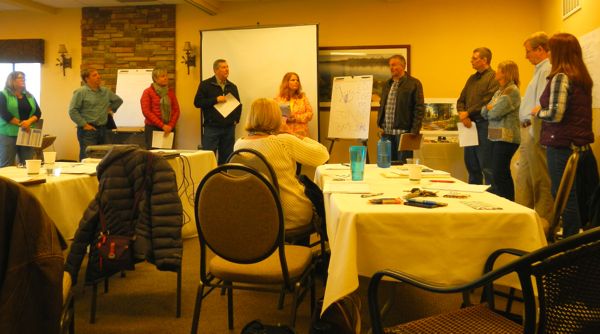
South Lake Tahoe city staff explain to the council the projects that are in the works. Photo/LTN

South Lake Tahoe city staff explain to the council the projects that are in the works. Photo/LTN

Here are some of the ideas:

• Erase the state line. Or go even further and create an entity whereby the Lake Tahoe Basin governs itself – almost like it is a state unto itself, or have the area be one bi-state county.

• Turn the casinos into condos.

• Have Caltrans turn Highway 50 over to  the city so it becomes a city street, which would give the city more opportunities.

• Redevelop Barton Ranch – possibly convert it into a farm for locally sourced food.

• Light rail on Highway 50.

• Tear down dilapidated hotels in town and build quality affordable housing.

• Build a quality recreation center.

• Create an events center for concerts.

• Public art.

• More special events.

• Focus on quality of life.

• Ensure the community is engaged in order to make changes.

• A safe community – in terms of lighted walkways, low crime, and fire safe.

• Build a children’s or discovery museum.

• Better transportation.

• Better connectivity with the trail system.

• Tear down one-third of the hotels. (“We need families here instead of tourists.”)

• Purchase private beaches and turn them into public beaches.

• Remove private residences from the shoreline and create more public access via commercial enterprises like lakeside dining.

• Get rid of Campground by the Lake and make it city offices.

• Revise commercial floor area so it is only needed for one level; this would create more development opportunities.

• Turn the airport into a heliport and then have special events there.

• Take over South Tahoe Public Utility District; this would reduce redundancies and allow for improvements to be made faster.

• Collaborate with private entities and public agencies.

Gaebler reminded the City Council that their responsibility is to the steer the boat, not to actually be doing the rowing.

“We can’t do any of the stuff we would like to do without new revenue,” Councilman Austin Sass said.

He wanted his colleagues to embrace getting a tax hike of some kind on the ballot in November 2016. But they collectively said “slow down” so there would be time to evaluate what exactly any new income would be spent on. Then there will be the discussion about how the money would be raised.

The electeds do seem to agree money should be spent on recreation – but that is a broad topic. The idea, though, is to improve recreation – which will bring money to city coffers – and use revenue from those recreation endeavors to fund road improvements and other needs within the city.