Landmark Calif. plastic bag ban on hold

By Lydia O’Connor, Huffington Post

The nation’s first statewide ban on single-use plastic bags will not go into effect this summer after all. The California secretary of state’s office announced Tuesday that a referendum to overturn the measure has qualified for the November 2016 ballot.

The state confirmed that the trade group American Progressive Bag Alliance submitted at least 110 percent of the 504,760 verified signatures it needed to qualify its measure to overturn the plastic bag ban, the Los Angeles Times reported. As such, the landmark law is now on hold until California voters weigh in next year.

Approved by California Governor Jerry Brown last September and originally slated to go into effect this July, the ban would require grocers to charge at least 10 cents for each recycled paper bag or reusable bag given to consumers. The law also provides $2 million in competitive loans to help plastic bag manufacturers convert their businesses to manufacture reusable bags.

Read the whole story


Nev. represents both sides of the immigration debate

By Ana Ley, Las Vegas Sun

Nevada represented both sides of the country’s immigration debate on Wednesday at separate events discussing President Obama’s stalled immigration deal.

In Washington, D.C., Attorney General Adam Laxalt spoke before the House Judiciary Committee to defend his controversial decision to bring Nevada into a lawsuit against the president’s executive action granting deportation relief to millions living in the country illegally.

Meanwhile in Miami, Las Vegas activist Astrid Silva attended a town hall where Obama vowed to do everything in his power to overhaul the nation’s immigration system.

Read the whole story


Poll: More Californians want mandatory water rationing

By Christopher Cadelago, Sacramento Bee

Amid stubborn drought conditions, more Californians are warming to the prospect of government-imposed mandatory water rationing, but a majority still favor the state’s current approach of urging residents to voluntarily curtail their water use.

Support for rationing swelled to more than a third of voters in the latest statewide Field Poll, a rise of 7 percentage points since last spring. Support is greatest in the Bay Area and other parts of Northern California.

Meantime, an increasing number of voters think that the state is experiencing a severe water shortage. Ninety-four percent describe the situation as “serious,” with nearly seven in 10 characterizing it as “extremely serious.” To put that in perspective, when the state was in another long-term water shortage in 1977, far fewer voters (51 percent) described their feelings at the time as “extremely serious.”

“You can see that as the seriousness of the situation seems to be expanding in the public’s view, it’s willing to start making more trade-offs in certain areas than it was willing to do before,” said Mark DiCamillo, the director of the poll. “As the shortage continues, we’ll see how far voters are willing to go.”

Read the whole story


Adjunct faculty make case for equality

By Kathryn Reed

She wheels around what looks like an oversized briefcase. It’s heavy. People ask why she does it. Her answer – it’s her office.

This is Julie Ewing’s reality. For 12 years she has been an adjunct faculty member in Lake Tahoe Community College’s English Department. As such, she doesn’t have an office to store things. No adjunct faculty member does. That means taking everything with her every day she teaches. Taking it home. Taking it from room to room.

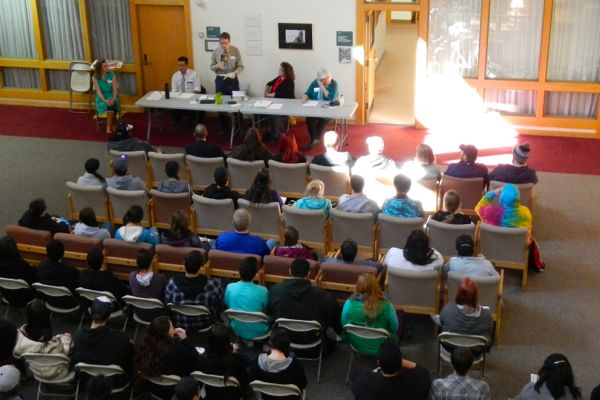
Adjunct faculty throughout the United States on Feb. 25 brought their issues to light in various ways. At some schools they walked out in protest. At LTCC there was an hourlong assembly where nearly 100 people – mostly students – heard the issues that face these part-time instructors.

Most of these instructors have the same education as full-time faculty. But being part time means they get paid less. On average they make $25,000 a year. They don’t have health benefits. They don’t have contracts and there is no job security. With no offices, they can’t have office hours for students.

At LTCC, the adjunct teaching non-credit ESL classes don’t get paid for holidays or snow days.

Nearly 100 people listen Fe.b 25 at LTCC about the plight of adjunct faculty. Photo/LTn

Nearly 100 people listen Feb. 25 at LTCC about the plight of adjunct faculty. Photo/LTn

These part-timers don’t get to take sabbaticals every seven years for enrichment opportunities like the LTCC full-timers do. They don’t get time to do research – at least not paid time. Ewing said she has never made $25,000 a year. She was close one year. But that was the year she spent on the road working at schools here, in Reno and Incline Village.

For Maxine Alper, who has been an adjunct faculty member at LTCC since 1997, she is wondering how her rent will be paid in the fall. On Friday a full-time faculty member bumped her. Full-timers have first rights to a class. The loss in pay is equivalent to two-thirds of Alper’s monthly rent.

It wasn’t a woe-is-me pity party, but instead an informative session about the disparity between those who work full time as instructors and those who work part time and how this may be impacting students and the community at large.

“It damages student learning, faculty governance, and academic freedom. Each of these is an educational cost that institutions incur when they choose not to invest adequately in their instructional missions,” Scott Lukas said. He teaches anthropology and sociology at LTCC – full time.

Lukas was one of four presenters Wednesday. Joining him were Albert Ponce – full time political science professor, Alper and Ewing. Alper said adjunct at LTCC make one-quarter to one-third what full-time faculty make.

Colleges use adjunct faculty because they can be paid less and benefits are not included.

At LTCC in fall 2014 and winter 2015 there were 158 contracts for adjunct faculty. Both quarters there were 39 full-time faculty members on the payroll.

Ponce called it a two-tiered system.

“We need to delink from this neo-liberal logic. We need to follow a model other than this one,” Ponce said.

It was acknowledged that much of the problem is at the state level where funding decisions are made and that people should be addressing lawmakers.

Jessica Sota, who is part of the LTCC student senate, said students need to be more involved and aware of who is teaching them.

LTCC students were in Sacramento on Feb. 25 voicing their concerns. They will be returning Monday for the annual March in March, at which time they will also be speaking with individual lawmakers about concerns at community colleges.


The differences with Williams and O’Reilly

By Jonathan Mahler and Emily Steel, New York Times

Hours after the news broke that Brian Williams had misrepresented his account of a helicopter trip in Iraq, he issued an on-air apology. NBC News started an investigation, and within days had suspended Williams, calling his actions “wrong and completely inappropriate.”

When the magazine Mother Jones reported that Bill O’Reilly had engaged in self-aggrandizing rhetoric about his coverage of the Falklands war, he called one of the authors of the article “an irresponsible guttersnipe” and used his nightly show to fight back against his accusers. His bosses at Fox News, including the chief executive, Roger Ailes, rallied to his defense.

Fox’s handling of the controversy says a lot about the network. It also says a lot about its most visible star, a man who perhaps more than any other has defined the parameters and tenor of Fox News, in the process ushering in a new era of no-holds-barred, intentionally divisive news coverage.

Since dethroning CNN’s Larry King as the king of cable news almost 14 years ago, O’Reilly has helped transform a start-up news channel into a financial juggernaut, with estimated annual profits of more than $1 billion. He and Fox News have risen not on the back of big interviews or high-impact investigations but on the pugnacious brand of conservatism personified by O’Reilly.

There are other differences between the two controversies. The incident at the center of O’Reilly’s occurred more than 30 years ago; Mr. Williams’s happened in 2003. And his accusers are journalists, not military veterans as they were in Williams’s case. But the most meaningful point of distinction — and the reason O’Reilly’s job is almost certainly safe — is that he is not an anchorman, with all of the cultural weight that title carries. He’s a professional provocateur.

The accusations against O’Reilly, which have since been substantiated by other journalists in Argentina at the time, have played neatly into the network’s narrative of being the conservative outlier in an industry dominated by liberals.

Read the whole story


Gun injuries declared public health emergency

By Melissa Healy, Los Angeles Times

Seven medical specialty societies, the American Bar Association and the American Public Health Association on Monday joined forces to declare gun-related injuries, which annually kill an average of 32,000 Americans and harm nearly twice that number, “a public health crisis” that should be studied and solved “free of political influence or restriction.”

The professional societies jointly issued a “call to action,” and declared their collective backing for universal background checks, a ban on military-style assault weapons and large capacity magazines, more federal support for gun-injury research, and an end to laws that would punish physicians who discuss the safety of gun ownership with their patients.

They also called for better and more timely care for those with mental illness and substance abuse problems, and urged lawmakers not to stigmatize those patients or discourage them from seeking care in drafting laws to keep guns out of the hands of some.

Read the whole story


Drought could mean a bad West Nile year

By Phillip Reese, Sacramento Bee

Abbey Murphy never felt the mosquito bite that eventually swelled her brain and left her unable to walk for weeks.

“I had uncontrollable vomiting, severe migraines,” said Murphy, a sophomore at UC Berkeley. “I couldn’t get up to get breakfast.”

Murphy eventually recovered from her West Nile virus infection, though it took months. She was one of roughly 800 Californians infected last year during the worst West Nile outbreak in a decade, new state figures show.

Experts say the ongoing drought was largely to blame and predict another bad year in 2015.

Read the whole story


Nev. bill would punish contractors who employ illegals

By Sandra Chereb, Las Vegas Review-Journal

CARSON CITY — Conservative Assemblyman Ira Hansen wants to prohibit licensed Nevada contractors from hiring people who are in the country illegally.

The Sparks Republican is the sponsor of Assembly Bill 133, which would require the state Contractors’ Board to investigate and take disciplinary action against contractors who knowingly employ workers who are in the country illegally.

Employers who violate the law could be put on probation and subject to quarterly reporting on new hires. Subsequent violations could result in revocation of a contractor’s license.

Read the whole story


Drought brings early start to wildfire season

By Kate Schimel, High Country News

When Jim Stimson first spotted a fire burning 20 miles northwest of Bishop, California, on Feb. 6, he didn’t think much of it. Stimson, a 40-year resident of the area and a local photographer, was leading a workshop in the hills outside of town. He couldn’t remember the last time a fire in February did much damage.

But it didn’t take long for him to realize this wasn’t a typical February fire.

The Round Fire, as it was named, burned 7,000 acres and 40 homes before local firefighters, aided by a rainstorm, brought it under control.

For local residents, it drove home a message Westerners may finally have to get used to: Fire season isn’t just confined to the months of July and August anymore, or even May through September. Over the last four decades, the season across the West has gotten two and a half months longer. Last year, rare January fires swept across southern California. And just last week, the Round Fire wasn’t the only abnormally early burn to hit the West. A spate of wildfires broke out in northern Utah Feb. 8 and 9, burning a few hundred acres.

Read the whole story


Mental health a growing concern on South Shore

By Kathryn Reed

Mental health issues are a problem for educators, law enforcement, medical professionals and others. The illness tends to permeate nearly every facet of the population and not always in ways that are obvious.

When Barton Health conducted its Community Health Needs Assessment in 2012 mental health was one of the three priorities that needed to be addressed. Access to care and substance abuse rounded out the top concerns. (Barton is in the process of doing its second needs assessment.)

“Mental Health is multi-faceted, so there is not a quick or simple answer. Ideally having options for prevention, maintenance and acute crisis during different developmental phases would help support people when they need that support,” Kindle Craig, executive director of Barton Health Foundation, told Lake Tahoe News.

Mental health can be difficult to treat because of limited funding and facilities, especially in an area like Lake Tahoe because it is nowhere near a metropolitan area that has more resources.

“The adult populations experiencing the greatest barriers to mental health care in El Dorado County, and particularly in South Lake Tahoe, include low-income populations, the Hispanic community, ex-offenders, homeless and co-morbid mental health and substance addicted adults. According to the patient panel of the county Mental Health Division, dual-diagnosis patients (mental illness and substance abuse) comprise approximately 80 percent of the population served, and the county has reported an increase in the number of youth with this dual diagnosis,” the mental health assessment concluded.

Law enforcement is often interacting with people who are mentally unstable. It’s an issue South Lake Tahoe Police Chief Brian Uhler regularly brings up. He did so again at Saturday’s strategic planning workshop – saying more resources are needed and attention paid to mental illness in the community.

“A February 2012 report to the California Department of Health Care Services indicated that approximately 5 percent of the El Dorado County population needed mental health services based upon the serious mental illness definition. Within households below 200 percent of the federal poverty level, this rate increased to approximately 9 percent. When a broader definition of mental health needs is utilized, the percent of population that had a need for mental health services increased to approximately 12 percent of the population, and within households below 200 percent FPL, the need increased to approximately 20 percent. This indicates that over 21,000 county residents may need mental health services, many of whom are likely not seeking treatment,” the mental health assessment states.

According to the National Institute of Mental Illness, mental disorders affect tens of millions of people each year, with only about half of those affected receiving treatment.

In September 2013 a group came together for the inaugural mental health forum on the South Shore. The next gathering is March 5.

“The goals of the mental health forum are to continue to raise awareness, identify gaps in service/access, and build a community care flow map allowing all parties – caregivers, providers, schools, and first responders – to understand the appropriate pathways for patient access with regard to patient age and insurance coverage,” Craig said.

She said the first forum provided greater understanding by those who participated of the mental health system, the deficiencies and why they exist.

“A specific positive outcome was developing a way to work across state lines to be able to transport certain patients to appropriate facilities in Nevada, as well as California, depending on the need,” Craig said of the 2013 gathering.

Barton, law enforcement, paramedics, El Dorado County, Lake Tahoe Unified School District and nonprofits were part of the first forum.

Invited to this year’s gathering are: Barton Health, LTUSD, Douglas County School District, Family Resource Center, city and county officials, El Dorado County Mental Health, South Lake Tahoe Police Department, South Lake Tahoe Fire Department, Drug Free Coalition, Lake Tahoe Collaborative, Live Violence Free, Child Protective Services, and others.

Next week’s all-day forum is designed to create achievable goals.

“South Lake Tahoe is in need of a more collaborative, effective approach to addressing mental health. Working cooperatively with the social services agencies and community members is essential to understanding the issues, identifying gaps, and solving problems,” Craig said. “As a healthcare provider, Barton offers an array of medical services including child psychiatry, bereavement counseling, and tele-psychiatry. Patients come to Barton through a variety of access points in need of assistance related to mental health. If it is not a medical need, Barton works with the appropriate agency to refer patients to the best location to receive appropriate services like counseling.”