Nev. bill would mandate later school start, ethnic study class

By Riley Snyder, AP

Nevada school districts are opposing a bill that would push back school start times and require an ethnic studies course in order to graduate from high school.

Democratic state Sen. Tick Segerblom is the primary sponsor of SB211 and testified on the bill Thursday in the Senate Education Committee.

Segerblom said the bill would require Nevada high school students pass a course in ethnic studies focused on sensitivity to all nationalities and races. The majority of high school history classes are narrowly focused on the achievements of white Americans, he said.

“It’s for people of color to be able to learn ways to be prideful of their heritage,” Segerblom said. “The world is not just Columbus coming over here.”

A number of school district lobbyists testified against the mandate, saying they supported the concept but feared that more graduation requirements would lead to longer school times. Republican state Sen. Scott Hammond, a teacher at Indian Springs High School, said he was concerned about adding more mandates for teachers.

“It seems like every year there’s something else that comes down the pipe that they want us to get in the child’s head,” he said during the hearing.

The proposal would also require classes to start no earlier than 7 a.m. for elementary schools, 8 a.m. for middle schools and 9 a.m. for high schools.

Republican bill co-sponsor Sen. Becky Harris said the bill would give students additional sleep and more flexibility in scheduling extracurricular activities before school.

The American Academy of Pediatrics issued a policy statement in 2014 saying that a large percentage of teenagers don’t get enough sleep and recommended that school districts move back their start times.

Clark County School District lobbyist Nicole Rourke said the district is running a pilot program experimenting with different start times for schools. The price of expanding bus routes and hiring additional staff to comply with the changed start times could cost the district up to $80 million, she said.

Segerblom said he’s willing to work with the districts to alleviate their concerns but that the ideas were solid. “It’s just a question of whether we can afford to do it, and money is always a problem in Nevada,” he said.


The art – and science – of forecasting wildfires

By Kate Schimel, High Country News

In the midst of fighting a wildfire, predicting the future is a matter of tracking invisible forces: gust fronts, storms, air columns. While firefighters battle the flames on the ground, fire experts look for signs that the weather or the wildfire might shift. They follow storm tracks, watch weather models and study the fire’s path.

Their attempts at prediction begin even before the first plume of smoke rises. In regional centers around the West, forecasters determine the risk of wildfire and brief fire managers on where they should have teams ready to go.

For the Rocky Mountains, that task falls to Tim Mathewson, a 20-year veteran of weather forecasting. “It’s a tough science,” Mathewson said. “There’s a lot of ingredients that help determine whether there’s a big fire today.”

For example, in 2012, much of the Rocky Mountain region was dry. Figuring out where a chance ignition might blow up into a large-scale fire was tricky. At one point, teams were staged and ready to go in four of the five states Mathewson watches.

Read the whole story


Selfie stick bans increasing worldwide

By Greg Keller, AP

“Selfie sticks” have now been banned at a French palace and a British museum, joining a growing list of global tourist attractions to take such measures.

The devices are used to improve snapshots, but critics say they are obnoxious and potentially dangerous. Officials at Palace of Versailles outside Paris, and Britain’s National Gallery in London, announced the bans Wednesday, saying they need to protect artworks and other visitors.

Other places that have put limits on the selfie-stick craze:

France

Unlike Versailles, the Louvre and Centre Georges Pompidou art museums have not banned selfie sticks — yet. The Pompidou — the contemporary art museum whose exterior of colorful tubes and scaffolding looks like a building turned inside out — is studying what, if anything, needs to be done about the phenomenon, Le Monde reported.

Musee d’Orsay, which houses an Impressionist art collection, bans not just selfie sticks, but any photography whatsoever.

Italy

Rome’s Colosseum banned selfie sticks last month as a security measure, both for the objects on exhibit inside and for the 16,000 daily visitors to the 2,000-year-old monument.

“The twirling around of hundreds of sticks can become unwittingly dangerous,” Colosseum spokesman Christiano Brughitta said.

Two American tourists were arrested last week after carving their names into the Colosseum’s wall — and then taking a photo with a selfie stick.

United States

The Smithsonian museums in Washington banned selfie sticks last week. Cameras and pictures are still allowed, but selfie sticks, tripods and monopods are not. Smithsonian officials say this is a preventative measure to protect visitors and museum objects.

Other U.S. museums that ban selfie sticks include the Art Institute of Chicago, the Detroit Institute of Arts, and New York’s Museum of Modern Art and the Metropolitan Museum of Art.

Austria

Vienna’s Albertina, one of the city’s top art museums, prohibits selfie sticks. Museum spokeswoman Sarah Wulbrandt says visitors must check-in the sticks before entering.

Britain

Besides the National Gallery, some English soccer teams have banned the selfie stick from their stadiums.

The National Portrait Gallery, adjacent to the National Gallery, says the sticks are allowed, but “anything that may prove disruptive is reviewed on an ongoing basis.” The British Museum is “currently reviewing” its selfie-stick policy.

Some art-lovers praised the idea of a ban.

“If you go into an exhibition, surely the purpose is to see what is on show and not to take umpteen photographs of yourself?” said Bill Doig, a retired doctor visiting the National Portrait Gallery.

Brazil

Soccer stadiums in the South American country have also banned selfie sticks because of their potential use as weapons in fights between rival fans, police say. Selfie sticks were also banned from Brazil’s recent Carnival parades in Rio de Janeiro.


Calif. pumping water that fell to Earth 20,000 years ago

By Tom Knudson, Reveal

By now, the impacts of California’s unchecked groundwater pumping are well-known: the dropping water levels, dried-up wells and slowly sinking farmland in parts of the Central Valley.

But another consequence gets less attention, one measured not by acre-feet or gallons-per-minute but the long march of time.

As California farms and cities drill deeper for groundwater in an era of drought and climate change, they no longer are tapping reserves that percolated into the soil over recent centuries. They are pumping water that fell to Earth during a much wetter climatic regime – the ice age.

Such water is not just old. It’s prehistoric. It is older than the earliest pyramids on the Nile, older than the world’s oldest tree, the bristlecone pine. It was swirling down rivers and streams 15,000 to 20,000 years ago when humans were crossing the Bering Strait from Asia.

Tapping such water is more than a scientific curiosity. It is one more sign that some parts of California are living beyond nature’s means, with implications that could ripple into the next century and beyond as climate change turns the region warmer and robs moisture from the sky.

“What I see going on is a future disaster. You are removing water that’s been there a long, long time. And it will probably take a long time to replace it. We are mining water that cannot be readily replaced,” said Vance Kennedy, a 91-year-old retired research hydrologist in the Central Valley.

Despite such concern, the antiquity of the state’s groundwater isn’t a well-known phenomenon. It has been discovered in recent years by scientists working on water quality studies and revealed quietly in technical reports.

Groundwater is crucial to California. In an average year, nearly 40 percent of the state’s water comes from underground sources. In the current extended drought, it’s more than half. Eighty percent of California residents rely to some degree on groundwater. Some towns, cities and farming operations depend entirely on it.

Groundwater is like a bank account. You want to balance the debits and credits, not draw down the principal. But California has been depleting its groundwater principal for generations, pumping more than nature can replenish. So, too, has the United States as a whole. The biggest overall user is agriculture.

“If we continue irrigating at the increasing rates that we are in the U.S., the bottom line is that can’t be sustained,” said Leonard Konikow, a retired U.S. Geological Survey hydrogeologist in Virginia. “That can’t go on forever.”

A new article by Konikow in the journal Groundwater estimates that nearly 1,000 cubic kilometers – about twice the volume of Lake Erie – was depleted across the United States from 1900 to 2008. That’s enough to contribute to rising sea levels, along with melting glaciers and polar ice.

“That really surprised a lot of people,” Konikow said.

The pace of depletion has jumped dramatically since 2000. And Konikow identified one area that appears to have the most serious depletion problem in the nation – California’s agricultural powerhouse, the Central Valley, especially its more arid southern portion.

How long the bounty can last is anyone’s guess. As wells are drilled deeper, pumping costs soar. Water quality can suffer. In some areas, the earth itself is starting to sink as deep aquifers are pumped to historic low levels.

That problem is known as subsidence, and it’s a big deal. As the land sags, it is harming water delivery canals, damaging wells and buckling pavement.

“The rates of subsidence we are seeing are about a foot per year in some areas. They are just phenomenal,” said John Izbicki, a research hydrologist with the U.S. Geological Survey.

The last time this happened, during a binge of overpumping in the 20th century, one part of the valley sank 28 feet and damages topped $1.3 billion (in 2013 dollars), according to the California Water Foundation.

But that’s not all: As those deep aquifers are pumped, they suffer structural damage and no longer hold as much water as before. To visualize what happens, imagine a kitchen sponge.

“You take it out of the package and it’s all nice and fluffy,” said Bryant Jurgens, a research hydrologist with the U.S. Geological Survey. “After a month of use, it starts to shrink. When you wet it again, it doesn’t ever quite get as big as it originally was. That’s exactly what happens to the aquifer.”

And some of that water, as it turns out, is quite ancient. If you bottled it, you could label it the provenance of the Pleistocene – a geological epoch that lasted from about 2.5 million to 12,000 years ago.

The landscape was much different back then. Yosemite Valley was a river of ice. Mastodons and other now-extinct creatures roamed the West Coast. To the east and south, lakes stretched for miles across terrain we now call desert.

All water, in a sense, is ancient. It’s been cycling through clouds, rivers, forests and oceans for millions of years. But in recent decades, scientists have found ways to determine roughly when precipitation fell to earth and percolated into the surface, becoming groundwater.

They do it by testing water for the presence of certain compounds that decay slowly over time, such as carbon-14, a radioactive isotope that also is used to estimate the age of ancient civilizations and human ancestors.

There is no point-and-click website that reveals the age of groundwater in the state. To access the information, you must wade through a tangle of studies compiled by the U.S. Geological Survey as part of a state-funded public drinking water-quality monitoring program.

The jargon in those studies is so thick it is nearly incomprehensible. But deep in the scientific sediment are nuggets worth sharing with friends – a sentence here, a table there. They show water pumped from some deep public supply wells in the valley is 10,000 to more than 30,000 years old. Similar ages also have been reported in many desert basins, including Coachella Valley and Owens Valley, a major source of drinking water for Los Angeles.

What that means for the future is uncertain. Even though many areas pump more water than is recharged naturally, there is still more groundwater to be pumped.

“We are withdrawing from a fairly large bank account,” said Tom Myers, a hydrogeologic consultant in Reno, Nevada, who has worked in Southern California. “But we are withdrawing from it a lot faster than we are putting back in. The problem is we don’t know how close it is to empty.”

And many areas also recharge aquifers with surface water imported from elsewhere.

“There are places where you could be pumping very old groundwater and there is sufficient recharge to the system – so it’s not necessarily a problem,” said Miranda Fram, a research chemist with the U.S. Geological Survey. “But in many cases, it is. It’s mining old groundwater that’s not being replenished.”



Parolee slips past South Shore officers

Officers on March 12 look for a fugitive near the businesses at Timber Cove Pier in South Lake Tahoe. Photo/Denise Haerr

Officers on March 12 look for a fugitive at Timber Cove Pier. Photo/Denise Haerr

A South Lake Tahoe man accused of violating his parole is still on the loose.

El Dorado County sheriff’s deputies and South Lake Tahoe police officers spent several hours Thursday night trying to track down the man who is in his early 30s. Deputies are not releasing his name for fear the publicity might chase him out of town.

“We don’t have him as a public safety threat. His main victim is usually himself,” sheriff’s Sgt. Michael Seligsohn told Lake Tahoe News.

He is, however, on parole for domestic violence as well as drugs. Seligsohn said heroin is the guy’s drug of choice.

The sergeant said the man is back using and has stopped checking in with his parole agent.

Law enforcement tracked him to the Beverly motel on March 12. The suspect jumped out of two-story window and ran. Officers searched other hotels, near Timber Cove Pier and crawled through drain pipes, but turned up nothing.

— Lake Tahoe News staff report


Placer County bans e-cigarettes from public buildings

By Associated Press

Placer County has banned the use of electronic cigarettes within public buildings and inside county-owned vehicles.

Supervisors voted unanimously for the restrictions during a meeting Tuesday where nobody spoke about the issue during public comment. The ordinance will take effect in late April.

The use of electronic cigarettes, also known as “vaping,” has been touted by supporters as a safe alternative to traditional tobacco products such as cigarettes. But public health officials say the safety of the chemicals contained in e-cigarettes is unknown.

Kirk Uhler, chairman of the Board of Supervisors, says the ban goes toward making a comfortable work environment for public employees.

According to the Sacramento Bee, more than 150 jurisdictions in California have passed legislation regulating e-cigarettes.


Reducing fine sediment helping Lake Tahoe

By Kathryn Reed

Abrasives put on roadways in the Lake Tahoe Basin are a huge contributor to the loss of lake clarity.

That was one of the messages delivered to the Lahontan board on Thursday when staff gave an update about the total maximum daily load program. The TMDL is designed to keep fine sediment from reaching the lake. Those tiny particles are degrading the lake’s clarity, along with phosphorus and nitrates.

“Caltrans is leading the way with El Dorado County with traction abrasives. They were shooting themselves in the foot by putting fine sediment on the ground,” Bob Larsen, senior environmental scientist with Lahontan Regional Water Quality Control Board, said March 12.

Brine is now being used more often than salt or decomposed granite to handle slick roadways. Sweeping after a storm to collect the leftover matter is also helping to keep material from the lake. Changing abrasives and vigilant street sweeping has proved to be a cost-effective route.

Larsen said it has also been proven that sweeping streets with cracks is not effective.

“That is why it is important to maintain the infrastructure,” he said.

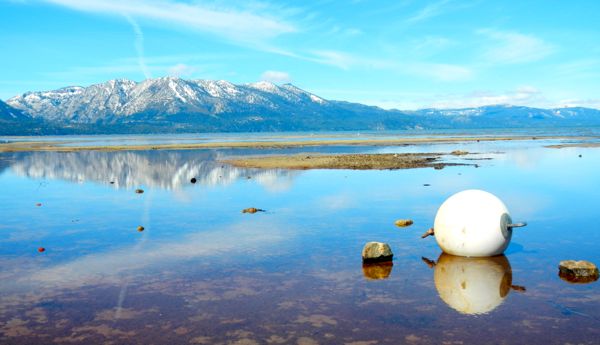
Lake Tahoe clarity is an ongoing issue. Photo/Kathryn Reed

Lake Tahoe clarity is an ongoing issue. Photo/Kathryn Reed

One of the early complaints from the jurisdictions having to comply with the unfunded TMDL mandate was the cost. Larsen told the board it’s important for Lahontan to be an advocate for the stakeholders when it comes to securing funding for projects.

Another tactic is to crack down on lax maintenance of erosion control measures – or best management practices.

Larsen said he is cautiously optimistic that the decline of Lake Tahoe’s clarity is stabilizing.

The Lake Tahoe TMDL is a 65-year program, with this being year four. The goal after all that time is to be able to see what amounts to a white dinner plate being visible 100 feet below the surface of Lake Tahoe. Larsen said the 2016 goal of 71 feet of clarity is on target to be met.

Because the urban runoff is responsible for 70 percent of the fine particles reaching the lake, that is where the emphasis is.

Non-urban areas are also a concern, with unpaved roads in the forest being the biggest problem. Since 2004, the U.S. Forest Service has decommissioned more than 200 miles of roads.

All of the initiatives are likely to help improve the near shore as well, Larsen said. This is the beach area that has turned murkier as the water temperature increases. This area is also being studied by other agencies to determine other reasons why the water is more brown than clear.

While Lahontan only has jurisdiction in California, the TMDL is a joint policy with Nevada. A universal website has been established to encompass what is going on lakewide.

TMDL is not unique to Lake Tahoe. Lahontan also has jurisdiction over the TMDL program for Heavenly Valley Creek, Indian Creek Reservoir, Squaw Creek, Blackwood Creek, and Truckee River.

Rich Booth with Lahontan gave a summary to the board about those water bodies. He said the four main pollutants are metals, nutrients, total dissolved solids, and other things, with bacteria being part of the other.

All but Squaw Creek are on target to meet the 20-year compliance goal, Booth said. He called the increase in fine sediment “disturbing”.

The agency is also going to take a harder look at the Truckee River because by the current standards it is in compliance. However, last year the Truckee River Watershed Council presented information to the board saying it is still an impaired waterway. It’s likely the goals will be reconfigured.


Chinese tourists are headed your way with $264 billion

By Edna Curran, BloombergBusiness

Book your holiday now, before a wave of 174 million Chinese tourists snap up the best bargains.

Already the most prolific spenders globally, the number of Chinese outbound tourists is tipped to soar further as the millennial generation spreads its wings.

Here are the numbers: 174 million Chinese tourists are tipped to spend $264 billion by 2019 compared with the 109 million who spent $164 billion in 2014, according to a new analysis by Bank of America Merrill Lynch. To put that in perspective, there were just 10 million Chinese outbound tourists in 2000.

Read the whole story


Placerville hotel construction moving forward

By Mark Anderson, Sacramento Business Journal

A SpringHill Suites hotel project in Placerville that had a site plan approved years ago but went dormant after the economic downturn is again moving forward.

The 124-room hotel proposal won approval in January 2010, but at the time the country was in the midst of the financial crisis. The crisis also wiped out much of the lodging market with declines in leisure and corporate travel. Hotel business in Northern California is now making new construction viable again.

Forni Business Park LLC is a partnership that proposes the hotel on 3.3 acres on the west side of town just off Highway 50.

Read the whole story


South Tahoe cops searching for parolee

Officers on March 12 look for a fugitive near the businesses at Timber Cove Pier in South Lake Tahoe. Photo/Denise Haerr

Officers on March 12 look for a fugitive near the businesses at Timber Cove Pier in South Lake Tahoe. Photo/Denise Haerr

South Lake Tahoe police officers and El Dorado County sheriff’s deputies have been looking for an at-large parolee since early Thursday evening.

Reports are that the fugitive fled out a window at the Beverly Lodge in South Lake Tahoe on March 12 shortly after 5pm and then went to the parking lot as Lakeland Village.

Officers have also been scouring the Timber Cove Pier area.

The man is described as white, buzz haircut, round face, with cheek piercings and tattoos. He was last seen wearing jeans and no shirt.

It is not known why officers are trying to track him down. No South Lake Tahoe police officers were available for comment.

— Lake Tahoe News staff report