Nev., Del. poker players can play together online

By Associated Press

State officials say a multistate online poker network allowing gamblers in Delaware and Nevada to play against one another is up and running.

Govs. Jack Markell of Delaware and Brian Sandoval of Nevada announced the start of the network on Wednesday.

The network is the result of an agreement that Markell and Sandoval signed in February 2014.


Pine tree-killing beetles thrive in drought

By Lewis Griswold, Fresno Bee

PINEHURST — A massive die-off of pine trees in the southern Sierra Nevada caused by beetles attacking drought-stressed trees is turning forests brown and creating a fire tinderbox.

From El Portal in Mariposa County to Kernville in Kern County and beyond, stands of dead trees are striking fear in the hearts of mountain residents.

“You drive around and it’s all around us,” said Lee Duncan, who lives in Miramonte in Fresno County near Pinehurst. “It’s like a gasoline can everywhere.”

About the only hope in halting the die-off is for the drought to end, an unlikely occurrence this year as winter ended with perhaps the lowest Sierra snowpack on record.

As a fourth year of drought looms, mountain residents are stuck with the cost of removing dead trees next to their homes and loggers fault the U.S. Forest Service for not allowing them to thin forests. But forest managers say the tree die-off might help Mother Nature.

Read the whole story


Feds need $11.5 billion to fix public lands

By Jenna McLaughlin, Mother Jones

In 2014, the 300 million visitors to U.S. national parks may have noticed the potholes in the roads, the magnificent vistas obscured by dense brush, dirty visitors’ centers in need of basic repairs, trails that were not maintained, and overgrown campgrounds. Why? Blame Congress, which has routinely purchased new federal lands over the last 20 years while neglecting to fund the maintenance of existing national parks. National parks and historic sites need almost $12 billion in upkeep — or about four times the National Parks Service’s annual budget. Meanwhile, congressional Republicans proposed a budget that would slash spending by $5.5 trillion in 10 years.

So why the backlog? The NPS claims that stingy funding from Congress has forced park employees to make tough decisions about which repairs to perform and which to put off. But Sen. Lisa Murkowski, R-Alaska, and many conservationists place most of the blame on the government, which has bought up new land instead of spending money maintaining the sites it already administers.

“We spend hundreds of millions of dollars each year to acquire additional federal lands, but none of that funding is applied to the maintenance backlog,” she wrote in a 2013 op-ed in the Hill.

With an annual budget of $3 billion, the NPS is responsible for managing and maintaining 75,780 sites across the country — including such tourist destinations as the Grand Canyon, San Francisco’s Golden Gate National Recreation Area, Ellis Island, Mt. Rushmore, Yellowstone — and many of the nation’s most iconic NPS-administered landmarks are fast falling into disrepair.

Read the whole story


Vehicle broken into at Tahoe trailhead

This person is being sought in connection with  using a stolen credit card. Photo/Provided

This person is being sought in connection with using a stolen credit card. Photo/Provided

A credit card stolen from a trailhead off Upper Kingsbury Grade was used at the Walmart in Gardnerville.

A reward is being offered for information that leads to the arrest and conviction of the perpetrator. Call Douglas County Sheriff’s Department at 775.782.5126 or Douglas County Secret Witness at 775.782.7463.

The victim had parked her vehicle off Andria Drive in Stateline on March 5. When she came back from hiking she found her window smashed and contents of her purse stolen. The credit card was used later that afternoon.

— Lake Tahoe News staff report


NDOW investigating injured Tahoe goose

By Kellene Stockwell, KTVN-TV

The Nevada Department of Wildlife says it’s trying to find a way to help a goose that is stuck near Lake Tahoe with an arrow through its body.

Viewer Mark Sarkissian sent us a photo and video of the injured goose near Cave Rock.

He says he first noticed the bird on Sunday afternoon.

Read the whole story


Sides being drawn over SLT vacation rentals

By Jessie Marchesseau

Residential neighborhoods in South Lake Tahoe being used for tourist lodging are beginning to divide the town.

More than 100 people packed the City Council chambers for Tuesday’s vacation home rental workshop, while still more looked and listened in from outside the door. The meeting, originally scheduled for 1½ hours, lasted twice that long, with more than two hours taken up exclusively by public comment.

Dozens of people voiced their opinions on the subject, including residents who do not own vacation rentals, and residents who do, property managers, contractors, real estate agents and business owners.

While there did not appear to be a unanimous opinion on any of the topics, it was generally agreed upon that stricter enforcement was needed. However, there was a divide when it came to who should be fined, the owner or the renter.
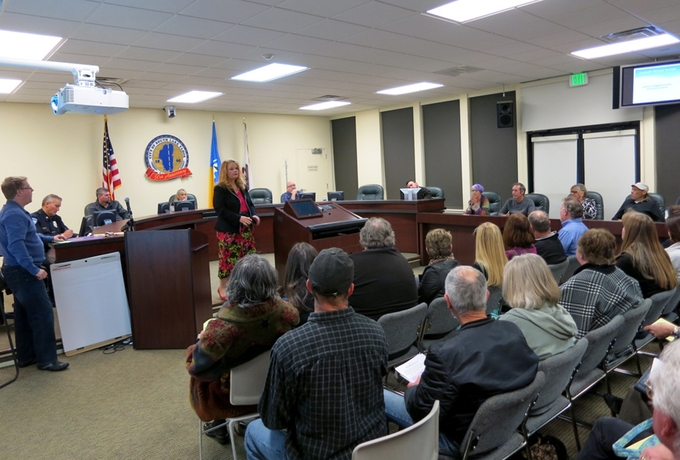
City Manager Nancy Kerry   outlines proposed changes to South Lake Tahoe's vacation home rental ordinance. Photo/Jessie Marchesseau

City Manager Nancy Kerry outlines proposed changes to South Lake Tahoe’s vacation home rental ordinance. Photo/Jessie Marchesseau

People weighed in on the proposed amendments and some proposed their own. Many shared experiences as neighbors, owners, renters and managers.

Non-VHR-owning residents voiced the most concerns and complaints with some going so far as to request a moratorium on VHRs altogether. This is not likely to happen though, as City Attorney Tom Watson said such a move would almost guarantee a lawsuit.

In the end, no final decisions were made at the March 24 meeting; however, the City Council received myriad comments and feedback with which to move forward.

“This is to have all sides heard,” Watson said. “Both opinions are important to the community.”

City Manager Nancy Kerry reiterated how residents as well as VHR owners have property rights that must be respected and taken into consideration when creating new ordinances. She said the city is aiming to balance the needs of everyone, not just serve one group. They are considering how any changes will affect real estate values, the tourist economy, the environment, the community, and the quality of life for residents and business owners. Taking all those things into account, Kerry presented the city’s proposed amendments.

According to the city’s research, there are four main issues with VHRs causing a negative impact on the quality of life for local residents: noise, trash, parking and the commercialization of neighborhoods.

Increased enforcement of regulations would include possibly hiring an additional enforcement officer for one year and conducting on-site visits to check for compliance. Increased fines, citations to renters and owners, and the elimination of the first time violation warning in lieu of a fine are all on the table.

Another proposed amendment is to provide incentives for owners to use local property management firms as opposed to doing it themselves through services such as VRBO. This incentive would be in the form of lower permit fees for locally managed properties. The proposed fees for properties not having a local manager would be double those of locally managed properties.

The new fee structure would also be based on occupancy, meaning larger homes would have higher permit fees. The council suggested changing the occupancy limit from two people per bedroom plus four, to just two per bedroom, exempting children under 10. The hope is this will help to reduce both the noise and parking issues often plaguing vacation rentals.

Also addressing the noise issue was the proposal to restrict hot tub use after 10pm as well as any use of outdoor speakers or other noisy equipment or activities. When it comes to parking, the possibility of neighborhood permits was mentioned, but Police Chief Brian Uhler pointed out that it is not possible to limit public parking on public streets. Any enforcement must be limited to illegally parked vehicles.

To help remedy the issue of vacationers leaving trash on the curb for days, the city could require VHRs to have bear boxes. However, there was some concern that this could become unsightly.

The Council will discuss the topic further at the April 7 meeting. The first reading of the new ordinance will likely be April 21.




Customer data may be sold in RadioShack bankruptcy

By Joshua Brustein, BloombergBusiness

The remnants of RadioShack’s retail empire went on the auction block on Monday, giving bidders the first chance to snap up the company’s trademarks, patents, leases—and the names, e-mail addresses, and phone numbers of millions of RadioShack customers.

For RadioShack itself, the stakes are enormous. Bloomberg News reported Tuesday morning that Standard General, a hedge fund that is one of RadioShack’s creditors, has won the auction. Hanging in the balance on Thursday, when a federal bankruptcy court is expected to approve or reject the asset sale, is the continuation of the 94-year-old retailer’s operations. Standard General has said it will try to keep the retail chain operating on a smaller scale.

RadioShack’s customers—even those whose most recent purchase came years ago—could also find themselves sold off in the deal. The company included personal data in its bankruptcy auction as its own asset class. A website maintained by Hilco Streambank, which is serving as an intermediary for RadioShack, says that more than 13 million e-mail addresses and 65 million customer names and physical address files are for sale. Hilco Streambank is careful to note that the bankruptcy court might not approve the deals, and there have already been two legal filings in attempts to block the sale of customer data.

Read the whole story


Nev. bill would create repeater felony for graffiti crimes

By Associated Press

CARSON CITY — Nevada lawmakers are reviewing a bill creating a felony charge for repeated graffiti offenses.

Republican Assemblyman Lynn Stewart is sponsoring AB 244 which was heard Tuesday morning in the Assembly Judiciary Committee.

The bill would require a person convicted of three graffiti offenses would be guilty of a category C felony which includes a one to five year prison sentence.

Graffiti offenses can range from a misdemeanor to felony based on the amount of damage and where the crime takes place.

Las Vegas police lobbyist A.J. Delap said the bill would mainly target repeat adult offenders who continuously violate the law.

Clark County Public Defender’s Office lobbyist Steve Yeager said the current law sufficiently covers graffiti offenses and worried the bill would harshly affect juveniles.


LTUSD-LTCC seek seamless transition

LTUSD and LTCC board members meet March 24 for the second consecutive year. Photo/LTN

LTUSD and LTCC board members meet March 24 for the second consecutive year. Photo/LTN

By Kathryn Reed

Education and life post high school graduation are becoming less distinct transitions in South Lake Tahoe.

Instead of the solid lines between grade levels and physical entities, the powers that be are on a quest to make it a seamless transition. Lake Tahoe Unified and Lake Tahoe Community College are trying to blur the lines between the academic institutions.

This will be accomplished in several ways. Part is through a dual enrollment program that was unveiled Tuesday night to LTUSD and LTCC board members. This was the second joint meeting of the two elected boards.

The goal is to develop a memorandum of understanding that would have a South Tahoe High School teacher teaching a college-level course. The dual enrollment concept has been around since 1974. Today 60 high schools in California participate in dual enrollment.

LTUSD Assistant Superintendent Ivone Larson and LTCC Dean of CTE & Instruction Virginia Boyar jointly presented the idea to the elected officials March 24.

Dual enrollment allows high school students to get a head start on college credits.

Still to be determined is what the cost, if any, of these classes will be for STHS students. No matter what, LTCC will be able to count them as students, which allows the college to get financial reimbursement from the state.

“Dual enrollment offers high school students the opportunity to complete college level courses while still attending high school,” the staff report said. “These college courses can occur at the college, on the high school campus, or online. Courses that are completed through dual enrollment appear on both the students’ high school and college transcripts.”

Up to 30 semester units may be obtained.

Complementing this will be the Get Focused Stay Focused Initiative. This two-year pilot program that ends in December 2016 involves seven community colleges in the greater Sacramento area, including LTCC.

It will start this fall with the incoming freshmen class, with the pilot program ending after the first semester of their sophomore year.

The goal is to get students to think about their future and not just be in the moment. Flexibility is built in so teens can change their minds about what they want to do in the future. It’s not all about having a college degree be the end goal, but instead about having a plan for their lives.

The semester-long class is designed to get students to have realistic discussions regarding the realities of life. It means if their goal is to live in Glenbrook and they want a job in retail, then one of those goals needs to change. They will be taught about economic realities, what to do to achieve dreams, and know that college does not have to be the answer.

“There is a pathway for everyone,” Boyar said.

Students will develop a 10-year education and career plan.

An advisory committee will be put together between LTUSD and LTCC officials to solidify the plan.

What high schools that have the Get Focused Stay Focused Initiative have found is that students are more engaged, not as many kids drop out, and graduation rates increase. Colleges like that students arrive with a plan of study, need fewer remedial courses and are focused on a goal.


Break for gaming, mining, others in Sandoval tax bill

By Kyle Roerink, Las Vegas Sun

CARSON CITY — Buried in the 130-page tax bill that Gov. Brian Sandoval pitched to lawmakers last week, there’s a safe haven for mining, gaming, insurance and bankers.

The tax, known as the business license fee, is a broad-based framework that would levy new dollars from the state’s 330,000 businesses based on percentages of their gross revenues every fiscal quarter. Section 20, which outlines a series of deductions and exemptions, is what all special interests are looking at in the bill. It cuts new loopholes into law and protects some industries from double taxation. An array of the state’s industries are eligible: mining companies, aircraft manufacturers, gaming operations, insurance companies, hospitals, retailers and others.

Critics of the bill say the deductions and exemptions could lead to a slippery slope of largesse as Sandoval and other lawmakers in support of the tax try to push the bill through the Legislature. In other words: If one industry gets a break, others will come with their hands out.

Read the whole story