Legislature wants NHP officers to wear cameras

By Associated Press

CARSON CITY — Nevada lawmakers have approved a measure requiring all Nevada Highway Patrol troopers to wear portable body cameras by 2016.

Assembly members voted to approve SB111 on Monday, and the measure now goes to Gov. Brian Sandoval for approval.

The measure is sponsored by Democratic Sen. Aaron Ford and transfers nearly $1.3 million over two years to outfit more than 400 troopers with portable body cameras.

The bill requires the highway patrol to have regulations in place for troopers wearing the cameras by July 2016.

Lawmakers approved AB162 earlier in May, which requires police to set certain regulations on wearing portable body cameras and clarifies that footage captured on the cameras is a public record.


Stateline casino worker accused of stealing winnings

By Associated Press

STATELINE — A Lake Tahoe casino employee has been arrested on suspicion of theft after police said he made off with a bundle of $100 bills totaling $10,000 that had been accidentally dropped by a gambler.

Douglas County sheriff’s deputies say the gambler had won $70,000 and was walking to an elevator from the Harrah’s Lake Tahoe casino floor when he dropped the wad of cash early Wednesday.

Contract janitorial worker Richard Ferrer is accused of sweeping the money into a dustpan, then heading to the employee break room.

The entire incident was caught on tape and the suspect told security personnel he stashed the money in a garbage can, where all but $100 was recovered.

The 36-year-old Ferrer told deputies he intended to turn the money over to his supervisor at his next break except for $100, which he planned to keep to himself. That $100 was found under the same garbage can.

The policy for the Stateline casino and the contractor calls for employees to turn such money over to security.


1 oz. cocaine, illegal ammo seized in S. Tahoe

An armed ex-convict and two others were arrested early June 1 near the state line.

What started as a noise complaint at two rooms of the Big Pine Mountain House on Cedar Avenue ended with three arrests, about 1 ounce of cocaine being confiscated, along with scales and packaging material, and a .40-caliber handgun with an illegal high capacity magazine.

“Normally that’s an amount connected to distribution,” South Lake Tahoe Police Chief Brian Uhler told Lake Tahoe News of the coke.

Kevon Lomach, 26, of Sacramento was found sitting on the floorboard of a vehicle with the door open when officers arrived Monday about 2:30am. He was wanted on a misdemeanor arrest warrant. Officers also found the handgun on him, which is illegal for a felon to possess.

Two people in one of the rooms tried to flee out a back window but were detained by officers in the room.

Also arrested were Tiana Perez, 18, and Chris Jackson, 22, both of Sacramento and both on drug charges. Jackson was on criminal probation for attempted pimping.

A 19-year-old woman who is believed to be Lomach’s girlfriend was not arrested.

“It’s not uncommon for people to come from outside the area to think they are going to peddle their drugs. I don’t know if it is connected to prostitution, but certainly there was that element with that guy who had that history,” Uhler said.

— Lake Tahoe News staff report


Using rain barrels a violation of Nev. water rights

By Mark Robison, Reno Gazette-Journal

Can you use a rain barrel to collect water in Nevada?

Short answer: 

No.

Full answer:

During spates of rain as we’ve had recently, the topic of rain barrels comes up.

These are what they sound like: a barrel that you collect rain or other precipitation so that you can use or redirect the water later.

How they work generally is that the downspout coming from the roof gutter is cut or has a diversion spout so rain empties into a barrel. Barrels then have a faucet inserted into the base. A hose can be attached to redirect the water when and where needed.

This is not legal in Nevada.

Read the whole story


South Lake Tahoe pot shop raided

By Kathryn Reed

Various law enforcement agencies descended upon Tahoe Wellness Cooperative on Monday afternoon.

Search warrants were executed June 1 at the marijuana collective and at owner Cody Bass’ home in South Lake Tahoe.

“A lot of evidence was taken that needs to be reviewed and audited before a decision is made (about any arrests),” Jim Clinchard, El Dorado County assistant district attorney, told Lake Tahoe News. “The investigation relates to tax evasion and possession of marijuana for sale.”

What exactly was confiscated was not released.

No one was answering the phone at the collective so it is not known if the shop will stay open. Authorities did not shut it down.

TWC is the only remaining pot dispensary in South Lake Tahoe. There was a time when there were three. The city has created an ordinance where no new ones may open without City Council approval.

Collectives have long been in a tax void because of the federal government not recognizing medicinal marijuana as a legal substance. That is also why most collectives are not able to open a business bank account and do transactions via cash.

Assisting with what was described as a long and ongoing investigation were South Lake El Dorado Narcotics Task Force, South Lake Tahoe Police Department, El Dorado County Sheriff’s Department, state Board of Equalization and the Employment Development Department.


Pesticides used at levels that defy warnings

By Andrew Donohue and Bernice Yeung, Reveal

California continues to allow one of agriculture’s most popular and potent chemicals to be used under rules its own toxicologists have said aren’t scientifically sound.

As a result, residents in farming counties such as Kern, Fresno and San Joaquin are being put at a higher risk of cancer than state scientists believe to be acceptable, internal documents and interviews show.

A Reveal investigation last year showed how the state’s Department of Pesticide Regulation gutted regulation of 1,3-Dichloropropene at the request of its manufacturer, Dow AgroSciences. In the past year, state officials have begun to rein in the use of the pesticide, a gas injected into the soil before planting crops such as strawberries and almonds.

This has limited the most excessive use in Ventura, Monterey and Merced counties, which went beyond what even Dow had envisioned. But the recent changes don’t mean the department closed the loophole that allowed the excess use.

It simply has gone back to enforcing the original outlines of the Dow loophole, meaning growers in communities across the state still legally can use the pesticide at levels that state scientists have said are unacceptable, newly released data for 2014 shows.

Last year, growers went past the original safety limits in 20 communities in Fresno County and in communities in Monterey, Santa Barbara and Kern counties, among others.

In total, growers in 54 townships went over the cap in 2014, according to department documents. That’s an increase from 2013, when 47 did. In the areas that went over the cap, the most common crops were almonds, grapes and strawberries.

Joseph Frank, a retired state toxicologist who oversaw the department’s review of 1,3-D, said top state officials chose Dow’s analysis over their own scientists’ analysis.

“It is playing games with numbers, and we’ve told management this,” he said.
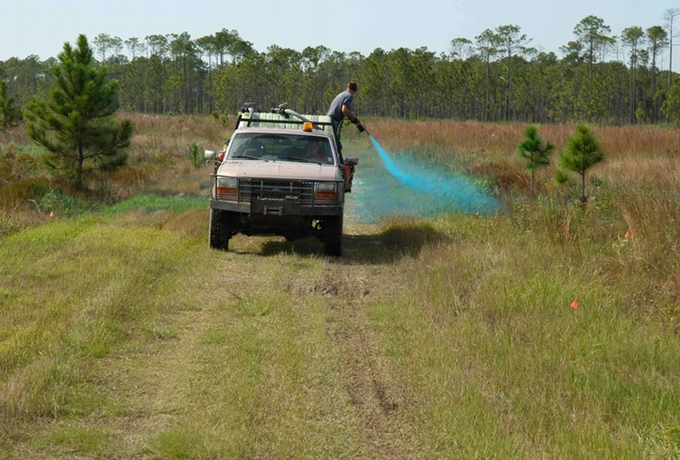
Pesticides are regularly being used despite health concerns. Photo/USFWS

Pesticides are regularly being used despite health concerns. Photo/USFWS

The department said it’s doing a new analysis of the health impacts of 1,3-D, an exercise known as a risk assessment. Staff toxicologists are reviewing the science around 1,3-D and will issue safety guidelines to top managers. From there, managers will balance that science with a pesticide’s benefits to design rules about how it can be used.

“The risk assessment will provide the scientific basis for a new plan to manage the use of this pesticide,” said department spokeswoman Charlotte Fadipe.

Dow said the original state limits are based on conservative estimates and outdated science. Recent real-world air monitoring and studies on how long people live in one place show that the loophole doesn’t cause public health concerns, the company said.

That 1,3-D is considered a cancer-causer in California doesn’t on its face have to be alarming. We’re constantly surrounded by things that could cause cancer, like the sun or arsenic in rice.

As the saying goes, the dose makes the poison.

The 1,3-D loophole highlights a core tension in how the government handles these doses.

While the pesticide regulation department’s mission is to protect human health and the environment, its regulations often reflect a compromise between scientists’ recommendations and the benefits a pesticide gives to the powerful agricultural industry.

This is generally how governments handle industrial chemicals. The name of the process manages to be at once bureaucratic and straightforward: risk management.

However, in the case of 1,3-D, there was little compromise. In the early 2000s, growers needed something to fill the gap left by an international ban on what was once their go-to pesticide, methyl bromide.

1,3-D fit the bill. It’s a byproduct of plastic manufacturing that Dow has turned into an effective pesticide. But the state says it can cause cancer. Some 1,3-D eventually escapes into the air and can be breathed in by neighbors and workers.

Because of concerns over how much 1,3-D lingered in the air, the pesticide faced tight restrictions. The state had gone through a rigorous process to decide how much 1,3-D could be used. That limit already was stretching the boundaries of what state scientists thought was acceptable, Frank said.

But those limits didn’t last long. Despite warnings from his own scientists, the department director at the time, Paul Helliker, signed off on Dow’s request to loosen the rules. He and his successors then stopped enforcing the rules altogether, allowing excess 1,3-D use in agricultural communities across the state.

Because of all the different factors that can cause cancer, there’s little way of knowing definitively whether anyone has gotten or will get cancer because of 1-3,D. But the excess use does increase the probability, the state scientists say.


The state already had a complicated history with 1,3-D.

In the early 1990s, it pulled 1,3-D from the market after learning how much lingered in the air after it had been applied. Air monitors at a Merced middle school picked up levels that were 800 times what the state said was acceptable on one day.

After five years of research, Dow persuaded state officials to put it back on the market. The state, though, needed a way to limit the amount of 1,3-D that could be used in each community. So regulators divided the state into small grids, 6-by-6-mile squares known as townships, and capped the amount of 1,3-D that could be used by growers in each township at 90,250 pounds a year.

At this level of use, scientists projected it could cause one extra cancer case per 100,000 people. The rules management put into place, Frank said, already were pushing the boundaries of what scientists thought was appropriate. State scientists previously had suggested that the department try to limit that risk to one cancer case per 1 million people. But state officials said Dow had argued that those restrictions would make it impossible to use 1,3-D.

A couple of years later, Dow and growers began pressuring the state to loosen those restrictions.

The proposed Dow plan worked like cellphone rollover minutes: If growers in a township didn’t use all of their annual 1,3-D allotment in previous years, they could save it in a bank and use that much more in future years.

Each year, growers could use up to double the amount of 1,3-D that the original rules allowed – 180,500 pounds, so long as they had that amount saved up in the bank.

Dow and the department directors said that because cancer risk is averaged over 70 years, allowing a few years of increased use was fine as long as it all averaged out over time.

Scientists objected, saying anything over the annual limit violated the science underpinning the regulations. They said the concept of banking didn’t hold water. Just one year of high exposure, Frank said, could provide the catalyst that may eventually give someone cancer.

Here’s how one outside expert described it in our November story:

Chensheng Lu, an associate professor at Harvard University’s School of Public Health, likened the averaging idea to drinking and driving. If you get pulled over once and you are sober, but you are pulled over a second time and your blood alcohol level is twice as high as the legal limit, you can’t average the two incidents and say everything is fine. “This is a very dangerous approach,” Lu said.

In 2002, Helliker, the department director at the time, agreed with Dow, adopting the heart of its plan.

Once the Dow loophole was in place, top department officials essentially stopped regulating 1,3-D. In 2004, they began allowing growers to exceed the limits they had set – to the point that the exception became the rule. Agricultural businesses essentially had unfettered access to the chemical.

Over 12 years, growers in one Merced community used 1 million pounds more 1,3-D than they were supposed to even under the Dow plan.

Growers near Oxnard’s Rio Mesa High School, which is surrounded on all four sides by strawberry fields, far surpassed the 180,500-pound limit under the Dow plan. In 2006, they used 267,000 pounds. Over 12 years, they used 317,000 more pounds 1,3-D than they had in the bank.

1,3-D use increased by more than 200 percent across the state. As it became a hit with strawberry growers, it increasingly was used near schools, homes and businesses in more populated areas like Ventura County.

Between 2002 and 2012, 1,3-D use in Ventura jumped 1,174 percent.

All told, people in more than 100 California communities have been at greater cancer risk, interviews with former state scientists and internal documents show.

Scientists with the Department of Pesticide Regulation have analyzed this system twice since Dow began floating the concept. Both times, state documents show, they objected to the basic plan put forth by Dow and top officials.

“We are unaware of a defensible scientific rationale justifying such a practice,” staff toxicologist Linda Hall concluded in a 2009 study.

Frank, who was Hall’s boss at the time, said his team consulted experts at Harvard and the Massachusetts Institute of Technology. “We could not find anyone in the field who disagreed with us,” he said. “It wasn’t even debatable.”

Department leaders have been unable to provide a competing scientific analysis, outside of Dow’s, that justifies the loophole.

Early last year, following inquiries from Reveal, Department of Pesticide Regulation Director Brian Leahy said the department would stop issuing 1,3-D exemptions.

The new state data reveals the limits of that decree.

Growers still may go above the 90,250-pound annual limit if they have 1,3-D in the bank. And the growers who accrued negative balances won’t be monitored to ensure that they pay back their debt.

The department appears to be hoping that things eventually average out.

Fadipe, the department’s spokeswoman, said simply holding the most prolific 1,3-D users to under 90,250 pounds “will not increase the average concentration.” She continued: “You are either reducing the average air concentration (over 70 years) or not increasing it.”

But that doesn’t mean it will all add up.

Take the Merced community where growers used 1 million more pounds than they were supposed to under Dow’s plan. In 2014, they used 80,377 pounds of 1,3-D.

If growers there used that amount each year for the next 50 years, the township’s 70-year average since 1995 still would be more than the 90,250-pound cap – 97,841 pounds. But there’s no fixed year that the 70-year average starts and stops, so choosing a timeframe for averaging becomes arbitrary.

Still, Leahy has trumpeted his decree as if it were a get-tough regulation, rather than a return to following the rules of the loophole.

In Leahy’s response to pointed questions from school officials in charge of Rio Mesa, here’s how a department fact sheet described the regulatory history of 1,3-D and other pesticides:

“Based on its scientific analysis of monitoring data and computer modeling, DPR (the Department of Pesticide Regulation) implemented a series of requirements beginning in the mid-1990s, including restrictions on application methods, buffer zones, limits on use, and other protection measures for metam (sodium), methyl bromide, and 1-3,D. In February 2014, DPR implemented additional restrictions to further reduce long-term exposure to 1-3,D. DPR will implement restrictions for chloropicrin in 2015. DPR is likely to further update its restrictions for 1-3,D in 2016.”

The fact sheet skips straight from the 1990s to Leahy’s February 2014 decree, leaving out the loosened regulations and broken rules in between.


Caesars studying restoration of lost retirement payments

By Howard Stutz, Las Vegas Review-Journal

The general counsel for Caesars Entertainment Corp. told the Nevada Gaming Commission on Thursday the casino company was going through a “painstaking” process to determine how its bankrupt division can restore lost retirement and deferred compensation payments to current and former employees.

The issue came up during a routine suitability finding for one of Caesars’ executives.

Caesars halted some $78.6 million in monthly payments in January when it filed a Chapter 11 bankruptcy for its largest operating unit. This month, the company resumed payments to workers in two of five deferred compensation plans when it was determined the parent company was partially liable for those funds.

Caesars said in March the payments were halted because, under bankruptcy law, a company in a Chapter 11 reorganization, can’t separate supplemental retirement plans from other unsecured creditors.

Read the whole story


Drought doesn’t prevent Tahoe development

Crews work on the golf holes that will be rerouted to accommodate Edgewood Lodge. Photos/Kathryn Reed

Crews work on the golf holes that will be rerouted to accommodate Edgewood Lodge. Photos/Kathryn Reed

By Anne Knowles

Large commercial development projects around Lake Tahoe are moving along unchanged in the midst of a historic drought.

Squaw Valley’s proposed 94-acre hotel, condo, timeshare and recreation area, Edgewood Tahoe’s 154-room lodge, and the Chateau’s multiphase retail and hotel project at Stateline are all on track.

A fourth project, Homewood Mountain Resort’s redevelopment, is mired in litigation but owner JMA Ventures expects to begin construction on the $500 million project a year from now.

Placer County has requested an update to the water supply assessment for the Squaw Valley Specific Plan environmental impact report, according to Alex Fisch, senior planner for Placer County.

That EIR became available in mid-May and public comment on the project is being accepted through July 17.

The update to the water supply assessment, provided by the Squaw Valley Public Service District, will include data on precipitation and aquifer pumping through 2014.

Fisch said the county requested a 25-year assessment of water availability. By law, a 20-year assessment is required for all projects constructing 500 or more dwelling units.

The controversial Squaw Valley plan on 85 acres includes up to 1,493 bedrooms in 850 units; 297,733 square feet of commercial space, including conference rooms, retail and restaurants; 90,000 square feet of recreational features such as movie theater, indoor rock climbing and pool and water slides; and parking. Housing for up to 300 employees and 20,000 square feet of additional commercial space is planned on another 8.8-acre parcel.

The development is expected to take 25 years to build and, according to the EIR, will need 234 acre-feet of water annually by 2040.

“It’s difficult to say how much water it will need in the intervening years,” Mike Geary, SVPSD general manager, told Lake Tahoe News.

“The county, to its credit, is allowing a flexible phasing plan. So many projects are affected by market forces so the county just said build it how you want.”

SVPSD plans to drill four wells on the property to deliver the water.

SVPSD is also developing an 8-mile pipeline to the Martis Valley to import water into Olympic Valley as a redundant, emergency source of water for existing customers, says Geary.

Water purveyors are still working out the details for future phases of the Chateau project in South Lake Tahoe.

Water purveyors are still working out the details for future phases of the Chateau project in South Lake Tahoe.

Also in Placer County is Homewood’s controversial redevelopment project, which includes hotel, retail and new base area. That project’s EIR outlines two alternatives for water. One alternative calls for Tahoe City Public Utility District to be the sole water provider. A second alternative says TCPUD would supply water to the south base area while Madden Creek Water Co. would supply the north base.

It estimates water demand at 385 acre-feet per year for the south base, 134 acre-feet per year for the north base and 43.6 acre-feet a year for snowmaking.

Calls to JMA Ventures to clarify the project’s plans were not returned.

Water for the long-delayed build out of the Chateau project is still being ironed out. When the project was initially permitted, South Tahoe Public Utility District was going to deliver service to the bigger portion of the development, the convention center and a 400-unit hotel, while Lakeside Park Association was set to supply so-called project B, 125 time-share units.

Now, the two purveyors are in negotiations about who and how to deliver service to the significantly altered project. STPUD provides service to the retail that has already gone in. The storefronts currently use 1,480 gallons per day, according to Richard Solbrig, STPUD general manager.

(The permit on STPUD’s portion of the original plan, for a convention center and hotel, called for 77,700 gallons per day, Solbrig said.)

Solbrig told Lake Tahoe News it’s unclear where the overall project is going next, although a 32-room hotel with pool big enough to accommodate two planned hotels and 19,000-square-feet of retail space is being designed now for the next phase that could break ground this summer.

STPUD and Lakeside agreed on a revenue sharing deal, since Lakeside lost most of its customer base when the project went belly up, and are working out the details now, according to Solbrig and Jack McLaughlin, president of Lakeside Park Association.

The Edgewood Lodge project is moving along, with corollary work being done now and construction on the hotel itself starting later this summer. But it’s unclear how much water the project will consume. Douglas County’s EIR on the project only mentions water quality, like what is required for the Tahoe Regional Planning Agency.

Patrick Rhamey, vice president of real estate, said an analysis of water demand exists, but he didn’t have the time to provide it to Lake Tahoe News.

The water purveyor is Edgewood Water Co., a small company that delivers water to properties totaling about 2,000 rooms, said Rhamey.

“Edgewood Lodge’s 154 rooms, excuse the pun, are a drop in the bucket,” he said.


Feds propose land controls to preserve Nev. sage grouse

By Steve Tetreult, Las Vegas Review-Journal

WASHINGTON — The Department of Interior on Thursday proposed added controls across 17 million acres in rural Nevada and northeastern California to preserve habitat and avoid an endangered species listing for the imperiled sage grouse.

Solar and wind energy development would be excluded or subject to added scrutiny across Northern Nevada, according to a new environmental impact report. Controls would be put in place for geothermal and oil and gas exploration over 15 million acres and restricted outright in 1.5 million acres of the most sensitive areas where the range birds flock.

There would be potential effects on mining and grazing in the best remaining areas for the grouse, whose population has dropped from the millions to about 200,000 to 500,000 across the West.

Read the whole story


Slow start, gradual improvement for U.S. Internet gaming

By Wayne Parry, AP

ATLANTIC CITY — Internet gambling is off to a slow start in the United States, with banks hesitant to handle credit card payments for online bets and some politicians and casino moguls pushing to ban it, but there remains potential for great growth, participants in a major gambling conference agreed Wednesday.

Despite the nascent industry’s many challenges, including illegal offshore websites that casinos admit are easier to use, gradual improvements are happening, they said.

Three states currently offer Internet gambling: New Jersey, Delaware and Nevada. Other states are considering doing so, including California and Pennsylvania.

New Jersey took in $122 million from Internet gambling last year; Delaware took in nearly $2.1 million and Nevada won $8.1 million at poker, the only game it offers online, from February to November of last year, when it stopped reporting online revenue results.

In March, Morgan Stanley cut its estimate of the potential U.S. Internet gambling market by nearly half. The firm now estimates the nationwide online betting market at $2.7 billion by 2020, down from an initial estimate of $5 billion.

Speaking at the East Coast Gaming Congress in Atlantic City, casino operators, payment processors and legislators agreed the legalized online gambling industry is still being held back by the refusal of some banks to handle Internet betting transactions, and the relatively limited liquidity in games of online poker that would be improved by having more states join together to increase prize pools.

“The biggest challenge of Internet gambling in the U.S. is that this is an industry still looked at as having been born out of sin,” said Gil White, whose law firm represents 888 Holdings. “The new world of Internet gambling is clearly regulated and regulatable.”

When online gambling began in 2013, many customers had a hard time making deposits to fund their accounts because banks refused to authorize the transactions. That has improved somewhat with new transaction codes adopted by Visa last month to narrowly recognize Internet gambling transactions from state-regulated, approved sites. That has raised Visa acceptance rates for Internet gambling from the 18 to 22 percent when it first started to about 50 percent now, said Joe Pappano, senior vice president of Vantiv Gaming Solutions, which handles electronic transfers for New Jersey online gambling sites.

Thomas Winter, vice president of online gambling for the Golden Nugget Atlantic City, also said his casino is seeing half of all attempts to fund Internet betting accounts using Visa cards accepted.

“It’s improving, but it will take time,” he said.

Raymond Lesniak, a New Jersey state senator who sponsored his state’s Internet gambling law, was blunt about the biggest challenge facing online gambling.

“The biggest problem is Sheldon Adelson,” he said of the Las Vegas Sands chairman who has vowed to spend as much as necessary to ban Internet gambling in the U.S. Adelson says he fears for exploiting “vulnerable people” and worries about children being able to access betting websites.

“When a billionaire says he’ll spend whatever it costs to stop Internet gambling, that scares the bejeezus out of legislators,” Lesniak said.

Proposed legislation to ban Internet gambling is being considered by Congress but has not yet been brought to a vote.

David Rebuck, director of New Jersey’s Division for Gaming Enforcement, said the crucial questions of preventing illegal activity and protecting customers have already been mastered, which should encourage other states to approve Internet gambling as well. He also said sports betting, if it is legalized nationwide, will take place primarily over the Internet. New Jersey is waging a court battle to overturn a ban on sports betting in all but four states.

Rebuck also said state lotteries could be the next wave of growth for Internet gambling nationwide.