SoCal woman dies in Highway 50 accident

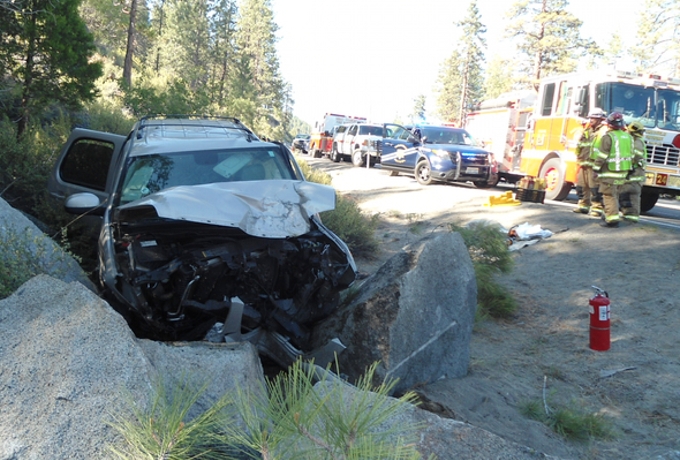
An accident on Highway 50 June 3 claimed the life one person. Photo/Provided

An accident on Highway 50 June 3 claimed the life of one person. Photo/Provided

A Southern California woman died in a single-vehicle accident near Glenbrook on June 3.

Darlene M. Hall, 75, of Skyforest was pronounced dead at the scene of the 8:35am accident on Highway 50. She was wearing her seat belt.

One of the two dogs in the vehicle also died. The other was taken to a veterinarian with serious injuries.

Hall was traveling west in a 2009 GMC Yukon when the vehicle went off the north paved shoulder and down a dirt slope. The vehicle struck several large rocks and boulders head on. The vehicle came to rest upright on its wheels.

Neither alcohol nor drugs is suspected as a factor in the cause of the incident. However, Nevada Highway Patrol troopers do not know what caused Hall to drive off the pavement.

Anyone who may have information related to this incident is asked to contact Trooper Chris Austin at 775.684.7381 or caustin@dps.state.nv.us.

— Lake Tahoe News staff report


Calif. won’t ID who’s draining the groundwater

By Lance Williams and Katharine Mieszkowski, Reveal

A new law that attempts to preserve California’s precious groundwater comes with a catch: The state will hide the names of people draining this vast underground water source, Reveal has learned.

The secrecy provision could make it impossible for the public to identify water wasters and learn whether conservation efforts are taking hold, according to documents and interviews.

One of the law’s authors, former Assemblyman Roger Dickinson, said farmers and private pumpers wanted confidentiality.

“In essence, this was a battle we didn’t think we could take on,” Dickinson said. “So we agreed to keep the confidentiality.”

At issue is little-noticed language in the Sustainable Groundwater Management Act, a package of laws that for the first time sets rules on farmers’ use of groundwater, a vital but rapidly disappearing subterranean water supply for the Golden State.

California growers provide the country with almost half of its fruits, vegetables and nuts. In a normal year, they rely on groundwater for about one-third of their entire water supply. Years into a historic drought, it can account for more than half.

Meanwhile, groundwater management has been a free-for-all, with farmers drilling ever-deeper wells and pumping as much water as they want with little regulation or scrutiny.

The result: Some rural aquifers have been subject to such intense pumping that they are in danger of drying up. Some rural residents’ taps have gone dry, and growers have chopped down orchards fields and fallowed fields. In parts of the Central Valley, the earth has sunk as much as one foot per year as the water has been drained beneath it.

The Legislature tried for years to address the issues. The package of bills that finally passed – hailed as historic by Gov. Jerry Brown when he signed them in September – has a long lead time but ambitious goals.

The new laws require officials to identify regions in California where aquifers are in danger of drying up. It gives water officials the power to limit overdrafts.

And, for the first time, the laws require farmers and other well operators in affected regions to account for how much water they are drawing from the ground. The most-stressed aquifers must be recharged and brought to sustainability by 2040.

For decades, water use data was a matter of public record in California – at least for residential and commercial customers of public utilities.

During the last drought, in 1991, news stories naming and shaming water wasters led to important reforms. But in 1997, in response to privacy concerns about Silicon Valley tech executives, the Legislature weakened the state Public Records Act to make water consumption information confidential.

In discussing the groundwater measures, water agencies wanted that same confidentiality provision applied to groundwater users.

Environmental groups, including Sierra Club California and Clean Water Action California, argued that the confidentiality language was too broad. They feared it could be used to hide not just the names of the pumpers, but also how much water was being pumped. They didn’t get much traction.

James Wheaton, legal director of the Oakland-based Environmental Law Foundation, called the secrecy provision “jaw dropping.” He said lawmakers are saying, “We’re going to finally regulate and monitor groundwater, and we’re going to keep it all secret.”

The foundation is suing to open confidential records about groundwater contamination on the Central Coast, arguing that state secrecy violates a fundamental principle of democratic governance.

A cloak of secrecy already shrouds other important information about California’s groundwater. Well logs, documents filed by well operators that could provide scientists with important information about the condition of aquifers, are secret in California, though they are public records in other Western states.

Dickinson, a former Assembly Democrat from Sacramento and co-author of the groundwater legislation, said confidentiality became “a very sensitive subject” as the bills were being written.

Over the years, some agencies have made water-extraction data public, and others have refused, said Dickinson, now a lawyer in Sacramento. Farmers and private pumpers opposed making the information public, and in the end, proponents feared that a debate over confidentiality might kill the entire effort to regulate groundwater, he said.

He said he believes additional legislation likely will be necessary “somewhere down the road” to make more information about pumping public.

Dickinson’s co-author, Sen. Fran Pavley, D-Calabasas, has trumpeted the groundwater bills as a major legislative achievement. But she wasn’t interested in talking about the secrecy issue.

Through an aide, Pavley declined requests for an interview. At one point, the aide said Pavley was unavailable for a phone interview because she was on a plane to her district in Los Angeles County. Asked whether she could be interviewed after the plane landed, the aide said that wouldn’t be possible, either.

“We’re not going on the record on this,” the aide said.


Calif. water use fell 13.5% in April

By Associated Press

Ordered to use a fourth less water during this record drought, Californians managed to get about halfway to their goal in April, regulators announced Tuesday.

California residents reduced overall water usage by 13.5 percent compared to the same month in the benchmark year of 2013, water officials said.

That’s the second-best conservation achievement since state officials started closely tracking water use more than a year ago, but falls short of the 25 percent cuts Gov. Jerry Brown that became mandatory for cities and towns on June 1.

“Local communities are stepping up in a way they weren’t before, and I’m hoping that’s why we are starting to see the uptick” in conservation, said Felicia Marcus, chairwoman of the state Water Resources Control Board, which compiles usage reports from more than 400 water agencies around California.

“The real challenge is, we really have to step it up for the summer months,” Marcus said. “If we miss the summer, we are toast.”

April’s still-lackluster achievement could set off more alarm bells about the severity of California’s drought and the need for much more conservation.

This year’s snowpack in the Sierra Nevada is dismal, with surveyors on April 1 finding the lowest-ever water level up in the mountains. Brown used that grim news as a backdrop when he announced sweeping and unprecedented conservation measures.


Woman, dog die in Hwy. 50 car accident

A woman and her dog were killed in a car crash Wednesday morning near Glenbrook.

The single-car accident on Highway 50 was called in at 8:36am June 3.

The name of the deceased and details about the accident will not be released until Thursday at the earliest, according to the Nevada Highway Patrol.

The driver was headed west. Traffic as of noon Wednesday was moving slow in both directions.

— Lake Tahoe News staff report


EDC supes say yes to seniors, table raises

By Kathryn Reed

In the same week El Dorado County interim CAO Pamela Knorr wanted to cut senior programs she asked the Board of Supervisors to give key employees, including herself, a 15 percent raise.

The raise was tucked into the June 2 consent agenda. This is usually where items that don’t need discussion from the electeds are placed. The item was to amend the salaries resolution to include longevity pay. None of the supporting documents mentioned that Knorr and County Counsel Robyn Drivon would be eligible for the spike in salary.

The proposal came from the Human Resources Department, of which Knorr is still head of. It was to change longevity to be based on total years in government service, not just at El Dorado County. Knorr, according to a February county press release, has more than 28 years of government service. She is 44 years old; making her 16 when she started her career.

The new rule would have only affected those employees not covered by a union; so not the rank and file workers.

The issue was first broached in mid-May at which time the Auditor-Controllers Office found errors with the proposal and got the item delayed. More errors were found in the latest proposal.

The multi-page document was released to the supervisors after 5pm May 29.

On June 1 at 9pm, Auditor-Controller Joe Harn emailed the supervisors and Knorr asking for the item to be delayed at least two weeks. The letter in part says, “This draft resolution has not been reviewed and vetted in accordance with our normal process. … I still note significant changes in the resolution that are not explained, noted, or disclosed in any way in HR’s board letter. Most significantly, the resolution proposes to change Section 901 and grant longevity pay to department heads that have prior service at other cities and counties. This could mean a 15 percent raise for some department heads. This is a major change in the Salary and Benefits Resolution. This change should either be eliminated or clearly disclosed in the board letter and discussed and justified in public.”

County Assessor Karl Weiland also sent an email to the board: “I support the auditor’s request. Subsequent to the last continuance, I sent an email to the CAO and county counsel expressing my concerns regarding process. The reinstatement of the longevity for prior service clause into §901 (a) whether accidental or intentional, needs to be thoroughly vetted before adoption.”

At this week’s meeting the supervisors removed the item from the agenda.

As for the seniors, Knorr recommended the supervisors shut down the senior lunch programs in Diamond Springs, El Dorado Hills, Greenwood, Pioneer Park and Pollock Pines. She also wanted the county’s senior daycare program to be eliminated.

The board said no way to both proposals. A large contingent of seniors was in the audience at Monday’s budget workshop meeting advocating for their programs.

Another matter on the June 2 agenda was discussion about hiring a permanent chief administrative officer. Knorr this spring told the board she would start the recruitment process. This is instead of relying on a consultant and subcommittee of the board, even though Knorr wants to have the job on a permanent basis. There was no reportable action taken.

Knorr was not available for comment.


Nev. runs out of license plate numbers

By Associated Press

The Nevada Department of Motor Vehicles is changing its license plate numbering scheme for the first time in more than three decades.

Division Administrator of Central Services Sean McDonald says the department simply ran out of the 12 million possibilities possible under the numbering system created in 1982.

Instead of starting with three numbers and ending with three letters, license plates will now carry two numbers, a letter, and three numbers.

This new system creates 34 million possible combinations that McDonald said should last a long time into the future.


SLT council passes plan for Y, residential hotels

A greenbelt is planned for the Y as part of the Tahoe Valley Area Plan. Rendering/Design Workshop

A greenbelt is planned for the Y as part of the Tahoe Valley Area Plan. Rendering/Design Workshop

By Kathryn Reed

With the approval of two items Tuesday, the South Lake Tahoe City Council took significant steps to mapping out the city’s future.

One issue was the Tahoe Valley Area Plan and the other was single room occupancy hotels. The council members individually said how important these two votes were on June 2.

It has taken more than 20 years for the city to approve a development plan for the Y. A previous city manager hijacked one plan that had been created by a citizens’ committee. Then the powers that be decided to wait for the TRPA to finish its Regional Plan update.

Steve Leman, who was on the committee years ago, had high praise for this iteration of the plan, calling it balanced, creative, comprehensive and professional. He also alluded to wanting to possibly go forward with a small project in the area on the land he owns on Emerald Bay Road.

But Leman also wondered if the city missed its golden opportunity to renovate this area now that the state has done away with redevelopment.

John Hitchcock, planner for the city, highlighted some of the changes that evolved through public meetings that started 16 months ago as well as staff input from the last time the city went through the process. They include creating a greenbelt. How to go forward with this proposal will be on the council’s next agenda.

“The storm water facility becomes multi-use space instead of single,” Hitchcock explained. It will also have scenic, recreation and open space components.

Another change is updating the stream environmental zone map through the use of consultants, which included digging in the dirt to determine if the area originally mapped was SEZ. Hitchcock said planning for a 20-year, one-hour storm is sufficient, and that it is most important to capture the first flush of a storm when it comes to dirty water reaching the lake.

But Laurel Ames questioned why the city was reducing the stream environmental zone area from what has been on the books for decades and wondered why the flood plain was not greater. She pointed out how many people in Texas weren’t in a flood plain either, but still were flooded.

Ames wanted to show the council and audience a map of what the zoning changes looked like but the city would not accommodate her by loading her thumb drive. (She was allowed to do so at the Tahoe Regional Planning Agency meeting last week.)

Shannon Eckmeyer, representing the League to Save Lake Tahoe, had high praise for the plan. She is also on the city’s Planning Commission, which approved the plan at its last meeting.

Tahoe Regional Planning Agency Governing Board is expected to vote July 22 on the Tahoe Valley Area Plan.

As for the hotel issue, health and safety are the driving forces to mandate property owners upgrade their establishments. Single room occupancy (SRO) hotels are essentially long-term housing in a hotel room with a hot plate or microwave and a fridge. Owners are able to retain the hotel designation and therefore the tourist accommodation units. These TAUs then add value to the structure with this unique commodity attached to it.

Tuesday was the first reading of the ordinance, with the second set for June 16. The ordinance would become effective 30 days later. Property owners will have one year to meet the rules. Having enough electrical power is a main worry because it could lead to a fire. (Fire Chief Jeff Meston said recent hotel fires were not an electrical issue.)

An on-site laundry facility is no longer required.

For places that might install a communal kitchen, it will be up to the owners to set the rules. Some people want to install a tiny sink, but that would trigger a hook up fee for each sink. South Tahoe Public Utility District counts kitchens as a sewer unit. Hook up fees are $3,600.

The city is working with STPUD to get that lowered for the low-income housing.

—–

In other action:

·      The council approved the Chateau project’s acquisition of 6,307 square feet of commercial floor area for the next phase, which is slated to break ground in August and take 18 months to complete. It includes a condo-retail mix, with the condos potentially used as tourist rentals.

·      The vacation home rental ordinance will be on the June 16 agenda.

·      There may be fewer bear boxes at Connolly Beach. Info about the beach’s history will be on a future sign. Councilman Tom Davis brought up needing to provide access to public restrooms.


Bear League accused of cyber-stalking

By Jeff DeLong, Reno Gazette-Journal

A legal battle between bear advocates and a Lake Tahoe couple who says they were threatened and intimidated after reporting a problem bear to authorities will continue after a judge said evidence suggests “cyber-stalking” occurred.

Richard and Adrienne Evans failed to prove the Bear League intentionally interfered with the relationship between Adrienne and her professional mountain bike racing sponsors and that claim in the couple’s lawsuit is dismissed, Washoe District Judge Lidia Stiglich ruled May 27.

But the judge declined to dismiss two other claims in the Evans’ complaint as requested by the Bear League, including that the nonprofit organization engaged in civil conspiracy and attempted to defame the couple in an impassioned dispute over Nevada’s bear management practices.

Katherine Parks, attorney for the Bear League and its founder and executive director Ann Bryant, declined to comment Tuesday.

Read the whole storyB


Top court overturns online threats case conviction

By Adam Liptak, New York Times

WASHINGTON — The Supreme Court on Monday made it harder to prosecute people for threats made on Facebook and other social media, reversing the conviction of a Pennsylvania man who directed brutally violent language against his estranged wife.

Chief Justice John G. Roberts Jr., writing for the majority, said prosecutors must do more than prove that reasonable people would view statements as threats. The defendant’s state of mind matters, the chief justice wrote, though he declined to say just where the legal line is drawn.

Chief Justice Roberts wrote for seven justices, grounding his opinion in criminal-law principles concerning intent rather than the First Amendment’s protection of free speech. The majority opinion was modest, even cryptic.

Read the whole story


Nevada Legislature OKs record budget, adjourns

By Sandra Chereb and Sean Whaley, Las Vegas Review-Journal

CARSON CITY — The Nevada Legislature came to a halt at midnight Monday, capping a day that saw approval of a record $1.1 billion general fund tax package to fund Gov. Brian Sandoval’s aggressive education package and a dizzying day of dealmaking.

When combined with $336 million directed to the state school fund, the total tax measure stretches to $1.4 billion. With two hours left in the session, the Assembly gave final approval to the last of five budget bills authorizing Sandoval’s $7.3 billion two-year general fund spending plan.

Committees met on short notice and on the chamber floors throughout the day. Lobbyists and lawmakers pitched amendments to bills. And the Senate and Assembly processed bills until the very end.

Once the clock struck midnight, anything twisting in the wind died. The Senate adjourned for a final time, sine die, about 12:18am.

Read the whole story