Rich Californians balk at water limits

By Rob Kuznia, Washington Post

RANCHO SANTA FE  — Drought or no drought, Steve Yuhas resents the idea that it is somehow shameful to be a water hog. If you can pay for it, he argues, you should get your water.

People “should not be forced to live on property with brown lawns, golf on brown courses or apologize for wanting their gardens to be beautiful,” Yuhas fumed recently on social media. “We pay significant property taxes based on where we live,” he added in an interview. “And, no, we’re not all equal when it comes to water.”

Yuhas lives in the ultra-wealthy enclave of Rancho Santa Fe, a bucolic Southern California hamlet of ranches, gated communities and country clubs that guzzles five times more water per capita than the statewide average. In April, after Gov. Jerry Brown called for a 25 percent reduction in water use, consumption in Rancho Santa Fe went up by 9 percent.

Read the whole story


Squaw spends half million to derail incorporation

By Brad Branan, Sacramento Bee

An effort by some residents of Olympic Valley to turn the small Sierra Nevada community into a town has attracted notable opposition from Squaw Valley, the ski resort that would provide most of the new municipality’s income.

The movement to create a town was born of opposition to Squaw Valley’s plans to build new hotels, condos, commercial properties and a large recreation center over a 25-year period. Incorporation proponents, however, are downplaying that as a motivating factor, saying they need Squaw Valley’s expansion to sustain the town and that they are driven instead by a desire to have “greater self-determination.”

Executives of the ski resort said they’re skeptical of the group’s intentions and believe they can get a fairer review of their expansion from Placer County officials.

In a 12-month period ending in April, a Squaw-backed political action committee spent about $570,000 in its effort to derail the incorporation bid, according to records filed with the Placer County elections office. The money has paid for attorneys and consultants.

Read the whole story


Record-breaking temps may continue in Tahoe

A high pressure is making the Lake Tahoe Basin unseasonably warm. Photo/Toogee Sielsch

A high pressure is making the Lake Tahoe Basin unseasonably warm. Photo/Toogee Sielsch

Record high temperatures were set this weekend and the same may happen next weekend.

“We are going to have a high pressure over the area. There will be clear skies, sunny skies and just a lot of sunshine over the area,” Brian O’Hara, meteorologist with the National Weather Service in Reno told Lake Tahoe News.

On June 13, South Lake Tahoe hit a record high of 85. The old record from 1974 was 82 degrees. The high of 84 on June 14 broke the 1975 record of 82 degrees.

O’Hara said more of the same is in store for next weekend. The best date for another record setting high is June 21. The current record of 85 degrees was set in 1988. The forecast high is for 87 degrees.

— Lake Tahoe News staff report


Placer County working on massive area plan

By Kathryn Reed

STATELINE —  Placer County is putting a twist on its area plan that other jurisdictions have not done. That is to tie an actual project to environmental documents.

“An additional benefit is we will see what regulations do on the ground,” Arlo Stockholm, consultant for the county, last week told the Tahoe Regional Planning Agency’s Advisory Planning Commission.

The Tahoe City Lodge is a 120-unit hotel on 3.1 acres that is being proposed to be built across from Commons Beach on Highway 28.

Comments are being taken until Aug. 3 regarding the notice of preparation for scoping the environmental impact documents.

A rendering by Design Workshop of what Tahoe City could look like.

A rendering by Design Workshop of what Tahoe City could look like.

The county wants to change how commodities are traded in the Lake Tahoe Basin so commercial floor area could be converted to tourist accommodation units. The Regional Plan does not currently allow for that. This is one reason why Placer has bought a hotel in South Lake Tahoe and desires to do so again – it needs to acquire TAUs so people can build lodging establishments.

Samir Tuma with Kila Properties in Palo Alto is the developer of the Tahoe City Lodge. He said they are in talks with the Tahoe City Golf Course to try to integrate their businesses.

Ellie Waller, who lives on the North Shore, isn’t against a good project. However, at the meeting she questioned why taxpayer dollars were being used to pay for the environmental documents of a private developer.

Jennifer Quashnick with Friends of the West Shore is concerned the lodge will preclude other projects from being considered. She also hopes the cumulative impacts of growth in the region will be looked at, in particular the proposed expansion at the Squaw Valley Village.

Stockholm said the recently approved Fanny Bridge project will be taken into consideration with the area plan docs.

Waller also questioned why Placer is doing one area plan that encompasses the entire Lake Tahoe portion of the county instead of breaking it up into smaller chunks like what South Lake Tahoe and Douglas County have done.

The county should save a considerable amount of money with the consolidated format even though there are four designated geographic segments in the area plan. The Tahoe Basin Area Plan encompasses about 72 square miles.

“There will be separate design standards for the four plan areas,” Stockholm told the commission.

—–

Notes:

·      Future meetings:

1.     Placer County – June 16, 12:30pm, North Lake Tahoe Event Center, Kings Beach.

2.     Placer County – June 16, 5:30pm, Tahoe City Public Utility District board room.

3.     Placer County – workshop, June 22, 5:30pm, North Tahoe Event Center, Kings Beach.

4.     TRPA Regional Plan Implementation Committee, June 24, 8:30am, Stateline office.

5.     TRPA Governing Board, June 24, 9:30am, Stateline.

6.     Placer County – workshop, June 29, 5:30pm, Tahoe City Public Utility District board room.

·      More information is available online.


Accident claims life of motorcyclist

A motorcyclist was killed in Zephyr Cove on June 13. Photo/Provided

A motorcyclist was killed in Zephyr Cove on June 13. Photo/Provided

A motorcyclist was killed Friday night in Zephyr Cove.

The June 13 accident occurred about 9pm on Highway 50 at Martin Drive.

A passer-by told Lake Tahoe News that parts of the motorcycle littered the highway.

The other vehicle that was involved had its front end smashed, with air bags going off in the front and back.

Nevada Highway Patrol is not releasing more details until Monday.

— Lake Tahoe News staff report


Sandoval signs final bills of legislative session

By Sean Whaley, Las Vegas Review-Journal

CARSON CITY — Gov. Brian Sandoval signed the final bills of the 2015 legislative session into law Friday, including a measure creating the “Breakfast After the Bell” program for schoolchildren and another providing $14 million for the construction of a Northern Nevada Veterans Home.

In all, Sandoval signed 549 bills and issued six vetoes from the session that ended June 1.

The bills signed into law Friday, the deadline for Sandoval to sign or veto measures, include those that are part of a comprehensive effort to create and expand resources for Nevada veterans and their families through enhanced educational, employment and health care services.

Read the whole story


EDC Grand Jury: Probation Department improves

El Dorado County’s Probation Department has made strides to be a better place to work compared the previous year year, according to the grand jury.

A year ago, the department was one of several that contributed to the county being called “dysfunctional” by the investigating body. The bulk of the problems were in the South Lake Tahoe office.

This year’s report says, “Even the most negatively impacted officers acknowledged that positive changes have come about in the South Lake Tahoe Probation Office, although they report that some problems linger with reduced impact.”

Credit is given to Brian Richart, who took over last year as chief of the department, for helping right the ship.

The grand jury recommended the positive changes continue so more improvement may be achieved.

— Lake Tahoe News staff report


Calif. auditing school mental health services

By Jocelyn Wiener, CHCF Center for Health Reporting

California’s state auditor has launched an investigation of school districts and other local educational agencies to determine whether they are delivering enough treatment to children with serious mental illnesses.

In 2011, a change in law shifted responsibility for decisions about the mental health care of students with disabilities from counties to the schools.

Since then, families, advocates and child psychiatrists have charged that some of the state’s sickest children are struggling to get help. A story in The Sacramento Bee last year focused on these complaints, and on data showing significant drops in placements in residential treatment facilities since the law changed.

State Sen. Jim Beall, D-San Jose, chairman of the Senate’s mental health committee, requested the audit. He said nearly 80,000 children with disabilities had been receiving mental health services through the counties before the change in law. Now, due to a lack of data, it is no longer clear how many are being served, he said.

“Right now, we literally don’t have any results or information,” he said. “My job is to make sure these services are available to all the kids who need them.”

He said he expects to see results in December and may pursue legislation after that.

The state auditor will examine how well school districts and Special Education Local Plan Areas are fulfilling their responsibilities to treat children with mental illnesses, how they are spending the money designated for these services, and whether the state Department of Education is fulfilling its oversight role.

Critics of the change in law say there have been significant disparities in how well schools have followed through on their new obligations.

“If you really look under the hood, what you see is enormous variance,” said Ken Berrick, CEO of the Seneca Family of Agencies, which serves children with emotional disturbances in a dozen counties.

Randall Hagar, director of government relations for the California Psychiatric Association, said the audit is a first step toward creating a more accountable, transparent system.

“We’ve needed information to clarify how the state is doing and whether it’s doing right by its kids,” he said. “Once we get that data, we’ll be able to figure out what the next steps are and how to improve care where it needs to be improved.”

Wiener writes for the California HealthCare Foundation Center for Health Reporting at USC’s Annenberg School for Communication and Journalism.


Natural gas leaks exacerbate climate change

By Jonathan Thompson, High Country News

There have been 12.8 billion cubic feet natural gas released since 2010 in nearly 700 “incidents” reported to the federal Pipeline and Hazardous Materials Safety Administration. This occurred in the nation’s natural gas gathering and transmission systems.

Natural gas leaks are not  rare. Photo/Tod Baker

Natural gas leaks are not rare. Photo/Tod Baker

Another 36 million cubic feet of natural gas escaped during incidents from the distribution systems that deliver gas to homes and businesses during that time. Added up, it’s enough gas to heat more than 170,000 homes for a year.

Oil pipeline busts, like the one that wrecked the shoreline near Santa Barbara, recently, tend to get most of the attention these days — oil is sticky, nasty stuff. But natural gas infrastructure failures are equally alarming. Punctured natural gas pipelines can be dangerous. The reported incidents killed 70 people and injured more than 300. They can be expensive. Total costs in lost gas and property damage was nearly $700 million.

Read the whole story


Nev. fails to create rules to deal with drought

By Anne Knowles

CARSON CITY — Nevada could pay a price for not making any substantive changes to its water laws during the 2015 legislative session.

The possibility of a special session for the Legislature was discussed at the first meeting of the Nevada Drought Forum, a panel created in April by executive order of Gov. Brian Sandoval and consisting of several state agency heads and other water authorities.

Lynn Hettrick, deputy director of the Nevada Department of Agriculture and a former Nevada assemblyman, said a special session should not be ruled out if the forum determines new statutes are needed immediately to address the ongoing drought.

“We don’t know if we need to do something on an emergency basis,” Hettrick told Lake Tahoe News. “It’s a long time to wait for the next session and we have to at least be open to that possibility.”

The Carson River on The Nature Conservancy's River Fork Ranch near Genoa. Photos/Anne Knowles

The Carson River supplies water to farms and ranches in Nevada. Photos/Anne Knowles

The forum participants are conducting several meetings, including a three-day summit in September, and are tasked with delivering a report to the governor by Nov. 1 outlining actions the state should consider in order to deal with what is now a four-year drought.

“The bar would have to be really high for a special session, but never say never,” Leo Drozdoff, director of Nevada Department of Conservation and Natural Resources, who chairs the forum, told Lake Tahoe News.

The 2015 legislative session ended June 1 with neither bill requested by the Nevada Department of Water Resources becoming law. Even a separate bill sponsored by state Sen. Pete Goicoechea, R-Eureka, chair of the Senate Government Affairs Committee and the Legislature’s respected water expert, failed to pass.

Jason King, state engineer, told Lake Tahoe News he was “blindsided” by the opposition to the bills.

King said the water department spent the two years between sessions meeting with all the stakeholders who would be most affected by any changes to existing law, trying to craft acceptable legislation.

That included domestic well owners in Pahrump, a town about 65 miles west of Las Vegas, and farmers in Eureka County’s Diamond Valley, where basins are drying up due to overappropriation and overpumping. Both were the targets of Senate Bill 81, a bill making changes to critical management areas.

Critical management areas are a designation created by law in 2011 in which either by order of the state engineer or petition of the majority of the water rights holders a water management plan is mandated for a distressed basin.

SB81 proposed to give the state engineer the authority to limit the quantity of water that may be withdrawn from domestic wells in a designated basin. Currently, domestic well owners do not need water rights or a permit but they are limited to pumping 2 acre-feet of water annually. During one of several workshops on the bill, it was suggested that under the new law the state engineer might temporarily reduce that to half an acre-foot because that is what the average household consumes.

That drew immediate opposition from the domestic well owners as well as water rights holders, who also could by restricted by SB81.

“Since SB81 was made public, water users, particularly in one basin we have been working in, have accused our office of using this bill as a ‘power grab’,” said King, during his testimony to the Senate Government Affairs Committee. “I strongly disagree. This bill is directly in response to their concerns.”

The office’s goal, King said, is to have a more flexible way to limit water users where water is being overpumped. Right now, the state engineer can issue curtailment orders, but the orders are all or nothing.
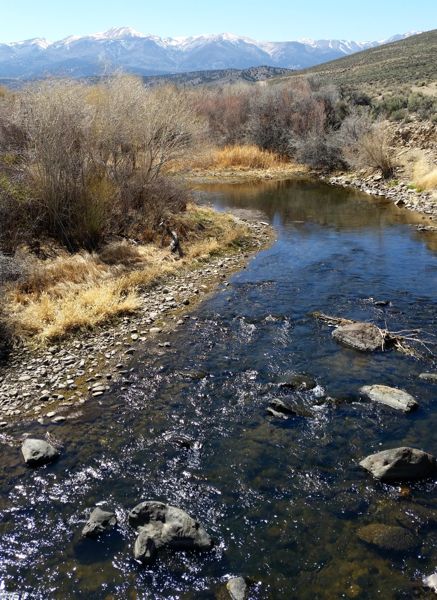
The Walker River that farmers in Mason and Smith valleys rely on. Photo/Anne Knowles

The Walker River that farmers in Mason and Smith valleys rely on. Photo/Anne Knowles

In February, in its first-ever curtailment of groundwater, the state engineer ordered farmers in Smith and Mason valleys to cut groundwater pumping by half. (Their groundwater rights are a supplemental right used in conjunction with surface water rights on the Walker River.) The farmers formed Farmers Against Curtailment Order LLC and sued the state engineer. District Court Judge Leon Aberasturi granted a temporary injunction.

“The judge might have been OK if we had cut off by priority,” said King, rather than try to reduce usage by a percentage.

By priority means that water is allocated by seniority. Those with the oldest or most senior rights receive their full amount of water, those with newer or junior rights are cut off.

All or nothing.

That could be the next step in Pahrump or Diamond Valley. Indeed, on April 28, Sadler Ranch in Diamond Valley sued the state engineer, saying the office’s failure for decades to curtail groundwater pumping by junior water rights holders in the valley has impinged on his senior water rights. The 3,000-acre ranch has rights dating from 1870.

The petition for curtailment, filed in the 7th Judicial District Court in Nevada, says pumping by junior appropriators has reduced the ranch’s water by 90 percent.

The suit, citing the state engineer’s data, says Diamond Valley has a perennial yield of 30,000 acre feet, which is the maximum amount of groundwater that can be pumped annually over the long term without depleting the aquifer.

But more than 130,000 acre feet of groundwater rights have been issued and in 2011, more than 96,000 acre feet of water was pumped, says the suit.

King said his office is examining what existing tools it has to use in Pahrump and Diamond Valley, which could including making the first designation of a critical management area.

“The biggest hammer we have that we never want to use is to manage by priority,” said King. “The biggest trigger is if senior rights holders can’t get their water.”

Domestic wells, too, can be regulated by priority. Even though the wells don’t need water rights, they do need permits to be drilled so each has a date that sets priority.

SB81 was the more disputed of the two bills. Senate Bill 65, a lengthy bill that primarily updated antiquated language in the state’s century-old water law, went through workshops too and was eventually stripped of its most controversial sections, including a definition of perennial yield and restrictions on where domestic wells can be drilled. Even then the bill failed.

“There was a fear factor,” said former Assemblyman Hettrick. “People looked at the bills and said what door is this going to open? Once you do this, what’s next?”

Next for the Nevada Drought Forum are two meetings to get the perspective of water users. A meeting with tourism, mining and other business interests is set for July 14 in Las Vegas and a meeting with the state’s two biggest water users, agriculture and municipalities, is scheduled for Aug. 19 in Carson City or Sparks.

The forum summit, likely somewhere in the state capital, is now planned for Sept. 21-23.