Vail Resorts boosts minimum wage to $10/hour

Vail Resorts is increasing its minimum wage to $10 an hour effective Sept. 26. This is when annual salary increases are to take place.

This is for employees companywide, including the three Tahoe area resorts.

“This is a wage above current minimum wages in all states where we operate and will impact thousands of employees across our resorts and lines of business,” the resort said in a FAQ for employees.

The Colorado-based company said the reason to do this was, “For Vail Resorts to be successful as a company we need to deliver an experience of a lifetime to our guests and we do that by creating an experience of a lifetime for our more than 25,000 employees. As such, our company needs to remain competitive on wages, particularly as the economic environment continues to strengthen.”

The federal minimum wage is $7.25 an hour; it’s $9/hour in California and $8.25 in Nevada.

The company said it intends to increase the minimum wage with inflation each year.

The company did not release specifically how many employees this affects companywide or at individual resorts.

— Lake Tahoe News staff report


Family pursuing lawsuit against SLTPD

By Van Tieu, KRNV-TV

There are new allegations in the officer involved shooting at the Tahoe Hacienda Inn in South Lake Tahoe earlier this week that left a 22-year-old man dead.

Kris Jackson

Kris Jackson

An attorney for Kris Jackson’s family is pursuing wrongful death and violation of civil rights actions against the officer who shot him.

Alan Laskin, says the officer should be criminally charged for acting out of protocol and killing Jackson. He says, according to Jackson’s girlfriend, who was there, she never heard any type of warning from the officers to stop, like “put your hands up” before Jackson was shot.

Read the whole story


STPUD changing to at-large elections

The South Lake Tahoe Public Utility District board of directors this week unanimously decided to alter how members are elected.

The board passed a resolution that says instead of running for a particular seat, candidates will all run together for the number of seats available. The candidates with the highest number of votes for the number of seats available will be elected. This is the same process used for the South Lake Tahoe City Council.

The board had discussed this at a few meetings this spring. Public sentiment was in favor of the change.

“It was expected to increase interest in running for the board due to the elimination of challengers having to specify their opponent — when the incumbent choses to run for re-election — and it greatly reduced the likelihood that an incumbent would not have to campaign for re-election at the end of each term,” Richard Solbrig, South Tahoe PUD general manager, told Lake Tahoe News.

— Lake Tahoe News staff report


NASA data shows global groundwater depletion

By Renee Lewis, Aljazeera America

In over half of the world’s largest aquifers, water is being drawn faster than it is being replenished, while some of those wellsprings may be much smaller than previously assumed, according to two studies released on Tuesday.

As climate change and population growth increasingly stress the world’s water supplies, understanding how much groundwater exists and at what rates it can be sustainably drawn is critical, said scientists behind the studies.

“Until improved storage estimates exist to determine a system’s full capacity to buffer against renewable ground water stress, continued pressure on aquifer systems could lead to irreversible depletion that seriously threaten the sustainability of groundwater dependent regions,” said a UC Irvine report titled “Uncertainty in Global Groundwater Storage.”

Read the whole story


More Nevadans losing their homes

Nevada has been a leader in foreclosures for years. Photo/Brendel

Nevada has been a leader in foreclosures for years. Photo/Brendel

By Jennifer Robison, Las Vegas Review-Journal

If your mortgage is mired in a years-long default process, the bank may be finally coming for you.

A report from a national real estate research firm shows Nevada lenders stepped up foreclosure activity in May, including big jumps in bank-owned foreclosure sales, or completions.

Banks sold 775 repossessed homes in May, up 41.4 percent from April and up 106.7 percent compared with May 2014, California-based RealtyTrac said.

Read the whole story


House Democrats float new Calif. water bill

By Michael Doyle, McClatchy Washington Bureau

WASHINGTON — California water bills continue to fill the Capitol Hill hopper, and now one comes with a new twist.

It’s crowd-sourcing drought solutions, in a long-shot bid to break a congressional stalemate.

On Wednesday, House Democrats from Northern California who have complained about being shut out of drought negotiations took matters into their own hands. They unveiled a sprawling proposal and, in a pointed gesture, opened it for public suggestions before it’s formally introduced.

“This is what a good serious congressional response to the drought looks like,” Rep. Jared Huffman, D-Calif., said in an interview, stressing a need to “do no harm” and to avoid reigniting “the water wars.”

Read the whole story


Surging school meal prices a strain on families

By Aimee Picci, MoneyWatch

School meals are designed to be both nutritious for students and easy on their families’ pocketbooks. Yet while some school lunches might get an “A” on providing essential nutrients, they appear to be receiving a flunking grade for affordability.

The issue of school meal prices came to the forefront when a school kitchen manager in a Denver suburb said she lost her job after giving lunches to students who didn’t have the money to pay. While the school district later said the employee was let go for other reasons, the incident raised questions about how children from families earning at least $31,000 per year — the threshold for a family of four to receive free lunches — could fail to afford the seemingly modest cost of school breakfasts and lunches. Reduced-price lunches are available for families earning 185 percent above the poverty rate, or about $44,000 for a family of four.

At the heart of the issue is a tough economic squeeze for families considered the “working poor,” or those who are scraping by just above the poverty threshold. The average price of an elementary school lunch has surged 52 percent in just 11 years, according to a study from the Food Research and Action Center, a nonprofit that focuses on anti-hunger initiatives. During the same period, the median income of U.S. households has declined 5.4 percent.

Read the whole story


Cameras designed to be fire containment tool

By Ann Harmon

Drought? Never mind, the Tahoe basin hasn’t a problem. People who live here, people who visit, they’ll have plenty of water with Lake Tahoe nearby. But doesn’t a drought mean its forests are drying out, that many trees will die? Well, sure, but fire fighters and equipment are great these days. Tahoe will be fine.

Have we forgotten the 2007 Angora Fire? Dismissed the $160 million it cost, the 254 homes burned? Do we remember last year’s 97,000-acre King Fire fought for more than a month, costing $5 million per day? That came close to Tahoe, too close.

If Tahoe burns, a national treasure will be gone. Maybe we should pay attention after all. We have not been this dry for 1,200 years.
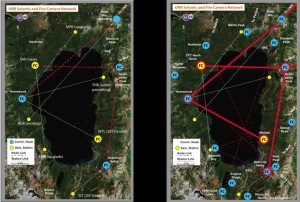
Left: Pilot program cameras; right: build out. Images/UNR

Left: Pilot program cameras; right: build out. Images/UNR

The UNR Seismological Laboratory, under Director Graham Kent, recognizes exactly what the drought means: possible basin fires. When the Lab learned of Forest Guard, an international 2009 award winning project of young students in Meadow Vista, it worked with them and with Sony Europe to develop a Tahoe plan. The ALERT Tahoe project is now under way to place 15 cameras around Tahoe to film any basin fire within seconds of its start using on-demand time lapse imagery. Four units are now in place.

The first aha was last August when Mac Heller with the U.S. Forest Service on a fire near Fresno logged onto the camera at Snow Valley Peak. He spotted a small lightning strike fire north of Spooner Summit. Firefighters put it out at less than half an acre.

The USFS-CalFire interagency joint command center in Camino now watches cameras 24/7. Pictures also go to the USFS, CalFire, BLM and local fire districts around the basin.

Axis HD cameras with 32x pan-tilt-zoom capability provide panoramic views from towers built on solid rock, also carrying early warning earthquake detectors. Notably, the BLM has funded these same cameras for Central and Northeast Nevada to catch sagebrush and forest fires. At $3,500 each, cameras have a three-year guarantee. Each station’s complete system of independent microwave communications, power systems, and other expenses is a $15,000 to $30,000 investment.

Towers withstand snow, high winds and earthquakes, so durable that inspections can be limited to two visits a year. This is a good thing. Access can be very difficult. Cameras, when funded, will ultimately provide coverage from Peavine to McClellan Peaks and possibly from Sierra-at-Tahoe and the western slope of the Sierra.

The ALERT Tahoe program is being funded by public grants and private donations. New donations are critical to roll the system out as rapidly as possible. Tahoe can’t wait. This summer, if $50,000 is raised quickly through private donations, installations will be placed above Zephyr Cove and, hopefully, on Martis Peak. If additional donations and site approvals are secured early this summer, possibly two other stations would be built, one on Diamond Peak, one above Cal Neva.

Two million dollars would provide the system and operating funds for a decade. Remarkably, that is only 1.25 percent of the cost of the Angora Fire. Kent notes that, were $2 million immediately available, camera eyes could be placed within two years on 15 towers. Delayed funding would take three to four years more.

System maps, cameras and donation information are on ALERT Tahoe’s website.

Also under way, with financing by the National Science Foundation and the Nevada Governor’s Knowledge Fund, is UNR lab’s research into using drones for quickly communicating real-time imagery during fires. Plans are to team with UC San Diego to share ideas and save possible costs, including crowd sourcing fire watching.

Ann Harmon is a retired research chemist who lives in Stateline.



CEQA exemptions for water projects inserted into budget bill

By David Siders and Jeremy B. White, Sacramento Bee

Some drought-related groundwater and water recycling projects would gain exemptions from the California Environmental Quality Act under late-emerging legislation at the Capitol.

The exemption, contained in a budget-related trailer bill, offers a narrower exemption than a broader one Gov. Jerry Brown originally proposed. Lawmakers appeared to be nearing a deal Thursday, after pushing back on Brown’s initial proposal.

The language would exempt certain groundwater replenishment projects and the development of building standards by state agencies for recycled water systems. It would also exempt from CEQA the adoption of stricter conditions in the issuance of permits for wells.

Read the whole story


Electric car chargers to link Reno-LV

By Riley Snyder and Michelle Rindels, AP

CARSON CITY — Hoping to attract millennials and eco-conscious tourists to rural parts of Nevada, Gov. Brian Sandoval is announcing a plan to install electric car charging stations at regular intervals on the lonely stretch of road between Las Vegas and Reno.

Sandoval and officials from NV Energy held a media conference Tuesday at an electric car charging station in Carson City to discuss the so-called “Electric Highway.”

Officials plan to partner with five different businesses along U.S. Route 95 and install three chargers at each of them by the end of the year. Sandoval said the project will give drivers the confidence to complete the 450-mile journey in their short-range electric cars, and help rural economies when drivers stop in small towns for an hour or more while they wait for their batteries to power up.

“This is a big deal for us to be able to invite visitors who are going to be using this type of transportation,” he said, “and the moment they cross that state line, to have that complete confidence that no matter where they are in our great state, they’ll be able to charge their vehicles.”

Officials also said that electric car manufacturer Tesla is planning to install more chargers in the state.

NV Energy head Paul Caudill acknowledged that electric cars make up a minuscule percentage of cars on Nevada roads — they account for 0.39 percent of new car registrations here — but said investing in clean energy would pay off down the line.

“Electric vehicle usage and penetration in Nevada today is relatively small, but with the governor’s leadership, adoption of this form of transportation is assured a bright spot in our energy future,” he said.

Las Vegas and Reno currently have about 150 charging stations shared between the state’s 1,400 registered electric cars. Drivers will be able to use the new stations for free.

Money for the project will come from NV Energy and Nevada’s renewable energy tax abatements program, but not from the state general fund.