Aircraft checking for dead trees in California

By Jane Braxton Little, Sacramento Bee

Low-flying helicopters are joining the legion of machinery responding to the state’s fourth-year drought.

Helicopters flying at treetop level throughout rural Northern California are checking for dead and dying trees near power lines, where they pose fire hazards.

The aircraft, contracted by Pacific Gas and Electric Co., have found thousands of trees in need of removal or pruning, said Paul Moreno, a spokesman for the utilities company.

Drought has weakened trees throughout the state and left others susceptible to disease or insects.

Read the whole story


Water, sage grouse dominate governors’ forum

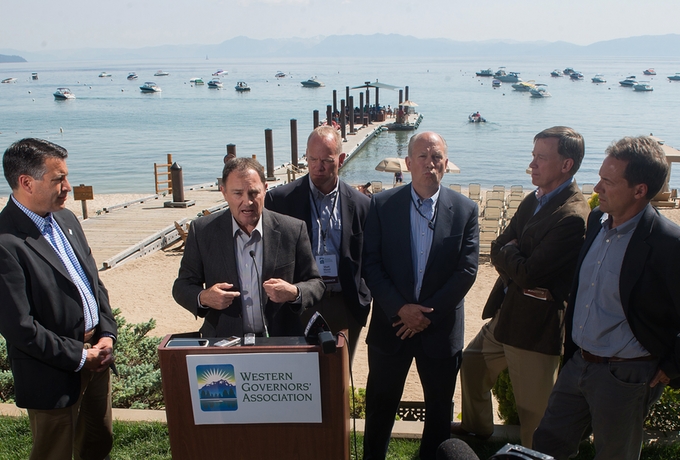
This year's annual Western Governors Association conference is in Incline Village. Photo/Provided

This year’s annual Western Governors’ Association conference is in Incline Village. Photo/Provided

By Anne Knowles

INCLINE VILLAGE — Water data and sage grouse were the main topics on the opening day of the Western Governors’ Association annual meeting.

The three-day conference kicked off June 24 with the release of the WGA’s drought forum report, what Nevada Gov. Brian Sandoval, WGA’s current chairman, called a “living document.”

The report was introduced during the initial panel, which included governors from nine western states as well as a consultant from Deloitte Consulting and Oklahoma’s secretary of Energy and Environment.

The panel was followed by a keynote speech by Secretary of the Interior Sally Jewell, who took questions from the governors. They were mostly concerned with the possible listing of the sage grouse as an endangered species.

The drought report is a broad overview of the WGA’s findings with links to its website for more detailed information on the group’s yearlong investigation of the drought, including meeting videos and webinars, and resources such as the U.S. Drought Monitor from the U.S. Department of Agriculture and stream flow and runoff data from the U.S. Geological Survey.
Secretary of the Interior Sally Jewell is working to keep her department's budget intact. Photo/Proviided

Secretary of the Interior Sally Jewell is working to keep her department’s budget intact. Photo/Proviided

The report is more a resource than a remedy and makes no specific recommendations.

Sandoval said there is no cookie cutter solution for the affected states.

“What is certain is this unprecedented drought is a critical issue if not the critical issue for the west,” Sandoval said.

The report focuses on seven areas, including conservation and infrastructure, but the WGA panel zeroed in on one: data and analysis.

Manson Brown, assistant secretary of commerce for environmental observation and prediction, said the data says there is no let up in sight.

“The seasonal outlook though Sept. 15 is for the drought to persist or intensify west of the Rockies,” he said.

Brown was asked by several governors how reliable is the data since the states rely on it to make policy. Brown said the farther out the timeframe, the less trustworthy the forecast, but that technology will soon allow a 30-day forecast as reliable as today’s 10-day outlook.

“They are very accurate, but there is always uncertainty in a hypercomplex system like the Earth,” he said.

William Sarni, director and practice leader for water strategy social impact at Deloitte Consulting, said it’s important to find better ways to convey the data.

“There is a lot of information out there and we need to present it better visually to engage people,” Sarni said.

The report itself says “groundwater data, predictive climate models for drought and analytical tools that allow users to compare multiple datasets over time were all cited … as ongoing needs.”

Jewell in her keynote speech implored the governors to help convince Congress not to cut the Interior budget by a proposed 15 percent.

“We really need to move beyond this mindless sequestration,” said Jewell.

The administration is also working on moving wildfire money into the disaster budget, she said.

In the morning before the WGA meeting, Jewell and Sandoval met with firefighters and personnel working to contain the 17,000-acre Washington Fire south of Markleeville.

Gov. Brian Sandoval is host of this year's governors' conference. Photo/Provided

Gov. Brian Sandoval is host of this year’s governors’ conference. Photo/Provided

Jewell said she is hopeful the U.S. Fish and Wildlife Service will decide not to add sage grouse to the endangered species list, a decision expected in September.

Utah Gov. Gary Herbert said his state’s sage grouse management plan was 75 pages versus the Bureau of Land Management’s plan encompassed in four large binders.

“I want to protect the sage grouse, but not to the detriment of economic development,” said Herbert, who added that other interests were using the bird in hopes of killing further oil and gas development.

Wyoming Gov. Matthew Mead wondered if the sage grouse pointed to a bigger problem with the act.

“Regardless of the decision there’s going to be lawsuits and some judge will decide,” said Mead. “Is the Endangered Species Act working then?”

Jewell conceded there have been problems with the act, but that her department was working on involving states and scientists up front to make sure listings weren’t too easy to get.

Arizona Gov. Doug Ducey, Colorado Gov. John Hickenlooper, Idaho Gov. Butch Otter, Montana Gov. Steve Bullock, North Dakota Gov. Jack Dalrymple as well as Guam Gov. Eddie Calvo also took part in the panel.

The meeting continues through Friday morning at the Hyatt Regency in Incline Village.


NDOT to work on Spooner Summit

A Nevada Department of Transportation project on Highway 50 in south Carson City is designed to enhance storm drainage to help preserve water quality and reduce erosion.

The project will replace more than 50 storm drains and drop inlets, as well as enhance roadside slopes and curb and gutter on 50 from the South Carson Street/Spooner junction to Tahoe Golf Club Drive, which is approximately four and a half miles up 50. Multiple drainage channels from the highway will also be improved with additional drainage pipes or rock work to reduce erosion.

Some of the drainage systems were originally constructed when the highway was built more than 50 years ago.

The project will also enhance roadway safety by replacing many storm grates from near the travel lanes, providing a smoother roadway surface and reducing potential roadway flooding risk.

The approximately $1.2 million project will be constructed by MKD Construction. As the project progresses, single lane closures withtravel delays are to be expected.

The project should be completed this fall.


SLTFD being proactive with threat of fire

The South Lake Tahoe Fire Department has implemented the Red Flag Program for a second year to help inform and educate people about days when the weather increases fire danger.

SLTFD will raise a red flag at each fire station to warn the public.

On these days the department will add extra personnel to staff a brush engine for an aggressive fire attack. The personnel assigned to the engine will patrol the highest fire danger areas.

During these time the public should be especially mindful to:

  • Avoid outdoor burning, such campfires, or any other open flame. Even grilling is not advised, when Red Flag Days exist.
  • Dispose of cigarettes and other smoking materials into fire safe containers. Tossing smoldering cigarettes onto the ground should be avoided.
  • Properly store flammable materials such as gasoline, alcohol, paint, lighter, and matches. These materials may reach their critical points during hot weather and can possibly result to fire.
  • Be extremely careful when using and fueling chain saws, lawn mowers, weed eaters and other lawn care equipment. High heat conditions make ignition of the fuel vapors more likely. Find shade if possible and allow the machinery to cool if it has been running. Also avoid welding in dangerously dry conditions, as the sparks can easily ignite the dry vegetation around you.
  • Be careful where parking vehicles. The hot underside of a car or truck filled with gasoline parked over dead grass or leaves is an explosion waiting to happen. Be sure to park on concrete or solid dirt or gravel, especially during Red Flag Days. Do not park where vegetation touches the vehicle.


Science helps golf courses reduce water use

By Katharine Gammon, Inside Science

In California’s current historic drought, there’s one particularly easy target when it comes to pointing fingers: green golf courses.

Courses around the U.S. suck up around approximately 2.08 billion gallons of water per day for irrigation. That’s about 130,000 gallons per day per course, according to the golf industry.

In California, Gov. Jerry Brown has announced a statewide mandate to reduce water consumption by 25 percent – but that number actually varies depending on the water district, signifying a reduction of anywhere between 4 and 36 percent.

Since there are about 1,140 golf courses in California, reducing water use by one quarter would reduce consumption by 37 million gallons of water per day – about a million bathtubs full.

The golf industry uses a substantial amount of water and is therefore working on ways to make courses more sustainable, with new irrigation technologies, new types of grass, and new layouts that are easier on the environment.

Read the whole story


Calif. renewable energy debate heating up

By Jeremy B. White, Sacramento Bee

A political fight over California’s renewable energy industry is playing out in the corridors of power, but it deals with something closer to home: your rooftop.

Capitol policymakers are advancing an ambitious proposal to have renewable sources generate half of the state’s electricity by 2030, up from the 33 percent benchmark already in law.

The full force of California’s political establishment backs the goal: Gov. Jerry Brown pitched the idea, Senate President Pro Tem Kevin de León, D-Los Angeles, has promoted it aggressively, and bills enshrining the new standard passed both the Senate and the Assembly with strong Democratic support.

The question now seems less whether the new goal will be enacted than how utilities will get there. With the clean energy industry anticipating an opportunity for more business, California’s rooftop solar firms are fighting to be included – and meeting resistance from other industry players.

Read the whole story


Guns in the U.S.: For every criminal killed in self-defense, 34 innocent people die

By Christopher Ingraham, Washington Post

“The only way to stop a bad guy with a gun is with a good guy with a gun.”says Wayne LaPierre, the vice president of the National Rifle Association.

That’s become the kernel of the NRA’s response to recent mass shooting tragedies — if only more people carried guns for protection, the thinking goes, then they would be less likely to be victimized by gun-wielding criminals.

“The only way to stop a bad guy with a gun is with a good guy with a gun,” LaPierre said

The challenge to that argument is that, data show, guns are rarely used in self-defense — especially relative to the rate at which they’re used in criminal homicides or suicides.

Read the whole story


Calif. judge throws out kill-gays ballot measure

By Associated Press

SAN FRANCISCO — A California judge has thrown out a proposed ballot initiative that advocated killing anyone who engages in gay sex, calling the measure “patently unconstitutional.”

Sacramento County Superior Court Judge Raymond Cadei relieved California’s attorney general late Monday of the duty to clear the so-called Sodomite Suppression Act for signature-gathering. Cadei said it would be “inappropriate, waste public resources, generate unnecessary divisions among the public, and tend to mislead the electorate” for Attorney General Kamala Harris to process the proposal.

Harris had asked for a judge’s permission in March to reject the initiative through a legal complaint against its sponsor, Orange County lawyer Matthew McLaughlin. After McLaughlin did not attempt to defend the measure in court, the attorney general last week sought a default ruling in her favor, a request Cadei granted.


Response to Washington Fire questioned

Updated June 24 10:03pm:

“Fire is burning in hazardous and inaccessible terrain and approaching an increasing number of structures and impacting travel corridors,” authorities report.

Updated June 24 6:19pm:

The fire has grown to 17,205 acres and is 10 percent contained.

There are now 900 people fighting the fire that was started by lightning.

Warmer temperatures are expected through Saturday, with a possible record high on Friday. Thunderstorms are forecast for Saturday and Sunday. The moisture would be helpful, but the threat of more lightning is worrisome to fire agencies throughout the area.

Updated June 24 8:40am:

Firefighters have 5 percent containment of the Washington Fire. The acreage burned is 16,544. Nearly 700 people are now fighting the fire.

By Kathryn Reed and Susan Wood

People who live and work in the area are raising questions about the response time of the Washington Fire.

The initial response was June 19 at 7pm, according to fire officials. By Saturday night the fire was at 350 acres, by Sunday night the acreage consumed was 6,500, by Monday night it reached 14,942 acres and as of Tuesday evening the burned area is 16,543 acres.

“The fire was reported at noon to 1 on Friday. There were no winds until Saturday. No one did anything about it. There are a variety of things they could have done. Well, that’s Alpine County for you,” Tom Abdoo, Markleeville property and business owner, told Lake Tahoe News.

U.S. Forest Service spokesman Larry Lucas said the Forest Service took over the fire at 6am June 22. He has asked local authorities for a time line detailing the response to the fire.

Lightning started the fire, the wind then spread it.

Smoke fills the drive into Carson City via Spooner Summit on June 23. Photo/Susan Wood

Smoke fills the drive into Carson City via Spooner Summit on June 23. Photo/Susan Wood

However, the fire is burning on Forest Service land in the Humboldt-Toiyabe National Forest so the feds should have had authority the entire time.

A Forest Service employee told Lake Tahoe News their firehouses are not staffed around the clock during the fire season.

Alpine County itself is serviced by a volunteer fire department.

Any delay in getting resources to the fire could have been the result of who was notified first. People don’t tend to call the USFS dispatch. Instead, they call 911. Which dispatch center that call goes to depends on the nearest cell tower to the caller.

In 2007 during the start of the Angora Fire the 911 calls went to CHP dispatch in Truckee which at first told everyone it was a controlled burn and not to worry.

The weather conditions on that June 24 were very similar to this past weekend’s – high winds and low humidity. These conditions had been in the forecast, with the National Weather Service having issued alerts about red flag days for the entire weekend.

With Angora, 254 houses were reduced to ash in a matter of hours. With the Washington Fire, 15 buildings are in imminent danger and the town of Markleeville is threatened. Fire officials on the night of June 23, though, didn’t have information about how far the flames are from this Alpine County town.

Lake Valley has sent one engine to the Washington Fire, while Tahoe Douglas has firefighters in San Bernardino.

Most of the Tahoe agencies are staying put because the local conditions warrant firefighters being on alert. The state mutual aid system is voluntary, so departments don’t have to send crews if the local needs warrant staying put.

The Forest Service is using 11 helicopters, eight air tankers – including two DC-10s, 17 engines, three water tenders, and about 500 people to fight the Washington Fire. At one point the blaze was 10 percent contained, but the conditions worsened and the firefighters lost the upper hand. There is no containment this evening.

What it is costing to fight the fire each day has not been disclosed.

On a related note, Liberty Utilities has canceled the June 24 and July 1 planned power outage for parts of Alpine County because of the fire. The outage was scheduled to allow crews to replace power poles in the area.


Prison, probation for 2 men involved in Stateline man’s death

By Sarah Jarvis, Arizona Republic

A Phoenix man was sentenced to 4 1/2 years in prison this month after prosecutors said he killed his roommate and left the burned body of the Lake Tahoe man in the desert in 2013.

Vrouyr Manoukian, 24, was convicted of negligent homicide and abandonment of body in the death of 24-year-old Matthew McMaster of Stateline. The 740 days Manoukian has spent incarcerated while awaiting trial will count toward his sentence, meaning he will spend about 2 1/2 more years in prison.

Investigators found McMaster’s body in a northwest Phoenix desert in July 2013.


The other roommate involved in the fight that led to Matthew McMaster’s death, Randall Lee Young, was charged with a probation-only offense. He was sentenced to three years probation.

Read the whole story