Future of Lake Tahoe Airport in council’s hands

By Kathryn Reed

Before summer is over, a preferred alternative for the Lake Tahoe Airport Master Plan should be selected.

The South Lake Tahoe City Council is expected to discuss the matter July 21 or Aug. 4.

It was in 1992 that a settlement agreement regarding the master plan was reached. This involved the city, state Attorney General’s Office, League to Save Lake Tahoe and Tahoe Regional Planning Agency. That document expired in 2012 so the city has been operating the airport without a valid master plan.

The June 30 meeting attended by about a dozen people was the final public workshop before the council takes over. The public will have two more opportunities at council meetings to offer input.

Michael Hotaling, the consultant preparing the master plan, said it’s likely the preferred alternative will be a combination of the various proposals that have been whittled down based on public comments, research and staff input. The alternatives separately address the airfield, and land area with buildings and open space.

Under consideration is whether to keep the airport as it is or do something else.

The FAA will have the ultimate say over the Aviation Demand Forecast and the Airport Layout Plan. The feds are paying 90 percent of the cost to create the master plan.
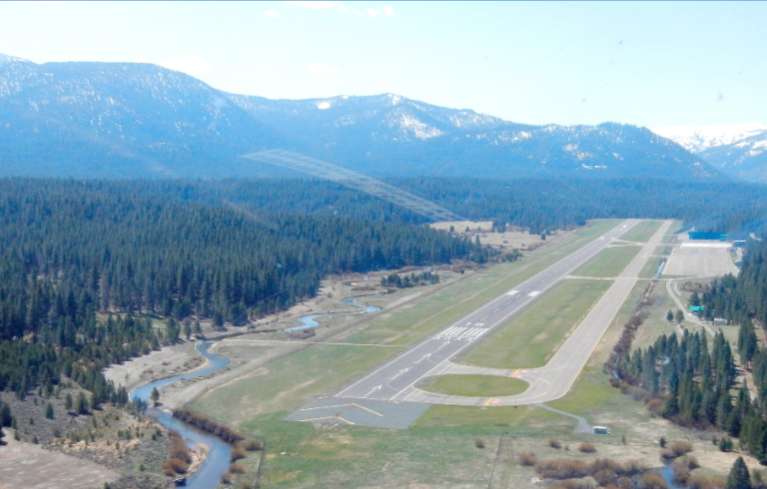
Lake Tahoe Airport's airfield could be altered. Photo/LTN file

Lake Tahoe Airport’s airfield could be altered depending on what the master plan calls for. Photo/LTN file

Closing the airport, while considered early on, is no longer an option. This is because the FAA deems the airport an important element in its greater transportation plan. Plus, it is a resource in emergencies and could provide the only way out of the basin in a catastrophe.

To accommodate a large number of planes like what will be arriving for this month’s celebrity golf tournament a temporary tower will be in place. Personnel from Reno will operate it. This is the second year for the portable tower. The permanent one cannot be used because it does not have equipment and the line of sight is blocked by trees.

Bringing back commercial air service is also off the table. The 139 certificate, which would allow commercial service, no longer is in effect. The council in the last year voted to give up that FAA designation.

Based on input from a meeting earlier this year the public is divided over what should be done at the airport. Some want to alter the airfield to allow a larger class of plane that is forecast to be the aircraft of choice going forward, others want to leave things as they are.

The consultants predict air traffic at Lake Tahoe Airport to increase 1.7 percent in the next 20 years. This means going from 2.7 flights per hour to 3.1.

When it comes to the land segment, some want to get keep the aviation designations for the property in case things change, others want to allow different uses. The city is looking at creating an outdoor events area east of the tower.

In the 2013-14 budget, $351,972 of the general fund was used to keep the airport afloat. That is a decrease of 43 percent from 2010-11. Hotaling said projections are for that number to continue to decline.


Supreme Court won’t hear Nev. patient dumping case

By Associated Press

WASHINGTON — The Supreme Court won’t hear an appeal from Nevada over a lawsuit that claims the state wrongfully bused indigent psychiatric patients to San Francisco without paying the costs of their medical care.

The justices on Tuesday let stand a lower court decision that said California state courts have authority to hear the case challenging Nevada’s discharge policies.

San Francisco is seeking $500,000 in reimbursement costs for treating 29 patients who were given vouchers for one-way bus tickets to California. It also wants an order barring Nevada from sending over any more patients.

A California Superior Court judge ruled that Nevada could be sued in California because it knew San Francisco would have to spend money on the patients.

Nevada claims the lawsuit interferes with its sovereign powers.


Nev. working on skill-based slot games

By J.D. Morris, Las Vegas Sun

Nevada’s effort to make casino floors feel more like arcades advanced last week as gaming regulators started crafting the rules that will govern the introduction of skill into the state’s slot machines.

The Gaming Control Board had its first workshop to receive input on regulations that will implement Senate Bill 9, which Gov. Brian Sandoval signed in May. The bill directs regulators to encourage “innovative, alternative and advanced technology” in casino games — now the board is making rules to figure out exactly how that will work.

Once in place, the regulations should let slots play more like arcade and video games by allowing for an element of skill, hopefully making the games more appealing to customers who aren’t attracted to the traditional, chance-controlled slots.

Board Chairman A.G. Burnett said he expects the skill-based regulations will bring a “sea change” to the casino industry.

Read the whole story


Drought conditions make bad air worse


Smoke from the Washington Fire filled the Lake Tahoe Basin last week. Photo/Kathryn Reed

Smoke from the Washington Fire filled the Lake Tahoe Basin last week. Photo/Kathryn Reed

By Sammy Caiola, Sacramento Bee

A longtime asthma sufferer, Shirley Bittante tries to stay inside when the air district rates conditions outside her Fair Oaks house as “unhealthy.” She may have to spend more time indoors this summer as heat and drought degrade air quality across the state.

Bittante, 60, said she’s noticed more dust and fumes in the air in recent years. More fallow farmland, more forest fires, stagnant air and other factors aggravated by the state’s record four-year drought have spiked annual particle concentrations in Sacramento and other cities, creating an especially difficult environment for people with respiratory illnesses.

“I don’t have to physically see the smog. I just know it’s bad,” she said. “When you live with it every day, you get so used to it – the congestion and the coughing … I don’t see any end in sight.”

Particle pollution has increased in 25 California counties, where the number of unhealthy particle days has nearly tripled since 2014, according to the American Lung Association’s 2015 State of the Air report released in April. Statewide, 28 million people live in counties that received a failing grade for air quality, making up 73 percent of the state’s population.

Read the whole story


More areas opening near Washington Fire

Updated 8:55pm:

All state highways through the Washington Fire area are open to through traffic. This includes Highway 4 over Ebbetts Pass and Highway 89 east over Monitor Pass to Highway 395.

The fire near Markleeville is 66 percent contained, with 17,790 acres burned.

—–

While the Washington Fire continues to burn near the town of Markleeville, favorable weather conditions are helping firefighters to make progress.

The fire remains at 56 percent containment, with 17,787 acres burned.

“Fire is burning in hazardous and inaccessible terrain, and has burned into the Carson Iceberg Wilderness,” officials said.

However, in the flatter terrain crews are in mop-up mode and rehabilitation of the fire line has begun. The structure and night groups will be demobilized tonight.

Temperatures are expected to be cooler today with afternoon thunderstorms possible bringing rain.

The BLM area closure and the Indian Creek Campground closure were lifted at 8am Tuesday.

— Lake Tahoe News staff report


Indian tribe recognition process overhauled

By Kevin Freking, AP 

WASHINGTON — The Obama administration is making it easier for some Indian tribes to obtain federal recognition, addressing a longstanding grievance of many Native Americans.

The new regulation updates a 37-year-old process that has been roundly criticized as broken because of the many years and mounds of paperwork that typically went into each application.

But the effort to address those criticisms generated a backlash of its own, with some lawmakers and existing tribes with casino operations complaining that the administration’s original proposals set the bar too low.

The Obama administration made changes in the final rule that answers many of those concerns, but not all. Kevin Washburn, an assistant secretary at the Department of Interior, announced the regulation Monday during a National Congress of American Indians conference in Minnesota.

Federal acknowledgment means a tribe is treated as a nation within a nation, able to set up its own government, legal system, and taxes and fees. Recognition also brings critical federal investments in medical care, housing and education. It also can lead to tribes opening casinos in future years through a separate approval process.

Washburn told the Associated Press that the regulatory changes will greatly enhance transparency by letting the public see most of the documents submitted by the petitioning groups via the Internet.

The changes will also give tribal groups facing rejection the chance to take their case to an administrative judge before a final determination is made.

Interior Secretary Sally Jewell said the new regulations for tribal recognition “makes good on a promise to our First Americans to clarify, expedite and honor a meaningful process for federal acknowledgment.”

The most scrutinized changes will be the new criteria that must be met for recognition to occur.

Indian groups seeking recognition will no longer have to show that outside parties identified them as an Indian entity dating back to 1900. Washburn said the requirement clashed with the reality of the times. Many Indians were attempting to hide their identity from outside sources out of fear they would be discriminated against, or worse. “They would have been crazy not to have,” said Washburn, a member of the Chickasaw Nation in Oklahoma.

Some federally recognized tribes had urged that the requirement be kept.

“We cannot understand why a legitimate petitioner could not produce external documentation of its existence,” Robert Martin, chairman of the Morongo Band of Mission Indians, testified during a recent congressional hearing.

Petitioners also had to show that their tribe has existed as a community and exercised political control over its members since first contact with European settlers, or as early as 1789. The proposed regulation had changed the threshold to 1934. After much pushback, the final rule sets the date at 1900 — more than a century of documentation that includes “a time when it was dangerous to be Indian,” Washburn said.

Under the current system, which began in 1978, the government has recognized 17 tribes and rejected the petitions of 34 other groups.

The Obama administration had originally envisioned giving groups who were denied federal recognition another opportunity to re-petition the government. That provision wasn’t included in the final rule.

“It would be unfair to allow people to come in and re-petition when there are people in line who haven’t had their first chance to make their case,” Washburn said.

Lawmakers in Connecticut had been particularly critical of allowing previously denied groups the chance to re-petition, and the change deals a blow to four Indian groups whose petitions were rejected in 2005.

Congress also has the authority to recognize tribes.

The Obama administration is moving ahead with the regulation even as lawmakers had expressly warned them to pull it back. A spending bill in the House contains language banning the Interior Department from using federal money to implement or enforce the regulatory change.

In all, there are 566 federal recognized tribes and hundreds more want to join their ranks.

Arlinda Locklear, an attorney in Washington who has worked on behalf of about a dozen tribes seeking federal acknowledgment, calls the current tribal recognition process heartbreaking because it’s so demanding and takes so long, often more than a decade.

“You have a whole generation of people who just die while they’re waiting for it to happen,” Locklear said.


Washington Fire 56% contained

The 17,787-acre Washington Fire is 56 percent contained.

“The structural fire engines assigned to Markleeville are being phased out and will be continue to be released to their home units,” according to officials.

The fire started June 19 from a lightning strike that had occurred about 10 days prior to winds turning it into the inferno.

Highway 89 to Monitor Pass and Wolf Creek Road remain closed to all traffic.

Pacific Crest Trail hikers may use the Ebbetts Pass area for resupply.

— Lake Tahoe News staff report


BLM defends its Burning Man requests

By Reno Gazette-Journal

Federal Bureau of Land Management officials defended on Sunday their request for special housing accommodations during the annual Burning Man festival in Nevada, disputing comments by Sen. Harry Reid and others that the plans are unnecessary and extravagant.

A Reno Gazette-Journal investigation broke the details of the request last week.

Burning Man organizers have refused the request, saying amenities such as flush toilets, washers and dryers, showers, air conditioning and refrigerators at the bureau’s on-site camp in the Black Rock Desert would cost $1 million and increase permit fees to about $5 million.

The request, a first of its kind in Burning Man’s history, has turned into a point of contention as organizers negotiate with the agency for their annual permit to stage the event in the Black Rock Desert. No permit has been issued for this year’s event, which runs Aug. 30 to Sept. 7. Permits are typically issued in early August.

Gene Seidlitz, the bureau’s Winnemucca district manager, said Sunday to the Associated Press that the cost of the portable units is being “robustly exaggerated” by organizers. The compound will offer basic amenities only for top agency officials who oversee the event, he said.

Read the whole story


TRPA grants Barton Ranch demolition permit

By Kathryn Reed

A segment of South Lake Tahoe’s past is about to visually disappear from the landscape.

A hearings officer with the Tahoe Regional Planning Agency today approved the demolition of all of the buildings at the old Barton Ranch at the Y. Slated for the wrecking ball are the barn, ranch house, guesthouses, cabin, cottage and shed.

Gary Midkiff, a land use and permitting consultant representing the Ledbetter and Mosher families who own the property and are descendants of the Bartons, spoke at Monday’s meeting. Despite a full room, Kirk Ledbetter was the only other person to talk June 29. He could not be reached after the meeting.

The family takes issue with people putting up signs that say “History vs. Greed”. The family’s contention is the usefulness of these buildings is long gone. Now vagrants are using them. Vandals are ruining what is still standing. Squatters are living there.

The family has been going through this process for more than four years.

Boarded up Barton Ranch building in South Lake Tahoe. Photo/Bill Kingman

The boarded up Barton Ranch buildings in South Lake Tahoe are likely to be demolished this summer. Photo/Bill Kingman

The landowners are open to people repurposing the buildings – whether turning them into historical museum-like structures or something else. No one has come forward with the money to make that a reality.

Part of the problem is these once iconic white and green buildings are full of graffiti, mold, mildew and lead-based paint.

TRPA is involved in the process and not just South Lake Tahoe officials because it is identified as a historical resource by the bi-state regulatory agency. This triggered a more involved process than a routine demolition permit.

The Bartons were pioneers in this area. In 1915, they moved to the South Shore, establishing a dairy ranch at what is now the Lake Tahoe Airport. Across the Upper Truckee River it is still known as the Barton Meadow.

They ran a milk route to Echo Lakes, Camp Sacramento, Twin Bridges, Tahoe Meadow and Beecher’s Country Club, where Harrah’s is now located.

Then they developed the acreage near the Y. At that time it was wide open – not full of commercial enterprises like today.

What becomes of this 4-acre site next to Raley’s remains to be seen. The demolition permit is good for three years. If the structures don’t come down in that time the property owners lose their rights to the commodities associated with the parcel. This includes 39,007-square-feet of coverage, two residential units and 5,631-square-feet of residential floor area. Those items will be banked and the owners able to use them on another site.

Conditions of the permit include revegetating the site and trying to obtain a recorded history of the one family member still alive who lived at the property.

If anyone appeals the demolition permit before the July 20 deadline, the Governing Board would then have the final say.


Next water fight — companies bottling water

By Tony Dokoupil, MSNBC

MOUNT SHASTA — Throughout parched California, a punishing drought has forced communities to cut back on their water use. Just outside the town of Mount Shasta, however, a private bottling company is about to do the opposite, opening a tap on millions of gallons of the state’s dwindling public resource.

The pumping is set to start later this summer, when Crystal Geyser – a subsidiary of Otsuka Holdings, a massive Japanese health care conglomerate – will drop its straw into a famous spring here, sucking in and selling the run-off from ancient glaciers. Some of it will be shipped overseas, while the rest will be sold in-state, according to the company.

No matter where it’s sold, many residents of Mount Shasta are angry and confused by the move. They fear dry wells and an overdrawn aquifer. Some also believe that the mountain spring should be shared by all, not sold off for individual gain. They’ve decided to fight, hiring a lawyer and pledging to picket the plant when it opens.

For the moment, the cold, clean glacier-melt of Big Springs flows into the wells and jugs of locals, and feeds the pipes and faucets of millions of thirsty state residents. It pools in a shrine-like park in the city of Mount Shasta, beneath a dome of blue sky at the roof of the state, a short hike from the base of the 14,179-foot peak.


Read the whole story