Fire cuts power to parts of Harveys

A fire in the electrical room at Harveys has the Mountain Tower of the hotel-casino in the dark.

Tahoe Douglas firefighters were able to contain the Friday night fire to the area where it started.

“NV Energy is on site and people are in the dark,” Eric Guevin, fire marshal with Tahoe Douglas, told Lake Tahoe News about 11:25pm July 3.

The switch gear is out, he said.

The Stateline property has generators, according to a hotel employee. The front desk worker said there have been no evacuations.

— Lake Tahoe News staff report


Gamblers’ abuse claims test sovereignty of tribal casinos

By Michael Melia, AP

MASHANTUCKET, Conn. — For gamblers skilled at counting cards, it can be especially risky to play at America’s tribal casinos: Those who have gotten caught tell stories of seized winnings, wrongful detentions, or worse.

Casino bosses everywhere have ways of making so-called “advantage players” feel unwelcome, regularly tossing and blacklisting them. But gamblers have limited options to press claims of mistreatment at Native American-owned properties, which generally are shielded from lawsuits in outside courts by laws recognizing tribes’ sovereignty.

Now, a pair of lawsuits in federal courts is testing the principle of tribal immunity in cases involving allegations of abuse and bias in tribal justice systems.

The cases, in Connecticut and Arizona, involve crackdowns on advantage players who say they use card-counting or other methods that shift the odds in their favor, but generally are not illegal.

“You do not have a level playing field,” said Stanford Wong, a Las Vegas-based gambling expert who advises readers of his newsletters to be aware that tribal properties are governed by their own laws. “In a tribal casino, there’s no recourse whatsoever. You can’t sue them in regular court. The odds are all stacked against you.”

At the country’s largest Indian casino, Foxwoods in southeastern Connecticut, three gamblers from China claim the casino wrongly seized $1.6 million deposited as “front money” and $1.1 million in winnings after accusing them of cheating at mini baccarat during a graveyard shift on Christmas Eve 2011. The gamblers said they used a card-monitoring practice called edge-sorting, which involves players being able to tell the difference between some cards because of imperfections on their non-playing sides.

The gamblers including Cheung Yin Sun, a woman known as the “Queen of Sorts” for her card-monitoring skills, said they were denied the lawyer of their choice in tribal proceedings that ended with a ruling against them by the tribe’s gambling commission.

When the gamblers filed suit in federal court, the casino’s owner, the Mashantucket Pequot Tribal Nation, argued it had immunity, and a federal judge in early June dismissed the suit. An attorney for the plaintiffs on Wednesday filed notice of an appeal.

In the United States, there are 493 Indian casinos and 1,262 commercial casinos. In 2013, tribal casinos generated $28.3 billion in revenue while commercial properties had $37.7 billion, according to the Casino City research firm.

The options available to gamblers who want to press a claim depend on the contracts between tribes and the host states, which typically grant rights to operate locally in exchange for a share of revenue. The state of Connecticut, which does not require the tribe to waive sovereign immunity, has seven gambling regulation officers assigned to Foxwoods, but their role is limited to testing of the slot machines whose revenue is shared with the state. The state has no oversight of table games.

While tribal gambling commissions answer to the same tribes that own the casinos, National Indian Gaming Commission spokesman Michael Odle in Washington said they operate independently. He said those alleging a lack of impartiality could make the same argument about federal courts handling cases involving the U.S. government.

George Henningsen, chairman of the Pequot gaming commission, said it’s difficult to dispel allegations of bias because it’s typically only losers who speak out about their experiences with tribal justice.

A handful of lawyers around the country with expertise in gambling disputes say the worst horror stories are at tribal casinos. While some hope to bring pressure to put tribal properties on the same legal footing as commercial casinos, one attorney, Bob Nersesian, said he is more focused day to day on helping the clients who call with claims of abuse.

In the Arizona case, advantage players filed suit after they were detained on suspicion of cheating in 2011 at the Mazatzal Casino, owned by the Tonto Apache Tribe. A federal judge in Arizona last year ruled that sovereign immunity did not apply because tribal officials involved were named in their individual capacities, and an appeals court affirmed that decision on Tuesday.

One of the plaintiffs, Rahne Pistor, said the officers who detained him did not identify themselves as police and grabbed his genitals as they assaulted him.

“I simply had won more money than they liked,” Pistor said, “so they kidnapped me, handcuffed me, forced me into an isolated back room in the casino and physically stole whatever money they could out of my pocket.”

Nersesian, the plaintiffs’ attorney in the Mazatzal case, said such disputes do not discourage advantage players from visiting tribal casinos. If anything, he said, they draw them out in greater numbers by showing the games can be beaten.

“It’s more like somebody dying from a hot shot of heroin,” he said. “As soon as that happens, the market goes up, not down.”


DC commissioners say no to Liberty solar plant

People were on the floor and in the hall for the July 2 Douglas County Commission meeting. Photos/Anne Knowles

People were on the floor and in the hall for the July 2 Douglas County Commission meeting. Photos/Anne Knowles

By Anne Knowles

MINDEN — The Douglas County Commission has denied another application for a solar facility in Carson Valley.

Citing too many unknowns about the project, and a few surprises, the commissioners on July 2 unanimously rejected the application by Greenstone Renewables to build a 260-acre, 20 megawatt solar plant on Muller Lane.

“We’re finding out things today I wasn’t aware of and I don’t like that,” commission Chairman Doug Johnson said. “It’s OK, that’s the nature of the beast.”

After more than four hours of presentations, public comment and discussion, the commissioners agreed the project did not meet the county’s mandate to maintain a scenic and rural valley.

“I can’t get past the location,” said Commissioner Nancy McDermid. “The Planning Commission is the gatekeeper of the master plan and I believe the ones that voted for this project relied on private property rights and ignored the master plan.”

A special use permit required for the project was approved by the Douglas County Planning Commission by a 4-3 vote at its May 12 meeting.

Commissioners had volumes of paperwork to read before making their decision.

Commissioners had volumes of paperwork to read before making their decision.

That decision was appealed by Steve and Mary Walker, whose home is the only residence to abut the project property.

Their appeal contested six of the 16 conditions the planning commission imposed on the permit and four of its eight findings.

Those disputes centered on mitigation of glare from panels, noise in high winds, dust control, irrigation loss and wildlife impact, particularly to the bird population.

“We ask that you deny the application. It was an erroneous decision in conflict with the county master plan and recommendations of the Valley Vision plan,” said Steve Walker during his presentation to the board.

Walker also said an additional 40 acres would be required for a potential battery storage unit, bringing the total project acreage to 300 acres, which was news to the commissioners.

“I have a question I did not have before,” said Commissioner Steve Thaler after presentations from the Walkers and from Keith Rutledge with Greenstone Renewables. “This battery storage facility. I was not aware of this additional 40 acres. That’s taken me by surprise.”

Rutledge said Greenstone did not include the battery storage unit in its application because it was uncertain if it would be needed, and that the developer would return to acquire permission for that in the future.

But Walker pointed to the minutes of the Planning Commission meeting, in which staff said the battery storage facility would be considered an accessory use and would need no further permits.

Daniel Leck, a local appraiser engaged by the Walkers, said the solar plant would not only impact the Walkers’ property value but have a ripple effect in the community. He estimated property values in Douglas County, which stand at $6 billion, could drop between 5 and 10 percent, or by $300 million to $600 million.

The Walkers helped to generate a lot of public interest in the Greenstone project, collecting 700 signatures on a petition opposing the project.

The commissioners said they had received hundreds of emails and phone calls from county residents.

At least 200 people attended the county commissioners meeting, jamming the room and outside halls. Twenty-eight people rose to offer public comment, the majority of who opposed the project.

One complaint for many was the fact the power generated by the solar plant would be going to California customers serviced by Liberty Utilities, which had entered into an initial contract with Greenstone for the power generated.

Travis Johnson, Liberty Utilities’ director of Utility Planning and Business Development, spoke during public comment, to say those customers are all around Lake Tahoe. However, Liberty has no Nevada customers.

“Liberty Utilities is disappointed by the decision of Douglas County Commission. We believe that Greenstone’s proposed solar project would be an environmentally responsible means of bringing renewable resources to the region, as well as providing reliability improvements to the Carson Valley. Liberty remains committed to the pursuit of cost-effective renewable development for its 49,000 electric customers in the Lake Tahoe region,” Liberty Utilities’ VP of Operations Rich Salgo told Lake Tahoe News.

The owner of the Muller Lane property, which was set to be leased by Greenstone, also spoke.

“We feel strongly that we all have property rights,” said Jon Park. “We love to ranch. We love to irrigate our property. At the end of the day if this was a perfect world, we’d just ranch.”

Barbara Byington, whose ranch is adjacent to the Park property, also spoke in support of the plan.

“I border it, but I’m in favor of it,” said Byington. “I’ve kept my ranch green for all you people who want it green. But how can I keep it green in this drought? I think we ranchers need something. Maybe it’s not a solar farm, but every time we come to you, you say no, you can’t have that.”

In the end, the board, acting as the board of adjustments, voted unanimously to approve the Walker’s appeal and deny the solar project.

In July 2014, the county commission approved an ordinance adding solar to the county’s agricultural zoning.

In March, the commissioners denied a request by E.On Climate and Renewables for a 320-acre solar plant on Bently Ranch because it was too close to nearby residences. In June, they passed a 180-day moratorium on solar projects, but excluded the Greenstone plan because the application was already in process.

Greenstone could file a petition for judicial review. It would need to be filed within 25 days.



Californians starting to reduce water use

By Fenit Nirappil, AP

California’s drought-stricken cities set a record for water conservation, reducing usage 29 percent in May, according to data released by a state agency Wednesday.

Regulators hope the savings will last through summer as California communities are under order to cut water use by 25 percent compared to 2013 levels. Gov. Jerry Brown announced his mandatory conservation order in April.

Felicia Marcus, chairwoman of the State Water Resources Control Board enforcing Brown’s order, said the results show it’s possible to meet steep conservation targets.

“It’s gratifying that far more communities are stepping up, and we want to see this much more through the summer,” Marcus said. “It ends up putting off the need for much harsher rationing, which has greater impacts on people and the economy.”

California is in a four-year drought that has devastated some rural communities, prompted some farmers to leave fields unplanted or tap expensive water supplies and dented fish populations. Many cities have avoided the brunt of the dry spell because of backup supplies and preparation, but the governor wanted conservation efforts ramped up with no clear end to the drought in sight.

May’s water savings were the best showing since the state started tracking conservation last summer. The report followed several months of tepid conservation, 13.5 percent in April and 4 percent in March.

Conservation may have been skewed by rain in parts of the state in May, which reduces the need to water lawns.

The data is self-reported by more than 400 California water departments and includes residential and business consumption. All regions of the state showed improvement.

Sacramento and its surrounding communities were the state’s top performer, cutting water use by nearly 40 percent.

The southern coast, where more than half of the state’s population lives in cities including Los Angeles and San Diego, conserved 25 percent in May after months of lackluster savings. Temperatures in the region were about 5 degrees cooler compared to May 2013 with an additional half inch of rain, according to National Oceanic and Atmospheric Administration data.

Regulators have been encouraging Californians to let their lawns go dry this summer as the easiest way to save large amounts of water and maintain local supplies if the drought continues.

The water board has assigned each community a mandatory conservation target between 4 and 36 percent, depending on how much water residents used last summer, that will be tracked between June and February. Cities that don’t meet these targets face fines or state-imposed restrictions on water use.

Some have complained these targets are unfair because it doesn’t take into account water savings made before the drought or how secure local supplies are. The city of Riverside is suing the water board over conservation, saying it has ample groundwater supplies.


Man dies diving off Angora Lakes cliffs

A 21-year-old man from Illinois died Wednesday at Angora Lakes.

Cameron Gillen, 21, Libertyville, Ill., was diving off the cliffs at the lake about 6pm July 1.

There are three normal areas where people dive. Gillen went up higher, according to El Dorado County sheriff’s Sgt. Michael Seligsohn.

“This young man went to the highest point and then scaled the cliff another 40 to 60 feet. As he goes up, he’s not going straight up, he’s also going away from the lake,” Seligsohn told Lake Tahoe News. “When he jumps I don’t think he possibly could have gone out far enough, so he struck at the base of the cliff.”

Paddleboarders brought him to shore and CPR was begun

First responders from the sheriff’s department, Lake Valley Fire and Calstar tried advanced life saving techniques for an hour before pronouncing the man’s death.

The lake level is not an issue. But the spot where one jumps from can make a world of difference.

Seligsohn warns people, “You can only jump as far out as you can jump from the ground.” In other words, if someone can do a 6-foot broad jump on flat ground, that’s as far as they will be able to leap from a cliff.

“Keep it to where everyone dives in from and you are likely to be safe,” Seligsohn said. Seeking a new, riskier adventure, he said, can have fatal consequences.

— Kathryn Reed


Weather a critical factor in Washington Fire

The Washington Fire for several days threatened the town of Markleeville. Photo/Carolyn E. Wright/Copyright

The Washington Fire for several days threatened the town of Markleeville. Photo Copyright 2015 Carolyn E. Wright

Updated 10:55pm: The Washington Fire’s perimeter is 90 percent contained, at 17,790 acres; full containment expected by July 31.

By Susan Wood

Fire officials evaluated the response timeline of the 2-week-old Markleeville-area blaze that spread rapidly in a wind-driven 24-hour period and found good news and bad news in their assessment.

The good news: The fire agencies and respective personnel followed protocol to the best of their ability under normal circumstances.

Key Activity Timeline –  Washington Fire near Markleeville June 9-11, 2015 – Wide‐spread heavy rain with lightning activity took place in the area where the fire began. With the right fuel and moisture conditions, this lightning can often ignite deep dead vegetative material on the forest floor that can smolder undetected for a couple of weeks before changing weather conditions such as low relative humidity, wind, and high temperatures fan embers to life, causing visible smoke.   June 19 about 6:15pm – Smoke was first reported in the Silver Peak area on the Humboldt‐Toiyabe National Forest (HTNF) Carson Ranger District. June 19, 6:30pm – Both HTNF fire staff and Alpine County fire and law enforcement personnel began looking for the fire’s exact location by traveling different routes. June 19, about 7:15pm – HTNF fire staff located the general area of the fire, estimated to be about an acre in size, in a remote location. An engine was staged nearby while best access points were identified.   June 19, about 7:45pm – When it became apparent the fire was in an area with no road access, a helicopter was ordered to arrive in the morning. By the time a helicopter could have reached the fire when initially ordered, darkness would have made its use inappropriate. June 19, about 8:40pm – A fire patrolman on foot arrived within 50 yards of the fire to better establish its location and size. The fire was in steep terrain with dense old‐growth timber. June 19, about 9pm – The four‐person engine crew arrived at the nearest road location and began hiking into the fire area for initial attack of the fire with hand tools. Soon after, additional crews were ordered for the morning shift as they would not have been able to safely enter the fire area under darkness.   June 19, about 11:15pm – The engine crew reported the fire’s latitude and longitude and the fire size at approximately 1.5 acres with active fire in the perimeter, including group‐torching of trees in deep duff. The crew planned to conduct hand‐tool suppression work through the night.   June 20, about 7am – Overnight the crew had been able to build line around one‐third of the 1.5‐acre fire. Snags within the perimeter were throwing out embers and would need to be felled. June 20, 8am-3pm – Additional ground crews and air support conducted suppression activities, including building line, felling burning snags, and dropping water and retardant from the air. Hot, windy conditions caused the fire to grow quickly as its intensity increased, bringing long‐range spotting and group tree‐torching. June 20, about 4pm – Because long‐range spotting was becoming more frequent, the decision was made to order Air Attack, including a heavy air tanker.   June 20, about 4:45pm – Fire intensity increased further, and winds became more erratic, causing the need to disengage all resources from the fire to reassess the situation from a safe location. More fire resources were also ordered to prepare for future operations. June 20, 5pm – The fire size had grown to about 35 acres, and Air Attack recommended ordering another heavy air tanker. June 20, 5:45pm – The Type III Sierra Front team was ordered in time to be mobilized the following morning. June 20, about 6:30pm – Extreme fire behavior continued, and the fire was spotting over a mile in front of itself. Fire leaders determined a Type II team was needed. The request was made immediately. Before midnight, the Type III Sierra Front team was briefed in preparation for taking over management of the fire in the morning. June 21, 6am – The Type III Sierra Front team took over management of the fire until the transition to the Great Basin Incident Management Team (Type II team) at 6am on June 22.

                                                 Photo Copyright 2015 Carolyn E. Wright                                                  

Key Activity Timeline – Washington Fire near Markleeville
June 9-11, 2015 – Wide‐spread heavy rain with lightning activity took place in the area where the fire began. With the right fuel and moisture conditions, this lightning can often ignite deep dead vegetative material on the forest floor that can smolder undetected for a couple of weeks before changing weather conditions such as low relative humidity, wind, and high temperatures fan embers to life, causing visible smoke.  
June 19 about 6:15pm – Smoke was first reported in the Silver Peak area on the Humboldt‐Toiyabe National Forest (HTNF) Carson Ranger District.
June 19, 6:30pm – Both HTNF fire staff and Alpine County fire and law enforcement personnel began looking for the fire’s exact location by traveling different routes.
June 19, about 7:15pm – HTNF fire staff located the general area of the fire, estimated to be about an acre in size, in a remote location. An engine was staged nearby while best access points were identified.  
June 19, about 7:45pm – When it became apparent the fire was in an area with no road access, a helicopter was ordered to arrive in the morning. By the time a helicopter could have reached the fire when initially ordered, darkness would have made its use inappropriate.
June 19, about 8:40pm – A fire patrolman on foot arrived within 50 yards of the fire to better establish its location and size. The fire was in steep terrain with dense old‐growth timber.
June 19, about 9pm – The four‐person engine crew arrived at the nearest road location and began hiking into the fire area for initial attack of the fire with hand tools. Soon after, additional crews were ordered for the morning shift as they would not have been able to safely enter the fire area under darkness.  
June 19, about 11:15pm – The engine crew reported the fire’s latitude and longitude and the fire size at approximately 1.5 acres with active fire in the perimeter, including group‐torching of trees in deep duff. The crew planned to conduct hand‐tool suppression work through the night.  
June 20, about 7am – Overnight the crew had been able to build line around one‐third of the 1.5‐acre fire. Snags within the perimeter were throwing out embers and would need to be felled.
June 20, 8am-3pm – Additional ground crews and air support conducted suppression activities, including building line, felling burning snags, and dropping water and retardant from the air. Hot, windy conditions caused the fire to grow quickly as its intensity increased, bringing long‐range spotting and group tree‐torching.
June 20, about 4pm – Because long‐range spotting was becoming more frequent, the decision was made to order Air Attack, including a heavy air tanker.  
June 20, about 4:45pm – Fire intensity increased further, and winds became more erratic, causing the need to disengage all resources from the fire to reassess the situation from a safe location. More fire resources were also ordered to prepare for future operations.
June 20, 5pm – The fire size had grown to about 35 acres, and Air Attack recommended ordering another heavy air tanker.
June 20, 5:45pm – The Type III Sierra Front team was ordered in time to be mobilized the following morning.
June 20, about 6:30pm – Extreme fire behavior continued, and the fire was spotting over a mile in front of itself. Fire leaders determined a Type II team was needed. The request was made immediately. Before midnight, the Type III Sierra Front team was briefed in preparation for taking over management of the fire in the morning.
June 21, 6am – The Type III Sierra Front team took over management of the fire until the transition to the Great Basin Incident Management Team (Type II team) at 6am on June 22.
                                                            Source: U.S. Forest Service

The bad news: The new normal is anything but normal in drought conditions and climate change. Hot, cold or otherwise, climatologists have long warned of more severe weather conditions in multiple seasons with climate change. One of those factors is wind.

“They did a good job, but it wasn’t textbook,” Russ Bird, U.S. Forest Service fire management officer in charge of nine ranger districts in Nevada and a slice of California from Bridgeport to north of Reno, told Lake Tahoe News.

“The way they responded and how the people responded – they followed procedure. No one could have predicted (the wind) would have come up like that. I don’t think they knew the severity of the weather. It was not worth the risk. It was hard to get people up there,” Bird said of June 20, the second-day inferno when 40 mph consistent wind carried the fire and tree snags crashed, leaving embers flying every which way in steep, overgrown terrain.

“It was 40mph constant wind. It was like a cold front passing,” Bird said.

Lightning sparked the June 19 blaze, which has consumed almost 18,000 acres and is 77 percent contained. Fire officials believe the lightning hit Alpine County 10 days prior to the first reports of smoke at 6:15pm June 19 in the Silver Peak area off Highway 4 in the Humboldt-Toiyabe National Forest of the Carson Ranger District. This was reported in the time line from the U.S. Forest Service Minden dispatch team to the duty officer of the Markleeville station. Upon hiking in to within 50 yards of the fire at 8:40pm that night, a fire patrol scout assessed most of the crews should stand down that night and wait to go in upon first light.

At another time, the fire’s intensity prompted all the resources to disengage to reassess the situation from a safe location. The wind was erratic and more resources were ordered, the latter an answer to a shortcoming Tactical Team Division Chief Kevin Kutterer complained about when Lake Tahoe News asked about progress while on the scene off Wolf Creek Road.

Kutterer wasn’t the only one being critical.

Local businessman and property owner Tom Abdoo questioned what took so long for firefighters to attack the blaze.

“There was a 24-hour period when nothing happened,” Abdoo told Lake Tahoe News. “It was hard to get to. I understand that. But there were several ways they could have attacked it. Then, it went crazy.”

In some respects, Bird would agree with Abdoo that the fire went crazy on the second day. And, both men would like to see more tools at firefighters’ disposal to use for what many think the Sierra Nevada is embarking on – one of the worst fire seasons ever.

Under conditions of “high” fire danger, protocol calls for federal fire officials to send a chief officer, air tanker, three engines and a helicopter. But there’s no real protocol on when. The timing is based on a case-by-case basis.

“It takes time to get in there to figure things out,” Bird said of the rugged terrain.

The firefighting veteran would like more money for cameras so firefighters have more eyes in the woods. The two cameras that the UNR has installed on Snow Valley Peak and another at McClellan south of Carson City were turned the wrong way at the time of the fire, Bird said.


Police, bike advocates work to make roads safer

By Kathryn Reed

Most fatalities involving a vehicle in South Lake Tahoe are the result of a bicyclist or pedestrian being hit, not cars crashing into each other.

The police department is in the preliminary stages of building a campaign to make people more aware of others who are on the road. The Lake Tahoe Bicycle Coalition wants to be part of that message.

At a meeting in late June police Sgts. Shannon Laney and Shannon Norrgard spoke to a group of residents – mostly cycling advocates – about options, funding and solutions.

In the city limits in 2012 there were three deaths, one in 2013 and three in 2014 involving a vehicle hitting either a cyclist or pedestrian.

The No. 1 factor in the deaths is drivers under the influence, then failing to yield, and third is pedestrians not in a sidewalk, according to Laney.

Sgt. Shannon Laney listens to ideas about how the public could help with bike safety in South Lake Tahoe. Photo/Kathryn Reed

Sgt. Shannon Laney listens to ideas about how the public could help with bike safety in South Lake Tahoe. Photo/Kathryn Reed

It was pointed out how there is blame on all sides for accidents and fatalities. No matter the mode of transit – including walking – people are not always following the rules. Bicyclists are under the same laws as motor vehicles.

Laney said it could be difficult to catch up to cyclists who are violating the laws, especially riding on the wrong side of the street. It has to do with traffic and being able to flip a U-turn, and then whether that infraction rises to a level of importance to be worth chasing down.

South Lake Tahoe has an ordinance that makes it illegal to cross Highway 50 outside of a crosswalk. With crosswalks at times being quite a distance, many pedestrians opt to jaywalk. It is up to Caltrans to add crosswalks.

A new law in California says motorists must give cyclists 3 feet of space. Laney said that’s pretty hard to enforce until there has been a collision. That’s when citations get written. He said it would take a sting operation or dedicated personnel to actively enforce that law. Manpower is an issue.

That is where the Bicycle Coalition might be able to play a role. It could work on securing grants that would pay for increased patrols for bike related enforcement as well as education material.

Education, all sides agreed, is one component that has been missing. This would be for cyclists and drivers.

Norrgard mentioned how it would be great to blast a message about the 3-foot law so more people would know about it. Eventually it would be engrained in people’s heads and then behavior would change without having to think about it. It might be similar to when 10 years ago the “click it or ticket” campaign was foreign, but now most people know it is about buckling up.

Cycling activist Curtis Fong said handing out literature at key intersections could be the first step to start educating people about the rules of the road – whether one is on two wheels or behind a wheel.

Both sides agreed to work more closely with one another.


Calif. water rights lawsuits a century in the making

Houseboats at Lake Oroville sit well below the high water mark. Photo/Kathryn Reed

Houseboats at Lake Oroville sit well below the high water mark. Photo/Kathryn Reed

By Bettina Boxall, Los Angeles Times

The lawsuits hit the courts within days of the state mailing notices to some Central Valley irrigation districts: They were to stop diverting from rivers and streams because there wasn’t enough water to go around.

Unsurprising as the move may be in this fourth year of drought, to the districts, the notices amounted to an assault on water rights they have held for more than a century.

“This is an attempted water grab,” said Steve Knell, general manager of the Oakdale Irrigation District, one of several San Joaquin Valley agencies suing the state to block the curtailments. “It is a power move and we will fight tooth and nail to make sure that this doesn’t happen.”

The drought has highlighted the arcane workings of California’s water rights system, one that rewards those who got here first and underpins agriculture’s position as the state’s dominant water user.

Read the whole story


Brown signs historic vaccine bill

By Tracy Seipel and Jessica Calefati, Contra Costa Times

SACRAMENTO — In a historic decision that could reverberate nationwide, Gov. Jerry Brown on Tuesday signed a bill mandating that almost all California schoolchildren be fully vaccinated, regardless of their parents’ personal or religious beliefs.

By signing Senate Bill 277 into law, Brown pushed the Golden State — long a bastion of liberal vaccine exemptions — into an odd political alliance with two conservative states, Mississippi and West Virginia. Until Tuesday, they were the only states that permitted medical exemptions as the sole legitimate reasons to sidestep vaccinations.

“The science is clear that vaccines dramatically protect children against a number of infectious and dangerous diseases,” Brown wrote in his signing message. “While it’s true that no medical intervention is without risk, the evidence shows that immunization powerfully benefits and protects the community.”

But the governor also noted that the Legislature had specifically amended SB277 to exempt children from immunizations whenever their physicians conclude that there are “circumstances, including but not limited to, family medical history, for which the physician does not recommend immunization.”

Read the whole story


Collaboration touted as key to Tahoe’s success

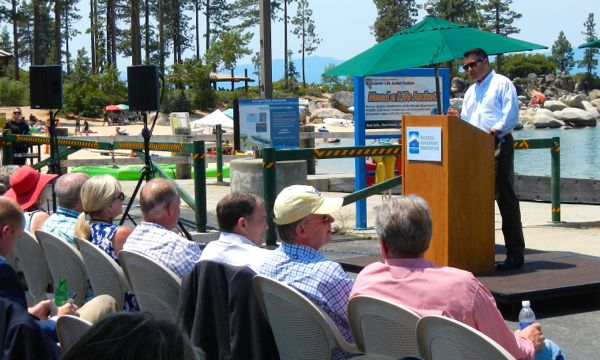
Gov. Brian Sandoval talks June 25 about collaboration as other Western governors listen. Photo/Kathryn Reed

Gov. Brian Sandoval talks June 25 about collaboration as other Western governors listen. Photo/Kathryn Reed

By Kathryn Reed

INCLINE VILLAGE – Collaboration. That is what has allowed public and private entities in the Lake Tahoe Basin to get things done.

Various speakers pointed this out last week at the annual Western Governors’ Association confab.

Nevada Gov. Brian Sandoval, the outgoing chair of the group, said how collaboration is necessary for the economic and environmental survival of Lake Tahoe. With Lake Tahoe the backdrop, the governors had a front row seat at Sand Harbor. Gov. Jerry Brown was not in attendance.

“We have to work together in a time of catastrophic drought,” Sandoval said. This ties into the need to work on water and fire issues as a region and not in isolated jurisdictions.

John Laird, California secretary of Natural Resources, spoke of the time when both states were hashing out details regarding the Tahoe Regional Planning Agency’s Regional Plan update and legislation that threatened the states participation. He said it wasn’t easy, but the end result was worth the angst.

Joanne Marchetta, TRPA executive director, said keeping aquatic invasive species out of Lake Tahoe has brought together a number of agencies. With the lack of funding nearly wiping out the inspection program, she credits both states with coming forward to rescue the program from a “fiscal cliff.”

“Nothing we do here follows neat political boundaries,” Marchetta said. “Collaboration is the way to protect the lake and getting things done.”

For Pete Sonntag, chief operating officer at Heavenly Mountain Resort, he said a new mindset has developed in the last five years since he has been at the helm.

“It’s less of what can we get. It’s evolved into what is possible if we partner together early on,” Sonntag said. “We wouldn’t be able to operate our business without collaboration.”