Report: Airbnb not hurting hotel revenues

By Alison Griswold, Slate
 
In mid-June, Amanda Hite, president and chief operating officer of Smith Travel Research, delivered some exciting news at an annual hospitality conference in New York: U.S. hotels were killing it. For the 12 months ending in April, hoteliers had hit all-time highs in occupancy, average daily room rates, and the money made off each room. Over the next two years, more growth was expected. This marked a stunning return from the recession, which left the lodging industry battered as businesses and households alike slashed travel budgets.

“We continue to experience some of the best fundamentals that we’ve had,” Hite said.

Hotels aren’t the only players in hospitality enjoying a banner year. Late last month Airbnb, the popular alternative lodging site and poster child for the “sharing economy,” closed a $1.5 billion funding round at a towering $25.5 billion valuation. One of the biggest privates rounds ever, the new money vaulted Airbnb into the upper echelons of the ultra-elite club ofbillion-dollar startups. Only two other venture-backed private companies — Uber and Chinese electronics-maker Xiaomi — have valuations that are greater.

Airbnb, which helps people rent out their homes and spare rooms for short stays, is expected to top $900 million in revenue this year. By 2020, that figure is projected to increase more than tenfold to $10 billion. Airbnb’s listings and annual guests have soared as well, roughly tripling from 2013 to 2014.

That astounding growth is just the latest sign that Airbnb is making good on its promise to “challenge the status quo,” as co-founder and CEO Brian Chesky once put it. Here and now, Airbnb isn’t profitable, forecasting an operating loss of about $150 million for 2015. But at $25.2 billion, Airbnb’s valuation has already surpassed the market cap of major hotel chains like Marriott ($20.6 billion), Starwood ($14.1 billion), and Wyndham ($10 billion), and it’s close to eclipsing that of Hilton ($27.4 billion) as well. While Chesky has at times balked at the term disruption, numbers like those can’t be denied. Airbnb is disrupting hotels. Which is why it’s so surprising that midway through 2015, somehow, both Airbnb and hotels are thriving.

Read the whole story


Study: Americans’ support of First Amendment grows

By Roger Yu, USA Today

Americans’ support for the First Amendment rebounded strongly over the past year, a new study says.

Three-quarters of Americans say it “does not go too far” in ensuring Americans’ freedom. That’s a jump from 57% last year after the Boston Marathon bombing in 2013 stirred public debate about the role of social media during a crisis and the media’s use of shocking images, according to State of the First Amendment 2015, a report by the Newseum Institute’s First Amendment Center in partnership with USA Today.

A year ago, 38 percent said the First Amendment goes too far, but the current survey shows only 19% agrees with the sentiment. The study saw a similar dive in public opinion and a subsequent recovery after the 2001 terrorist attacks, the authors noted.

Read the whole story


Calif. water rates rise as drought costs cities

By Fenit Nirappil, AP

Saving water doesn’t always mean saving money in parched California.

Millions of Californians expecting relief on their water bills for taking conservation measures instead are finding higher rates and drought surcharges.

Water departments are increasing rates and adding fees because they’re losing money as their customers conserve. They say they still have to pay for fixed costs including repairing pipelines, customer service and enforcing water restrictions — and those costs aren’t decreasing.

The financial blow is only expected to grow because Gov. Jerry Brown’s administration has ordered communities to slash their water use anywhere between 8 and 36 percent compared to 2013 levels in response to the four-year drought. Those cuts are expected to leave agencies with a $1 billion hole in revenue, and they’ll likely turn to customers to plug it, according to state estimates.

“Just because you use less water does not mean you have lower rates or a lower bill,” said Lori Dolqueist, a water attorney who represents private utilities. “All of these agencies and private water companies are being told to sell less of what they do. It’s a challenge financially.”

While intensive conservation reduces strains on local water supplies, it can spell trouble for government budgets.

Santa Barbara, for example, expects to lose $5 million if residents hit the city’s 20 percent water use reduction target. Residents are going above and beyond and reached 37 percent in May. That’s good for water supply but bad for financial stability.

This month, water bills in Santa Barbara rose between $13 and $120, depending on water use, to help the city recover lost revenue and activate a desalination plant.

“Our folks are coming in and saying ‘Hey, I’m doing everything right, why do I need to pay more?” said Joshua Haggmark, the city’s water resources manager.

It’s not clear precisely how widespread drought-related rate increases are because no government agency or association tracks them.

But agencies across California are reporting they’ve taken steps to tap customers to offset the losses of conservation. Residents in the Bay Area, for example, are seeing higher bills after the region’s largest water wholesaler increased the price of water 28 percent to make up for lagging sales.

Others are opting for a clearly labeled temporary drought fee, including the Sacramento suburb of Roseville which raised $1 million in the last year with a 15 percent surcharge on water use.

That surcharge, plus the relatively low price of water, left some residents disappointed by their bills after buying low-flow toilets and tearing out their lawns.

Travis Wills, 42, is still paying about $30 a month even after ditching a grassy front lawn for black mulch with sego palms, jasmine and Agapanthus flowers and collecting water from his shower and sink in buckets for plants in his backyard.

“We haven’t noticed much of a difference on the bill,” said Wills, who runs a home staging company. “That’s troubling because they want us to reduce water.”

Roseville could double its surcharge if the dry spell deepens, which Wills says he wouldn’t mind too much.

“Maybe if they do that, people will stop wasting so much.”

Dwindling water supplies during the drought have also driven up bills as agencies turn to more expensive resources. The East Bay Municipal Utility District, serving 1.3 million customers east of San Francisco, is charging the average household an extra $12 a month to pay for tapping water dozens of miles away near Sacramento and conservation programs.

Some water departments are able to weather a drought financially because they designed complicated rates that plan for conservation and cover fixed costs in times of drought. Even without such mechanisms, others manage to avoid rate hikes.

The Desert Water Agency serving Palm Springs was among the fiercest critics of California’s mandatory conservation order. It warned regulators it would lose more than $10 million under its 36 percent reduction target.

Instead of increasing its rates, the agency has tapped reserves and cut expenses by delaying needed infrastructure upgrades and implementing a hiring freeze. But residents may end up paying more when the agency sets new rates next year.

“This is a business regardless of what some people think,” general manager David Luker said. “When we strangle a business because of political correctness, there are massive consequences, and we still have to pay our bills.”


Rules being written to keep bears from trash

By Kathryn Reed

New regulations are designed to keep bears and other critters out of commercial and multifamily residential trash bins on the South Shore.

The Waste Management Joint Powers Authority last week voted that the lids, which can be plastic, must be shut at dusk or when the business closes. They may be opened no earlier than dawn, unless it’s trash day, then the time is 5:30am.

The current ordinance does not say the lids must be closed or what hours to do so.

“We’ve had issues where lids are open all night and that’s more attractive to bears,” JoAnn Conner, South Lake Tahoe’s rep on the JPA, told Lake Tahoe News.

Plastic lids will be allowed until a bear breaks through it. At that time South Tahoe Refuse will issue the customer an estimate to get it replaced with a metal lid.

The JPA is comprised of the city, El Dorado County and Douglas County – but just in the basin. Sue Novasel (EDC supervisor) and Nancy McDermid (DC commissioner) are the other two members of the JPA.

Residential customers will not have to get a bear resistant container until there has been an issue with trash being strewn all over. On the second offense where animals have been in the trash that customer will have to pay a fine and get a container or bear box. The screw top trash cans would be permissible until those prove not to work.

A difference among the jurisdictions is whether to require bear boxes when a new residence is built or a remodel takes place. El Dorado County requires the box under those circumstances. The city doesn’t. Douglas County, which does not have mandatory trash pick up like its neighbors, also does not mandate the boxes because of new or significant construction.

Conner’s belief is that mandating boxes in those instances is a punishment to people who have done nothing wrong.

It will be up to the individual jurisdictions to decide if construction triggers the need for a bear box.

The JPA is expected to vote on the final ordinance in September. The individual jurisdictions are likely to give direction or vote on the ordinance before then.


DUI arrests down in El Dorado County

Fewer drivers in El Dorado County have been arrested on driving under the influence charges this Fourth of July period compared to 2014.

From 12:01am July 3 through midnight July 4, officers representing three county law enforcement agencies had arrested six people who were allegedly driving under the influence of alcohol or drugs. Last year, 16 individuals were arrested during same the 48 hours.

Last year there was two alcohol related deaths during this same time. There were zero this year.

Patrols are out in force today as well.

— Lake Tahoe News staff report


Multiple injuries in 3-car Truckee collision

Several people were injured in a three-vehicle accident Saturday night in Truckee.

Truckee police officers said alcohol likely contributed to the first vehicle rear-ending another, which caused the middle car to strike the one in front of it.

No names or hometowns of those involved have been released.

The driver accused of starting the chain reaction was not wearing a seat belt, according to officers. That person was transported to Renown Medical Center in Reno with major injuries after having struck the steering wheel and windshield.

Two occupants were taken to Tahoe Forest Hospital with minor to moderate injuries. Several other people reported minor injuries at the scene, but were not transported.

The 10:54pm July 4 accident on Highway 267 near Brockway Road is still under investigation.

— Lake Tahoe News staff report


Beach-goers sip their way around booze ban

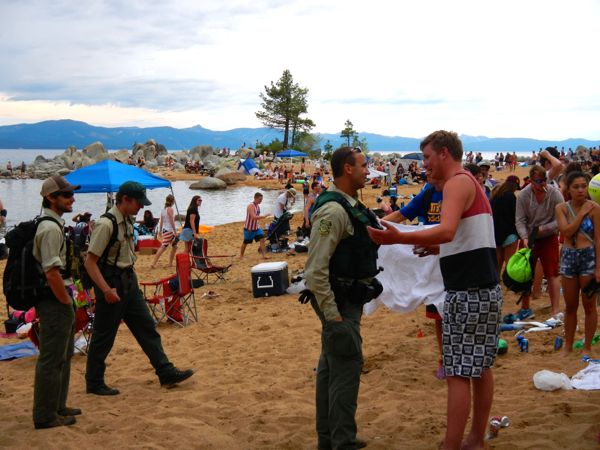
Frank Machler, USFS law enforcement officer. tells a group the beer is not allowed at the beach. Photos/Kathryn Reed

Frank Machler, USFS law enforcement officer. tells a group their beer is not allowed at the beach. Photos/Kathryn Reed

By Kathryn Reed

ZEPHYR COVE – It was hard to know an alcohol ban was in place at Zephyr Cove beach on July 4.

“Why can’t I drink today and yesterday I could?” Neil Fenton asked. The Irishman, one of about a group of 25 on the South Shore beach, practically begged U.S. Forest Service employees to be able to keep his beer.

No such luck.
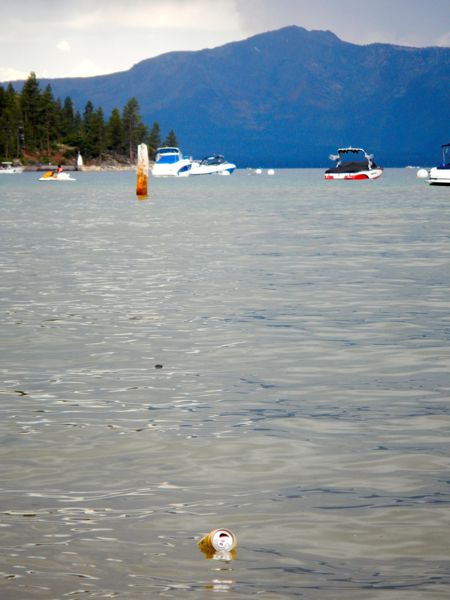
A beer can floats in Lake Tahoe.

A beer can on the Fourth of July floats in Lake Tahoe.

The Forest Service, which owns this beach along with many others in the basin, for several years has been saying no to alcohol on July 4 to help prevent things from getting out of hand.

With about 10,000 people just at this beach – as well as the neighboring Dreyfus Estate, the Forest Service is on a quest to maintain control. One way is curbing alcohol consumption.

People were lining up at 6:30am Saturday to get onto Zephyr Cove beach. With the thunderstorm rolling through midmorning, it scattered some people and kept the temperatures cooler than usual. This may have played a role in keeping the alcohol-induced troubles to a minimum.
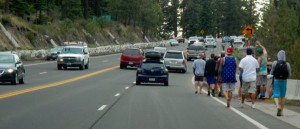
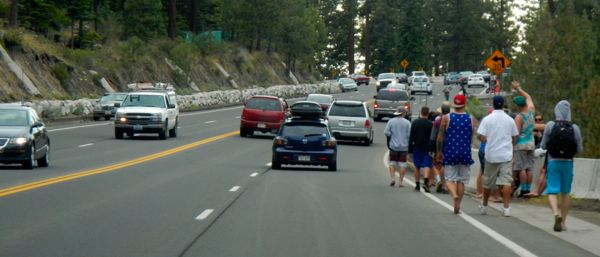
Vehicles and pedestrians fill the lanes of Highway 50.

Vehicles and pedestrians fill the lanes of Highway 50.

While signs were posted – and were up the day before the Fourth – and the media had gotten the word out about the booze ban, some people said they weren’t aware of the rules and others deliberately tried to get around them.

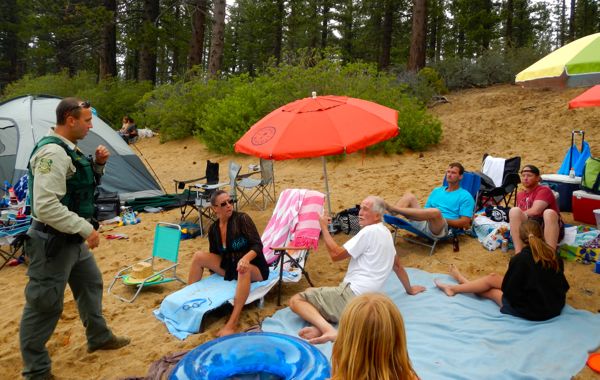
Jonathan Cook-Fisher, a forest protection officer with the USFS, had warned a multigenerational group at 11:30am about the alcohol ban. Frank Machler, a law enforcement officer with the USFS, saw the same people more than three hours later with beer cans next to them that anyone could see. He waited to see the cooler being hauled away. The older man in the group – at least in his 60s – glared at Cook-Fisher and his partner for the day, Gerard Dean, when he saw them later.

USFS law enforcement officers patrol the beer garden at Zephyr Cove.

USFS law enforcement officers patrol the beer garden at Zephyr Cove.

Cook-Fisher and Dean run into the Irishmen who’ve stopped in the forest to drink some more. Cans are scattered about. They are told to move on, but to first take their trash. They mumble and mosey on.

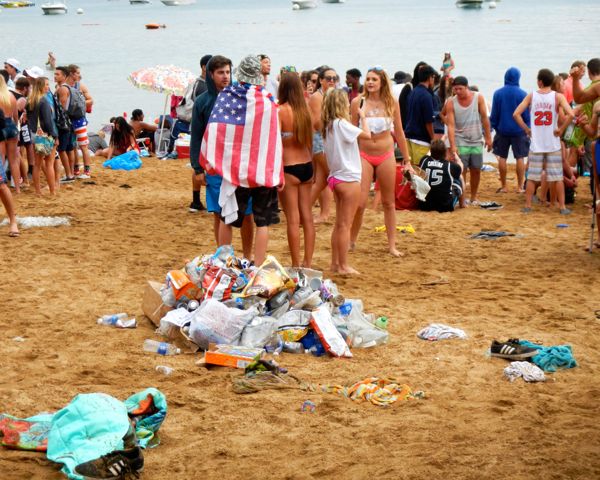
Beer cans on the beach prove the ban is being ignored. Some are empties on the beach, some float in the water. An abundance of trash litters the sand. No obvious trash cans are in sight.

Others try not to be so blatant with their alcohol consumption. On the party side a guy is drinking a cola colored beverage from a bottle that says it is water. An officer confiscates it, pours it out. It wasn’t just soda.
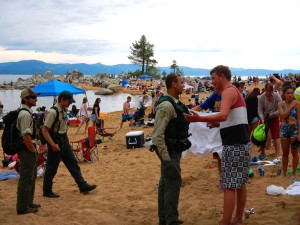
Frank Machler, center, talks with Neil Fenton, right, about getting rid of his booze, as USFS employees Gerard Dean and Jonathan Cook-Fisher standby.

Frank Machler, center, talks with Neil Fenton, right, about getting rid of his booze, as USFS employees Gerard Dean and Jonathan Cook-Fisher standby.

Instead of traditional water bottles, people are getting more deceptive with their contraband. Shampoo and sunscreen bottles are being used to transport alcohol. The problem is the container isn’t always washed out well so the imbiber ends up vomiting.

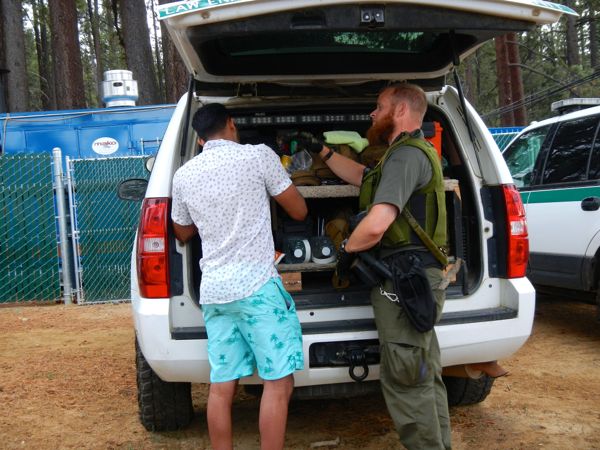
Machler said he likes to get people to pour the alcohol out or take it back to the vehicle. Citations are not immediate. If things get out of hand, the resort can tell people to leave or sheriff’s deputies can take people to jail.

Machler also has no tolerance for marijuana use. It’s illegal on federal property no matter what the state laws say – even medical marijuana. A guy admits to using, but said it was hours before and not on federal land.
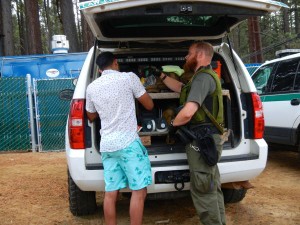
A man receives a citation for disorderly conduct and interfering with a law enforcement officer.

A man receives a citation for disorderly conduct and interfering with a law enforcement officer.

Cook-Fisher said that’s one of the things those patrolling the beaches have to do – make quick decisions in the moment. They weigh the seriousness of the infraction against possibly taking resources from where they might better be served. Is education more beneficial than a citation? Ruining someone’s fun at Tahoe is not their goal; instead it’s about making them and the others at the beach safe.

Another way to help maintain calm has been to increase the number of people who are working the Fourth holiday. On a normal summer weekend the Forest Service has 10 to 15 people in the field. (This doesn’t count fire personnel.) This weekend more than 40 additional USFS employees are in the basin working.

Cook-Fisher said the biggest change in the last five years is the collaboration between agencies.

“There’s a common understanding that resources are limited and we need to share,” Cook-Fisher told Lake Tahoe News.

At Zephyr Cove, in addition to Forest Service employees, Douglas County sheriff’s deputies were out, the resort hired Marines to work security, and Tahoe Douglas fire regulates how many people can be in the beer garden. Tahoe Douglas paramedics administer the serious medical aid. Before they can arrive the USFS Klamath firefighters who are in the region for added fire suppression relief render basic aid. One woman was about to get an ambulance ride in her bikini. She cut her elbow and thigh climbing a fence. Stitches were in her future.
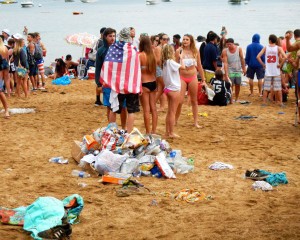
Piles of garbage could be seen at Zephyr Cove beach on July 4.

Piles of garbage at Zephyr Cove beach on July 4.

Cook-Fisher ends up giving medical attention to a group of women, one of whom is clearly intoxicated. Her fingernail is nearly torn off and she is whimpering in pain.

“Our purpose today is not about writing citations. It’ public safety and protecting natural resources,” Cook-Fisher said.

At this South Shore beach a temporary fence is erected on the Fourth with the goal of keeping families on one side, the more raucous revelers on the other.

The only alcohol allowed is in the beer garden that Zephyr Cove Resort runs. It’s hopping in there, with music playing and people dancing. Several law enforcement officers monitor who comes and goes.

About 4pm the beer garden closes. The beach closes about an hour later for a short time. Many people were headed for a place where they could watch the fireworks, like Nevada Beach.

For authorities, it was just another day at the beach — Lake Tahoe style.


S. Tahoe man accused of felony DUI

A South Lake Tahoe man was arrested Friday on felony charges of driving while under the influence of alcohol causing injury.

Benjamin Bassett

Benjamin Bassett

Benjamin Bassett, 27, had a blood alcohol level of 0.11 percent, according to police officers.

He was going west on Pioneer Trail near Woodbine Road on July 3 about 2am when he reported lost control of the vehicle, causing it to rollover and land on the roof of the Chevrolet Trailblazer. The speed limit is 35 mph. South Lake Tahoe officers said Bassett was going more than 50 pmn.

A passenger was transported to Barton Memorial Hospital with minor injuries.

— Lake Tahoe News staff report


Construction worker struck on Highway 89

By Barbara Barte Osborn, Sacramento Bee

HOMEWOOD — The California Highway Patrol on Tuesday arrested a Mill Valley man on suspicion of fleeing the scene after striking a road-construction worker the day before, causing serious injuries.

The incident occurred on Highway 89 in a busy construction zone in Homewood, on Lake Tahoe’s west shore, about 1:35pm Monday.

Following an investigation, CHP officers arrested Erich J. Griesemer, 60, of Mill Valley, in Tahoma about 4:20pm Tuesday.

Read the whole story


3 DUI arrests; beefed up patrols continue

Three people were arrested on driving under the influence charges in El Dorado County in the 24-hour period of July 3.

This was the work of local routine traffic enforcement and special Avoid the 6 DUI deployments. In 2014, five people were arrested in the same 24-hour period.

DUI arrest data collection will continue through midnight July 5. Law enforcement officials are continuing DUI efforts
throughout the county and region. Additionally, CHP throughout the state have all available officers patrolling
freeways and county roads throughout the weekend.

For July 4, all agencies will be staffing all available officer and extra DUI saturation patrols will be deployed in the Placerville, South Lake Tahoe and the unincorporated areas in the county.

— Lake Tahoe News staff report