68% of uninsured in Calif. now covered

By Victoria Colliver, San Francisco Chronicle

Two-thirds of Californians who were uninsured before the Affordable Care Act went into effect now have health coverage, according to a study released Thursday.

The nonpartisan Kaiser Family Foundation has followed more than 1,100 Californians who lacked health insurance as of September 2013 through the first two coverage enrollment periods, the latest of which ended in February.

The foundation found that 68 percent of previously uninsured Californians now have coverage, up from 58 percent after the first enrollment period ended in spring 2014. About a third of the previously uninsured are now covered through the state’s Medi-Cal program for the poor, while just 12 percent bought coverage through Covered California, the state’s health insurance exchange.

Read the whole story


Future of Caesars Entertainment remains murky

By J.D. Morris, Las Vegas Sun

More than six months after a major division of Caesars Entertainment Corp. filed for bankruptcy, it’s still unclear exactly how the company will emerge on the other side.

Caesars wants a Chicago bankruptcy court to approve a restructuring plan that could shed around $10 billion in debt from the division, but lawsuits from some of the company’s creditors continue to complicate things. One recent court decision in particular threatens to create big problems for the entire casino company.

If Caesars’ plan is successful, the division that filed for bankruptcy will be reorganized under a real estate investment trust setup that will split it into two parts: one that owns casinos and another that manages them. That setup would have Caesars follow in the footsteps of other casino companies — including Penn National Gaming, the company buying the Tropicana — that have made similar moves toward real estate investment trusts.


Harrah’s Reno, Harrah’s Lake Tahoe, Harveys Lake Tahoe, Caesars Atlantic City and Bally’s Atlantic City were among the properties included in the bankruptcy filing in January.

Read the whole story


CVS accused of overcharging for generic drugs

By Sudhin Thanawala, AP

SAN FRANCISCO — CVS Health Corp. deliberately overcharged some pharmacy customers for generic drugs by submitting claims to their insurance companies at inflated prices, according to a lawsuit filed last week in federal court in San Francisco.

The suit says those inflated prices led to higher co-pays for customers that exceeded what they would have paid for the drugs if they had no insurance and participated in a CVS discount program.

“We’ve seen people who pay $20 for a 30-day supply as their copayments on a drug that was $11.99 for a 90-day supply had they been in the (discount program),” said Kristen Broz, an attorney with Hausfeld, the firm that filed the suit.

The lawsuit seeks class-action status, a court order prohibiting CVS from engaging in the behavior, and unspecified damages.

Broz estimated that hundreds of thousands of people may have been affected since 2008.

CVS Health spokesman Michael DeAngelis said the Rhode Island-based company had not been served with the lawsuit, so it couldn’t comment on it. He said co-pays are determined by a patient’s prescription coverage plan and added that a similar suit in Massachusetts was dismissed.

At issue in the lawsuit is CVS’s “Health Savings Pass” program, which offers discounts to customers who do not have insurance or choose not to use insurance on hundreds of generic prescription drugs, including generic versions of the antibiotic Penicillin and the antidepressant Prozac, according to the suit.

Instead of presenting insurance companies with that discounted price, CVS reported the higher price that a normal retail customer not in the Health Savings Pass would pay, the lawsuit alleges.

Customers were then charged co-pays according to those higher prices.

“Not only was the HSP program a means by which CVS could maintain and increase its market share by fending off discounted prices from its competitors, but importantly, CVS also intended that the HSP program would serve as a mechanism to hide CVS’s true usual and customary prices from third-party payors,” the lawsuit says.



Site lets Californians tattle on water wasters

By Associated Press

California is launching a website that lets residents tattle on water wasters, from neighbors with leaky sprinklers to waiters who serve water without asking.

California has multiple restrictions on water use, including banning washing cars with hoses that don’t shut off and restricting lawn-watering within two days of rainfall. But enforcement varies widely across the parched state.

Residents can send details and photos of water waste at savewater.ca.gov. Complaints are then sent to local government agencies based on the address of the offense.

The site went online Thursday as the latest conservation initiative. More than 300 agencies have signed up to see the details of water waste tips. Many local agencies already had their own reporting sites.

Tipsters wary of being outed as the neighborhood snitch can remain anonymous.


Nevada seeks to keep drones grounded during fires

Drones can put firefighting aircraft at risk.  Photo/Nevada Division of Forestry

Drones can put firefighting aircraft at risk. Photo/Nevada Division of Forestry

The Nevada Division of Forestry is warning people to keep drones on the ground during a fire so firefighters can better do their job.

“If they fly, we can’t,” Nevada Firewarden Bob Roper said in a statement. “It’s a major risk to pilots, ground personnel and aircraft. There may also be civil and/or criminal consequences that Nevada operators need to know about.”

Often a temporary flight restriction is put in place around wildfires to protect firefighting aircraft. No one other than the agencies involved in the firefighting effort can fly any manned or unmanned aircraft during the restrictions.

According to the NDF, even if there are no restrictions, operating a drone could still pose a hazard to firefighting aircraft and would violate federal aviation regulations.

“If you endanger manned aircraft or people on the ground with an unmanned aircraft, you could be liable for a fine ranging from $1,000 to a maximum of $25,000,” said FAA Administrator Michael Huerta. “Know the rules before you fly. If you don’t, serious penalties could be coming your way for jeopardizing these important missions.”


Nev. expects to get NASA drone contract

By Daniel Rothberg, Las Vegas Sun

NASA could soon be testing drones in Nevada airspace.

As one of six designated drone test sites, the State of Nevada is in the process of securing a contract to host the agency while it researches unmanned aerial vehicles. Tom Wilczek, who works with the aerospace and defense industries in the Governor’s Office of Economic Development, expects to have an agreement within two months.

The contract would give NASA the freedom to use the Nevada test site for UAV-related projects, such as developing an air traffic management system for drones. NASA is also expected to conduct a demo flight in Nevada as part of its testing for unmanned aircraft. The state has not determined where the testing would take place, but the there are several locations throughout the state with good conditions for operating unmanned vehicles. They include Creech Air Force Base, Nellis Air Force Base, Fallon Municipal Airport, Reno-Stead Airport, Boulder City Airport and the Nevada National Security Site/Desert Rock Airport.

Read the whole story


Calif. missed a year’s worth of rain since ’12

By Avaneesh Pandey, International Business Times

California — currently facing one of the worst droughts on record — has accumulated a rainfall “deficit” of about 20 inches since 2012, according to a new NASA study. In other words, the difference between actual rainfall in the state and the rainfall expected on average is now equivalent to a whole year’s worth of precipitation.

Although California has typically seen wide annual fluctuations in rainfall, the wet years balanced out the dry ones during non-drought periods. However, the latest precipitation data gathered by NASA shows that California accumulated a deficit of almost 13 inches between 2012 and 2014, and another 7 inches during the 2014-2015 wet season.

According to the study, this lack of rains can be attributed to the absence of “atmospheric rivers” — narrow, water vapor-rich jets that travel through the atmosphere, typically from west to east — over the eastern Pacific Ocean.

Read the whole story


California’s pension hole now monstrous

By Teri Sforza, Orange County Register

Within the span of only 11 years, the hole at the bottom of California’s state and local pension funds increased a staggering 3,046 percent.

The monstrous growth of the gap between what public agencies have promised workers upon retirement and what they actually have – from $6.3 billion in 2003 to $198.2 billion in 2013, according to figures gathered by the state controller’s office – matters to all Californians, reformers argue.

If it’s not filled up with meatier investment earnings and heftier contributions from public workers and employers, that hole will continue to expand, and taxpayers must fill it directly.

Why? Because in California, the promises made to public workers on Day One of their employment can never, ever be broken – at least, not outside of federal bankruptcy court. And even in court, officials from Vallejo and Stockton and San Bernardino did not request permission to modify these burdens, fearing they’d have trouble attracting and retaining workers if the city next door offered something better.

Read the whole story


2015 fire season approaching record level

Grassy areas in the West are dry and quick to burn with this being year four of the drought. Photo/Carolyn E. Wright/Copyright

Grassy areas in the West are quick to burn with this being year four of the drought. Photo Copyright 2015 Carolyn E. Wright

By Gloria Dickie, High Country News

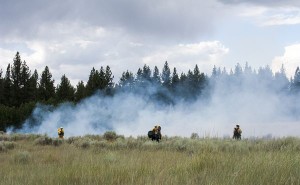
USA Today earlier this week reported that U.S. wildfires were approaching “record levels.” The article pointed at the more than 5.5 million acres burned so far this season — second only to the summer in 2011, when just more than 6 million acres had burned by the end of July.

Certainly, the 2015 fire season started off with a bang. As of Thursday, 21 large fires — meaning more than 100 acres — were burning in Western states. But when it comes to wildfire, the tide turns quickly, and this season may not set any all-time records.

This year’s fire season has been an odd one. The usually fire-prone Southwest has burned less than the Pacific Northwest, California and Alaska. More than 85 percent of acreage burned has been in Alaska. Meanwhile Colorado, which has broken a number of its own fire records over the past few years, has remained relatively fire-free.

Read the whole story


Boat patrols rescue family, kayakers on Tahoe

A Coast Guard crew from the Tahoe City station was alerted about 9:45pm July 29 that three people were missing on Lake Tahoe.

The 31-year-old woman and her two kids were found near Meeks Bay on a raft that was quickly losing air, according to authorities. Calstar used its radar to find the three, and then the Coast Guard boat reached them.

El Dorado County Sheriff’s Department’s search and rescue team returned the family to Meeks Bay. No one was injured.

The week before, on July 22, Coasties and a Good Samaritan rescued two kayakers who were unable to get back on their vessels.

The two were near Incline Beach at approximately 3:20pm July 22 when they fell in and then began drifting apart. Neither was wearing a life jacket. Both were in good condition after being pulled to safety.

— Lake Tahoe News staff report