Nev. far behind top states for commercial drone use

By Daniel Rothberg, Las Vegas Sun

The number of companies in Nevada approved for commercial drone flights is about on par with most states but lags far behind leaders like California and Arizona, according to an analysis of the first 500 waivers issued by the Federal Aviation Administration.

Nevada companies were issued six exemptions from the rules otherwise banning commercial drone flights.

California, meanwhile, led the nation with 70 approved operators, followed by Texas with 46, according to an analysis of FAA data released last week by the Association for Unmanned Vehicle Systems International.

Read the whole story


Study: Economic benefits to raising Shasta Dam

By Associated Press

WASHINGTON — A long-awaited study requested by Congress concludes that enlarging Shasta Dam by 18.5 feet is technically and economically feasible, though the Bureau of Reclamation declined to make a formal recommendation to move ahead with the project.

The study found the most viable expansion option would cost an estimated $1.4 billion and provide an economic benefit of $30 million annually from increased salmon populations, water supply, flood control and recreational opportunities.

However, it was unclear who would be willing to take on the cost of construction.

The report said nonfederal alternative financing would have to be secured for a majority of the construction costs before the secretary of interior could recommend the project.

State officials made it clear that the project is ineligible for funding through a recently approved bond proposition.

The federal government typically funds construction of major reservoirs that Congress authorizes and is then repaid from the project’s beneficiaries over the course of several decades.

California voters last year approved $2.7 billion for additional water storage as part of a bond proposition.

Nancy Vogel, deputy secretary for communications at the California Natural Resources Agency, said the project is not eligible for funding from Proposition 1, as funding cannot go to any project that would negatively affect a river protected under the state’s Wild and Scenic Rivers Act.

Raising the dam would inundate portions of the protected McCloud River.

California is in the midst of a four-year drought that has forced tough decisions for many cities and farmers. Gov. Jerry Brown has ordered communities throughout the state to collectively reduce water use by 25 percent.

To prepare for future droughts, some federal and state lawmakers have said securing more water storage through new or expanded reservoirs is critical. They have grown frustrated with how long it has taken for the Bureau of Reclamation to complete feasibility studies on a handful of projects.

Congress first authorized the Shasta study in 1980.

Shasta Lake, the state’s largest reservoir, is located on the upper stretches of the Sacramento River about 160 miles north of Sacramento.

Federal officials looked at an array of options for the dam, from raising the 602-foot concrete structure by 6.5 feet to raising it by 12.5 feet, then to 18.5 feet.

The most beneficial alternative calls for an 18.5-foot increase, adding spawning gravel to the upper Sacramento River and restoring habitat along the river.

The higher lake level would require the relocation of utilities and bridges as well as the modification or total replacement of several marinas, boat ramps and trails.

Expanding the dam by higher than 18.5 feet would require much more extensive and costly relocations, including for Interstate 5, the report said.

The study said the most economically beneficial option would increase the amount of water stored in the reservoir enough to cover 634,000 acres with a foot of water. About a third of that additional water would be used to benefit fish populations.

Members of Congress have been calling for more water storage projects in the state, but their immediate response to the study has been cautious.

“Ensuring that local residents, businesses and infrastructure are given proper consideration is key,” said Rep. Doug LaMalfa, R-Richvale, whose district includes Shasta Lake and surrounding communities. “Should this project move forward, I will work to ensure that those residents and businesses that could be affected are justly compensated and have an opportunity to relocate on the lake.”

Doug Obegi, an attorney with the Natural Resources Defense Council, said raising the dam would destroy sacred tribal sites and provide “virtually no environmental benefits.”


SLT crews demonstrate extrication intricacies

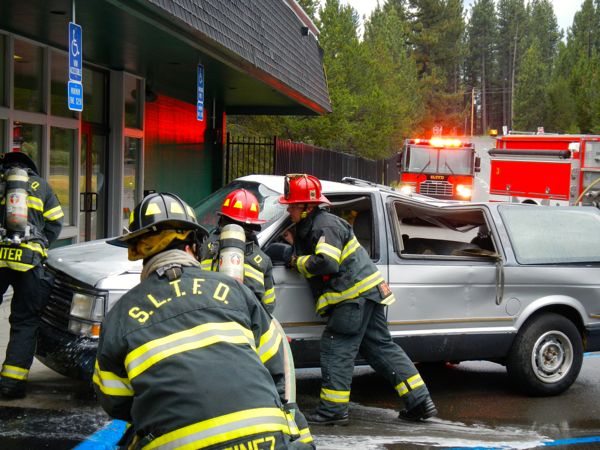
South Lake Tahoe firefighters demonstrate an extrication from a vehicle. Photos/Kathryn Reed

South Lake Tahoe firefighters demonstrate extricating a person from a vehicle is complicated. Photos/Kathryn Reed

By Kathryn Reed

A woman sat slumped in the driver’s seat. The car a heap of metal. There was no way to get to her without removing the door and roof of the vehicle.

What seemed like an inordinate amount of time passed before she was loaded onto a litter board.

It’s not easy work to extricate someone from a mangled car. That was proven by South Lake Tahoe firefighters as they demonstrated the process to City Council members and others.

Each department head is tasked with presenting to the electeds – and public – what it is their employees really do. Not all will be as visual as what Fire Chief Jeff Meston delivered.

Tools of the trade.

Tools of the trade.

Firefighters used this as an actual training for what it would be like to respond to a car crash where the driver is unresponsive and stuck inside. Besides injured people, the crew was concerned about fire and leaking hazardous materials.

Their safety is of utmost importance so the necessary gear must be put on before the work begins. Hoses are brought from the trucks. A variety of tools were needed to cut through the metal. It was a team approach to dealing with each aspect of the rescue.

Paramedics do what they can for the driver. A neck brace is put around her while still in the vehicle, other care is provided as well as the firefighters work to free her from could have been a metal tomb.

Being such a small city, most of the department’s resources are deployed to a serious crash. At the demonstration – just like if this were a real accident – Tahoe Douglas and Lake Valley fire departments back up city personnel.

“We use up all of our resources on a pretty regular basis,” Meston told the council. “No agency is able to do their own thing.” Mutual aid is what saves everyone in the basin.

Meston said California has the most sophisticated mutual aid system in the world.


AP U.S. history course revised to emphasize U.S. ideals

By Rebecca Klein, Huffington Post

After facing months of intense scrutiny over a new Advanced Placement U.S. history course outline that some conservatives perceived as containing anti-American biases, the College Board released a new framework for the class Thursday morning. This structure places more of an emphasis on concepts surrounding American national identity, the country’s founding leaders and documents and the effective role of free enterprise in U.S. history.

The College Board, the company that created and runs the Advanced Placement program, said the updated course framework reflects feedback it received from educators and historians during a public review period. The changes make it so “statements [in the framework] are clearer and more historically precise, and less open to misinterpretation or perceptions of imbalance” and so that specific important individuals and documents are clearly included, according to the group’s website.

After deciding to redesign the course in 2006, the College Board released a new course outline last year that hit classrooms in the fall. It was designed by a committee of professors and teachers, and generated controversy from critics who said it took an overly critical approach to teaching American history.

Read the whole story


Calif. meets drought-fueled fire season with extra crews

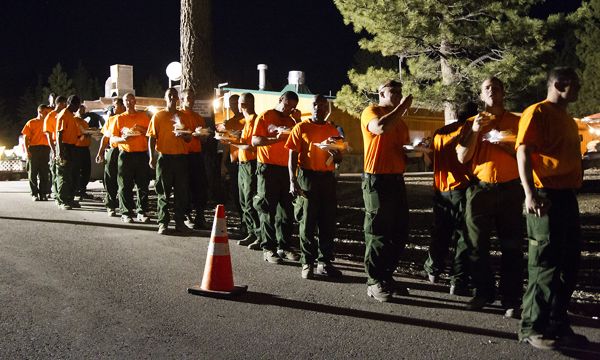
Inmates, temporarily calling Turtle Rock Park home, get dinner June 25 after working the fire line. Photo/Carolyn E. Wright/Copyright

Additional crews on many fire lines are inmates. Photo Copyright 2015 Carolyn E. Wright

By Janie Har, Associated Press

LAKEPORT —    f.

They bunk in tight sleepers and eat in a big mess hall. They depart in the mornings with enormous high-calorie sack lunches of sandwiches and cookies as others come back tired, footsore and hungry to their makeshift base at the Lake County fairgrounds.

The National Interagency Fire Center in Idaho has listed the fire 110 miles north of San Francisco as the nation’s highest priority for crews and equipment. It is the largest of 23 fires statewide and takes up nearly a third of the 10,000 firefighters dispatched in California, which has become tinder box amid years of drought.

The good news is state fire officials prepared for a drought-fueled fire season and staffed up early with several hundred more firefighters than previous years, CalFire spokesman Daniel Berlant said.

“We’re definitely at a medium to high level of activity but we’re not at extreme, where we are low on resources by any means,” he said. “That helps us out if there are new fires.”

Across the U.S., 118 fires are burning on 2,757 square miles, according to the Idaho fire center. About 17,200 people are fighting those fires, but resources are not tapped out yet, center spokeswoman Robyn Broyles said. If civilian crews run low, officials can call on national guard and military crews.

August is the height of fire season, and while the number of fires nationally is below average, the 9,361 square miles burned to date is about 50 percent above average. Most of that — 7,731 square miles — has been in Alaska.

On Wednesday, evacuation orders for a small Washington town were lifted after a fast-growing wildfire bypassed the community.

Fire spokesman Ron Fryer said people were being allowed back into their homes in Roosevelt, about 120 miles east of Portland, Oregon. He said the grass fire that began Tuesday has grown to 26 square miles.

In California, CalFire has responded to 4,200 fires this year — 1,500 more than average, Berlant said.

The biggest is in rugged terrain in Lake, Yolo and Colusa counties, and its cause is under investigation. More than 13,000 people have been required or urged to leave their homes, cabins and campsites, and at least 39 homes have been destroyed.

Some of the 3,400 firefighters on the blaze have been here since it started a week ago. The fire, which was 30 percent contained Wednesday night, isn’t expected to be fully corralled until at least Monday.

As much as crews love the work, fatigue inevitably sets in.

“This is our seventh day,” said Seaton King, a battalion chief with the Pasadena Fire Department. He returned from a shift protecting structures and cutting low tree limbs.

“You kind of get used to it, but it’s still taxing in terms of being up and available for those 24-hour work cycles.”

California fire officials say their biggest concern is that forecasts call for lightning that could spark more blazes.

Since July 1, when the new fiscal year started, CalFire estimates it has spent $63 million battling large wildfires. Last fiscal year, it spent an estimated $434 million.

Bills for firefighting are adding up across the country. On Wednesday, the U.S. Forest Service released a report showing rising firefighting costs are affecting national forest conservation, restoration, recreation and management programs.

Firefighting costs now consume more than 50 percent of the Forest Service’s budget, compared with just 16 percent in 1995. They are expected to comprise two-thirds of its budget in 10 years if left unaddressed.

At the fire camp here Wednesday, freshly returned firefighters in blue sat at long tables and dug into bowls of fruit, corned beef hash and fried eggs. They told jokes and drank coffee named after Justin Bieber, Johnny Cash and Metallica, to indicate strength.

Fire trucks parked outside hailed from Long Beach, Los Angeles and Riverside. Nearby were large white mobile sleepers that could fit 45 weary firefighters. Some preferred to pitch a tent.

“It’s tiring work, no doubt about it. But most of these guys are in really great shape, and they thrive in this environment,” said Hugo Patino, Modesto Fire Department battalion chief.

Mike Burt with the Glendale Fire Department in Los Angeles County said his crew received a call to help last Thursday morning and was in Lakeport that afternoon.

“I’d like to put my feet in an ice chest basically, but I won’t do that,” he said, laughing. “That would feel pretty good.”



California could allow more felons to vote

By Paige St. John and Timothy M. Phelps, Los Angeles Times

California Secretary of State Alex Padilla on Tuesday reversed the course set by the state elections chief before him and dropped efforts to prevent some 45,000 state felons from voting.

The move brought cheers from those seeking greater rights for former prisoners and comes as California is rethinking some of its get-tough criminal justice policies.

A lawsuit challenged a rule created by former Secretary of State Debra Bowen after California in 2011 enacted legislation that required lower-level felons to serve their time in jails instead of prison, or when released from prison on community probation instead of state parole.

Read the whole story


Newfangled slots aim to hook younger players

By Jeff Barker, Baltimore Sun

Many slot machines on casino floors bear images of faded but recognizable movies or TV shows such as “Sex and the City,” “Ghostbusters” or the still-running “Wheel of Fortune,” appealing to an older generation of players who reliably play the random games of chance.

But time and technology are catching up with traditional slot machines, which don’t hold anywhere near the same appeal for younger players as they do for their parents. Slots simply can’t compete with the variability and social nature of the window through which most young people view the world — their smartphones.

Slots play “has kind of been slowing down nationally. It’s not advancing as fast as table play,” said David G. Schwartz, director of the Center for Gaming Research at UNLV. “Today, anybody who has the disposable income to play a slot machine has something in their pocket that is way more entertaining than that slot machine.”

Anxious about millennials’ indifference to slot machines, manufacturers are testing more social and interactive games that would make the casino floor of the future look like a cross between a TV game show and a NASA flight control room.

Read the whole story


Caesars turns around loss in second quarter

By J.D. Morris, Las Vegas Sun

Caesars Entertainment, the massive casino company whose Strip properties include Caesars Palace, the Flamingo and the Paris, reported its second quarter earnings this week.

Revenue: $1.14 billion, up 17.4 percent from the second quarter of 2014 — but those numbers don’t include revenue from Caesars Entertainment Operating Co., the company’s division that went into bankruptcy in January. Including the bankrupt division, revenue was $2.3 billion for the quarter, up 8 percent from last year.

Earnings: $15 million, compared to a loss of $91 million during the same time last year. Neither of those numbers includes the bankrupt division, which controls Caesars Palace, Harrah’s Lake Tahoe, Harveys and others.

Read the whole story


Old Alta Mira site being given a new life

This area of South Lake Tahoe is slated to be a small gathering area without motorized access. Photo/Kathryn Reed

This area of South Lake Tahoe is slated to be a small gathering area without motorized access. Photo/Kathryn Reed

By Kathryn Reed

Lakeview Lookout – the working name of the other bookend of Lakeview Commons – is being designed to be a community gathering spot with a lake view, but on a much smaller scale.

The Alta Mira building came down in September 2014, opening up a view of the lake in South Lake Tahoe that hadn’t been seen in years.

The California Tahoe Conservancy, owner of the 0.55-acre site, is working on a plan to turn the parcel into something useable. To start with the state agency is removing the pavement and installing vehicle barriers to allow for better pedestrian and bicycle use.

Lakeview Lookout, like the Commons, is part of the greater 56-acre project. Beautification from this parcel to El Dorado Beach would complete the Lakeview Commons project. No money is in the bank for the Alta Mira site or the acreage going to the Commons, though plans have been drawn for both. (Lakeview Commons cost more than $6 million.) The remaining acreage in the bigger project is across the street and includes Campground by the Lake.

South Lake Tahoe City Council members on Aug. 4 agreed to form a committee to talk with El Dorado County officials about the 56-acre site’s future.

The Conservancy staff has solidified its plans based on public input and the creative forces at Design Workshop. The board will be briefed on the idea at the September board meeting, with the desire to see where members want to put this project on the priority list.

“Together with Lakeview Commons what excites us about this is that it really is a community space away from the tourist core,” Patrick Wright, CTC executive director, told Lake Tahoe News. “It is a place for primarily residents to have their space and enjoy the lake. For that reason it is likely to be a priority for us.”

There is only so much that could be done with the site because of how small it is and the fact it borders Highway 50.

Stephanie Grisby with Design Workshop told Lake Tahoe News, “We are trying to expand it out into the trees a little bit so it has a small cantilever. Because of the location right on the highway trying to get some sound mitigation is a key design goal. There will be a little bit of berming without blocking views of Lake Tahoe.”

The Conservancy is working on coming up with cash for the project that is estimated to cost more than $2 million, which includes going through the environmental process.

Soroptimist International of South Lake Tahoe and Tahoe Fund are two possible money sources. CTC staff will present the project to the service club today. Cathy DiCamillo, chair of the Soroptimist committee working with the Conservancy, did not return a phone call. The club has $250,000 to spend on a major project. A vote by the nonprofit is expected Aug. 12, however some in the club wonder how the capital improvement project has anything to do with Soroptimists’ mission of helping women and girls.

Amy Berry, who is executive director of the Tahoe Fund, is also a member of this Soroptimist group.

Wright said the remaining funds from Proposition 12 and other sources could help pay for the work. The state water bond, though, is not an option.

As for who would be responsible for the operation and maintenance of the site, Wright said it’s too soon to answer – instead he wants to develop the area first. However, he said it’s probable the CTC would engage South Lake Tahoe in a conversation about entering into a contract for the city to maintain the property like it does at Lakeview Commons.

Funding will dictate when anything of substance is done at this area.


Cattle grazing illegally in Tahoe basin

This photo, taken Aug. 4, were taken today (8/4/2015) of 27 cattle grazing illegally in the Lake Tahoe Basin, Big Meadow area. Grazing was discontinued in Meiss Country where Big Meadow is located over 10 years ago. This situation has occurred numerous times since the ban of cattle in the area and responsible agencies have been negligent in preventing this resource damage to the watershed. Second photo shows identification brand on cattle.
This photo, taken Aug. 4, shows cattle grazing illegally in the Lake Tahoe Basin, specifically the Big Meadow area. Grazing was discontinued more than 10 years ago in Meiss Country where Big Meadow is located. The South Shore resident who took the photo and wants to remain anonymous said, “This situation has occurred numerous times since the ban of cattle in the area and responsible agencies have been negligent in preventing this resource damage to the watershed.” Twenty-seven head of cattle were counted. The U.S. Forest Service controls the land. It was too late to obtain a comment from the feds.