Justice Dept. memo lets feds close pot shops

By Bob Egelko, San Francisco Chronicle

In a newly disclosed memorandum, President Obama’s Justice Department has told federal prosecutors they can file criminal charges against medical marijuana users and suppliers and shut down pot dispensaries, despite a congressional ban on federal interference with medical marijuana laws in California and other states.

The Justice Department had previously made its intentions clear by refusing to drop pending marijuana prosecutions and pursuing forfeiture actions against dispensaries, including Oakland’s huge Harborside Health Center. But the Feb. 27 memo, made public Wednesday by Tom Angell of the advocacy group Marijuana Majority, provides the department’s rationale for considering the congressional spending restrictions largely toothless.

The budget language passed in mid-December prohibits the department from using its funds to stop states from “implementing their own laws” on medical marijuana. But Patty Merkamp Stemler, chief of the Justice Department’s Appellate Section, told federal prosecutors the congressional action “addresses actions directed against states, not individuals.”

Read the whole story


BLM scraps Burning Man VIP compound, grants permit

By Jenny Kane, Reno Gazette-Journal

The U.S. Bureau of Land Management has scrapped demands for a $1 million VIP compound at this year’s Burning Man, the agency announced Friday evening.

The agency also announced that it granted Burning Man its special recreation permit for the 2015 event, which is allowed to draw 70,000 people to Nevada’s Black Rock Desert from Aug. 30 to Sept. 7. Burning Man is an annual arts celebration that has been held in Northern Nevada since 1990.

In June, the BLM requested that Burning Man pocket the expense to build a “Blue Pit Compound” on the event site, a living quarters area that would accommodate BLM law enforcement and officials from Washington, D.C., some of whom would only be visiting for a day or so.

Read the whole story


Placer County boots homeless from government land

By Brenna Lyles, Sacramento Bee

Dozens of homeless people camped out on the grounds of the Placer County government complex in north Auburn were forced to leave Thursday as a new ordinance took effect banning unauthorized camping on county-owned land.

Authorities estimated that 50 to 70 people had occupied camps sprawled across the county property. The camps started about a year ago and grew over time.

Jamie Brody, 37, who has been homeless for a year and a half, packs her belongings at a popular transient encampment in Auburn on Thursday. Residents of the encampment were evacuating after a Placer County ordinance banned unauthorized camping on county land.

Read the whole story


Reno job growth impacting Lake Tahoe

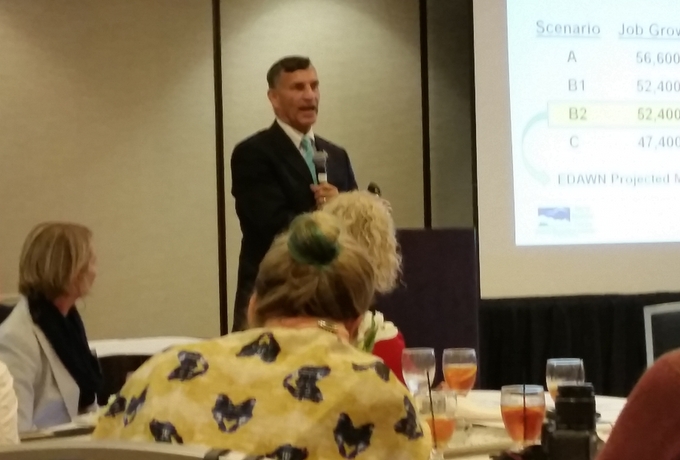
Mike Kazmierski, president and CEO, Economic Development Authority of Western Nevada, tells Tahoe Chamber members about how rapid job growth in Reno will affect Lake Tahoe businesses.

Mike Kazmierski, president and CEO if Economic Development Authority of Western Nevada, talks Aug. 7 in South Lake Tahoe. Photo/Anne Knowles

By Anne Knowles

Lake Tahoe businesses are going to be facing increasing competition from Reno employers for a range of workers.

That’s the downside of anticipated growth in the Reno area led by Tesla Motor’s battery factory and Switch’s data center, both under construction at the Tahoe Reno Industrial Center, the 107,000-acre business park nine miles east of the Northern Nevada city.

Tesla alone is expected to employ 6,500 people when its factory is fully operational, and that’s just a fraction of the 52,400 new jobs expected in the next five years in the Reno area, according to Mike Kazmierski, president and CEO of the Economic Development Authority of Western Nevada.

Kazmierski told members of the Lake Tahoe South Shore Chamber of Commerce and others on Aug. 7 that EDAWN helped create more than 4,000 jobs last year, through recruitment of existing companies, local start-ups and expansion of established businesses, and is waiting to announce the relocation of more than a dozen new companies bringing a total of 1,425 jobs.

EDAWN expects 4.5 percent job growth in the Reno area between now and 2019.

“There will be competition for workforce,” said Kazmierski at the Lake Tahoe Resort Hotel lunch meeting.

“I think that’s where we’re going to feel it,” said B. Gorman, chamber CEO. “My concern is I talk to businesses every day who are having trouble hiring people right now.”

The audience of about 65 was concerned, too, but more seemed to welcome Reno’s resurgence.

When Sandy Evans-Hall, Tahoe Prosperity Center board member, asked if people were worried about Reno’s growth, a few hands went up. But when she asked who saw it as an opportunity for their business, about half the people in the room raised a hand.

Kazmierski, too, said there would be plenty of upside for the Tahoe region. He said air service to the Reno Tahoe International Airport would improve, a boon for the visitor traffic Lake Tahoe relies on.

The new companies locating in Northern Nevada will do more business at the lake, as will many of their employees, who are largely expected to be younger.

“Millennials like to be outdoors,” said Kazmierski.

And there will be more quality job opportunities for locals.

“Your kids and grandkids can stay here and you can keep your family close,” he said.

EDAWN, along with a coalition of area cities and counties, as well as state agencies and infrastructure entities such as NV Energy, the Regional Transportation Commission of Washoe County and the Truckee Meadows Water Authority, have been working on a study of the expected impact of the growth.

Kazmierski said the EPIC report, to be released in September, would provide the data needed for the area to prepare.

“We’ve got to get ahead of the no-growthers before they close the door,” said Kazmierski, referring to interests, including some on the Reno City Council and elsewhere, who are opposed to growth.

Kazmierski was asked if water was a limiting factor.

“Water is absolutely no problem for the Reno-Sparks area,” he said. “We don’t brag about it because of the drought here in California.”

Kazmierski said there is enough water available in the Truckee Meadows to double the population.

“If we got serious about conservation, we could probably triple the population,” he said.

But at least one attendee was skeptical.

“I think he’s misguided on the water,” Garry Bowen, of Tahoe Future Forum, told Lake Tahoe News.

Bowen said he helped commission a study on area sustainability by the American Institute of Architects in 2005. The report included an assessment of water quantity and quality.

“I think he’s being misled,” said Bowen. “It just doesn’t compute.”


Runnels must remove abandoned cars at Y

By Kathryn Reed

A judge on Thursday put the brakes on abandoned cars being able to be stored in South Lake Tahoe.

John Runnels has 30 days to get rid of the vehicles sitting on his property on the northwest corner of the Y.

Previous city managers, city attorneys and councils have wanted to rid the vehicles. Until this week, none had succeeded.

John Runnels has a court order to remove the abandoned vehicles on his property in 30 days. Photo/Ernie Claudio

John Runnels has a court order to remove the abandoned vehicles on his property in 30 days. Photo/Ernie Claudio

In October 2006 Runnels went before a city zoning administrator for a nuisance hearing after police officers cited him. Runnels prevailed.

Runnels was issued a dealers’ license in 1979 by the DMV, the same year the city’s Planning Commission approved a special use permit allowing him to store unregistered vehicles at the Emerald Bay Road business. Two of the conditions of the city permit were that Runnels had to maintain valid certification from the state to sell and repair vehicles. They both expired. That gave the city the power to revoke the special use permit.

Talks have been going on for about a year, with both sides ultimately putting the matter in a judge’s hands. On Aug. 6 after a four-hour hearing, El Dorado County Superior Court Judge Daniel Proud ruled in the city’s favor, determining the vehicles are abandoned, which violates city ordinances.

“We did a title search on each vehicle. We had to prove they were abandoned,” City Manager Nancy Kerry told Lake Tahoe News. “We did a history search on each vehicle. All of this history and research determined they are abandoned and not for sale.”

Runnels could still operate a store on site. He was not available for comment. He owns the corner lot as well as the parcel behind it.


El Dorado Savings’ profits hold steady

Placerville-based El Dorado Savings Bank reported second quarter profits of $2,803,419, which represented a $21,312 increase compared to the same period in 2014.

Earnings for the first six months of this year totaled $5,795,045 compared to $5,901,573 in 2014.

“The continued strong profits reflect the stable performance of the loan and investment portfolios,” CEO George L. Cook Jr. said in a statement.

El Dorado ended the quarter with $1.93 billion in total assets and savings deposits of $1.72 billion.

“The bank remains in excellent financial condition with strong capital, high liquidity and excellent asset quality. We ended the first half of 2015 with only one foreclosed property on the books,” said Cook.

The bank operates 35 branches, 31 in California and four in Northern Nevada.

— Lake Tahoe News staff report


UNR profs at center of geothermal study

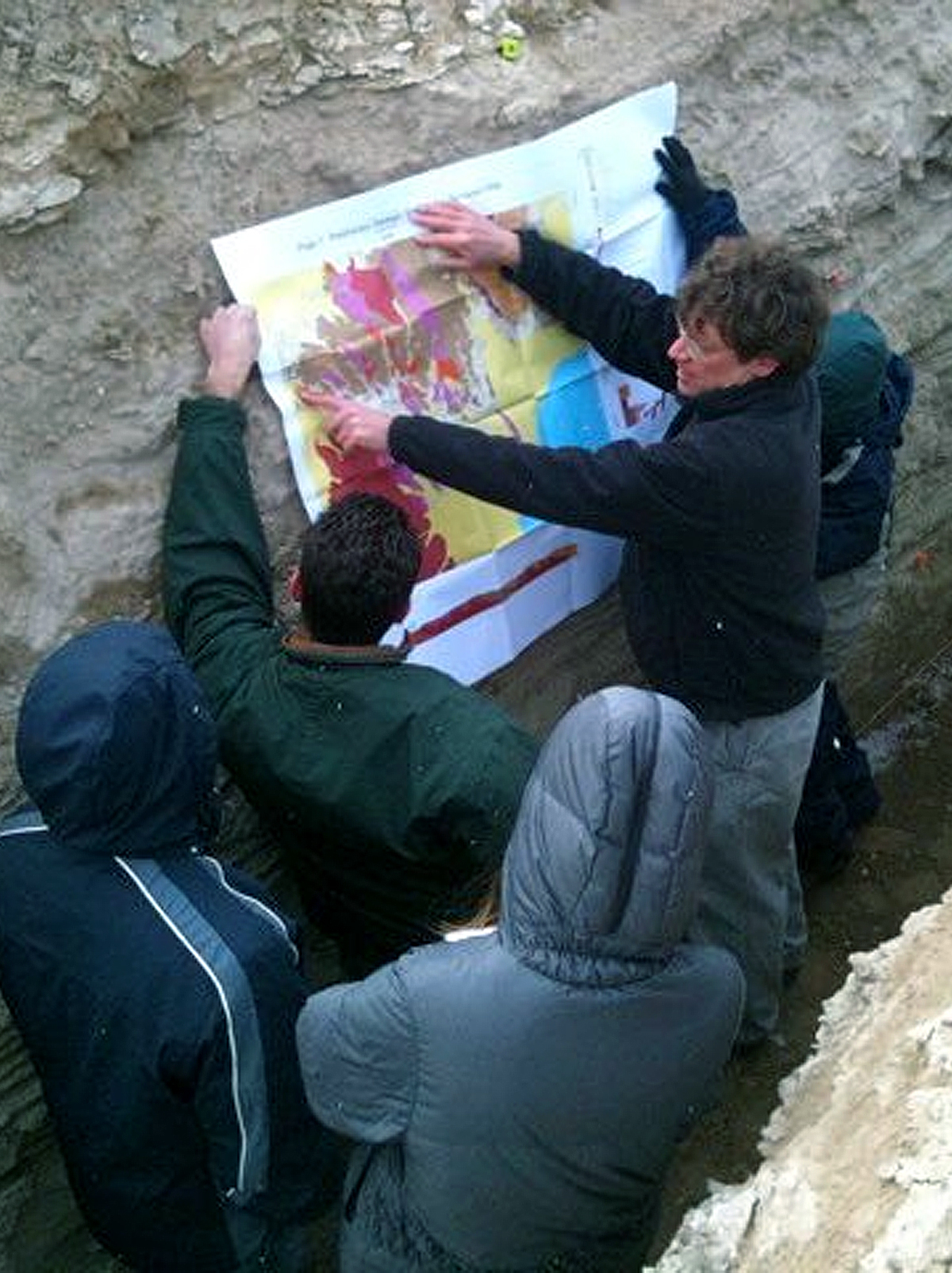
Director of the Nevada Bureau of Nevada Mines and Geology Jim Faulds talks about mapping geothermal resources with students. Faulds is leading the University of Nevada, Reno efforts in the recently funded Department of Energy FORGE project to identify a site to develop enhanced geothermal systems. Photo courtesy of University of Nevada, Reno.

Jim Faulds, director of the Nevada Bureau of Nevada Mines and Geology, talks about mapping geothermal resources with students.  Photo/UNR

Two researchers from the UNR are poised to play a key role in a project that has the potential to unlock massive resources of power generated from geothermal sources.

Professors Jim Faulds and Wendy Calvin, among the world’s leaders in the understanding of geothermal systems, are providing their expertise to the project funded by the U.S. Department of Energy.

The project dubbed FORGE – short for Frontier Observatory for Research in Geothermal Energy – seeks to dramatically widen the number of potential locations where power could be produced from geothermal resources.

The UNR researchers will provide geologic modeling of two potential FORGE sites – one near Fallon and a second near Coso in California. The establishment of FORGE at these two sites will provide the geothermal community a field laboratory where the science and engineering needed for widespread commercialization of enhanced geothermal systems can be developed and refined.

The FORGE project seeks to develop enhanced geothermal technology for use at locations where heat is available but water doesn’t naturally flow through the underground rock. Those locations are widespread through the Great Basin.

But the geological challenges are difficult, he said, because researchers need to find ways to open formations sufficiently so that water can move through the heated rock and become steam to drive generating units.

“We know that there are huge resources in the subsurface,” the geologist said. “Finding that fluid flow is the trickiest part.”

The researchers based in the University’s College of Science bring valuable experience to the FORGE team: experience that will make that job easier.

“We have a long history of working with the geothermal systems in the region and understanding the geologic setting of those systems,” Faulds said.

Participation in the FORGE project provides an opportunity for University researchers to widen their knowledge of geothermal operations and maintain the state’s position on the cutting edge of development of the geothermal industry.


Brown highlights climate change risks at fire site

By Chris Megerian, Los Angeles Times

In his quest to force tougher action on climate change, Gov. Jerry Brown has traveled to China, Mexico, Canada, even the Vatican.

But he was much closer to home on Thursday, just a couple dozen miles from the ranch his family has owned for generations.

Standing in front of scorched hills, the smell of smoke lingering in the air, Brown said the wildfire that had ripped through the area was evidence that global warming already has created dangerous conditions in California.

“This is a real wake-up call,” the governor said. “It’s a new normal.”

Read the whole story


Domestic violence perp on the run in Truckee

Truckee police officers spent the better part of Thursday night looking for a man accused of domestic violence.

Corbin Nunnally

Corbin Nunnally

Corbin Nunnally, 30, left the Gateway shopping center on Donner Pass Road when police arrived about 5pm Aug. 6. Officers were told a woman was in distress.

Nunnally is wanted for his possible involvement in several felonies including domestic violence, kidnapping, child endangerment and robbery. Nunnally is not known to have any weapons, but is considered dangerous based on the nature of the crimes.

He is described as a white, having a shaved head, last seen wearing a long-sleeve white button up shirt and light colored Dickie style pants. He may have changed clothes to basketball shorts and a white sleeveless T-shirt.

— Lake Tahoe News staff report


Scientist: Fires in Sierra Nevada to worsen

By Kathryn Reed

No one thing can be blamed for the proliferation of catastrophic fires, but there are some things that could be done to help combat them.

“So much is driven by politics. As a scientist, I’m not sure I have much control, Hugh Safford said.

Safford, a regional ecologist with the U.S. Forest Service, gave a talk Aug. 4 at the South Lake Tahoe Library about what is going on in the Sierra Nevada when it comes to managing the forest as well how fire and climate change play a role.

Suppression and the lack of fire are equally devastating to the ecosystem, he said. He believes more fires should be managed instead of immediately extinguished. This will create a more natural forest that is healthier. He’s also an advocate of controlled burns.

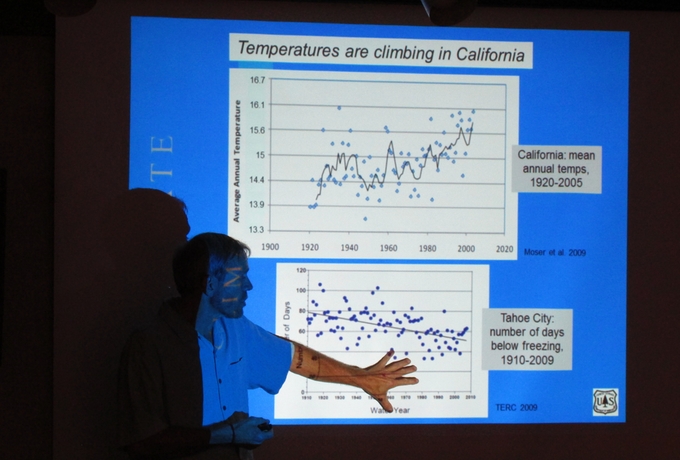
Hugh Safford, a USFS ecologist, talks about fire and the ecosystem of the Sierra Nevada on Aug. 4. Photo/Denise Haerr

Hugh Safford, a USFS ecologist, talks about fire and the ecosystem of the Sierra Nevada on Aug. 4. Photo/Denise Haerr

Fires are burning hotter than ever before because there is so much fuel as well as other changes like air temperature.

“Sixty-eight percent of the conifer stands have not burned since 1900,” Safford said.

Areas used to burn about every 10 years. They did so with less intensity and consumed small swaths.

The increase in overnight temperatures is having a huge affect with the growth of fires and the inability to quickly contain them. Humidity is not rising overnight with the higher temps, which means the fires are not dying down at night. This is when crews could get a handle on a fire. It is difficult for firefighters to work at night because of the lack of visibility.

“Precipitation is growing, but the snowpack is going down. That is driven by temperatures,” Safford said.

He said the indicators are that temps will increase 5 to 9 degrees by the end of the century. That would be like Davis having summer temps equivalent to Phoenix’s. For Lake Tahoe it will be like being in Nevada City.

“Poison oak will be here, oaks, algae in the lake. It is going to be a very different place,” Safford said.

The higher temps also mean less dew is forming. That little bit of moisture is what some animals rely on as their water source.

Fire is also impacting wildlife because animals’ homes are destroyed and won’t be “rebuilt”. The heat intensity is such that trees won’t grow because there are no seeds to naturally sow, and most often replanting has failed.

What ends up growing are shrubs. If shrubs are what burned, then it’s grass that sprouts. The landscape is changing because of catastrophic fires. That in turn impacts everything associated with what was once a forest of trees. This includes water quality and clarity.

Safford would like to be more experimental when it comes to dealing with managing the forests. He said his agency plans too much and doesn’t take enough risks. He also acknowledged those plans get challenged with lawsuits without ever being put to the test to see if they work.