Calif. plans taking land for huge water tunnels

By Ellen Knickmeyer, AP

SAN FRANCISCO — State contractors have readied plans to acquire as many as 300 farms in the California delta by eminent domain to make room for a pair of massive, still-unapproved water tunnels proposed by Gov. Jerry Brown, according to documents obtained by opponents of the tunnels.

Farmers whose parcels were listed and mapped in the 160-page property-acquisition plan expressed dismay at the advanced planning for the project, which would build 30-mile-long tunnels in the delta formed by the San Joaquin and Sacramento rivers.

“What really shocks is we’re fighting this and we’re hoping to win,” said Richard Elliot, who grows cherries, pears and other crops on delta land farmed by his family since the 1860s. “To find out they’re sitting in a room figuring out this eminent domain makes it sound like they’re going to bully us … and take what they want.”

Officials involved in the project defended planning so far ahead regarding the tunnels.

“Planning for right-of-way needs, that is the key part of your normal planning process,” said Roger Patterson, assistant general manager for the Metropolitan Water District of Southern California, one of the water agencies that would benefit from the twin tunnels.

The district serves 17 million people in Southern California as well as large farms and businesses.

Brown’s administration said re-engineering water flows of the delta — the largest estuary on the West Coast — is essential to undoing mistakes of past water projects and to supplying water to Southern California.

Brown has pushed for a massive delta makeover since his first stint as governor in the 1970s and 1980s. In May, he told critics of the tunnels to “shut up.”

Opponents say the tunnels would jeopardize delta farming and destroy vital wildlife habitat.

“If these reports are correct, then we have further confirmation that the tunnels project has been a forgone conclusion,” state Sen. Lois Wolk, D-Davis, who chairs a committee on the delta, said in an email Monday.

The environmental review, “which should be used to choose a project, is simply being used to justify the favored project,” she wrote.

Through October, the project officially is in a period of public comment on the environmental impact of the tunnels. The U.S. Environmental Protection Agency, which opposed an earlier version of the project, also must still weigh in.

Restore the Delta, a group of farmers, fishing associations, environmental groups and other opponents, released the property plan that was obtained with a request made under the state open records law. The plan targets public and private land in Sacramento, San Joaquin, Contra Costa and Alameda counties to be acquired for the project.

Under the plan, landowners would have 30 days to consider and negotiate a one-time state offer, while officials simultaneously prepare to take the land by forced sale if owners declined to sell. “Negotiations to continue in parallel with eminent domain proceedings,” the plan notes.

Contractors also appear to call for minimal public input.

“All transactions are conducted, reviewed and approved internally by DCE staff and managers to maintain control and avoid unnecessary delays to schedule,” the property plan outlines. “DCE shall seek to minimize external review and approval requirements.”

DCE is short for Delta Conveyance Facilities Design and Construction Enterprise, a private-contractor group embedded within the state Department of Water Resources to work on the proposed tunnels.

In a June interview, Neil Gould, an attorney for the Department of Water Resources, said planning for the proposed tunnels was no more than 10 percent complete and had focused on assessing the environmental impact.

Asked if planning the process of eminent domain was warranted as part of the project’s environmental review, Department of Water Resources spokeswoman Nancy Vogel said Monday in an email, “identification of properties that may be within the project area is necessary … as DWR needs to estimate the proposed project’s potential impacts to those properties.”

Public water agencies paid for the property acquisition plan, Vogel said. Those include water agencies in the San Francisco Bay Area and Central California, as well as Southern California, she said.

Patterson, with the Metropolitan Water District, said the latest revisions to the overall tunnels project laid out using more public land and less private land.

Osha Meserve, an attorney for some of the delta farmers fighting the project, said the latest plans still proposes taking roughly the same land as before.


EDC judge ousted from criminal bench

Dylan Sullivan, right, will join El Dorado County Superior Court Judge Suzanne Kingsbury. Photo/Wendy David

El Dorado County Superior Court Judge Suzanne Kingsbury, left, was at Dylan Sullivan’s election party last year. Photo/Provided

By Kathryn Reed

El Dorado County Superior Court Judge Dylan Sullivan has been removed from all criminal cases and instead will hear civil issues.

The reason for this change has not been disclosed.

Presiding Judge Suzanne Kingsbury, who makes the assignments, deferred comment to the El Dorado County District Attorney’s Office. She would not explain why.

“The legal system is designed so both the District Attorneys Office as well as the Public Defenders Office is offered the opportunity when appropriate to exercise the legal authority to exclude a Superior Court judge from a case. At this time the District Attorneys Office has chosen to utilize this legal right,” Deputy District Attorney David Stevenson told Lake Tahoe News.

The DA’s Office has filed a number of preemptory challenges against Sullivan. However, the reasons are not being disclosed. The DA’s office said Sullivan would be challenged on a case-by-case situation.

These types of challenges are not routine, but neither are they rare, according to legal officials. They must be made in a timely manner and can only be filed once per case.

Filing such a challenge is equivalent to saying one does not believe the judge will be able to handle the case, perhaps for ethical reasons. The attorney doing the challenge does not have to prove bias. While California is not alone in allowing this type of procedure, it is not the norm in most states.

The judge has no recourse and essentially does not get her day in court to prove she is or is not biased or that she is being wrongfully persecuted in a reverse case of bias.

People close to the issue told Lake Tahoe News things came to a head last week with Kingsbury clearing Sullivan’s court calendar starting on Aug. 10. By the end of the week Sullivan was told to go home. This week she has been seen following Judge Nelson Brooks who handles probate, an area of law Sullivan isn’t familiar with. Reports are the two judges will be swapping departments.

Even so, this will not eliminate Sullivan from interacting with deputy district attorneys. They are involved in delinquency and other cases in that department.

“There are judicial ethics that make it difficult for me to comment,” Sullivan told Lake Tahoe News. She would not say anything more.

The normal process if someone has an issue with a judge is to file a complaint with the Commission of Judicial Performance.

“We can’t talk about specific cases. We can’t say who is under investigation,” Victoria Henley, director and chief counsel for the commission, told Lake Tahoe News.

If a challenge for cause were filed, that is when the challenger has to prove bias or misconduct by the judge.

Sullivan, 49, was elected to the job in June 2014. She filled the vacancy of retiring Judge Daniel Proud. She was to begin the job in January, but instead Gov. Jerry Brown appointed her to the seat early. Kingsbury swore her in Sept. 19, 2014.

At that time Kingsbury said she assigned Sullivan to Department 7, the criminal pre-trial department in Placerville, to handle misdemeanor arraignments, hear preliminary matters, traffic issues, and drug court because of Sullivan’s training and experience.


Placer receives grant to curb underage drinking

By Cathy Locke, Sacramento Bee

The Placer County Sheriff’s Office has received a $50,000 grant from the California Department of Alcoholic Beverage Control for programs to combat underage drinking and alcohol sales to minors.

The sheriff’s office, throughout the year, will target problematic ABC licensed establishments that sell alcoholic beverages to minors and obviously intoxicated adult patrons. Minor-decoy and shoulder-tap operations also will be conducted countywide in an effort to reduce minors’ access to alcohol, sheriff’s officials said.

In a shoulder-tap operation, a minor, under the direct supervision of a peace officer, stands outside a liquor or convenience store and asks patrons to buy alcohol for him or her.

Read the whole story


Barton taking action to cut water use

 Barton Heath is participating in STPUD’s turf buyback program and removing sod from many areas, including near the Alpine Building. (Taken on May 13, 2015)

Barton Heath in May started removing sod from many areas, including near the Alpine Building. Photo/Provided

By Kathryn Reed

Hospitals use huge quantities of water – from old sterilizers operating 24 hours a day to non-aerated faucets to old toilets. And then there is landscaping.

According to the EPA, the median hospital uses 315 gallons of water per bed per day. Hospitals have historically been near the top for water consumption based on square footage at 55 gallons per square foot. Only senior care facilities and hotels ranked higher, according to the EPA.

The Centers for Disease Control and Prevention, Environmental Protection Agency, National Oceanic and Atmospheric Agency, and American Water Works Association put out a report titled “When Every Drop Counts: Protecting Public Health During Drought Conditions”. It says, “Hospitals, clinics, and other health care facilities oftentimes rely heavily on water to ensure the well-being of their patients. Water is used for drinking, sanitation, patient care, equipment sterilization, HVAC systems, and other essential functions throughout these facilities.”

Barton Memorial Hospital is no different than other entities when it comes to needing to use water for all of the above-mentioned reasons. However, the South Lake Tahoe medical facility it trying to curtail its usage as California deals with being in year four of a drought.

“Water plays an intricate part in our wellbeing which is why we, the staff and physicians at Barton Health, are doing our part to reduce our water usage and protect Tahoe’s natural beauty. We value our residents, visitors, and wildlife, and want to be part of the solution to help alleviate our state’s water crisis,” Rich Belli, director of facilities, told Lake Tahoe News.

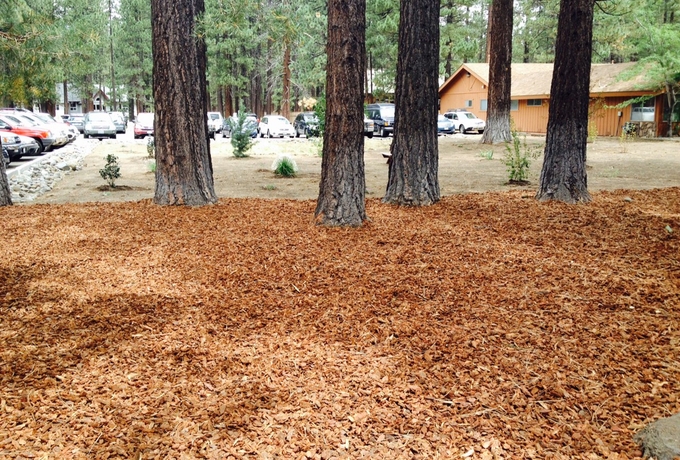
Mulch has been placed and native plants have been planted where sod was watered and growing before

Mulch was put down and native plants are growing where sod once was. Photo/Provided

In 2014, Barton cut its water usage by more than 28 percent compared to the previous year.

Actions taken this year include:

·      Replacing remaining standard toilets with low flow toilets at all Barton Health facilities.

·      Decreasing sprinkler usage and working with South Tahoe Public Utility District’s turf buyback program to remove 8,000 square feet of lawn in various areas throughout the hospital campus and replace it with drought tolerant landscape.

·      Turning off outside water features.

·       Minimizing use of bottled water by serving pitchers of water at catering events and to patients unless medically necessary.


Nev. receives $1.6 million in AmeriCorps grants

By Sandra Chereb, Las Vegas Review-Journal 

CARSON CITY — Nevada has received $1.6 million in AmeriCorps grants, money that will be used to aid and promote volunteer efforts targeting a host of causes, from education and rural healthcare access to environmental restoration and veteran services, the governor’s office said Thursday.

In all, the funding will support nearly 300 AmeriCorps members serving in more than 60 nonprofits throughout the state.

The AmeriCorps program is coordinated through Nevada Volunteers, set up under the Governor’s Commission on Service. Programs funded with the grants will start enrolling members Sept. 1.

Read the whole story


Uber, Lyft could be on Nev. streets in a month

By Conor Shine, Las Vegas Sun

After nearly a year of waiting, Uber and Lyft are finally coming to Nevada.

The ride-hailing giants have both filed permit applications with the Nevada Transportation Authority and, if everything goes according to plan, they should be able to begin operating on Las Vegas streets by Sept. 14.

Uber submitted its application Friday; Lyft filed earlier last week.

Read the whole story


Much drone testing in Nevada shrouded in secrecy

By Daniel Rothberg, Las Vegas Sun

It’s been more than a year since the Federal Aviation Administration designated the state of Nevada as a drone test site. Since then, the state has largely been quiet about what the sites are being used for.

One reason for the relative quiet: confidentiality agreements.

Much of the research going on at the test sites at about 35 locations across the state is proprietary, said Tom Wilczek, who works closely with the test sites as the aerospace industry specialist in the Governor’s Office of Economic Development.

The state has signed non-disclosure agreements with various organizations that have made use of the sites. Those using the sites include private companies, universities and public agencies.

Read the whole story


Fire closes Tioga Pass

The Walker Fire burning in Mono County has forced the closure of Tioga Pass.

The fire is near June Lake, burning north toward Tioga Pass and Yosemite National Park. Campgrounds in the Lee Vining canyon area have been evacuated, as well as about 20 structures near Walker Lake. Walker is west of June Lake, on the north end of the June Lake Loop.

About 1,200 acres have burned.

The fire started Aug. 14. The cause is unknown.

— Lake Tahoe News staff report


30% of Calif. forest firefighters are prisoners

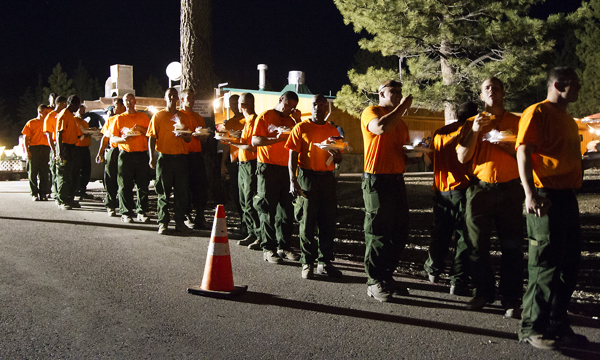
Inmate crews were used on the Washington Fire near Markleeville this summer. Photo/Carolyn E. Wright/Copyright

Inmate crews were used on the Washington Fire near Markleeville this summer. Photo Copyright 2015 Carolyn E. Wright

By Julia Lurie, Mother Jones

Here’s a kind of crazy stat: Between thirty and forty percent of California’s forest firefighters are state prison inmates. The state has become a tinder box of sorts from a four-year drought, and roughly 4,000 low-level felons are on the front lines of the state’s active fires. Here’s what’s going on:

Why are prisoners fighting fires?

For years, California’s prison system has operated a number of “conservation camps,” in which low-level felons in the state prison system volunteer to do manual labor outside, like clearing brush to prevent forest fires or fighting the fires themselves. A handful of other states have similar programs, but, with roughly 4,000 participants, California’s program is by far the largest. At its best, the program is a win-win situation: Inmates learn useful skills and spend time outside of the normal confines of prison, and the collaboration with Cal Fire saves the state roughly $80 million a year.

For each day they work in the program, the inmates receive a two-day reduction from their sentences.
Participants make $2 per day in the program and $2 an hour when they’re on a fire line. That may sound paltry, though it’s not bad by prison standards: Many prison jobs bring in less than $1 per hour. In addition, for each day they work in the program, the inmates receive a two-day reduction from their sentences.

Read the whole story


Kings Beach man accused of stealing vehicle

A Kings Beach man was arrested Aug. 13 on felony car theft charges.

Washoe County sheriff’s deputies said they saw Matthew Leaton Foster, 45, spray painting a vehicle in the Damonte Ranch Walmart parking lot in Reno about 6am Thursday.

The vehicle had been stolen earlier that morning from Incline Village.

Foster faces felony charges of possession of a stolen motor vehicle, tampering with a motor vehicle, grand larceny of a motor vehicle, and misdemeanor driving under the influence.

— Lake Tahoe News staff report