STPUD takes emergency step to replace sewer line

A sewer line on Osgood Avenue that serves the Ski Run Center and Chevy’s in South Lake Tahoe has failed, requiring the South Tahoe Public Utility District board to make an emergency declaration.

This will speed up the process to fix the problem because the formal bidding procedure can be scrapped.

About 400 feet of 6-inch diameter sewer line connecting to a 12-inch diameter main behind what used to be the Fantasy Inn failed. The district discovered this using a TV camera and high-pressure hydro-cleaning work.

“Several low points appear to have the bottom of the pipe missing, possibly from the use of degreasing agents being used over the years,” Richard Solbrig, general manager of STPUD, told Lake Tahoe News.  “The wastewater flow from the commercial businesses will be temporarily bypassed, probably to the line on Ski Run Boulevard so they will be able to remain in business.”

— Lake Tahoe News staff report


Calif. seeks to rein in medical pot industry

By Lisa Leff, AP

SAN FRANCISCO — The likelihood that California voters will be asked to legalize recreational marijuana next year is prompting lawmakers to make a serious run at reining in the state’s vast medical marijuana industry — a job they have deferred for nearly two decades.

A pair of bills pending in the California Legislature would create the first statewide regulations for medical marijuana growers, manufacturers of pot-infused products, and distributors such as storefront dispensaries and delivery services.

California authorized marijuana use for health purposes with a 1996 ballot measure that allows doctors to recommend the drug for any ailment, deliberately leaving the specifics for how it should be produced and sold for another day.

With advocates now working to qualify recreational-use initiatives for the November 2016 ballot, that day finally may have arrived.

The state Assembly last month approved a comprehensive licensing and oversight scheme on a bipartisan 62-8 vote. A compromise measure to create the Governor’s Office of Medical Cannabis Regulation, AB 266, is endorsed by both the California Cannabis Industry Association and the California Police Chiefs Association.

“The legalization discussion has definitely changed the tone of the conversation,” said Natasha Minsker, who directs the ACLU of California’s advocacy office in Sacramento. “There is real potential a legalization initiative will set the tone for regulation and taxation, and if the Legislature wants to be involved, now is the time.”

The eleventh-hour effort offers a preview of issues that are likely to surface during a legalization campaign, from concerns over water use and drugged driving to questions around consumer protections and who will be allowed to apply for business licenses.

The bill by Assemblyman Rob Bonta, D-Oakland, requires numerous state agencies to flesh out and enforce a regulatory framework by 2018.

The California Highway Patrol would develop a way to determine when someone is too high to drive, while the Department of Public Health would come up with rules for testing pot products for potency and toxic chemicals and set limits on when individuals with felony convictions or newly arrived in California would be eligible for a license to grow, process, transport or sell medical marijuana.

The bill also would create training standards and labor rights for industry workers — a nod to unions — and preserve the right of local governments to ban cannabis businesses, which is key to maintaining support from the League of California Cities and police chiefs.

“This is something that is greatly needed and long overdue,” said Chula Vista Police Chief David Bejarano, the police association’s president. “We are aware there will be an initiative on the ballot and if it is approved, we will have a good foundation, something to prevent some of the issues we have had with medical marijuana.”

Gov. Jerry Brown, a Democrat who has expressed skepticism about the wisdom of legalizing recreational marijuana use, has not indicated if he would sign the medical marijuana legislation if it reaches his desk.

Sen. Mike McGuire, a first-term Democrat whose 370-mile long coastal district encompasses Northern California’s prime pot-growing regions, blames the Legislature’s years of inaction on continuing skepticism over marijuana’s medical value, law enforcement resistance and industry doubts.

Noting there is no guarantee that California voters will go for full legalization, McGuire introduced his own medical marijuana bill. SB643 would establish an office within the state Business, Consumer Affairs and Housing Agency to license medical marijuana businesses and to develop regulations for how they should operate.

It would also require the California Medical Board to crack down on doctors who issue medical marijuana recommendations without a proper patient exam or valid medical reason for doing so.

“My beef is this: California’s approach to medical marijuana regulation has been impotent and when you allow an industry to grow unregulated for as long as we have with cannabis, we are going to pay the price,” McGuire said. “We are inundated with the impacts of this multi-billion dollar industry and we cannot sacrifice our communities, the environment and patient safety any longer.”



Nevada to buy up to 2.5 mil. rounds of ammo

By Kyle Roerink, Las Vegas Sun

Nevada negotiated an option to buy up to 2.5 million rounds of ammunition for state agencies over the next two years, according to documents and interviews with the Nevada Purchasing Division.

State officials made 55 separate requests for ammunition for 9mm pistols, 12-gauge shotguns, semi-automatic rifles and other firearms as part of a solicitation to vendors across the country, according to bidding documents received by sporting good wholesalers.

Officials described the deal as routine, a way to secure cheap rounds for highway patrol, parole and probation, emergency management, wildlife and other state departments. Several counties, including White Pine and Esmeralda, also took part in the bid, purchasing officials said.

Read the whole story


Brown seeks joint effort to fix roads

By Rachel Swan and John Wildermuth, San Francisco Chronicle

Filling car-shaking potholes and repairing crumbling highways and bridges shouldn’t be a partisan issue, Gov. Jerry Brown said.

Joined by Assembly Speaker Toni Atkins, D-San Diego, Brown used a news conference last week at the Port of Oakland to urge the Legislature’s Republicans and Democrats to work together in a special session he called to find a long-term answer to California’s continuing lack of cash for highway and infrastructure repairs.

California’s current gas tax, which hasn’t been raised since 1994, brings in $2.3 billion a year for repair work, billions short of what state officials say is needed. Compounded over the years, that’s left tens of billions of dollars in deferred maintenance, Brown said.

The gap is only going to get worse. As fuel efficiency increases and more electric and hybrid cars hit the road, gas sales will drop and tax revenue will fall with them.

Read the whole story


Electeds differ on what Tahoe needs

Sens. Dean Heller and Dianne Feinstein show bipartisan and bistate support the Lake Tahoe Restoration Act. Photos/Kathryn Reed

Sens. Dean Heller and Dianne Feinstein show bipartisan and bistate support for the Lake Tahoe Restoration Act. Photos/Kathryn Reed

By Kathryn Reed

ROUND HILL – Lake Tahoe’s congressional delegation wants the feds to spend more money in the basin. But they are divided on how much and where to spend it.

Money, forest health, lake clarity and transportation were the key subjects during the 19th annual Lake Tahoe Environmental Summit at Round Hill Pines on Aug. 24.

Sen. Dean Heller, R-Nev., is seeking $450 million in his Lake Tahoe Restoration Act reauthorization bill, while Rep. Tom McClintock, R-Elk Grove, is asking for $60 million in his bill.

Both include money for forest thinning and aquatic invasive species. The more expensive one will include transportation funds, cash for oversight and spending on other Tahoe environmental programs.

Since the inaugural summit in 1997, $1.8 billion in public and private money has been spent on environmental improvement projects in the basin. The initial push was on lake clarity. In the intervening years what does and could affect the lake’s clarity has changed and grown.

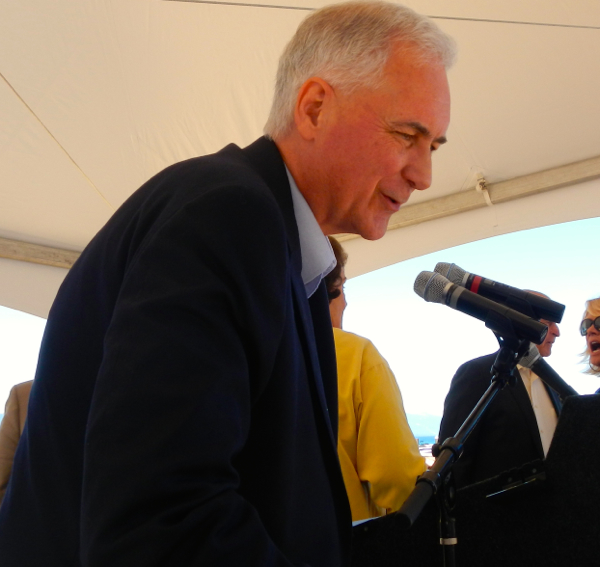
Rep. Tom McClintock, who represents the California side of the basin in the House, has introduced a scaled down bill to help Tahoe.

Rep. Tom McClintock, who represents the California side of the basin in the House, has introduced a scaled down bill to help Tahoe.

The other component that has been added is economic. With a healthy forest and a water body that allows people to see more than 70 feet down, it attracts tourists. Without these components, in some ways the basin becomes just another tree filled area with a potentially brown lake.

Gov. Jerry Brown pointed out that with California and Nevada’s populations expected to grow substantially in the coming years that it is impossible to stick with the status quo when it comes to solving problems.

“We are going to have to engineer at a higher level,” Brown told the more than 300 people in attendance. “We have to fight fires smarter and take care of the forests. We need to de-carbonize.”

McClintock warned, “The greatest environmental threat to Tahoe is a forest fire. The Rim Fire (two years ago near Yosemite) was 80 times larger than Angora.”

He believes since Congress has not approved the larger LT Restoration Act since 2009 that it is time to try a smaller formula and get the critical needs addressed. There are agencies in the basin that concur with this approach.


EDC school superintendent admits to DUI

By Kathryn Reed

Jeremy Meyers, El Dorado County superintendent of schools, was booked at the El Dorado County jail in Placerville on Aug. 22 on driving under the influence charges stemming from an incident in June. This was a condition of having pleaded no contest to the charges, which is the same as a guilty plea when it comes to sentencing.

He admitted that on June 9 he was driving under the influence with a blood alcohol level of more than 0.08 percent.

Jeremy Meyers

Jeremy Meyers

Although the booking statement from the weekend says there were drug charges, the criminal complaint from the district attorney does not. The latter is what ultimately matters and is what the court used for the sentencing guidelines.

The court process has been completed. All that remains is for Meyers to go through a first time DUI offenders’ course, which can take up to 18 weeks. He will also be on probation for four years.

“He was sentenced to five days in jail. That was probably because of the blood alcohol. He was treated no different than anyone else,” David Stevenson with the El Dorado County District Attorney’s Office told Lake Tahoe News.

He was, however, allowed on the night of the infraction to be released into the custody of his wife and friend instead of being taken to jail. The California Highway Patrol cited him that night when they pulled him over on Highway 49.

“I sincerely apologize for this personal mistake. I have already accepted responsibility and am personally dealing with my error in judgment. Most importantly, I want everyone to know that this will not interfere with the great work of EDCOE in continuing to provide quality education for all of the children and families in our county,” Meyers, 44, said in a prepared statement issued by his attorney.

Paul Zappettini, Meyers’ attorney, told Lake Tahoe News alternative sentencing allowed Meyers not to have to spend a night in jail.

“The El Dorado County Office of Education is aware that county Superintendent Jeremy Meyers was cited for driving under the influence. He is dealing with this matter on a personal basis. EDCOE will continue to focus on delivering quality service and support to the community,” Dina Gentry, spokeswoman for the office of ed, told Lake Tahoe News.

Meyers was first appointed by the school board to the position effective July 1, 2013. He was taking over for Vicki Barber who retired. At the time Meyers was the deputy superintendent. In June 2014 he ran unopposed for a four-year term.


Air Force buries dirty bomb material in Nev.

By Keith Rogers, Las Vegas Review-Journal

With thieves stealing radioactive sources in Mexico while other potent materials sat idle on a mountain in Alaska, U.S. nuclear security experts used military cargo jets this summer to whisk away some of North America’s most dangerous “dirty bomb” threats.

Thirteen highly radioactive sources were loaded on Air Force C-17 Globemaster jets in late July in southern Mexico and near the Arctic Circle and flown to Creech Air Force Base at Indian Springs, 45 miles northwest of Las Vegas, according to Air Combat Command and the National Nuclear Security Administration.

They were then hauled by trucks more than 20 miles to the Nevada National Security Site and buried in a guarded, monitored landfill.

Read the whole story


Calpers misses target with 2.4% return

By Alison Vekshin, BloombergBusiness

The California Public Employees’ Retirement System, the largest pension in the U.S., said it earned 2.4 percent last fiscal year, below its target rate as financial-market turbulence depressed stock and bond returns.

The $300 billion fund earned 1 percent on public-equity holdings and 1.3 percent in fixed-income investments, said Ted Eliopoulos, chief investment officer. Real estate returned 13.5 percent, while private equity gained 8.9 percent.

Calpers must average at least 7.5 percent a year to match its assumed rate of return or turn to taxpayers to make up the difference. Calpers is among pensions under pressure to boost investment returns as their unfunded liabilities tripled to almost $2 trillion from 2004 through 2013, according to Moody’s Investors Service.

Read the whole story


Brown: Groundwater management not aggressive enough

By David Siers, Sacramento Bee

Gov. Jerry Brown said in an interview aired Sunday that California is not aggressive enough policing use of the state’s groundwater, promising stepped-up oversight in future years.

Brown’s remarks on NBC’s “Meet the Press” followed the release of a study tying climate change to the worsening effects of California’s drought.

Asked he if was “about to police agriculture more,” the Democratic governor said, “Well, I think that’s good advice, but of course I don’t rule by decree. I work through the Legislature. California now has groundwater management for the first time in its entire history, so we are much more aggressive. But as that scientist suggested, we’re not aggressive enough. And we will be stepping it up year by year.”

Read the whole story


Caesars strikes a deal with largest lenders

By Howard Stutz, Las Vegas Review-Journal

Caesars Entertainment Corp. said late Friday it reached agreement with its largest lender group over the restructuring of the company’s bankrupt operating division.

In a statement, Caesars said the agreement allows the company to focus on gaining support from the last major debt holder group that has yet to agree on the restructuring plan for Caesars Entertainment Operating Co.

Caesars said the company now has support for the CEOC restructuring from both first lien bank lenders and first lien bondholders. The group represents $12 billion of CEOC’s debt

The restructuring is expected to trim almost $10 billion of debt from CEOC, which operates Caesars Palace, Caesars Atlantic City, Harrah’s Lake Tahoe, Harveys and other regional casinos.

Read the whole story