Weather helping with fire suppression

Updated 2:49pm:

All mandatory evacuations, evacuation advisories, and road closures in Amador County have been lifted.

—-

Mother Nature is lending a hand when it comes to the Butte and Valley fires burning in Northern California. However, tens of thousands of people remain displaced — either permanently or as evacuees — as the fires rage.

Rain fell overnight on the fire in Amador-Calaveras counties, and higher humidity is a factor in Lake-Sonoma-Napa counties. Temperatures are dramatically lower in both locations compared to the weekend.

The Butte Fire is at 71,660 acres, with 37 percent containment. The fire that started Sept. 9 has destroyed 166 residences, 116 outbuildings and damaged 12 others. Another 6,400 structures remain threatened.

“Fire behavior remained minimal throughout the night helping crews continue to progress with perimeter control,” according to CalFire.

More personnel continue to be added to the Valley Fire, which started Saturday in the remote town of Cobb. It is sparsely populated and is wooded like Tahoe.

Lost are 585 homes and hundreds of other structures, including the historic Harbin Hot Springs. That area rebuilt after fires in 1894 and 1943. There are 9,000 structures in immediate danger.

The 67,000-acre Valley Fire is 15 percent contained.

The cause of both fires remains under investigation.

— Lake Tahoe News staff report


Busy Tahoe summer equates to big money

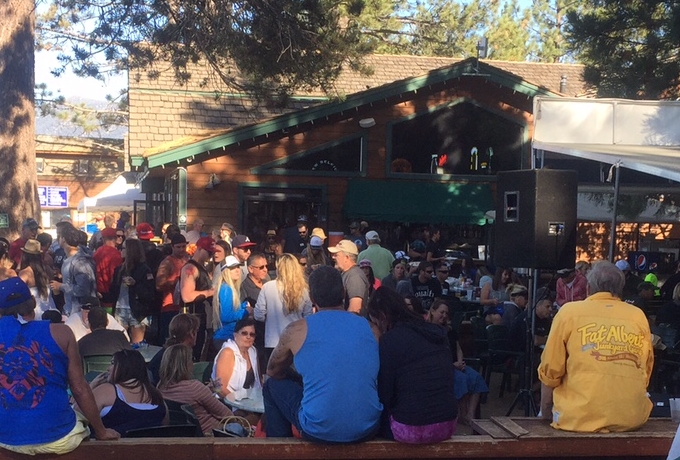
The Beacon restaurant at Camp Richardson is party central for much of the summer. Photos/Susan Wood

The Beacon restaurant at Camp Richardson is party central for much of the summer. Photos/Susan Wood

By Susan Wood

You weren’t seeing a mirage this summer.

The vehicle backups on Lake Tahoe roads were not caused so much by heavy road construction, but by travelers who were frequenting the tourist destination in large numbers this summer. And according to tourism officials and stakeholders, there are multiple reasons they were coming to the mountains.

Some may think tearing up the infrastructure would deter tourists because fewer lanes mean slower traffic, thus delaying the fun. But in the case of the Lake Tahoe Visitors Authority’s marketing efforts, it brings people in because travelers welcome an improved South Shore when they consider a destination for their vacations.

“Our focus has been renovations, and redevelopment projects are under way. In our market, word has gotten out about Tahoe’s improvement projects, and that’s powerful in the media,” LTVA Executive Director Carol Chaplin told Lake Tahoe News. “Definitely we think visitation is up. There are a lot of factors, but I haven’t talked to anyone who isn’t pleased – how much so depends on who you talk to.”

Chaplin estimated a 15 to 20 percent leap in lodging and restaurant receipts compared to 2014. The summer campaign increased LTVA’s website visits by 240 percent. In July alone, the LTVA reported 45,000 visits a week.
And an even more welcome sign: Hotel booking windows are longer in terms of advance notice and length of stay. This means more mid-week business – something all tourism-related businesses strive for.

Attributable factors vary, but one the LTVA has kept its eye on is its inaugural promotion to the San Diego market. This requires getting in the head of the average vacationer. The San Francisco Bay Area market will always be a cash cow for Lake Tahoe, but San Diego is whole new terrain. It takes more than three times the drive time to get here, or it requires paying for airfare. It’s simple math — the bigger the investment, the longer the investment in time staying here.

A market area split by a drive or fly option has been lucrative at first glance.

“We’re hitting the sweet spot on that,” Chaplin said.

And beyond gas prices being down, the events seem to fuel the interest. Recreation-oriented — including the adventurous, extreme kind — have been popping up like spring wildflowers. An old favorite golf event – the American Century Championship – celebrated its best attendance ever at 41,800.

“Generally speaking, travel is up and international travel is up,” she added.

All over the West, the trend for more traveling has increased.

Getting a parking spot at one of the beaches was tough at times.

Getting a parking spot at one of the beaches was tough at times. Photo/Susan Wood

People are on the move

Summer lodging occupancy is up 8 percent, with revenue rising 14 percent May through October, according to Denver-based DestiMetrics. The travel data research firm collects data from 19 western mountain destination resorts in six Western states.

“The robust numbers this month not only illustrate strength in both occupancy and rates but successful and sustained growth in summer business for mountain communities,” company Director Ralf Garrison said in a statement. “It’s pretty clear that mountain travel, as a whole, is strong and resilient despite weather challenges including everything from drought to excessive rainy patterns that have been experienced in different regions this summer.”

In California, the State Parks system has seen an overall estimated increase of up to 10 percent this summer. Some venues such as Donner State Park have enjoyed at least a 30 percent increase in visitors, with Emerald Bay leading the way at a 40 percent leap in receipts this year compared to the previous one. State Parks get revenue from parking, visitor centers and campground bookings.

“This is one of the busiest summers some of our rangers have ever seen,” parks spokesman Scott Elliott said.
One of the biggest reasons for the push to travel is pent up demand. Tourists who may have been still stinging from the recession along with a lingering, slow-to-recover job market are fed up with waiting to travel.

North Shore looking good

“As a destination, we’re running 75 percent occupancy – and that’s doing great,” North Lake Tahoe Resort Association spokesman J.T. Thompson told Lake Tahoe News.

Thompson indicated the North Shore is up 20 percent in pre-bookings – another notable positive trend. Pre-bookings translate to reservations made up to six months in advance. Those are usually reflective of more mid-week business, coinciding with South Shore trends.

“We know we’re going to get the Bay Area, but we’re hitting Los Angeles and Southern California and seeing the rewards for it,” he said.

Beyond the specific target market push, other factors abound for more tourist traffic such as spectacular warm weather compared to extremely hot temperatures. With that, you take the celebration of the continued emergence of human-powered events. Combine that with Lake Tahoe’s natural beauty, and it’s a recipe for business success.

And unlike other areas of California struggling with drought, Thompson believes the dry conditions may have helped lake visitation to varying degrees. First, fewer skiers prompted by less snow last winter pushed vacations to spring and summer. Then, there’s the mere lack of water everywhere else.

“We have a lot of water (in comparison),” he said.

Non-motorized water sports don't need to worry about the drought as much as motor boats. Photo/LTN file

Non-motorized water sports don’t need to worry about the drought as much as motor boats. Photo/LTN file

Just change watercraft

Even with a lower water level at the lake, there’s opportunity.

It’s location, location, location coupled with activity trends for Inn by the Lake General Manager Jeremy Agnew. He has seen a huge uptick in business stemming from the blockbuster popularity of standup paddleboarding. SUP requires little water underneath. That said, power boats are driven out farther on the lake, thus creating a serene experience as peaceful as hiking on water.

El Dorado Beach is a hotspot for the sport, and Inn by the Lake is feet away as the host hotel for the SUP races.
Agnew cited a surge in recreational warriors, international tourists and more childfree couples traveling in mid-August when the school year starts.

The numbers seem to add up.

Money coming in

According to South Lake Tahoe, the last transient occupancy tax collections recorded for June showed a year-over-year increase from $1.08 million to $1.27 million in receipts. Rooms rented comparing the same month year-to-year show a leap in city bookings from 54,548 to this year at 59,041.

“It’s been crazy this year. It started in February with people coming up because we didn’t have snow, but they liked that they didn’t have to drive in it,” Agnew said.

Ditto, said Tom Turner, who owns restaurants on the South Shore, east side and Truckee. Although his Caliente eatery traffic was tied up in the Kings Beach roadwork mess, that restaurant along with Riva Grill (South Lake Tahoe) and Bar of America (Truckee) witnessed “more people eating and drinking instead of skiing,” he noted.

Bob Hassett, who runs the Camp Richardson, Timber Cove, Lakeside and now Round Hill Pines marinas, enjoyed a decent showing on his water taxi. He pointed out how people would cart their bikes from one section of the lake to another.
The increased traffic overall offset the occasional challenges experienced by the lake’s lower-than-usual water level near shore. Improvise. His staff would simply negotiate the boats out 200 yards to help the watercraft renters.

“It’s been a good summer. There were definitely a lot of people in town, and I’m happy to see that. People were pleasantly surprised they could even get on the lake and heard marinas are closed. We’ve tried to get the word out there’s plenty of water out there,” he told Lake Tahoe News.

Hassett went as far as to say business revenue at the marinas, which mainly represents boat rentals, is back to where it was at pre-recession standards in 2008.

This experience may coincide to a completely different South Shore business.

With five years under her belt, Paige Rice who runs Tahoe Best Friends said she’s had the “best summer ever.”

The doggie day care service has been busy throughout the summer for overnight business, and that goes way beyond the locals. Some people decide to travel with their pets and stay wherever without worrying about whether the lodging establishment takes pets or not. They’ll even visit their dogs during the day to check in with them.

She averages 25 daytime dog visits and 20 overnight.

“And it’s consistently growing,” Rice said.

She’s not alone.

Sandy Cole has owned the Simple Bliss Vegan Café in the middle of South Lake Tahoe for three years and experienced a surge in business this summer to the tune of doing two-to-three times the traffic than in previous years.

“It’s been amazing. I grew up here, and I haven’t seen it like this for a while,” she said, noting the best times are the hottest. In particular, when Sacramento hits 100 degrees, Tahoe represents an ideal escape.

“I’d be up here too if I lived somewhere else,” Cole quipped.


Study: Antarctica melts if all fossil fuels burn

By Justin Gillis, New York Times

Burning all the world’s deposits of coal, oil and natural gas would raise the temperature enough to melt the entire ice sheet covering Antarctica, driving the level of the sea up by more than 160 feet, scientists reported Friday.

In a major surprise to the scientists, they found that half the melting could occur in as little as a thousand years, causing the ocean to rise by something on the order of a foot per decade, roughly 10 times the rate at which it is rising now. Such a pace would almost certainly throw human society into chaos, forcing a rapid retreat from the world’s coastal cities.

The rest of the earth’s land ice would melt along with Antarctica, and warming ocean waters would expand, so that the total rise of the sea would likely exceed 200 feet, the scientists said.

Read the whole story


Sage grouse face decline if wildfires can’t be stopped

By Keith Ridler, AP

BOISE, Idaho — If increasingly destructive wildfires in the Great Basin can’t be stopped, the sage grouse population will be cut in half over the next three decades, scientists say.

A report released Thursday by the U.S. Geological Survey comes just ahead of a court-ordered Sept. 30 deadline faced by the U.S. Fish and Wildlife Service to decide whether sage grouse need protection under the Endangered Species Act. Experts say such a listing could damage Western states’ economies.

“The sagebrush steppe and sagebrush ecosystem are in trouble,” said Matt Brooks, a fire ecologist with the USGS and one of the report’s authors.

The study also identified potential ways to avert sage grouse declines by classifying areas for their resilience to disturbance and resistance to invasive species such as cheatgrass, and then applying suitable strategies. Public land managers have already been doing that, but the USGS report could fine tune those efforts.

“It adds to the science that managers, and especially fire managers, can use,” said John Freemuth, a Boise State University professor and public lands expert. He said the report could factor into a sage grouse listing decision.

“That’s an indication that in the future (managers) will apply resources more effectively to protect the habitat,” he said.

The report is also in line with an order by Interior Secretary Sally Jewell in January calling for a new wildfire-fighting strategy using a “science-based” approach to protect wide swaths of the intermountain West sagebrush country that supports cattle ranching and struggling sage grouse.

Looming through much of the USGS report is cheatgrass, an invasive, fire-prone species that wipes out sagebrush ecosystems with wildfire as its main weapon.

“Management of cheatgrass is definitely a key,” Brooks said.

The study that examined 30 years of data up to 2013 found that burned areas near sage grouse breeding grounds nullified population growth that would normally occur after years with high precipitation. The study also looked ahead 30 years at projected wildfires and recovery rates of burned areas and predicted long-term population declines in the study area that included Nevada, Utah, Idaho, Oregon and California.

“Habitat degradation within the Great Basin ecoregion of the Intermountain West of North America is a contemporary example of how disturbance is driving rapid changes in ecosystem structure and function across enormous spatial scales,” the report said.

The 43-page study didn’t include a 436-square-mile wildfire in southwest Idaho in August that destroyed 297 square miles of sage grouse habitat, 83 square miles of that considered priority habitat that contained breeding grounds, called leks.

Rehabilitation efforts drew a high-visibility visit by the director of the U.S. Bureau of Land Management, Neil Kornze, to Idaho, who noted the agency’s concerns about a potential sage grouse listing as a reason for the trip.

The chicken-sized, ground-dwelling bird ranges across 11 western states, with much of its habitat administered by the BLM. The birds once numbered in the millions but now have an estimated population of 200,000 to 500,000.

Sage grouse are one of some 400 species that use the sage brush steppe. But scientists consider sage grouse an indicator of the overall health of the sagebrush steppe, sometimes called the sagebrush sea for the vast areas it covers and which is also facing challenges.

“It’s so much beyond a bird,” Freemuth said of the potential listing. “It’s people’s lifestyle. It’s people’s recreational opportunities. It’s everything. The bird is just the symbol of all that.”


Gamblers are betting against a Trump White House

By Matt Egan, CNN Money

Don’t bank on Donald Trump becoming the 45th president of the United States.

That’s the message from the gamblers placing bets on the 2016 race for the White House.

Trump is beating his rivals by double-digits in national polls, but bettors remain skeptical the billionaire’s lead will last until the Republican convention in Cleveland.

Jeb Bush is actually the odds-on favorite to win the GOP nomination, according to Irish gambling website Paddy Power. (Nevada casinos are prohibited from offering bets on U.S. political elections.)

Read the whole story


Sierra Nevada snowpack at a 500-year low

By Cheryl Katz, National Geographic

From frustrated snowboarders to migrating birds arriving at shriveled wetlands to wildfires raging through national parks, the Sierra Nevada’s lack of snow has transformed just about every aspect of life in California. Farmers, fish, forests, gardeners, hikers, boaters, and more depend on Sierra snow for water.

But now it’s clear that the “snow fail” in the 400-mile long mountain range has reached epic proportions: This year’s snowpack is the driest it’s been in at least 500 years, according to new research published Monday.

This stark finding comes from an analysis of more than 1,500 California blue oak tree rings dating back to the early 1500s, when Spanish explorers were just beginning their conquest of the state.

Read the whole story


Tahoe CCC crew sent to Valley Fire

A dozen young men and women based at the California Conservation Corps center in Meyers are providing logistical support to CalFire at the Lake County Fairgrounds to assist with issues surrounding the Valley Fire.

They are working 16-hour shifts along with five other CCC crews.

Statewide, the CCC has 40 crews — 520 corpsmembers — dispatched to eight wildfires.

The California Conservation Corps is a state agency in which young people ages 18 and 25 provide natural resource work and emergency response efforts.


Firefighters make small dent in NorCal fires

Updated 8:18pm

The Butte and Valley fires burning in Northern California continue to grow, though firefighters are gradually gaining control. The cause of both fires remains under investigation. Evacuations are still in effect and thousands of structures remain threatened.

Smoke from the Butte Fire, which has been burning in Amador and Calaveras counties for nearly a week, will continue to impact the Lake Tahoe Basin and Truckee areas today, but not to the extent that it did over the weekend.

The Butte Fire:

  • 71,523 acres
  • 35 percent containment
  • 135 residences and 79 outbuildings lost, 4 structures damaged
  • Sept. 9 start date
  • From CalFire: “Firefighters continue to fight the fire aggressively but critical fuel moisture levels, steep terrain, and limited fire access continue to provide challenges.”

The Valley Fire:

  • 62,000 acres
  • 10 percent contained
  • 1 civilian fatality; 4 firefighters hurt
  • 400 houses lost, plus several hundred other structures; 4,000 structures threatened
  • Sept. 12 start date
  • Fire started near Cobb in Lake County and has spread into Napa and Sonoma counties.
  • From CalFire: “Firefighters from across California are aggressively fighting the Valley Fire that has continued to spread in hot, windy conditions. The fire continues to grow as firefighters work to construct fire lines, while protecting lives and property.”

— Lake Tahoe News staff report


1 dead, hundreds homeless as fires ravage Calif.

Updated 9:31pm

By Associated Press


MIDDLETOWN — Authorities say a wildfire that overtook several Northern California towns has killed at least one person and destroyed more than 400 homes and businesses.

A California Department of Forestry and Fire Protection spokeswoman released the tally Sunday evening as firefighters continue to battle the out-of-control blaze north of San Francisco in Lake County.

Lynn Valentine said officials confirmed one fatality, though she had no immediate information on the deceased.

She said the fire has destroyed 400 homes, two apartment complexes and 10 businesses. Most of the destruction occurred in the communities of Middletown and Hidden Valley Lake, as well as homes along a shuttered highway.

The fire has burned at least 50,000 acres. At this point, it’s zero percent contained. It’s being called California’s worst wildfire of the season.

The devastation from the latest in a string of wildfires in Lake County comes after a separate wildfire to the southeast destroyed at least 81 homes.

Cal Fire spokesman Daniel Berlant said the fire started near Cobb, in unincorporated Lake County, and hit the communities of Middletown and Hidden Valley Lake particularly hard.

The fire initially pushed toward the southeast, but began moving north Sunday, according to Berlant.

Residents fled from Middletown, dodging smoldering telephone poles, downed power lines and fallen trees as they drove through billowing smoke.

Whole blocks of houses were burned in parts of the town of more than 1,000 residents that lies about 20 miles north of the famed Napa Valley. On the west side of town, house after house was burned to their foundations, with only charred appliances and twisted metal garage doors still recognizable.

Early Sunday evening, the fire spread into the Geysers area near the Lake County border and the Big Sulphur Creek drainage.

Gov. Jerry Brown declared a state of emergency in Lake and Napa counties Sunday because of the extensive damaged caused by the Valley Fire, according state officials.

The governor has also called up the California National Guard as part of the state of emergency and requested money from the Federal Emergency Management Agency, state officials said.

Napa County opened its emergency operations center Sunday and some people who had to flee the fire are staying at the Napa County Fairgrounds in Calistoga, county officials said.

Advisory evacuations were ordered by CalFire for Pine Flat Road at addresses 5000 and above as well as Geysers Road both out of Healdsburg (addresses 6000 and above) and Geyserville (addresses 9400 and above).

Advisory evacuations notify residents that existing conditions dictate that a mandatory evacuation order may be given in the near future, but that the threat to lives is not yet imminent.

Firefighters on Sunday afternoon could be seen driving around flaming utility poles to put out spot fires. Homeowner Justin Galvin, 33, himself a firefighter, stood alone at his house, poking its shin-high, smoking ruins with a piece of scrap metal.

“This is my home. Or it was,” said Galvin, who spent all night fighting another fire in Amador County.

Wind gusts that reached up to 30 mph sent embers raining down on homes and made it hard for firefighters to stop the Lake County blaze from advancing, CalFire spokesman Daniel Berlant said. Four firefighters were injured Saturday while battling the flames.

“This has been a tragic reminder to us of the dangers this drought is posing,” he said.

At least 10,000 residents in the area have been evacuated. “My dad worked hard for us to have that house and it’s sad that all those memories are gone … we lost everything,” said evacuee Roberto Vazquez.

Napa County officials have opened an emergency operations center to help with the response to the Valley Fire, county officials said.

Money from FEMA will come through a Fire Management Assistance Grant to reimburse the state for up to 75 percent of eligible expenses used to extinguish the fire, FEMA officials said.

FEMA officials have also sent two response division liaison officers to the California Office of Emergency Services in Sacramento, according to the agency. The liaisons will stay abreast of the fire and report to FEMA leaders, FEMA spokesman John Hamill said Sunday.

Hamill said the fire could prompt a greater federal response, if the fire exhausts state resources. “There could be a capacity issue,” he said.

To his knowledge Brown has not asked for a presidential disaster declaration, which would give California more federal resources.

Cal OES spokesman Brad Alexander said another request for federal help is always on the table. He said right now state officials are focusing on protecting lives and property.

He said state officials are in touch regularly with federal officials in Washington, D.C.

Mandatory evacuations are in effect in parts of Napa County, including Summit Lake Drive, Ink Grade Road, and Howell Mountain Road North beginning at White Cottage Road to Pope Valley, county officials said.

American Red Cross officials have set up a shelter at the Calistoga Fairgrounds and the officials are asking people to make donations to fire survivors at redcross.org.

County officials said people are scamming survivors through social media by asking evacuees’ for their addresses. The scammers say they are part of a news crew covering the fire and will check on the evacuee’s home, county officials said.

Burglars use the ploy to steal things, according to county officials.

Sheriff’s deputies are patrolling evacuated areas and advise evacuees to avoid giving out their addresses online.

It will be about two days before evacuees can return home, according to CHP officials.

Whole blocks of houses burned in parts of Middletown, where firefighters were driving around guardrails and flaming utility poles to put out spot fires Sunday afternoon.

On the west side of town, house after house was burned to their foundations, with only charred appliances and twisted metal garage doors still recognizable.

George Escalona told the Associated Press that parts of his town, including his home, have burned to the ground.

In some areas of town “there is nothing but burned houses, burned cars,” Escalona said, adding that he has nothing left but the clothes he was wearing.

The 60-square-mile fire erupted Saturday afternoon and rapidly chewed through brush and trees parched from several years of drought, Cal Fire said. Entire towns as well as residents along a 35-mile stretch of highway were evacuated.

The four firefighters who were injured were all members of a helicopter crew. They were airlifted to a hospital burn unit, where they were being treated for second-degree burns and were listed in stable condition, Berlant said.

Brown had already declared a state of emergency for the separate 101-square-mile wildfire about 70 miles southeast of Sacramento that has destroyed at least 81 homes and 51 outbuildings and turned the grassy, tree-studded Sierra Nevada foothills an eerie white. Fire officials had earlier counted 86 homes destroyed, but issued the new figure Sunday morning.

Crews by Sunday morning had increased containment on that blaze to 20 percent.

The fire, which broke out on Wednesday was threatening about 6,400 more buildings.

“I lost my business — it’s all burned up — my shop, my house, 28 years of living,” said Joe Thomas, who lives near the community of Mountain Ranch. “I got to start all over. It’s depressing.”

Thomas, who runs a tractor dealership and repair business, said he and his wife grabbed papers, his work computer, photos and their four dogs. But they left a goat, five ducks, six rabbits and more than 30 chickens behind.

“I turned the pens open and turned them lose. I just couldn’t gather them up,” he said. “All we want to do is go home. It’s miserable.”as been declared by Gov. Jerry Brown for the areas of all of these fires.


Scientists conduct drought study in 6 western states

By Keith Ridler, AP

BOISE, Idaho — Federal scientists are conducting a low-flow stream study in six western states in an attempt to gain insights that could help resource managers better allocate scarce water supplies during future droughts.

U.S. Geological Survey workers are measuring flows and temperatures through September in nearly 500 streams mostly in upper tributaries in Idaho, California, Nevada, Oregon, Utah and Washington.

The report could ultimately be used for everything from deciding how much water to release from dams, how many cattle to allow on grazing allotments, how much water will be available for farmers in irrigation districts and decisions about rivers that contain fish protected under the Endangered Species Act.

“If water managers can understand which streams are most vulnerable it helps them target efforts for drought relief,” said Chris Konrad, a research hydrologist with the federal agency and the study’s project chief.

The spring snowpack in the West in 2015 was much lower than long-term averages, and many rivers in the region are now at historically low flows.

What is especially unusual about the low snowpack, Konrad said, is that many areas received average amounts of precipitation. However, it came down as rain rather than snow, meaning it immediately ran through basins rather than forming a high-elevation snowpack that functions as a kind of reservoir slowly melting through the summer to replenish streams.

“This is pretty extreme by historical standards,” Konrad said. “I don’t know that we can expect this kind of year frequently. But at the same time, we also know climate models are telling us we should expect warmer winters and in some years less snowpack. If we see one year like this, it’s likely that we’ll see more years like this.”

One of the key goals of the $465,000 study is to determine which basins are most vulnerable to a low snowpack and which basins have the kind of geology that can mitigate a lack of snow with groundwater.

About 160 of the streams are in Idaho.

“Groundwater can act kind of like a buffer,” said Dave Evetts, data chief at the Geological Survey’s Idaho Water Science Center. “They’re going to know based on snowpack and precipitation amounts which areas may be impacted more severely by that kind of drought situation.”

That kind of information could be used by the U.S. Bureau of Land Management when it comes to grazing allotments or setting stream flows where fish are present in water rights agreements, agency spokeswoman Jessica Gardetto said.

“We use a lot of USGS products and studies,” she said. “We incorporate a lot of their data into our NEPA (National Environmental Policy Act) reports.”

Brian Sauer, water operations manager for the Middle Snake River field office with the Bureau of Reclamation, said the additional information could be helpful in knowing how much water to expect in the spring when managers are trying to fill reservoirs but also leave space to protect against downstream flooding. It could be especially helpful following a winter like 2015.

“It’s possible that more rain than snow could make us operate slightly differently,” Sauer said.
Joel Fenolio, senior water manager for the Upper Columbia with the U.S. Army Corps of Engineers, said one year won’t change how the agency operates dams. But he said the agency would be interested in the USGS report for 2015.

“It was a challenging winter to figure out total water supply,” he said. “There was a lot of precipitation, but it didn’t build as snow like is usually does. It just kept running off.”
Another key component of the study is tracking water temperature. Many species of fish, some with federal protections, can’t survive in warm water.

Geological Survey officials say the report will be published in 2016.