Caesars’ CEO shocked with lack of casino innovation

By Associated Press

New Caesars Entertainment Corp. CEO Mark Frissora says he is shocked at the casino industry’s lack of innovation in appealing to younger would-be gamblers.

Frissora joined Caesars in February after leading car-rental company Hertz and assumed the CEO role in July.

Speaking at the Global Gaming Expo in Las Vegas on Wednesday, Frissora says Caesars is testing a new environment — a casino within a casino — on the Las Vegas Strip to watch how millennials react.

He says the company is also experimenting with changing traditional slot machine playing by involving social game features such as leaderboards that track high-point players.

Frissora says the industry has room to grow particularly in oversaturated casino markets in parts of the country where gambling has exploded by appealing more to millenials.


Hwy. 89 project eliminates recreation parking

By Benjamin Spillman, Reno Gazette-Journal

Skiers, boarders and snowshoers are hopeful a looming El Nino could give the Sierra Nevada its biggest winter snowpack in years.​

But on the West Shore they’re also fretting about how they’re going to access all that powder once it lands on popular backcountry peaks in and around places such as Desolation Wilderness.

That’s because a Highway 89 improvement project aimed at reducing sediment runoff into the lake gobbled up an untold number of unpaved, roadside parking spots.

The project by Caltrans included landscaping touches that narrowed areas along the road that in previous years served as parking for skiers and others who use the backcountry for winter sports.

“What is happening is some of the pullouts people use to park for backcountry skiing are being eliminated,” said Bob Rowen, chairman of the Snowlands Network, which advocates on behalf human powered, winter recreation. “It is the same as if somebody’s favorite beach were closed or somebody’s favorite hiking trail.”

Read the whole story


Big rig crashes close eastbound I-80

A major crash involving five big rigs has closed eastbound Interstate 80 in the Castle Peak area.

Caltrans is advising motorists to expect major travel delays while emergency crews work to clear the area. There is no estimated time of reopening the highway.

Authorities are turning back all big rigs at Kingvale. Cars and small trucks are being detoured to old Highway 40 in the Soda Springs area.


Nev. tourism campaign aimed at Millennials

By Associated Press

CARSON CITY — Nevada is launching a fresh tourism campaign focused on attracting Millennials to the state.

The Nevada Commission on Tourism voted Wednesday to approve the new fall-winter advertising blitz, including two new commercials that will run in Nevada and in neighboring states.

The spots feature travelers who make friends with a wide array of memorable Nevada characters, including bikers, famous chefs and cowboys. They close with the tagline, “Go home with more stories than souvenirs.”

The commercials use a cover of the song “Don’t Fence Me In” that was recorded by the Las Vegas-based band the Killers.

State tourism director Claudia Vecchio says Nevada has improved its return on investment and is now bringing in $33 in tourism revenue per $1 spent on advertising.

The campaign will begin running in mid-November.


Public: Transit on South Shore failing riders

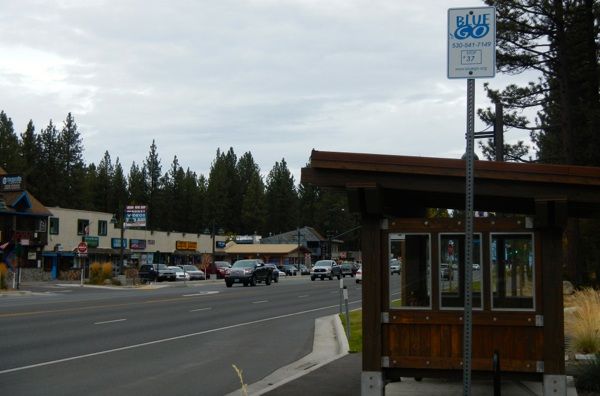
Some BlueGo stops have shelters, but none uses the words "bus stop".  Photos/LTN

Some BlueGo stops have shelters, but none uses the words “bus stop”. Photos/LTN

By Kathryn Reed

Public transportation on the South Shore is a nightmare that is not serving those who need it most.

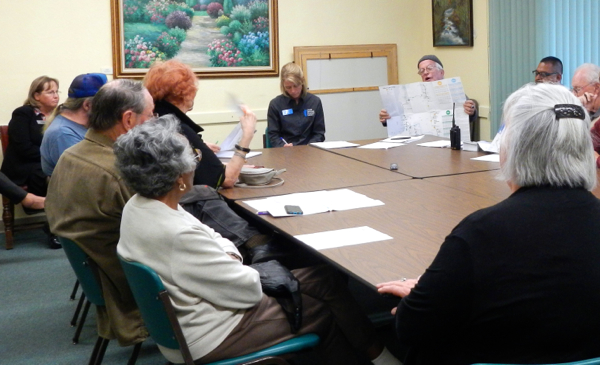
That was the message delivered by nearly two dozen people on Sept. 30 to Tahoe Regional Planning Agency and Tahoe Transportation District personnel. The purpose of the meeting was to gather information about unmet transit needs.

When asked what happens after Wednesday’s meeting, Judy Weber, TRPA associate transportation planner, said a report would be written. Then it would be decided what short- and long-range items, if any, could be tackled. Short range was defined as up to five years.

Basically, the workshop was convened to mark off an obligation of the bi-state agency’s transportation protocols.

El Dorado County Supervisor Sue Novasel joined the meeting an hour after it started and just before it ended. She is on the TTD board, but said she didn’t know about the meeting until someone at the Soroptimist gathering that day asked her about it.

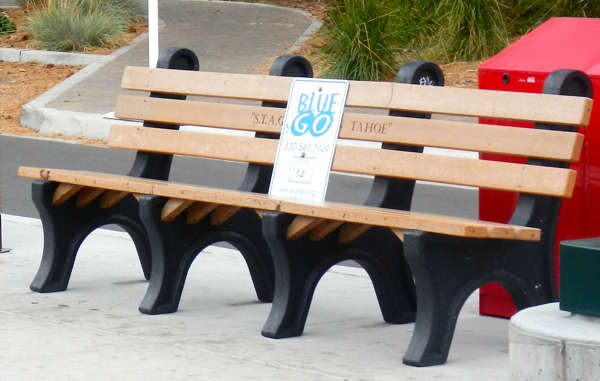
Bus riders are supposed to know this bench with a BlueGo sign is a stop.

Bus riders are supposed to know this bench with a BlueGo sign is a stop.

Some in the room, especially those associated with the Kelly Ridge housing complex, said they might not be around in five years if that’s how long it takes for change to happen.

An obstacle to getting anything done is money.

Weber said the BlueGo bus system on the South Shore is now almost exclusively funded by the federal government via pass-throughs to California and Nevada. Douglas County puts in money. Vail Resorts pays TTD to provide free bus service to Heavenly Mountain Resort on certain routes – mainly the ones servicing lodging properties. There was a time when South Lake Tahoe, El Dorado County, the casinos and Ridge Tahoe supported the bus system.

The Kelly Ridge residents and administration wonder why the bus stop that used to be outside the South Lake Tahoe senior-disabled housing complex was eliminated.

Lake Tahoe Community College students and faculty asked why a bus services the South Lake Tahoe institution every other hour instead of more often.

The on-demand service is unreliable, many said. They added that it is expensive.

Garry Bowen, top right, asks why maps can't be created for the bus shelters so people know where each line goes.

Garry Bowen, top right, asks why maps can’t be created for the bus shelters so people know where each line goes.

Others expressed concerns about inconsistent schedules.

It was pointed out that tourists could get from Stateline to the Y, but that the trolley then only goes a short way past Emerald Bay. Plus, the time to transfer is extremely short. There is no opportunity to access the beaches in Nevada via public transit.

Some wanted to know why something like the East Shore Express in Incline Village isn’t used on the South Shore to provide access to beaches.

Several asked about creating a transfer program.

Meyers doesn’t even have public transit anymore. Getting to Reno is not easy. Bus service is not available 24 hours even though this is a 24-hour community. Additional buses are not added during peak hours or days.

Tapping into Lake Tahoe Unified’s well-oiled bus system was broached.

Others wanted to know why some bus shelters are covered and other are not, as well as why some have seats and some don’t.

Bus stops don’t have their name on them. Routes are not listed at the stops. Schedules aren’t at the stops and not all buses have them on board. The signs just say BlueGo – not even bus. For those who don’t know what a BlueGo is, it makes it even more difficult. Then there is the fact that more buses are coming online that don’t say BlueGo; they say Tahoe Transportation District.

The result of a bus system that does not meet riders’ needs is that it is pushing people into vehicles – which goes against TRPA’s air and water quality thresholds.


Illegal gambling threatens casinos, association leader says

By J.D. Morris, Las Vegas Sun

The persistence of illegal gambling in the United States is a major threat to the casino industry that must be addressed, the head of a major casino lobbying group said Tuesday.

Geoff Freeman, president of the American Gaming Association, kicked off the first full day of the industry’s annual Global Gaming Expo, or G2E, with remarks that focused heavily on illegal gambling and his organization’s attempts to fight it.

Freeman said that despite laudable economic strides casinos have recently made, some policymakers hold outdated views about them, partly due to the popularity of “another industry that operates in the shadows.”

Read the whole story


Drought nightmare — the fire that wouldn’t die

By Mark Grossi, Fresno Bee

Firefighting commander Rocky Opliger can dial directly into the Rough Fire on his iPhone 6s to track his location via satellite as he walks the perimeter for a detailed look. He can stream live video feeds from helicopters and aircraft – in 3-D.

From any angle, this monster wildfire east of Fresno is a zombie. Opliger, a highly experienced incident commander, and other leaders who preceded him here, say the Rough Fire has repeatedly come back from the dead.

Over seven weeks, the fire has found unexpected ways to stay alive. It has burned parched moss on boulders to slip through defenses, blasted through cracks in fire lines and made an unlikely crossing of the Kings River.

As San Joaquin Valley cities filled with smoke for several days in September, firefighters waged a desperate war against a fire cutting through moisture-starved grasses, chaparral and timber.


Public land managers feared this type of blaze from the very beginning when a lightning strike sparked it in the early evening hours of July 31. At the time, the fire had burned only a few acres on a remote ridge between Rough Creek and Deer Creek at the southern edge of the Sierra National Forest.

Contrary to rumors, there was never any thought of allowing the fire to burn vegetation to thin out an overgrown forest, Opliger and other authorities say. They say they were always in suppression mode with this fire.

They had good reason to be concerned after four years of drought. California fires already have torched more than twice the acreage burned in 2014, according to CalFire.

Read the whole story


Dismal revenue numbers for Tahoe casinos

August was not a good month for casinos at Lake Tahoe, with both ends of the lake posting double-digit decreases compared to 2014.

Stateline casinos were down 33.55 percent from 2014, according to the Nevada Gaming Control Board. North Shore casino revenues were down 15.68 percent year-over-year.

Statewide the casinos collected $908.2 from gamblers in August, a decline of almost 1.4 percent.

— Lake Tahoe News staff report


Water year ends with parched conditions

By Matt Stevens, Los Angeles Times

The year of the brown lawn and shortened showers concludes today, with water officials citing bleak statistics and expressing hope that the next few months will bring the heavy rains California so desperately needs.

“Water year” 2015 was hot, dry and fiery, compounding the misery brought on by a fourth year of drought.

Water watchers keep track of precipitation and storage using Oct. 1 as a starting point. That day is considered the beginning of the wet season and the “water year.”

It was exactly halfway through the 2015 cycle — on April 1 — that Californians were schooled on just how dire the circumstance had become.

On that day, Gov. Jerry Brown stood in a barren field — one normally covered by several feet of snow — to announce historic water conservation restrictions. The Sierra snowpack’s water content measured just 5 percent of normal, obliterating the previous record low of 25 percent.

Read the whole story


S. Lake Tahoe does without traditional city hall

Publisher’s note: This is one in a series of stories Lake Tahoe News will be running leading up to the 50th anniversary of South Lake Tahoe on Nov. 30.
slt 50th logoBy Kathryn Reed     

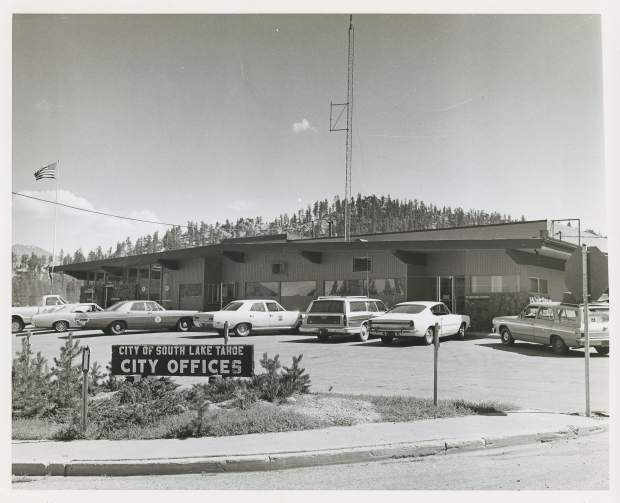
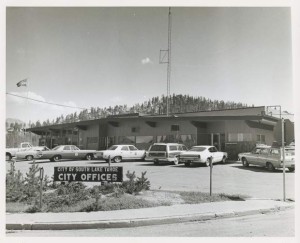
South Lake Tahoe was supposed to have a designated city hall that would be in the middle of town, not one shared with aeronautical services.

Politics is the easiest answer for why it didn’t happen. Plenty of finger pointing has gone on in the last 40 years to prove that no one person is at fault for the building never coming to fruition. But there is still a family who will forever be wronged. They gave the land for a city hall and instead cops and criminals occupy it.

The city is not letting the past stop it from moving forward. There are plans afoot to turn the lobby of Lake Tahoe Airport into a welcome center. This is where the bulk of the city’s business is conducted. In the last couple years a “city hall” sign was erected.
City Council meeting locations 1965 -- Tahoe Savings and Loan basement, Highway 50/Takela (now county offices) 1970 – 11044 Fremont St. (old police department near the bowling alley) 1970 – 1275 Meadow Crest, South Tahoe PUD building 1700 D St., (city offices were here; now where buses are stored) 1975 – 2155 South Ave., Alpine Professional Building (old TRPA office) 1021 Al Tahoe Blvd., Lake Tahoe Unified School District office 3064 Lake Tahoe Blvd., art building (now senior center) 1984 – 1900 Lake Tahoe Blvd. (old phone company offices) 2006-present – 1901 Airport Road Source: South Lake Tahoe

City Council meeting locations:
1965 — Tahoe Savings and Loan basement, Highway 50/Takela (now county offices)
1970 – 11044 Fremont St. (old police department near the bowling alley)
1970 – 1275 Meadow Crest, South Tahoe PUD building
1700 D St., (city offices were here; now where buses are stored)
1975 – 2155 South Ave., Alpine Professional Building (old TRPA office)
1021 Al Tahoe Blvd., Lake Tahoe Unified School District office
3064 Lake Tahoe Blvd., art building (now senior center)
1984 – 1900 Lake Tahoe Blvd. (old phone company offices)
2006-present – 1901 Airport Road
                                                                                    Source/Photo: South Lake Tahoe

As far as city officials – elected and staff – are concerned, the airport is city hall. With the city deciding commercial air service is not viable nor will it be pursued, the FAA is fine with South Lake Tahoe using the structure as a city hall and not an airport terminal.

Could there ever be something more? Possibly.

“If we were to ever have a city hall in this community, I think what might provide a good return on the investment for the community is a civic center, not just a ‘city’ hall. A building where Tahoe Regional Planning Agency, city, Tahoe Transportation District, and El Dorado Count would all have staff in the same building, primarily for permitting and licensing, the most common government requests,” City Manager Nancy Kerry told Lake Tahoe News. “For the community members, to be able to go into one building, one location and have joint meetings, get all the information in one visit, greater coordination of information, permit processing and conducting government business would be a huge benefit and good return on the investment.”

Something like that, though, would cost millions of dollars. And to be determined is if taxpayers would want it even if the money were available.

The early days

Incorporation was the focus when the city started, not where business would be conducted.

“That subject simply didn’t rise to the level of importance to make it on someone’s agenda,” Laurel Ames said of a city hall. Ames was one of the leaders in getting South Lake Tahoe incorporated in November 1965. “The one big idea that emerged in the first years after incorporation was the need for a convention center. The idea was from John Williams, the first city manager. That history is short. It was proposed for the county campground and I think there was a bond issue, then the people voted it down.”

Del Laine, who served on the council from 1976-80 and 1984-88, remembers a time when the electeds met in what are now the county offices in the government complex where the sheriff’s and public health offices are. The council seats were at the same level as the public – unlike today. It was the 1970s, when the Tahoe Regional Planning Agency was just getting off the ground, and a man leapt across the table in anger.

Today, there is always a police officer – often the chief – at each council meeting.

“When the first five (Brad Murphy, Gerald Martin, Eugene Marshall, Norman Woods and Don Clarke) met, it was over dinner and anyone could attend. They would discuss council business over dinner before the formal meeting,” Laine told Lake Tahoe News.

City archives are incomplete when it comes to listing all the places the council met as well as where city employees worked.

Marjorie Springmeyer at the dedication of her family's land that was to become a city hall. Photo/South Lake Tahoe

Marjorie Springmeyer at the dedication of her family’s land that was to become a city hall. Photo/South Lake Tahoe

A designated city hall

Marjorie Springmeyer and her brothers, Bill and Knox Johnson, wanted to honor their parents, who were early pioneers in the area. They owned large swaths of land; with the three still having title to hundreds of acres. They decided to give South Lake Tahoe land on Johnson Boulevard (named after their family) for a city hall.

The deed signed June 25, 1967, states, “On or before June 30, 1972, Grantee will construct or will cause to be constructed on the herein-above described real property, one or more office buildings which shall contain office space for the use and occupancy of various basic municipal government departments, services and offices, including by way of example and without limitation, grantee’s building, Planning, and Recreation Departments and City Manager ….”

Instead, a courthouse, police station and sheriff’s office were built on that land.

It didn’t matter that the agreement said if the city failed to comply with the deal, that the title would revert back to the Johnson siblings or their heirs.

“I’ll never get over that deal … how they screwed up our land with the courthouse,” Springmeyer told this reporter years ago.

The courthouse got built because of a 1972 agreement between South Lake Tahoe and El Dorado County in which the two entities agreed to build city and county offices on the Johnson land. The county gave the city $1 for the rights to the land.

Springmeyer filed a lawsuit to prevent El Dorado County from taking over what had been her family’s land. She lost the initial lawsuit as well as the appeal. The judge ruled the administrative uses on the land were consistent with the wording of the agreement.

It didn’t matter that Bill Johnson was on the Board of Supervisors from 1969-80.

The county agreed to “convey to city an easement for the construction by the City of public offices (sic) building ….” In a preceding paragraph the buildings to be located on the acreage included “County offices, County courts, City Council chambers, City offices, County Sheriff’s facilities, City Police facilities and other County and City facilities …”

On March 21, 1983, Knox Johnson wrote a letter to the Board of Supervisors saying “there has been perjury committed in the courts” and his family “made a civic contribution”. The letter went on to say,  “If it’s only worth $1, then I should have it.”

No one has ever been able say why exactly a city hall never got built. Today there is no space at the government center to do so.

Through the years other locations considered for a city hall include Bijou Community Park and the 56 acres where Campground by the Lake sits.

South Lake Tahoe's city hall is Lake Tahoe Airport. Photo/LTN

South Lake Tahoe’s city hall is Lake Tahoe Airport. Photo/LTN

Going forward

In March, when the council was devising goals for the next 18 months, overhauling the airport lobby to turn it into a showcase of sorts was discussed. Right now it’s hard to know one is walking into a city building. There was also talk of expanding the area to include a welcome center for visitors because coming in on Highway 50 from the west is the main route tourists reach South Lake Tahoe.

The engineering staff is working on a conceptual design and associated costs. Details will come back to the council later this year or early 2016, with the goal of starting the remodel in summer 2016.

The logic to staying at the airport is that the city owns the building. Plus, for 50 years it has survived without a building with the sole purpose of being a city hall so building one now doesn’t seem economically logical or feasible.

Not all cities have a distinct, ornate building along the lines of San Francisco’s city hall.

“A city hall can’t just be a pretty building; it must provide meaningful return on investment to the community. It should improve how the local government functions, provide new, improved and enhanced services and be a building that encourages civic engagement, promotes community pride of town ownership, provides opportunity for civic, community and cultural events – both art and culture – and opportunities for strengthening partnerships between government and the public,” Kerry said.

She is more concerned with providing quality services than the building from which those services are provided.

Even so, the city is on a quest to improve the infrastructure is has and not start from scratch. This means money will be spent at the airport to make sure it functions efficiently for the indefinite future.

“The building is our current city hall and will remain an important asset to the community for many years as so noted in the Airport Master Plan. The airport serves not only air travelers, but also serves community members conducting business with the city,” Kerry said.