Reno sees future, and it isn’t casinos

By Jim Carlton, Wall Street Journal

RENO—For much of the past half century, Reno moved in lock step with its glamorous big sister, Las Vegas, their fortunes rising and falling with their mainstay industry, gambling.

But Reno is now betting on a different economic future, turning its back on casino tourism as an economic driver in favor of becoming a manufacturing hub for everything from drones to car batteries.

Since 2011, the “Biggest Little City in the World” has recruited about 100 companies to locate or expand here with more than 10,000 new jobs—many cajoled by a former West Point cadet who instilled military discipline into Reno’s economic-development office.

Reno landed the Tesla deal in no small part because of a $1.3 billion tax-break package signed by Nevada Gov. Brian Sandoval. Critics saw the tax break, the state’s largest ever and among the biggest such enticements nationally, as a giveaway of public funds.


Many cities across the U.S. are trying to do the same thing as Reno: diversify away from once-bedrock industries that have cratered or become too volatile. Houston, for example, has tried to branch out from energy production into technology and health care. For many Rust Belt cities, the makeover process has been a struggle, in part because they started too late, says Gary A. Hoover, chairman of the economics department at the University of Oklahoma.

There are signs Reno’s strategy is starting to pay off. Before Nevada’s top two metro areas went into recession in 2008, both had unemployment rates below 4 percent. While the jobless rate in both soared to 14 percent in 2011, Reno’s has fallen to 6.1 percent, as of August, vs. 7 percent for Las Vegas, according to Labor Department estimates.

Read the whole story


CalFire: Threat of wildfire still high

Outdoor debris burning remains suspended for residents in the Amador-El Dorado Unit of CalFire.

This is because the foothills have not experienced a shift in the overall moisture content of the brush and timber due to the lack of a significant rain event. Even though the temperatures are cooler, the fire danger is still high, officials said.

October is statistically when California experiences its largest and most damaging wildfires. Four years of drought and bark beetle infestations have taken their toll on California’s forests and wildland areas.

CalFire offers these tips to help prevent a wildfire:

Camping:

• Obtain a campfire permit

• Check for local fire restrictions

• Clear away grass, leaves and other debris within a 10-foot perimeter of any campfire

• Have a responsible person in attendance at all times

• Ensure all campfires are completely extinguished before leaving

• When barbecuing, never leave the grill unattended.

Vehicles:

• Never pull over in dry grass

• Make sure your vehicle is properly maintained

• When towing ensure chains are not dragging on the ground

• Check your tire pressure to avoid driving on an exposed wheel.


Voters seek to recall EDC supervisors

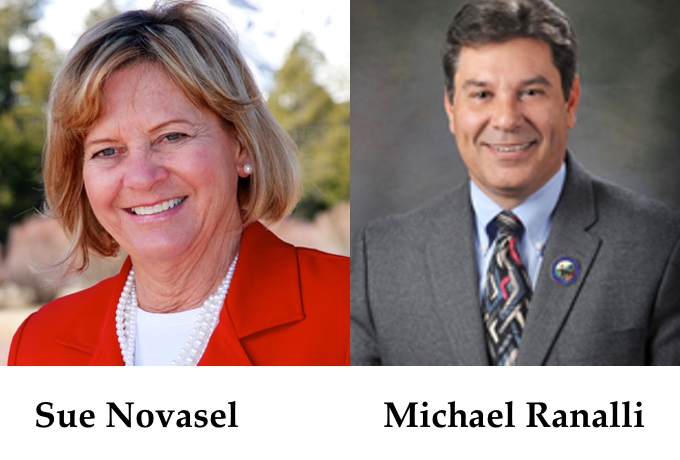
Novasell-RanalliBy Kathryn Reed

A group of residents disgruntled with how the El Dorado County Board of Supervisors is working is attempting to recall all five elected officials.

Today at their meeting in Placerville, Supervisors Sue Novasel and Michael Ranalli were served with the notice of intent for their recall. Supervisor Brian Veerkamp was not at the Oct. 27 meeting, but petitioners said he would be served upon his return.

The group is calling themselves El Dorado County Total Recall, and has said the intent is to recall every member of the board.

“Last year’s battles over a rural or urban future for El Dorado County pitted grassroots community groups against the huge financial backing of special interests. As a result, it is clear that citizens must rise up together from all over the county to fight for better representation,” a press release from the group said. “This may be our last opportunity to save our most important asset, the rural character of El Dorado County.”

County resident Kevin McAllister, who is quoted in the release, is part of the State of Jefferson movement that would like various counties to secede from California.

The actual notice says, “Whereas the voters of El Dorado County are a people of fairness, but when money or influences take precedence over the wishes of its citizens, we the people have a right to remove any or all of the elected officials.

“We the voters are seeking relief from the tyranny of our elected officials. They have failed to effectively and efficiently operate county government.”

Dan Kelly, spokesman for the recall group, did not return a phone call.

“This isn’t about anything specific. They don’t like our processes and our processes are working,” Novasel told Lake Tahoe News.

She believes some of the complaints people have relate to things before she was elected a year ago.

Novasel said she has been meeting with people, listening to concerns, but said it’s impossible to do what everyone wants because there are always multiple sides to an issue.

At least 20 verified signatures were required for the recall process to have gotten to this point. They must be from people in the supervisors’ respective districts.

Signing Novasel’s notice of intent were:

JoAnn Conner (South Lake Tahoe City Council member), Kenny Curtzwiler (defeated supervisorial candidate), Judy Clot (Tahoe Paradise Resort Improvement District member, and Recreation JPA member), Pam Curtzwiler, Marshall Curtzwiler, Jennifer Quashnick, Moya Sanders, Diane Verwoest, Ermel Herrmann, Matthew Adams, Tyler Baldwin, Luke Adams, Julie Ann Cavanaugh, Dov Shafer, John Oney, Mary Oney, Wayne McBride, John Adamski, Francesca Dionne Duchamp, Monica Givens-Day, Vincent Tanzi, Constance Hinton, Sue Abrams, Andrea Marion, and Dave Marion.

Novasel and Ranalli have seven days to respond to the petition in 200 words or less. The same will go for the other supervisors if and when they are served. (Ranalli did not return a phone call.) Those responses will go on the official petition. However, they are not required to respond.

The proponents then have 10 days to get other documents to the county Elections Department. The county works with the proponents to ensure a legal petition with both sides’ arguments is crafted. The proponents then have 120 days to seek the required number of signatures.

For Novasel, that is approximately 3,545 signatures, and for Ranalli it is 4,597. The figures are based on a percentage of registered voters.

Assuming the correct number of certified signatures is obtained, the recall election is then set for between 88 and 125 days after certification. The cost of the election comes out of the county’s general fund. The Elections Department could not provide what that figure might be. The next regularly scheduled election is the June primary, which if the recall could be on that ballot, would make the process less expensive.

“There was an attempt to recall a supervisor some years back, but it failed. It failed to get the requisite amount of signatures,” Linda Webster with the county Elections Department told Lake Tahoe News.

As for the supervisors, business goes on as usual.

“All I can do is concentrate on the job I am doing,” Novasel said.


Woman accused of wielding machete in assault

A South Lake Tahoe woman is accused of slashing an acquaintance with a machete.

Deborah Darr,

Deborah Darr

Deborah Darr, 51, was arrested Oct. 24 on assault with a deadly weapon charge.

El Dorado County sheriff’s deputies found a man on Brockway Avenue bleeding from multiple cuts on both arms. He told deputies he was awakened about 6:45am Saturday when someone was pounding on his front door. A woman he know was reportedly on the other side with a machete. She allegedly demanded money,and charged him. He was injured fighting over the machete.

Deputies tracked the woman to an address on Tata Lane in South Lake Tahoe where she was located and detained. She, too, had injuries as a result of the fight.

Darr has been released on a $25,000 bond.

— Lake Tahoe News staff report


NDOT trying to curb private runoff onto public roads

Nevada Department of Transportation wants the public’s help when it comes to runoff flowing onto state roads.

Illicit discharge is anything entering a roadway drainage system that is not natural stormwater, according to NDOT. This includes pesticides, construction dirt or materials, as well as materials from neighboring properties and roadway runoff containing fertilizers, vehicle oil and chemicals.

Legislation allows NDOT to issue permits for certain water discharges onto state roadways, as well as assess fines if needed.

“It’s important to remember that, in much of Nevada, any water reaching a storm drain directly enters our water system or natural environment with no filtration,” Steve Cooke, NDOT environmental division chief, said in a press release. “We want to educate and work side-by-side with community members to keep that water as clean as possible. It’s about helping to preserve water quality for everyone in Nevada.”

Illicit discharges may be reported by calling 775.888.7013 with the location and type of drainage or discharge.

Tips to reduce water pollution:

·         Keep your car in good repair. Leaking vehicle oil and chemicals can be transported into local waterways with stormwater runoff.

·         Recycle used oil and antifreeze at service stations and other recycling centers. Never put used oil or other chemicals down storm drains or in drainage ditches. (One quart of oil can contaminate up to 2 million gallons of drinking water.)

·         Used vehicle batteries should be disposed of at appropriate recycling centers and not as general refuse. Spent vehicle batteries contain acid and heavy metals and therefore need to be disposed of properly. Do not store them outside where they can be exposed to precipitation and stormwater runoff.

·         When washing your vehicles, take them to a commercial car wash facility. Wash water from vehicle washing can contain a variety of pollutants, including detergents, oils and grease, salts and dirt. Car wash facilities drain their wastewater into sewer systems, so it gets treated before it is discharged back into the water system.

·         Perform vehicle maintenance inside or under cover whenever possible.  Immediately clean up spilled vehicle fluids, solvents and other chemicals to prevent water and soil contamination.

·         Be aware that many chemicals commonly used around the home are toxic. Apply household chemicals per manufacturer recommendations. Use non-toxic substitutes and low-phosphate or phosphate-free detergents whenever possible.

·         Fertilizers contain nutrients that can degrade local waterways and readily leach through the soil. Take care not to over-fertilize and avoid spreading fertilizer onto areas that are subject to stormwater runoff. Sweep up fertilizer that ends up on your driveway or sidewalk areas. Avoid overwatering your landscaped areas where excess runoff can transport these nutrients into the storm drain system.

·         Never pour unwanted chemicals on the ground or down the drain. Soil cannot purify most chemicals, and they could eventually contaminate runoff. Take them to hazardous-waste collection centers instead.

·         Keep storm gutters and drains clean of leaves and yard trimmings. Decomposing vegetative matter leaches nutrients and can clog storm systems and result in flooding.

·         Clean up pet waste on a regular basis. Pet waste can be a source of bacteria and other pathogens in our waterways if exposed to stormwater runoff.


Mental health issues a concern in S. Lake Tahoe

By Kathryn Reed

There is no magic pill to cure mental illness. There is no one-size-fits-all diagnosis. There is no single cause.

The complexities of the illness and limited resources in South Lake Tahoe can exacerbate the problem or delay diagnosis. And being in a small town may mean those in need feel intimidated about asking for help for fear they will be mocked or run into the person who is helping them at the grocery store or elsewhere. Added to the equation, Medi-Cal options are limited.

These were some of the revelations to come out of last week’s mental health workshop sponsored by Tahoe Regional Young Professionals at Lake Tahoe Community College. Panelists were Cheyenne Lane with Tahoe Youth & Family Services, Sabrina Owen from El Dorado County Mental Health Services, and Betsy Glass, social worker with Barton Health.

Lane has noticed that while her agency’s crisis line is receiving fewer calls, experts don’t believe this is because the need has diminished.

“I think now we need something more like a text help line. We would get more younger people to talk to us,” Lane said.

With there being no psychiatrist in South Lake Tahoe, Barton Health uses telemedicine to reach specialists. This month Barton started offering telepsychology as well. Patients are able to interact with these medical professionals remotely and in turn receive care and prescriptions.

TED Talks are another resource, according to the panelists. This is for those in need of help and those wanting to learn what can be done.

Cheyenne Lane with Tahoe Youth & Family Services, Sabrina Owen from El Dorado County Mental Health Services, and Betsy Glass, social worker with Barton Health.

Cheyenne Lane with Tahoe Youth & Family Services, from left, Sabrina Owen from El Dorado County Mental Health Services, and Betsy Glass, social worker with Barton Health, talk about metal health issues. Photo/LTN

All three said it’s imperative for each member of society to learn compassion, to listen to people and then try to provide help. Help can be a shoulder to cry on, getting the person care or alerting authorities.

Those with mental health issues are prone to hurting themselves as well as others – sometimes fatally either by committing suicide or homicide.

Owen said car accidents don’t always get recorded as a suicide or the deliberate killing of someone else. Without a note left behind or a survivor to tell the story, these deaths get labeled merely as a vehicle “accident”.

About one-third of the audience admitted to having had thoughts of suicide in the past. The professionals guessed even more sitting there were afraid to raise their hands.

Depression is a mental issue with many gradients to it. It is something everyone will experience. It’s the degree and how one copes with it that varies so greatly.

“A lot of times people with mental health issues are always in a state of anxiety,” Lane said.

How a past trauma translates to mental health issues is a relatively new area of study. Glass said conversations and studies about physiological impact on mental health are just starting.

Trauma could be a car accident, military experience, sexual abuse, childhood upbringing or something else.

“Your history affects how you respond to current situations,” Owen said.

The presenters noted that on the South Shore the level of poverty (more than 60 percent of students in Lake Tahoe Unified School District qualify for a reduced or free lunch) is contributing to mental health issues. It may be manifested with alcohol or other drug use, domestic violence or child abuse.

Poverty often means poor nutrition and living conditions. This can all lead to stress. Stress is a mental issue and can escalate into unhealthy situations.

Lane said one of the problems with today’s society is people are desensitized.

People seem to accept certain behaviors that a few years ago would have come with consequences for the aggressor.

“When we are in pain we hurt others. We hurt ourselves,” Glass said.

Mental issues also can come in the form of bullying and lashing out. That type of inflicted pain is harder to define. It’s something akin to knowing what pornography is when one sees it, but not always being able define it cerebrally. Mentally stable individuals don’t routinely act in a bullying manner.

“Bullies are often diagnosed with anti-social personalities,” Owen said.

She said children who are bullied tend to have issues as adults.

But it’s not just adults who have mental health issues.

According to the gun-control advocacy group Everytown Gun Safety, there were an average of two shootings a month in K-12 schools in 2013.

There is a growing desire by some in law enforcement and mental health circles for the media to not use the names of the shooter. This way their deadly act is not glamorized. For the media, though, the First Amendment is a concern.

Owen said it’s important to talk about what goes on, but at the same there is a need to be careful what the media shows.

School shootings aren’t just something local law enforcement deals with. The FBI has a behavior-analysis team working with schools that have identified students they believe pose a potential threat. The federal government has also made $45 million available for armed school resource officers.

South Tahoe High School for years has had such an officer on campus – at least sporadically.

California requires all law enforcement officers to receive some training in how to handle calls involving mental health issues. A select number of El Dorado County sheriff’s deputies have received extra training to be more specialized in these types of situations.

—–

Notes:

·      South Lake Tahoe 24-hour crisis hot line – 530.544.2219.

·      National 24-hour crisis hot line – 800.273.8255.

·      There will be a free Mental Health First Aid for Youth class through Barton University on Nov. 22 from 8am-4pm. For more info, go online.


Flood repairs to Scotty’s Castle in Death Valley may cost $20 mil.

By Lawren Linehan and Brett LeBlanc, Las Vegas Review-Journal

Scotty’s Castle will require millions of dollars in repairs for flood damage, a Death Valley National Park spokeswoman said Saturday.

“I’d say $10 million is a conservative estimate, $20 million is a conservative estimate,” said spokeswoman Abby Wines.

Fortunately, the main building and attraction, the castle itself, suffered only minor water damage from a small leak in the roof, according to spokeswoman Linda Slater. The rest of the damage could take up to six months to repair.

Part of the road leading to Scotty’s Castle was washed away and covered in debris. Roads were secure enough for four-wheel-drive vehicles to make it to the castle Saturday.

Read the whole story


EDC retail center took 2 decades to break ground

By Brian van der Meer, Sacramento Business Journal

Many development projects put on hold during the recession have reemerged recently. But not many go back to the 1990s.

That might be the most surprising thing about the Crossings at El Dorado retail project, which broke ground earlier this week. The 425,000-square-foot project outside Placerville first got entitlements in 1998 — predating even the dot-com recession of the early 2000s.

Among the confirmed tenants are Petco, Sports Authority, Michaels, Ulta and Verizon Wireless. The first phase should start opening in late summer 2016.

Read the whole story


Reward for water conservation is higher utility bills

By Sharon Bernstein, Reuters

Their lawns dry and their trees on the verge of dying, Californians have dramatically cut water use during the state’s relentless drought, only to learn that many local utilities are hiking rates to make up for the lost revenue.

Water providers in Los Angeles, the San Francisco Bay Area and other parts of the state have recently told customers that rates will go up at least temporarily, as utilities struggle to pay for building and repairing pipes, buying water and other costs, even as customers cut back.

“Droughts are costly for water agencies,” said Lisa Lien Mager, spokeswoman for the Association of California Water Agencies. “Revenues are being affected by the mandatory conservation but at the same time costs are going up.”

Read the whole story


S. Lake Tahoe picks airport plans with flexibility

By Joann Eisenbrandt

The South Lake Tahoe City Council last week took the next step in the Airport Master Plan process by selecting the preferred airfield and land side alternatives which will determine the future configuration of the airport. This update of the 1992 Master Plan looks out 20 years and determines not only the types of aircraft using the airport, but also potential non-aeronautical uses of airport property.

Michael Hotaling of C&S Companies, the Airport Master Plan consultants, went over the steps in the process for the council during the Oct. 20 presentation.

Hotaling reviewed their analysis to date, noting that there would be relatively modest growth for Lake Tahoe Airport in the next 20 years and that due to a shift in the aircraft industry the return of commercial service to Tahoe in the near term was unlikely. In August 2014, the council decided to release the airport’s Part 139 certificate for commercial service and embrace the general aviation alternative as the airport’s best future use.

He termed this meeting the “decision-making” step where the City Council chooses the preferred airport configuration, which will then go through an environmental review under CEQA.

There were seven airfield alternatives and four land side alternatives that were studied. They ranged from no-action through middle ground alternatives that combined retaining flexibility for future airfield uses with releasing some of the land for non-aeronautical uses to bring in needed revenue, to the most expensive alternatives releasing little land and requiring major airfield and taxiway changes to accommodate larger planes and possible commercial service in the future.

After reviewing choices made by the public at an earlier public meeting where residents chose preferred alternatives by placing dots on maps, as well as a more technical analysis of the alternatives using the EOS (Economic Vitality, Operational Efficiency, Natural Resource Conservation and Social Responsibility) scoring scale the consultants recommended Alternative 2C.

The council expressed concern that some of the land designated for release to non-aeronautical uses would not work for that purpose because of terrain and steep slopes. They reviewed the alternatives and came up with a blended alternative 2B/C allowing for the most potential non-aeronautical uses such as warehousing, a fly-in campground, or a training center for the Forest Service, which could bring in added airport revenue while retaining airfield flexibility. The release of land for non-aeronautical uses will require review and approval by the FAA.

The consultants will now complete the Airport Layout Plan (ALP) and publish a draft final report. A CEQA analysis is then performed. This is a separate process for which the city will put out a request for proposal. City Manager Nancy Kerry said either C&S Companies or a new consultant could be chosen to undertake this analysis. The ALP is then adopted by the City Council and goes to the FAA for approval. Hotaling estimated this process will take about a year. Once the ALP is approved by the FAA the airport becomes eligible to receive federal grant funding.