Underground movement to bank El Niño’s rainfall

By Bettina Boxall, Los Angeles Times

Gary Serrato watched as a tractor worked its way across a field of dried-up weeds, slicing the sandy dirt into orderly furrows.

The field was being readied not for a crop but for what he hopes will be a bountiful harvest of floodwater this El Niño winter. “We’re going to capture as much as we can,” said Serrato, general manager of the Fresno Irrigation District.

He was standing in the district’s Boswell Groundwater Banking Facility near Fresno: A complex of 100 graded acres enclosed by low earthen berms. If El Niño lives up to its promise, early next year up to 10 feet of Kings River flood flows will inundate the shallow basins and slowly seep into the torn earth, replenishing growers’ groundwater supplies.

With El Nino promising a wet winter, water districts across the state are working feverishly to capture as much rain as possible to recharge depleted aquifers.

A confluence of factors is focusing attention on stowing supplies underground, which is generally cheaper and less environmentally damaging than building a big dam and reservoir.

Read the whole story


Pot farmers’ pesticides poisoning forest animals

By David Perlman, San Francisco Chronicle

Fishers, those rare little forest animals barely larger than a big house cat, are dying from rat poisons left behind by illegal marijuana growers in California who abandon their plantations when the law closes in.

Ecologist Mourad Gabriel should know: He lives in Blue Lake, a Humboldt County town not far from the area’s fast-moving hidden pot farmers. Nyxo, his pet Labrador retriever, died of a powerful rat poison last year while Gabriel was investigating the unusual deaths among fishers.

Fishers, related to the weasel family, live in forests along the West Coast from Oregon to Yosemite and the southern Sierra and are already proposed for federal protection as a threatened species. Once abundant, their populations have been declining for years as civilization closes in on their habitats.

But now Gabriel, along with colleagues at UC Davis and the Hoopa Valley Indian Reservation’s tribal forestry department, have found that a variety of poisons are killing some of the fishers, although their primary enemies are still predators.

Read the whole story


Climate change may push 100 mil. into poverty by 2030

By Associated Press

STOCKHOLM — Climate change could push more than 100 million people into extreme poverty by 2030 by disrupting agriculture and fueling the spread of malaria and other diseases, the World Bank said in a report Sunday.

Released just weeks ahead of a U.N. climate summit in Paris, the report highlighted how the impact of global warming is borne unevenly, with the world’s poor woefully unprepared to deal with climate shocks such as rising seas or severe droughts.

“They have fewer resources and receive less support from family, community, the financial system, and even social safety nets to prevent, cope and adapt,” the Washington-based World Bank said.

How to help poor countries — and poor communities within countries — deal with climate change is one of the crunch issues in talks on a global climate accord that’s supposed to be adopted next month in Paris.

Those who say that rich countries aren’t doing enough to help the poor said the report added emphasis to demands for billions of dollars in so-called climate finance to developing countries.

“The statistics in the World Bank report are suitably shocking and I hope they force world leaders to sit up and take notice,” said Mohamed Adow of Christian Aid. “The Paris deal needs to support the poor and vulnerable communities to cope with unavoidable climate crises better, and to be more resilient to a changed climate.”

Despite pledges to rein in emissions of carbon dioxide and other global warming gases, climate change isn’t likely to stop anytime soon. Carbon emissions are expected to rise for many years as China, India and other developing countries expand the use of fossil fuels to power their economies.

But efforts to protect the poor, such as generally improving access to health care and social safety nets, and targeted measures to upgrade flood defenses and deploy more heat-tolerant crops could prevent most of the negative consequences of climate change on poverty, the bank said.

“Absent such good development, climate change could result in an additional 100 million people living in extreme poverty by 2030,” the report said.

The report referred to studies showing climate change could result in global crop yield losses as large as 5 percent by 2030 and 30 percent by 2080. It also referenced studies showing warming temperatures could increase the number of people at risk for malaria by 150 million.


SLT-EDC eager to resolve land dispute

By Kathryn Reed

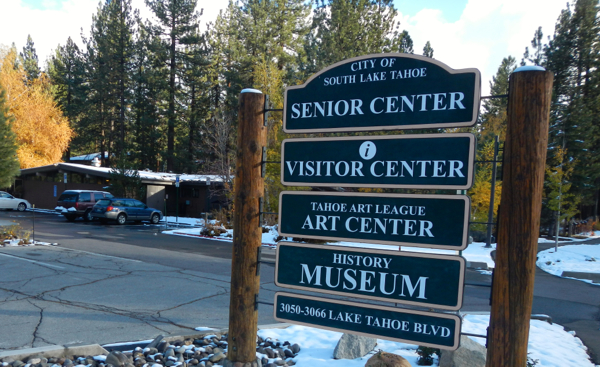
It looks like South Lake Tahoe may soon be the landowner where the senior center, museum, art building and visitors center sit in the middle of town.

“It’s a good idea to transfer it to the city and get out of the middle,” El Dorado County Supervisor Sue Novasel told Lake Tahoe News.

This month, just not tomorrow, Novasel expects the county electeds to vote on how best to have the city take over that land. Whether this involves the transfer of money or land, or changing property lines remains to be seen.

“We hope there is no money exchanged. We hope there is a lot line adjustment,” Mayor Hal Cole told Lake Tahoe News.

This conversation has gone on for decades, but not until this year has any real progress been made. Timing and new players at staff level and elected positions are part of the reason a resolution is apt to be found.

“We are not coming in with any predisposed biases about what to do with property. We are looking at how to make it work, not how to stop it. That seems to be the spirit of everyone at the table,” Novasel said.
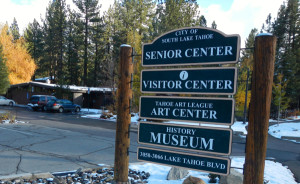
The land where these entities do business may be transferred from El Dorado County to South Lake Tahoe. Photo/LTN

The land where these entities do business may be transferred from El Dorado County to South Lake Tahoe. Photo/LTN

The other impetus is the seniors. Their complaints are finally being acknowledged by the city and county.

A big issue is that the county owns the land that houses all of these entities, while the city is responsible for the maintenance. In many ways it’s like the organizations have two landlords who aren’t always in agreement.

The seniors want to make repairs and expand, but the city doesn’t want to say yes to a building it doesn’t own and the county has essentially been an absentee landlord. Lingering disagreements are whether issues are maintenance or capital improvements. The former the city would be liable for, the latter would be the county’s responsibility.

The City Attorney’s Office did not provide Lake Tahoe News with what the actual lease agreements are between the city and the seniors, Tahoe Art League, Lake Tahoe Visitors Authority and Lake Tahoe Historical Society.

All of the property is part of what is known as the 56 Acres, which includes the $65 million Lakeview Commons site.

The county owns a slice of land no more than 100 feet by 100 feet near the old Alta Mira building site that the city would like to acquire in order to get the bike path there built. That, too, is on the table for discussion.

Moving the county’s vector control is also being considered. It’s possible that department could be relocated to the industrial area when the city takes its fleet there.

The larger parcel of the 56 acres includes Campground by the Lake and undeveloped areas on that side of the highway.

“We expressed our desire to take that land and add it into our recreation master plan, possibly improve the campground and bring it up to standard like the rest rooms and possibly RV hookups to make it more desirable,” Councilman Austin Sass told Lake Tahoe News.

What to do with this bigger parcel, including the campground, is not expected to be resolved this year.

Once the Board of Supervisors votes on the senior center property et al, the City Council will take up the issue. The goal is to have votes cast this calendar year. The city, though, only has one meeting left – Dec. 7.


1,400 on waiting list for Nev.’s independent living program

By Yesenia Amaro, Las Vegas Review-Journal

Marsha Rodriguez waited six months to get into a Nevada Medicaid waiver program providing home services so the disabled woman wouldn’t have to move into a nursing home.

Seven years later, the 72-year-old is still receiving those services along with 4,558 other people from three different vulnerable populations — the frail elderly, blind and disabled — through a state agency to help them live independently.

“I really needed the program and I was blessed when I finally got on it,” said Rodriguez at her home on Tuesday. She uses oxygen, has limited arm motion and suffers from alpha-1 antitrypsin deficiency, which is a disorder that might cause lung and liver disease. “If I didn’t get the help, I would have to be in a nursing home.”

But another 1,415 people are on a waiting list to receive the same services, and it’s estimated that it would cost about $40.3 million to eliminate the backlog, according to data requested by the Las Vegas Review-Journal from the state’s Aging and Disability Services Division, which administers the services.

Read the whole story


Educators work to make history more inclusive

By Jennifer Modenessi, Bay Area News Group

ORINDA — When Miramonte High School social studies teacher Elizabeth Aracic teaches Civil War history, she makes a point of giving her students a wide-angle look at the country’s deadliest war.

Answering legislation that seeks to make history more inclusive, Aracic explains to high school juniors that it wasn’t just men on the battlefield. Women dressed in men’s clothing and fought too, with some continuing to live as men long after the fighting was over.

The lesson and others being crafted and taught across Bay Area public schools are in direct response to the FAIR Education Act, which requires California public schools to provide fair, accurate, inclusive and respectful representations of the lesbian, gay, bisexual and transgender communities in K-12 history and social studies curriculums. Studying the contributions of people with disabilities is also part of the mandate.

But progress in implementing the law has been uneven since it took effect nearly four years ago.

Read the whole story


Calif.’s ballot could be a blockbuster next November

By John Myers, Los Angeles Times

Call it a dream for California political consultants, a nightmare for voters or an electoral extravaganza: The November 2016 ballot could feature a bigger crop of statewide propositions than at any time in the past decade.

“The voters pamphlet is going to look like the Encyclopaedia Brittanica,” said Steve Maviglio, a Democratic campaign strategist.

The list of measures is very much a work in progress. Most campaigns are still gathering voter signatures or waiting for their proposals to be vetted by state officials.

But political strategists have identified at least 15 — perhaps as many as 19 –measures that all have a shot at going before voters next fall.

Read the whole story


Placer making public roads in Truckee private

Ownership of two short roads near Northstar is changing.

The Placer County Board of Supervisors last week approved the abandonment of Mill Site Road and Cross Cut Court so they will become privately owned.

Mill Site Road runs through the Retreat at Northstar, an 18-lot development. Adjacent to the Retreat is Martis Camp, a 668-lot development, of which less than one-third is built-out. The main roadway through Martis Camp is Schaffer Mill Road, a private road that ends at Mill Site Road. A transponder controlled gate separates the two roads.

Residents of the Retreat were under the impression the gate would only be used for emergency vehicles and public transit. The reality is people are using it as a short cut.

Martis Camp reps wanted to keep the status quo to reduce travel time to their development.

— Lake Tahoe News staff report


Fight on West Slope ends in 1 death, 1 arrest

By ABC-10

A fight led to a man’s death and another man’s arrest in El Dorado County early Friday morning.

The El Dorado County Sheriff’s Office said that deputies were sent to investigate a report of an assault near a residence in the 2800 block of Elmer Street in Camino about 1:05am.

When they arrived, they found a man unconscious in the driveway.

Read the whole story


California researchers re-create forest blazes

By Rory Carroll, Guardian

The doors clang shut, casting the laboratory into gloom, and the scientists don goggles, yellow helmets and flame-resistant jackets. Two crouch behind computers, readying measurements. Another picks up a blowtorch. The rest stand back.

Wood shavings and dry chaparral, which resembles hay, line the bed of a 30ft wind tunnel. Green shrubs, leaves and branches sit on a shelf above. The replica forest is ready for immolation.

“Computers!” shouts Jeanette Cobian, the lead engineer, signalling the start of the experiment. “Ignition!”

The scientists have just simulated a “crown fire”, in which flames leap from treetop to treetop, a spectacle firefighters dread. The computers recorded heat of more than 800C (1,472F).

“We want to know when fire will transition to a crown, and if so, how fast will it spread,” said Cobian, a mechanical engineering PhD student at the UC Riverside.

Read the whole story