Calif. economy is booming, but is still No. 1 in poverty

By Chris Kirkham, Los Angeles Times

From a quick glance at the headline numbers, California’s economy looks to be in its strongest shape in years.

Over the last four years, California has added jobs at a rate faster than all but six other states, and faster than the U.S. overall.

The state unemployment rate is at 5.9 percent, the lowest since November 2007, and significantly below the 25-year average of 7.5 percent.

California has added jobs at a faster rate than the rest of the country in recent years.


But that swift economic growth hasn’t improved the fortunes of California’s poorest. The state’s official poverty rate (based on a federal threshold of $24,230 for a family of four) is at 16.4 percent, according to the most recent census data from 2014, up from 12.4 percent in 2007.

Read the whole story


El Niño: ‘One storm after another like a conveyor belt’

Early snow in Lake Tahoe has people cross country skiing at lake level. Photo/LTN

Early snow in Lake Tahoe has people cross country skiing at lake level. Photo/LTN

By Rosanna Xia and Rong-Gong Lin II, Los Angeles Times

The strong El Niño in the Pacific Ocean is becoming even more powerful, setting the stage for an unusually wet winter in California that could bring heavy rains by January, climate experts said.

The National Weather Service’s Climate Prediction Center said El Niño is already strong and mature, and is forecast to continue gaining strength. This El Niño is expected to be among the three strongest on record since 1950.

Generally, El Niño doesn’t peak in California until January, February and March, Patzert said. That’s when Californians should expect “mudslides, heavy rainfall, one storm after another like a conveyor belt.”

Read the whole story


CDC: Obesity still a growing problem in U.S.

By Karen Kaplan, Los Angeles Times

America’s obesity problem just keeps getting bigger.

A new report from the Centers for Disease Control and Prevention says that 37.7 percent of U.S. adults were obese as of 2014. That’s up from 34.9 percent two years earlier.

From 2011 through 2014, an estimated 36.5 percent of Americans ages 20 and older had a body mass index of at least 30, putting them over the threshold for obesity. The prevalence was higher for women (38.3 percent) than for men (34.3 percent), the CDC data show.

Read the whole story


Extending Prop. 30 comes with consequences

By Jerry Nickelsburg

In 2012 voters passed Proposition 30—an initiative to raise taxes and take state government finances out of crisis mode. However, the new taxes, primarily falling on the top income earners in California, did not purport to be a cure for the underlying problem. Rather, the rationale was to give the state some breathing room. And Proposition 30 came with an expiration date, 2018.

Now it looks like Prop. 30 might have an even longer life. Last month, the California Teacher’s Association—the union representing more than 300,000 teachers—filed an initiative to extend Prop. 30’s temporary income tax surcharges until the year 2030. The rationale according to Gale Kaufman, strategist for the initiative, is to “keep our state budget balanced, and prevent devastating cuts to programs affecting students, seniors, working families and health care.”
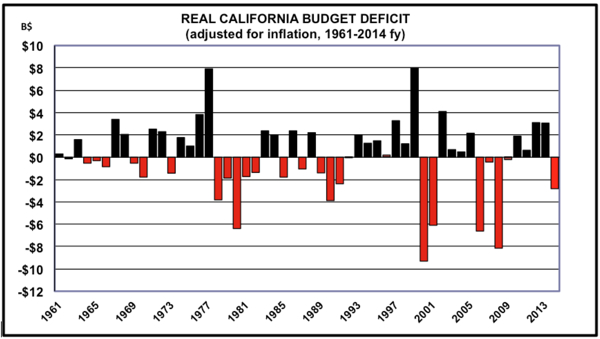
Caption: Data from California Department of Finance, BEA.gov, UCLA Anderson Forecast

Source: Data from California Department of Finance, BEA.gov, UCLA Anderson Forecast

Unfortunately, economics and the available empirical evidence suggest there is a large risk that Prop. 30 will produce the exact opposite outcome from that suggested by Kaufman.

There are two issues that voters must consider before deciding whether to accept this risk.  The first is the difference in incentives between a temporary and a permanent increase in income taxes. The second is the different impact a tax may have at different points in the business cycle.

When Prop. 30 was proposed, it was billed as a temporary tax increase to bail the state and its schools out of a recession-induced financial crisis. In the political campaign Gov. Jerry Brown said: “It’s about putting money into California’s schools or taking money out of it … there is no third way.”

At the time, opponents warned of a mass exodus of high-income earners from the state were Prop. 30 to be enacted, since the income tax hikes were restricted to those who earned at least $250,000 a year. California has become increasingly dependent on such high-income earners for tax revenues. Income taxes paid by the top 1 percent of income earners grew from 33 percent of the total in 1994 to more than 50 percent in 2012, the first year of the Prop. 30 tax surcharges. But the exodus did not happen. Most high-earners stayed, more came, and they and the Golden State have prospered.

Why were the doomsayers wrong? It’s not easy to say. There are no data on this; nor are there data on the difference between a temporary Prop. 30-like tax increase and a permanent one.

However, we do know that people react differently when presented with the same policy if they think there is a crisis (let’s all pitch in and solve this) or if they think it is business as usual (why am I contributing this amount?). These questions of context and timing must inform how we think about extending Prop. 30.

For example, will there be a significant move of Californians to Seattle–where there are no income taxes—if Prop. 30 income tax surcharges are made effectively permanent? If the answer is yes, then it could well be the case that state tax revenues would decline as high-income earners and their employees depart, offsetting gains from the higher taxes on those who stay put. This is a difficult but essential forecasting problem facing the voters as they consider the extension of Prop. 30.

Another forecasting problem involves the fact that income taxes apply to earned income, and in a recession income declines. A recession is coming. When? We do not know, but it is coming and tax revenues will necessarily decline when that occurs. Importantly, when it does, California’s high-income earners will once again take a greater hit to their income than the balance of the state. The heavier the reliance on them to fund state government, the greater the cuts will be to the same programs that Kaufman cited.

But then shouldn’t the state extend Prop. 30 income taxes to cover this impending shortfall? The unfortunate answer is no. Income that does not exist because of a recession yields the same revenue regardless of the marginal tax rate—zero.

In fact, an extension of Prop 30. could make the situation worse than it was during the Schwarzenegger and Davis budget crises. Our current greater dependence on high-income earners to balance the state budget makes us more not less vulnerable. It is one key reason why the three bond rating agencies, Fitch, S&P, and Moody’s, rate California bonds as relatively high-risk investments compared to those of other states.

The close and deleterious relationship between the unstable incomes of high-income earners and California’s public finances dates back to Gov. Ronald Reagan’s progressive tax law, which itself was supposed to be temporary. Ever since then, when rich people have done badly, so has the state. The impact was not pronounced in the early years (1967-90) because the California economy was dominated by large manufacturing firms, which paid middle-class wages to their workers. As innovation, technology, and their concomitant entrepreneurial activity replaced large-scale manufacturing, the importance of high-income earners soared.

The income of the new entrepreneurial class is quite different than their high-income predecessors. In good times, these entrepreneurs and their team rake in profits. Their companies issue IPOs, they exercise stock options, and they receive generous bonuses.  But when the economy tanks, so do their incomes. It is just not the same as, for example, a 15 percent reduction in the workforce at the GM plant in Van Nuys hitting revenues. It is a virtual wipeout of a major source of revenue.

And so actual deficits–that is, an excess of general fund spending over general fund revenues (not counting savings from previous years)—have, even adjusting for inflation, grown dramatically. There is nothing in the revenue structure to suggest today is any different from the recent past.

One counterargument is that the state now has a “rainy day” fund thanks to Proposition 2 approved by voters in 2014. The current budget projects between $3 billion and $4 billion in the rainy day fund at the end of the fiscal year. It cannot be more because of Proposition 98’s education-funding requirements and because of budgets that dedicate some of the increased income to restoring expenditures cut at the time of the previous recession.

The important question then becomes: When compared to previous deficits, is this rainy day fund sufficient? A dispassionate reading would suggest it is not even close. Do we remember the $26 billion deficit of 2009? One estimate, using data from the 1991 recession, found that states need rainy day funds equal to about one-third of their budgets. For California, that would mean a rainy day fund of roughly $40 billion—10 times as large as today’s rainy day fund. A much milder recession than the last one, with heavier reliance on high-income earners, wipes the rainy day fund out and then some.

There are two questions any discussion of an extension to Prop. 30 must address. First, will permanent increases in taxes on entrepreneurs, the source of California’s rapid recovery from the last recession, leave the state bereft of many of them for the next recovery? Second, will increasing volatility in state tax revenues over the business cycle be a harbinger of what will happen in the next recession?

I would suggest that the answer to both questions is yes and the initiative to extend Prop. 30 taxes, rather than solving a problem, creates a worse one.

A better alternative would be to change the tax system such that it generates a smoother revenue stream available to the general fund over the business cycle and prevents the kinds of drastic cuts we have become accustomed to. There are many ways of doing this that preserve progressivity in the tax structure, but the extension of Prop. 30 is not one of them.

Jerry Nickelsburg is adjunct professor of economics at the UCLA Anderson School of Management, and senior economist for the UCLA Anderson Forecast.





South Shore woman dies after home catches fire

One person died after this trailer in  Stateline caught fire Nov. 13. Photo/Provided

One person died after this trailer in Stateline caught fire Nov. 13. Photo/Provided

A Stateline woman in her mid-60s died early Friday morning after the trailer she was in caught fire.

Firefighters pulled her from the burning structure, tried to resuscitate her, but she died at the scene. The coroner will determine the exact cause of death, but preliminary reports are smoke inhalation. Her name is being withheld pending notification of family.

She was the only occupant at the time at the singlewide trailer on Ponderosa Avenue on Kingsbury Grade.

The fire was reported about 12:30am Nov. 13.

The cause of the blaze is under investigation. The fire was contained to the one trailer.

“The trailer is a total loss,” Tahoe Douglas Fire Marshall Eric Guevin told Lake Tahoe News.

Two Douglas County sheriff’s deputies were evaluated at Barton Memorial Hospital for smoke inhalation.

— Lake Tahoe News staff report


Loft designed to be a magical experience in SLT

Bryan Kambitsch was assembling the crystal chandelier one piece at a time. Photos/Kathryn Reed

Bryan Kambitsch assembles the chandelier for the The Loft Theatre one piece at a time. Photos/Kathryn Reed

By Kathryn Reed

It takes some imagination to appreciate what The Loft will be like in a month. The hum of machinery echoes through the vacant building. A hole has been punched through the third floor of the parking garage.

Contractors are busy working their magic to create what will be an original South Lake Tahoe entertainment venue. About $1 million is being spent to turn what had been a vacant section of the Heavenly Village into what will be part theater, part restaurant and part lounge.

The Loft is Paul Reder’s baby. Reder, who runs PR Entertainment on the South Shore, is known for having brought Fusion magic shows to Stateline starting in 2003. Magic Fusion is the show that will take center stage at The Loft.

The Loft Theatre is above the cinema entrance at Heavenly Village. Rendering/Provided

The Loft Theatre is above the cinema entrance at Heavenly Village. Rendering/Provided

Reder and Tony Clark are the producers, with Clark also being the star. He will be the main attraction for the first 60 to 90 days. Twice Clark has earned magician of the year accolades from the International Magicians Society. In 2010, the two won the Merlin Award for producer of the year. In the world of magic this is like winning an Academy Award.

“We will rotate world-class performers through Magic Fusion through Tony’s direction,” Reder told Lake Tahoe News. “You are not going to see the same show twice because a lot of what is done is based on the audience.”

Shows are designed to be appealing to all ages. The 107-seat theater is intimate. It is awash in red, will have floor to ceiling curtains. Comfort was placed ahead of capacity when it came to choosing the seats, Reder said.

A large television will be above the stage so people have a close-up view of the magician’s hands to see every trick as it unfolds.

A construction team works at the third floor parking garage entrance to The Loft.

A construction team works at the third floor parking garage entrance to The Loft.

What is unique with this stage is that it is two sided. When the magic is happening in the theater, bar and restaurant patrons will see what looks like a repurposed barn door. It will open when the theater is dark to become a stage for bands or other entertainment.

To the left of that door will be the glass wine case. Farther left is the seated bar area, which will be backlit in gold. High-end wines and handcrafted cocktails are being touted.

Two indoor fireplaces, overstuffed couches and metal chain dividers for intimacy – for couples or groups – are incorporated into the design.

Paul Reder has been a part of the South Shore entertainment industry for decades.

Paul Reder has been a part of the South Shore entertainment industry for decades.

Environmental entertainers will be sauntering through the restaurant and lounge. They will perform slight of hand magic so even if people aren’t seeing a show that night they get a taste for the main attraction.

There are two entrances to The Loft. The ground floor, where the box office will be located, is across from the ice rink in the middle of storefronts between Starbucks and the movie theater. Stairs and an elevator will take people to the third floor.

This entrance will immediately say magic based on memorabilia that will decorate the walls.

The other way to enter is via the third floor of the parking garage.

One of Reder’s desires was to have the work be done by locals.

Architect Brian Shinault had 5,700-square-feet of space to work with. It is an extremely horizontal shape.

Carpenters working for general contractor Mike Bailey were busy this week getting the room ready for the Dec. 11 install of all the furniture and accessories. On Monday, Bryan Kambitsch was assembling the crystal chandelier one piece at a time.

Carol Faccinetti is the interior designer.

Her approach to any project is to ask a lot of questions so she can transform the area to her client’s liking. With The Loft, it is a bit retro and vintage, with leather, iron and reclaimed wood.

“I really don’t think there is a lounge space like this in Tahoe,” Faccinetti told Lake Tahoe News. “It has a whole urban look, with pipes showing in the ceiling. I like the materials and the product. It will be a fun space.”

Lisa Devincenzi-Miller has the executive chef duties. She owns Capisce in Round Hill. The Italian recipes she brings to the table are family secrets passed down from her great-grandmother.

“Nothing is out of a box,” Reder said. It’s fresh food made daily, with ingredients often being imported from Italy.

With this being on the California side, it means no smoking or gaming anywhere inside.

The theater seats 107 people. Rendering/Provided

The theater seats 107 people. Rendering/Provided

Reder has a 10-year lease with a five-year option from Gary Casteel of Trans Sierra Investments, who owns the Heavenly Village. The two have known each other for years and have talked about creating something like this for at least a decade.

“At this point they are exceeding our expectations,” Casteel told Lake Tahoe News.

He believes The Loft will round out the amenities offered at the village that locals and tourists will enjoy.

“We have become more of a lifestyle center and downtown district for South Lake Tahoe,” Casteel said of the entire village.

While the venue will open in mid-December, not all the work will be done by then. Plans are to move the bungee jumping apparatus that is set up in the summer to another part of the village. This area will then be transformed into outdoor seating for Loft guests, which will likely include fire pits.

There is one tiny balcony that a couple people could stand on to look out onto the ice rink. This was designed to make it look like the Marriott properties. Reder and Casteel one day would like to explore making this a functional deck area.

The Loft will have a soft opening Dec. 15 for the restaurant and lounge. The first magic show is set for Dec. 19.

—–

Notes:

·      Tickets are available online.

·      There will be an 8pm show on Monday and Tuesday, 7 and 9pm shows Thursday-Sunday. The theater is dark Wednesdays.

·      There will be a special New Year’s Eve package.

·      The restaurant and lounge will be open seven days from 4pm-2am.

·      Loft guests will pay $1/hour in the garage instead of the regular $3.75/hour.


EBay planning $412 mil. investment in Nevada

By Daniel Rothberg, Las Vegas Sun

EBay is moving forward with plans to expand its data operations throughout the state, pending the approval of tax abatements at an economic development meeting next week. In two separate applications with Nevada for tax breaks in Clark and Storey counties, the e-commerce giant plans to invest $412 million, a large portion going to the purchase of servers, and to hire 52 new employees.

EBay’s desire to expand its data operations presence in the state has been well-known for some time, but the details weren’t previously available. Switch, the Las Vegas data company in the midst of its own expansion, confirmed this year that eBay would be the anchor tenant in Switch’s planned $1 billion facility near Reno.

Having a well-known company like eBay, which plans to spend $230 million on its data operations near Reno, could be a stimulus for the region and encourage more investment.

Read the whole story


Full House Resorts reverses third quarter net loss

By Howard Stutz, Las Vegas Review-Journal

Regional casino operator Full House Resort reversed a third quarter net loss while cash flow jumped 20.5 percent for the Las Vegas-based company.

Full House, which operates casinos in Northern Nevada, Mississippi, Indiana, said Wednesday net income for the quarter than ended Sept. 30 was $2 million, or 11 cents per share. A year ago, the company lost $766,000, or 4 cents per share. Net revenue increased 4.1 percent to $34.3 million.

In Nevada, Full House owns Stockman’s in Elko and manages the Grand Lodge Casino at the Hyatt Regency Lake Tahoe.

Read the whole story


Study: Reno is drunkest Nevada city

By Seth A. Richardson, Reno Gazette-Journal

Congratulations Reno, pour yourself a drink for being named the drunkest city in Nevada.

24/7 Wall Street, a financial news and opinion website, listed the drunkest city in every state Wednesday with Reno topping the chart for Nevada.

The findings showed one in five adults – or 20 percent – engage in binge or heavy drinking in Reno compared with 15 percent of the national population.

Read the whole story


NDOT finishes drainage work on Hwy. 50

Storm drain improvements on Highway 50. Photo/Provided

Storm drain improvements on Highway 50. Photo/Provided

More than $1 million in storm drainage work has been completed on the east side of Spooner Summit.

The Nevada Department of Transportation project was designed to enhance storm drainage, preserve water quality and reduce erosion on Highway 50 in south Carson City.

More than 50 storm drains and drop inlets, as well as enhanced roadside slopes and curb and gutters were installed on the highway from the South Carson Street/Spooner junction to Tahoe Golf Club Drive, approximately 4.5 miles up 50.

Some of the drainage systems were from when the highway was built more than 50 years ago.  The drainage systems carry storm water into the Clear Creek Watershed on the south side of Highway 50.