By Joann Eisenbrandt
PLACERVILLE — “What the hell are you doing? Why would you make El Dorado County like Los Angeles … Are you all crazy? What is your vision? More big-box stores, more dense housing, more people, more traffic? You are supposed to take care of the people who live in your county.”
— Dave Hammond, Shingle Springs Comments submitted for the Dec. 15 El Dorado County Board of Supervisors meeting
Land use planning is often seen as a tedious, technical pursuit, relegated for the most part to obscure planning department offices far removed from most residents’ daily lives. That is, until it directly threatens the things they hold most dear.
On Dec. 15, the El Dorado County Board of Supervisors is slated to approve the Targeted General Plan Amendment/Zoning Ordinance Update (TGPA/ZOU). California law requires counties to develop a General Plan to codify goals and policies to guide how land is developed and to review and update that plan regularly as needed. The TGPA/ZOU is the county’s response. More than a decade in the making, it includes amendments to the county’s 2004 General Plan and an extensive update of the Zoning Ordinance that implements it.
El Dorado County encompasses 1,805 square miles divided into two distinct areas, the Lake Tahoe Basin and the West Slope. The TGPA/ZOU affects only the unincorporated areas of the county and not cities like South Lake Tahoe and Placerville or publicly-owned lands.
Dave Hammond isn’t the only county resident unhappy with the TGPA/ZOU and the process through which it was created.
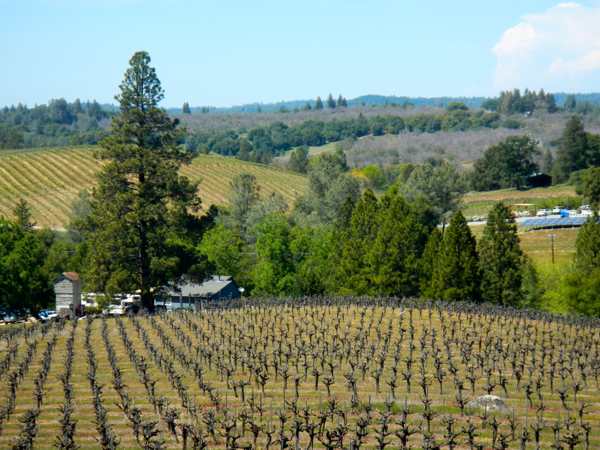
Many people don’t want El Dorado County’s rural nature threatened. Photo/LTN file
The 2004 General Plan states, “It is imperative to balance competing goals in approving the General Plan. The adopted General Plan encourages a balance between population growth, economic development, and the need to protect the environment ….” But as those who live at Lake Tahoe know all too well, the struggle to achieve this balance can be a protracted and emotional one. Even without TRPA, it’s no walk in the park.
The county’s West Slope has been no stranger to this struggle. Just how deep feelings run became apparent during three days of board meetings on the TGPA/ZOU on Nov.10, Nov. 12-13. Opponents of the TGPA/ZOU characterized it as a seriously-flawed, “developer driven” document that would create massive, unneeded and inappropriate rezoning of parcels for more intensive uses, lead to growth that cannot be supported by existing infrastructure or water resources, and create traffic gridlock especially along Highway 50. Most of all, they insisted, it will destroy the rural character of the county and create the Los Angeles that Dave Hammond fears.
County planning staff views it quite differently. Shawna Purvines, the county’s principal planner on the project and Long Range Planning’s main presenter at those meetings, characterizes it as a faithful representation of the views of past county planners and decision makers and the appropriate response to the state’s mandate to provide for growth in the county.
“I’ve heard the concern that the Zoning Ordinance is going to substantially change the character of the county,” Purvines told Lake Tahoe News,” and so I took that to heart and I started digging deeper. I went back to the Area Plans and the 1969 General Plan and to the 1949 Zoning Ordinance to be able to adequately respond … these are not new policies, this is a new ordinance.”
After an initial two-year review, a General Plan is revisited every five years to compare its original assumptions with reality. The results of that five-year review in 2011 provided the impetus for the development of the TGPA/ZOU. It brings the Zoning Ordinance into conformity with the General Plan as required by state law, but does not, Purvines stressed, “overhaul” the 2004 General Plan, remove important development restrictions, create any new parcels or maximize the density potential of that plan. If the TGPA/ZOU were not implemented, she added, the environmental impacts would be unchanged from those identified in the 2004 General Plan’s environmental impact report (EIR).
An EIR is required by the California Environmental Quality Act (CEQA) for projects initiated by public agencies. It identifies significant environmental impacts the project could create, the mitigation measures to reduce them, and lists those impacts that cannot be mitigated to less-than-significant. If the lead agency, in this case the county, feels the merits of the project outweigh unmitigated impacts, they prepare a Statement of Overriding Considerations, declaring the overall benefits of the project make such potential negative impacts “acceptable.” The EIR prepared for the TGPA/ZOU is a “program EIR,” which means it focuses on general policies and zoning designations, not on site-specific development proposals.
It outlined the project’s objectives to create affordable housing for the moderate income earner, create jobs, stop sales tax leakage from the county and promote and protect agriculture by expanding opportunities there for recreation and rural commerce. It identified “unmitigated adverse environmental impacts” and a Statement of Overriding Considerations was prepared. Impacts include, among others: damage to scenic resources including historic buildings along scenic routes; loss and fragmentation of wildlife habitat; creation of substantial incompatibilities between land uses; creation of substantial population growth; substantial depletion of groundwater supplies; and, conflict with level-of-service (LOS) traffic standards and travel demand measures.
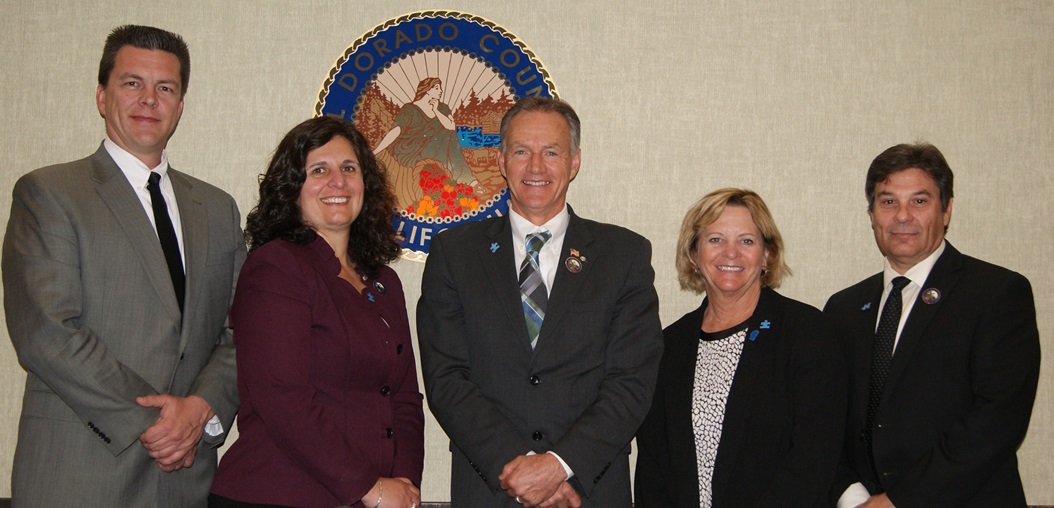
El Dorado County supervisors on Dec. 15 are expected to approve the General Plan documents. The item will be discussed at 1pm in Placerville. From left are, Ron Mikulaco, Shiva Frentzen, Brian Veerkamp, Sue Novasel and Michael Ranalli. Photo/Provided
Rural Communities United (RCU), an unincorporated association originally formed to help pass the Measure Y initiative in 1998 to prohibit approval of residential developments that could lead to traffic congestion on Highway 50, finds these impacts unacceptable. Another community group, Shingle Springs Community Alliance, agrees. Individually and in concert, they have analyzed and commented upon the TGPA/ZOU throughout its formulation by the county.
Don Van Dyke outlined RCU’s concerns for Lake Tahoe News. “The biggest problem with this update is that it was represented as a very minimal update to the public. The reality is that it is a very major update especially to the building ordinance that will allow for increased density in both community and rural areas and doesn’t take into account our infrastructure like roadways and water to support all the development.”
In her comments to the board on Nov. 10, Monique Wilber, a former El Dorado County Senior Planner and an RCU member, insisted that the mitigation measures in the TGPA/ZOU are “infeasible,” and it relies on mitigations that “have proven ineffective in the past.” Many of the mitigations identified earlier in the 2004 General Plan, she added, have not been implemented at all.
County planning staff says the rezoning of 37,000 parcels, the removal of some zones and addition of new ones, and changes in the type and intensity of allowed uses on others was required to make the zoning maps consistent with the 2004 General Plan. Opponents contend it goes far beyond that. Sue Taylor, longtime land use planning activist, believes the project will, “destroy our rural lifestyle and the quality of life we have here.” Taylor believes the board has not done enough direct study of the project themselves. “They turned everything over to Long Range Planning,” she told Lake Tahoe News, “and have given Shawna Purvines our future.”
Supervisor Ron Mikulaco disputes Taylor’s claim. “I’ve read the documents in there … of course their concerns were taken into consideration. That’s why I put aside the time to go through all the materials.”
Howard Penn, unsuccessful candidate for county supervisor in 2014 and current executive director of the Planning and Conservation League, told LTN, “I don’t blame the county staff as others do. Ultimately, this is not the county staff’s fault. It’s the supervisors’. The direction comes directly from the supervisors and they are directly responsible for land use.” Penn believes the county is planning in a vacuum, and not looking at the impacts their decisions will make on surrounding counties, insisting that, “Land use planning and transportation planning are key issues for the future health of our entire state.”
Bill Center, local businessman and former El Dorado County supervisor, believes the county is repeating the mistakes it made that led to the creation of the Tahoe Regional Planning Agency (TRPA) at Lake Tahoe. “The completion of Tahoe Keys and the planned massive subdivision from Meyers to Echo Summit forced the first nationalization of land use planning in the country. It basically was caused by El Dorado County … by the county’s absolute refusal to recognize that rampant residential growth without any commercial development would kill the goose that laid the golden egg. Over and over, the West Slope has gone through the same kind of pressures, and unlike Keep Tahoe Blue, a simple statement of the environment we have focused on here is, ‘It’s Traffic Stupid’.”
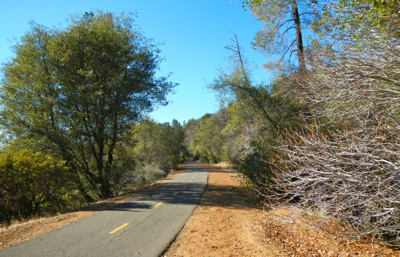
The El Dorado Trail is a reminder even in Placerville the county is rural. Photo/LTN file
Center refers to proposed large residential subdivisions on the West Slope, some adjacent to the Highway 50 corridor, and the traffic impacts they will create. While these private developments are not directly addressed in the TGPA/ZOU, some contend the zoning changes it allows will streamline their approval.
Measure Y, the Control Traffic Congestion Initiative, prevented the approval of residential subdivisions that would create level of service (LOS) F on Highway 50. LOS F is the highest congestion level on the traffic measurement scale and essentially represents gridlock. Measure Y expired in 2008 and was reapproved, this time giving the board the discretion to selectively allow projects that create LOS F. According to Center, this was, “an opening they drove a Mack truck through.”
Another key issue is water. As the TGPA/ZOU points out, the majority of the groundwater supply in El Dorado County comes from “underground zones of hard crystalline or metamorphic rock within which there are fractures that provide natural storage for groundwater. The fractures do not form a connected system.” This makes it difficult to determine how much water will be available at a specific location. At the Nov. 10board meeting, Cheryl Langley, a Shingle Springs resident, insisted the county needs to develop a Ground Water Management Plan first as other counties have, and then base their development decisions on the results of those studies.
While the TGPA/ZOU includes the unincorporated areas of the county in the Lake Tahoe Basin, its potential impacts there are more limited. Although 14,500 of the 37,000 proposed parcel rezonings are for parcels in the Tahoe basin, most of these, county staff explained, are primarily name changes to make them consistent with TRPA’s Regional Plan designations since the current county zoning ordinance was adopted before the latest TRPA Regional Plan update. All projects in the Tahoe basin, including the TGPA/ZOU, must be consistent with the TRPA Regional Plan, its Code of Ordinances, Plan Area Statements and other regulations. When reviewing specific applications for land uses in the unincorporated areas at the lake, county planners must apply those TRPA standards. County development regulations may be more stringent than TRPA’s, but not less.
Under the TGPA/ZOU, the county will continue to work with TRPA and local entities in the completion of the Meyers Area Plan and to identify lands in the basin that can support affordable housing. Supervisor Sue Novasel, who was involved in the creation of the original Meyers Community Plan 25 years ago, explained that once the current Meyers Area Plan’s environmental documentation is completed it will need to be approved by the county and TRPA.
Asked why Tahoe residents need to be concerned about the impacts of the TGPA/ZOU on the West Slope, Novasel said, “I think some people forget that El Dorado County encompasses a large part of the Tahoe basin from Stateline to Tahoma and what happens on the West Slope as far as land use will have an impact on the Tahoe basin. The General Plan affects all of our departments and the health of the county in general. If we don’t have growth and the ability of the county to provide the services we need here, Tahoe will suffer.”
There have been years of talk about the TGPA/ZOU, but some say, not enough listening. “The most frustrating thing,” Don Van Dyke contends, “is that the county does not listen to residents. We need a change of culture at the county. We need the county to be working with residents and developers in projects that are good for everyone in the county.”
Many of the hundreds of pages of comments submitted by RCU and others, Van Dyke insists, were not answered at all or were inadequately responded to by the county in the project’s EIR.
“Over the past four or five years,” Van Dyke believes, “residents from mostly community regions who tried to become involved were routinely marginalized and bullied out of discussions with CEDAC.”
CEDAC is the Community and Economic Development Advisory Committee. It grew out of the 2004 General Plan’s desire to “establish a forum for discussion and make recommendations on pending environmental issues that affect the County’s economic vitality.”
Eva Robertson, an attorney and member of the CEDAC board was the only member opposed to certifying the EIR. In her comments to the board on Nov. 10 she said, “Certifying a deficient EIR leaves the county open to a viable legal challenge. My understanding is that the county has been successfully sued for CEQA violations more than once already.”
The 1996 General Plan was successfully sued and remained unimplemented until CEQA inadequacies were corrected to the court’s satisfaction in 2004.
Novasel stands behind the process. She told Lake Tahoe News, “We’ve had years and years of testimony and input from the public on this. What I’ve found is an effort to slow down the process just to slow down the process. I don’t know what happened with CEDAC but the board did not marginalize anyone in our meetings. We listened carefully and then made a decision. I don’t know how we could have done it any better.”
Some impacted property owners believe they didn’t even get the chance to comment because they failed to receive adequate notice about proposed zoning changes on their properties or adjacent ones. Some parcel owners did receive individual notices in the mail, others did not. Those that didn’t were part of the public notification process which included meeting notices, agendas and posting of project documents on the county website, articles and notices in the media and town hall meetings conducted by individual supervisors in their districts.
“The county has an ordinance that tells it how to implement CEQA,” Purvines explained. “The county defaults to the basic CEQA requirements (for notice). If there are more than 1,000 parcels we default to public notification. We believe we did more than the minimums but there is a difference of opinion on who should get a notice.”
Lori Parlin, founder of Shingle Springs Community Alliance, says the county put an inappropriate burden on residents to seek out information. “There were 200 meetings held, and I’ve been to a lot of them, but they did not provide any site-specific information to attendees. I didn’t know they were rezoning property next to me. My back fence is now going to be next to a parcel zoned regional commercial, which would allow for a WalMart or Costco. “
The TGPA/ZOU project was discussed at Supervisor Michael Ranalli’s Dec. 10 town hall meeting in Shingle Springs. In response to similar concerns raised again by Parlin and others, Ranalli said, “We took a pounding for trying to bring the General Plan up to date. There still may be things in there that are not optimum for certain areas. Staff will be asked to review this again in a year.”
Supervisor Shiva Frentzen had her own concerns over the public notification process. She was the lone vote against giving tentative approval to the major components of the TGPA/ZOU at the Nov. 13 board meeting saying, “My struggle is with fairness and doing what’s right.”
In an email to Lake Tahoe News, Frentzen explained, “My concerns with the ZOU are: Altering the rights of the property owners without directly notifying them; altering the neighborhoods without proper notification within a one mile radius; it affects our resources and infrastructure; it has unintended consequences; the economic impact of all these policies and updates are not analyzed.”
If the board approves the TGPA/ZOU on Dec. 15, Rural Communities United is prepared to stop talking and take action. RCU had requested an appeal hearing to go over their concerns, and again at the Nov. 10 board meeting asked the supervisors to postpone a decision and agree to re-examine the project in smaller, more manageable pieces. These were both rejected. RCU attorney Tom Infusino warned the board that if they approve the project, “You should have no doubt left in your mind your actions will be challenged in Superior Court.”
Brian Veerkamp, chairman of the Board of Supervisors, declined to respond to LTN’s questions on the TGPA/ZOU due to this threat of litigation.
After years of discussion, what happens next remains an unknown. Will there be a lawsuit, and if so, what impacts will it have on implementation of all or part of the TGPA/ZOU? How did things get to this point, and where should the finger of blame be pointed? There are no simple answers.
Once again, it’s that tricky balancing act between economy and environment. The fight over the TGPA/ZOU is more than all the individual details. It’s about how El Dorado County envisions itself, now and in the future, and who gets to determine the framework of that future. The 2004 General Plan lists as its objective, “To foster a rural quality of life.” The problem comes with finding agreement on exactly what that rural quality of life looks like. As Supervisor Ranalli put it at his Dec. 10 gathering, “I think rural depends on your point of view, but it’s worth defining. After all, some people who live in El Dorado Hills think they’re rural.”