Study: Rising lake temps may worsen algae blooms

By John Flesher, AP


TRAVERSE CITY, Mich. — Some of the world’s biggest temperature jumps are happening in lakes — an ominous sign that suggests problems such as harmful algae blooms and low-oxygen zones hazardous to fish will get worse, says a scientific report.

An analysis of 235 lakes that together hold more than half the earth’s fresh surface water found they have warmed an average of 0.61 degrees Fahrenheit or 0.34 degrees Celsius per decade, the report said. While seemingly insignificant, the increase is bigger than those recorded in the oceans or the atmosphere.

Such rapid swings can affect aquatic ecosystems in profound ways, raising concerns about the quality of waters that people rely on for drinking supplies, crop irrigation and energy production.

A combination of satellite data and ground measurements, such as from instrumented buoys like this one in Lake Tahoe on the California/Nevada border, were used to provide a comprehensive view of changing lake temperatures worldwide. The buoy measures the water temperature from above and below. Photo/Limnotech

A combination of satellite data and ground measurements, such as from instrumented buoys like this one in Lake Tahoe, were used to provide a comprehensive view of changing lake temperatures worldwide. The buoy measures the water temperature from above and below. Photo/Limnotech

“The message we’re getting from our lakes is that they’re getting more and more stressed,” Catherine O’Reilly, an Illinois State University geologist who led the study, said Thursday. “With these rates of warming, the problems we’re seeing will become increasingly common.”

Dozens of scientists in six continents took part in the project, funded partly by NASA and the National Science Foundation. The results, made public this week during a meeting of the American Geophysical Union in San Francisco, were based on a first-of-its-kind combination of temperature data from satellites and ground measurements over 25 years. They are being published in the group’s journal, Geophysical Research Letters.

Lakes warming at the average worldwide rate or higher were widespread, including the Dead Sea, Lake Tahoe, Lake Baikal in Siberia and Lake Fracksjon in Sweden. But deep lakes in cold regions had the most rapid changes, said John Lenters of LimnoTech, a water science consulting firm in Ann Arbor, Mich.

They included four of the five U.S. Great Lakes — Superior, Huron, Michigan and Ontario. Only Lake Erie, the shallowest and warmest of the Great Lakes, was below average. Superior, the deepest and coldest, warmed three times faster than the global average.

In addition to rising air temperatures, factors causing lakes to warm vary among regions, scientists said. The Great Lakes and others in northern climates are losing winter ice earlier, and some areas are getting less cloud cover, exposing their surfaces to more sunlight.

Algae blooms flourish in warmer waters. The report predicted a 20 percent boost in lake algae over the next century, including a 5 percent increase in blooms that are toxic to fish and animals. An outbreak of toxic algae left more than 400,000 residents of Toledo, Ohio, and southeastern Michigan without usable tap water for two days in August 2014.

Such an increase would expand “dead zones” with so little oxygen that fish cannot survive, O’Reilly said. It also would boost emissions of methane, a greenhouse gas even more potent than carbon dioxide, the leading cause of climate change.

Warming causes a different problem for some lakes. In eastern Africa, Lake Tanganyika is less able to blend warm water near the surface with colder layers farther down, reducing distribution of nutrients for algae on which fish feed.

Donald Uzarski, director of the Institute for Great Lakes Research at Central Michigan University, who was not involved with the study, said its findings were consistent with other water temperature measurements in places such as the Great Lakes and Poyang Lake in China.

Other likely results of warmer lakes, he said, include lower lake levels, damaged coastal wetlands and exotic species invasions.

“What seems to be nothing more than a small change in water temperature produces a domino effect that drastically impacts the ecosystem,” Uzarski said.




Moving rocks at Lake Tahoe comes with $5,000 fine

Moving rocks in Lake Tahoe so they would not scrape kayaks and creating an 8-foot-wide path 4 feet into the water as well as a rock line path in the sand cost Martis Camp Club $5,000.

The Tahoe Regional Planning Agency Governing Board approved the settlement agreement on Dec. 16.

The Beach Shack is located on the North Shore.

About 50 yards of shoreline was impacted.

The fine will be put in a trust for special research projects and other directed purposes. It is not used for general TRPA operating expenses.


— Lake Tahoe News staff report


U.S. drug overdose deaths surge 7%

By Associated Press

Drug overdoses rose again last year, driven by surges in deaths from heroin and powerful prescription painkillers, according to new federal statistics.

Overdose deaths in the U.S. surpassed 47,000 — up 7 percent from the previous year.

Many of the deaths were due to a group of powerful opioid painkillers, which have long been the leading cause of fatal overdoses. But the number had been stable recently.

Last year, the count rose to nearly 19,000 deaths, an increase of 16 percent.

Heroin deaths continued to climb, by 28 percent to about 10,500.

The Centers for Disease Control and Prevention posted the numbers this week. They are based on death certificates.

The federal agency is analyzing the drug numbers to determine what caused last year’s increases, said CDC Director Dr. Tom Frieden.

But clearly, he added, the nation’s drug overdose problem “is not getting better.”

Opioid pain relievers, including OxyContin and Vicodin, have been the focus of a government campaign to reduce overdose deaths. The CDC is working on new guidelines for doctors about how to more carefully prescribe such drugs.

But CDC officials believe at least some of the increase in painkiller deaths last year may be due to illegally made fentanyl, which is a synthetic form of morphine. Some medical examiners classify fentanyl deaths in the prescription painkiller category, Frieden said.


Report: Lake Tahoe’s economy sputtering

By Kathryn Reed

Lake Tahoe’s economy is not thriving.

That was the message delivered this week by three members of the Tahoe Prosperity Center.

“We need to make it a less difficult place to make a living,” Heidi Hill Drum, executive director of TPC, told a group of near two dozen people at Lake Tahoe Community College on Dec. 16. She was joined on the panel by board members Jesse Walker and B Gorman. It was Gorman who spearheaded the TPC in 2011 as a way to have a single entity delving into the regional economic issues.

Earlier this fall the center released a report titled Measuring for Prosperity.

B Gorman, right, makes a point about Tahoe's economy as Heidi Hill Drum and Jesse Walker listen. Photo/LTN

B Gorman, right, makes a point about Tahoe’s economy as Heidi Hill Drum and Jesse Walker listen. Photo/LTN

Highlights include:

·       The Lake Tahoe Basin had a $4.7 billion economy in 2010, with tourism being responsible for two-thirds of that total.

·       Tourism-related jobs went from 50 percent of the overall work force in 2003 to 44 percent in 2013. This could in large part be a result in the dramatic decline in casino jobs.

·       2013 was the first time population in the basin increased in years. It’s too soon to know if this is a blip or a trend.

·       Hotel tax revenue is increasing in the basin, but not at the same pace as it is throughout California. With Monterey, Napa and Sonoma being Tahoe’s competitors, this is a concern that people in Northern California are choosing to vacation places other than Tahoe. However, with the tax rate being different in each locale, it’s not a true apples to apples comparison.

·       There has been a significant loss in the 25-44 age group.

·       Housing costs continue to outpace income levels.

·       Unemployment is above average compared to California and Nevada.

“Generally household incomes are low in the basin and they are continuing to decline,” Walker said. “They are not keeping up with inflation.”

A chart showed North Lake Tahoe incomes the highest in the basin – averaging more than $35,000 a year, while in South Lake Tahoe they are below $25,000.

“We’ve got problems that are exacerbated by the income trend going down and housing going up,” Walker said.

Carl Ribaudo with Strategy Marketing Group said it’s time to look at unconventional, smaller housing options such as cargo containers or two houses on one lot.

TPC’s next project in partnership with chambers of commerce on both ends of the lake is going to be looking at the work force. Gorman said having enough workers to fill jobs is going to be a critical issue in the coming decade. She mentioned how businesses in the area are already having a hard time finding qualified candidates for jobs that aren’t entry level, service industry positions.


Ex-SLT redevelopment chief takes Central Valley job

Gene Palazzo

Gene Palazzo

Gene Palazzo, former director for the South Lake Tahoe Redevelopment Agency, is now city manager of Galt.

Most recently he was city manager of Crescent City on the North Coast. He took that job in 2011.

He starts his job in the Central Valley on March 1 with a salary of $156,750. He’s in line for a 3 percent raise starting July 1.

The move will put Palazzo closer to his wife, Ellen, who is remains assistant city clerk in South Lake Tahoe.

— Lake Tahoe News staff report


Sierra snowpack trumping last winter

weather grafix

By National Weather Service

After four dry winters, the mountain snowpack is off to a great start in the Eastern Sierra and Western Nevada.

The peak of the snowpack is typically near April 1, and this is the date used to compare overall winter snowpack numbers.

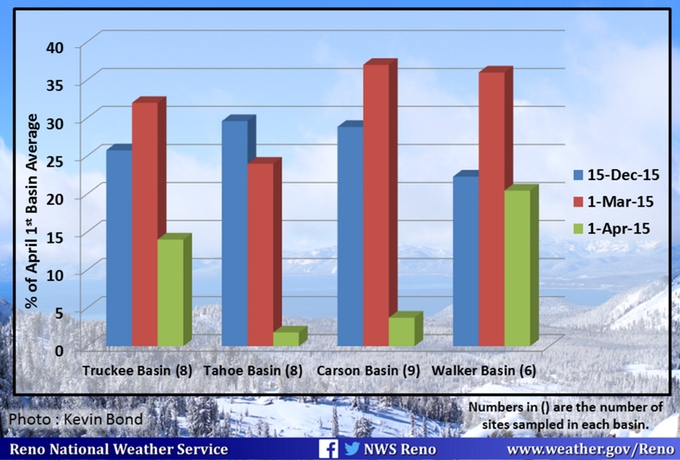
The winter of 2014-15 brought an abysmal snowpack to the region, with most basins only reporting 2 to 20 percent of average as of April 1, 2015. However, last year’s peak was also earlier in the winter, closer to March 1, and would be slightly higher than current conditions, as can be seen in the chart above.

So far, the winter of 2015-16 is already nearing the overall snowpack percentages of last winter.

Keep in mind, we are comparing the current snowpack to the April 1 averages, so the data set is not complete for this season. We are just trying to show that we are off to a great start this winter and the snow water equivalent numbers in the Truckee, Tahoe, Carson, and Walker River basins are slightly above average for this time of the year.

As a side note, snow water equivalent is the amount of liquid that would be produced if all the snow were melted instantaneously. The graphs in the first image are showing the same four river basins and comparing the percentage of average in the snowpack today based on March 1 and April 1 averages and what the percentage of average on April 1 of 2015 was. The number of sites sampled in each basin are in parenthesis, all data courtesy of NRCS.


Adelson son-in-law orchestrated purchase of LV paper

By James DeHaven, Howard Stutz and Jennifer Robison, Las Vegas Review-Journal

The son-in-law of billionaire casino owner Sheldon Adelson arranged the $140 million purchase of the Las Vegas Review-Journal on Adelson’s behalf, sources confirmed Wednesday.

Patrick Dumont, who is listed on the website of Las Vegas Sands Corp. as the company’s senior vice president of finance and strategy, put together the deal at the behest of his father-in-law, the chairman and CEO of the casino operator.

Dumont, a 41-year-old attorney from New York, in 2009 married Sivan Ochshorn, a daughter of Adelson’s wife, Dr. Miriam Adelson, from a prior marriage. Sivan Ochshorn Dumont is listed as owner/agent of Israel Hayom, which is owned by the casino mogul.

Read the whole story


Property values climb in region, Calif.

By Mark Glover, Sacramento Bee

Assessed property values in the seven-county Sacramento region rose nearly 6 percent in the past year, according to statistics released this week by the California Board of Equalization.

BOE said values in Sacramento, Placer, El Dorado, Yolo, Amador, Sutter and Yuba counties totaled a combined $272.8 billion for 2015-16, compared with $257.7 billion in 2014-15.

Read the whole story


Massive undertaking to deliver holiday mail

Letters and packages from Lake Tahoe all go through Reno. Photo/Linda Fine Conaboy

Letters and packages from Lake Tahoe all go through Reno. Photo/Linda Fine Conaboy

By Linda Fine Conaboy

RENO – It’s the busiest mailing day of the year and surprisingly this humming and thrumming place was occupied by seemingly happy people, masters of their powerful conveyors, sorters, forklifts, trucks, and bins and bins of mail, all awaiting their attention.

The Reno Main Post Office on Vassar Street is the U.S. Postal Service’s regional hub, where each and every letter, magazine and parcel from as far away as the Oregon border, Northern California, Winnemucca, Carson City, the entire Lake Tahoe region as well as Reno and Sparks is processed.

Overseeing this organized chaos is Michael Sralik II, plant manager, and Karen Little, post office supervisor. Sralik, most recently from Arizona, has been here about a year, while Little, who’s from Colorado, has been on the job two years—both started their careers as letter carriers.

Sralik, who knows each and every facet and cranny of the place, will work practically around the clock during the busy season, with breaks when he dashes home for a quick four-hour nap and returns.

Karen Little, post office supervisor, checking the days mail. Photo/Linda Fine Conaboy

Karen Little, Reno post office supervisor, checks the mail. Photo/Linda Fine Conaboy

He said he’s hardly ever in his fairly plush and spacious office. He prefers being on the floor where the action is. The action on Monday night included the processing of a record 420,000 letters and 100,000 packages; nationally, the post office anticipates 612 million packages will fly out the doors of a huge network of postal offices in December.

However, Sralik added, if you think Dec. 14 is busy, wait for Dec. 21, when the anticipated peak delivery crunch will occur. Nationally, the figure this year will soar to 30 million pieces on a single day.

He attributes this phenomenon partly to online services.

“More than 7 million people are expected to use USPS.com,” he told Lake Tahoe News, adding that events such as Cyber Monday can be extremely beneficial to the post office.

The other employees in Reno work various shifts to keep the 250,000 square foot plant running on a round-the-clock schedule, every day of the year.

To get the job done, across the nation, about 30,000 seasonal workers are hired, while at the Reno facility, 40 people were added to the staff.

At the rear of the facility lies the loading docks where huge 18-wheelers are serviced as well as smaller neighborhood delivery vehicles, all being loaded and unloaded.

In this area too, are numerous plus-sized bins of packages and letters ready to head out of town.

“We fly about 80 percent of our volume by commercial airline,” Little said. “We buy tickets for our mail, which is why we ask all of those questions about content when a customer drops off a package.”

Because most of the post offices around the lake are smaller and can’t accommodate big trucks at their docks multiple trips are made each day.

“For the last three Sundays, we’ve been transporting there early in the day. South Lake Tahoe got two trucks in two days,” he said.

All of this increased activity bodes well for the Postal Service, Little said. “We’ve seen a 20 to 30 percent increase in package delivery over last year. Maybe it’s the better economy. But we’ve done a good job, so people are coming back to us.”

Routing mail to the appropriate address is a massive undertaking. Photo/Linda Fine Conaboy

Routing mail to the appropriate address is an intricate process. Photo/Linda Fine Conaboy

In addition, Little said the “If it fits, it ships,” slogan advertising flat rate mail has been exceedingly helpful. “It’s a convenience to customers. The carrier gets a notification, knocks on the door or picks up the package off the porch. How much more convenient can that be?” she asked.

Not only does computer automation help the home customer or business, but it’s been a boon to the post office too. Unless they’re oversized and culled from the herd, letters and even parcels are all loaded on conveyor belts, sorted, bar coded and distributed to carriers, all in the blink of a computer’s eye. This process happens for incoming and outgoing mail and happens to each piece.

Still, there is a downside to post office operations. Enter David Rupert, a corporate communications specialist based in Denver. “We’ve been self-sufficient since 1972,” Rupert said. “Before that we were taxpayer-supported. Over time, we’ve been required by law to break even and we have, but the last few years, we’ve struggled.

“We’re still losing lots of money because first class mail is down 30 percent over the last six years. Parcels are on the increase, but not making up the difference yet. We welcome this, but we still struggle over decreasing volume. In part, it could be that many people are now paying their bills online,” he told Lake Tahoe News.

But even the battle to overcome a difficult past record can’t dampen the spirits of the crew at Vassar Street. Heck, you’d think that any minute Santa was going to pull up to the loading dock. This is one happy crew, eager to deliver good tidings.

“This is a very choreographed, organized process, believe it or not,” Stralik laughed.

—–

Notes:

Important mailing dates are fast approaching. For a stress-free season remember to mail first class letters by Dec. 19; priority parcels by Dec. 21; and express mail by Dec. 23.


Voters may have say in Calif. death penalty

By Bob Egelko, San Francisco Chronicle

Opponents of California’s death penalty began an initiative campaign Monday to repeal the state’s capital punishment law at the polls in November and said they’ve lined up some conservative support and $2 million in financial backing.

The measure, if it qualifies, would be on the ballot four years after another initiative to repeal the death penalty received 48 percent of the statewide vote. Sponsors said they hope to succeed this time as new reports in several states have surfaced of onetime Death Row inmates found to be innocent, leading to a decline in public support for capital punishment.

The measure may face competition on the ballot in the form of an initiative proposed by death-penalty supporters to speed up executions in California, where appeals by condemned prisoners typically take two decades or more. The rival measure would set strict deadlines for filing appeals and for rulings by the state Supreme Court, and would seek to expand the pool of death-penalty lawyers to include all attorneys who accept court appointments to represent impoverished defendants.

Read the whole story