What 2016 will do to your checkbook

By Sarah Skidmore Sell, AP

Wondering how you will fare financially in 2016? Below are what experts think next year will hold for financial matters close to home: Raises, rent, gas, food and health.

Will you get a raise in 2016?

Maybe.

Wage growth has been perhaps the job market’s biggest weakness since the recession ended. Pay increases have been both slow and uneven, highly dependent on your field of employment. And for many, it has not been enough to keep pace with the cost of living.

In November, average hourly earnings climbed 2.3 percent from a year earlier, according to the government’s most recent report. But that is only about two-thirds the roughly 3.5 percent typically seen in a strong economy.

Many economists are optimistic Americans’ pay will start growing faster soon because hiring has been good and layoffs have been low. But that’s been the case for a while, and wages haven’t taken off yet.

Joseph LaVorgna, chief U.S. economist at Deutsche Bank, is not expecting major gains ahead. He notes that measures that include a broader mix of compensation beyond hourly wages show there’s even less growth in pay than it seems.

“I’m not convinced things are going to grow as much as I would like them to,” he said.

Will my rent go up?

Yes, most likely.

It’s been a tough few years for U.S. renters because demand has outpaced supply, causing prices to rise.

Rents increased 4.5 percent in October, 5.3 percent in September and 6.2 percent in August, according to real estate data firm Zillow. The median rental payment nationwide was $1,382 in October, roughly 30 percent of the median U.S. family income and high enough for the government to consider it financially burdensome. Over the past decade, that number of renters spending over this threshold on rent has jumped from 14.8 million to 21.3 million, or 49 percent of all renters.

There are more rent increases anticipated ahead.

“Rents are expected to rise in virtually all major cities in 2016,” said Hessam Nadji, senior executive vice president with commercial real estate services firm Marcus & Millichap.

Some small consolation: While rents will still rise, the pace of rent growth will slow modestly from the exceptional levels set in 2015 as new construction creates more housing competition, Nadji says.

Will gas prices stay low?

Yes, most likely.

Oil prices have plummeted over the last year, a result of high global supplies and weaker demand than expected. U.S. drivers are paying less than $2 a gallon on average for the first time since the Great Recession. Seasonal factors and volatile oil prices will push prices up and down throughout the year, but overall prices are expected to remain low compared with recent years.

The Energy Department forecasts an average of $2.37 a gallon next year, which would be the lowest annual average since 2009.

Tom Kloza, head of energy analysis at the Oil Price Information Service, said drivers should expect lower lows and higher highs at the pump in the year ahead, but he doesn’t expect the price of a gallon of gasoline to go over $3 at any time in 2016.

“Nationally we are looking at a year that is very similar to the year we are ending,” Kloza said.

What about food?

New year, same dish.

Food prices should rise at a rate near the historical average, according to the USDA’s forecasts.

The United States Department of Agriculture’s Economic Research Service anticipates the price for food will be up 2 to 3 percent for 2016, same as 2015 and in line with the 20-year historical average of 2.6 percent. That includes food people consume at home and out at restaurants.

Annemarie Kuhns, an economist at the ERS, said that certain food prices were off this year due to unusual events, such as the avian influenza that led to the death of millions of birds and sent egg prices up roughly 15 percent. Looking ahead, she and fellow economists anticipate these prices may level off in 2016 — assuming cooperation from Mother Nature.

Will my health insurance cost more?

Probably.

People buying their own coverage through the exchanges created by the Affordable Care Act should see premiums go up faster in 2016 than in previous years, said Cynthia Cox, associate director of health reform and private insurance at the Kaiser Family Foundation.

According to Kaiser research, if you do not shop around and let your plan passively renew, the premiums for the lowest silver level plan —the most popular on the exchange — will increase 15 percent on average next year. If you are willing to switch, premium increases are expected to be zero to 1 percent. This is because the exchange is set up to encourage shopping around.

These increases apply only to people who are receiving subsidies to help pay for the insurance. For those who do not, the increase is expected to be 6 percent.

Cox added that shoppers should also update any personal information — such as changes to your family size or income — which can impact what they pay.

“It’s very important to go back online and shop every year,” Cox said. “This is still an evolving market — there are new insurers coming in and other insurers leaving. The only way to find (the best price) is to go online or navigate through a broker.”

Employer-sponsored plans premiums increased about 4 percent this year. And while Kaiser does not forecast employer-sponsored plan price changes, it does not anticipate any unusual hikes in health care costs that tend to push up insurance prices. However, employees may end up paying more out of pocket for deductibles, copayments and other expenses they are responsible for, depending on their employer’s plan.


San Quentin: Inside California’s death row

By Howard Mintz, San Jose Mercury News

SAN QUENTIN — A dozen years ago, state prison officials opened up this infamous death row for a tour to demonstrate the crumbling, overcrowded cells housing the 600 killers then awaiting execution.

Puddles of water sat on the cold, dank floors, as California leaders worried that the nation’s largest death row would run out of space.

Prison officials unlocked death row for media inspection once again in December — and it seemed time had stopped.

There are now 745 condemned killers, with no realistic projection for when San Quentin’s lethal injection chamber might reopen for business.

Joseph Michael Nissensohn, sentenced to die two years ago for the murder of two Monterey County teen girls and a Lake Tahoe girl, captures the irony of California’s death row. Even if the state resumes executions, Nissensohn, beginning a 25- to 30-year trip through the appeals process at 64 years old, knows he’s unlikely to die by lethal injection.

“By the time they get to me, I’ll be long gone,” he said through his cell bars.

Read the whole story


Fire safety rules citations lag during drought

By Don Thompson, AP

SACRAMENTO — Amid the most destructive wildfire season in more than a decade, California’s firefighting agency amped up its warnings to thousands of property owners who weren’t doing enough to protect their homes by clearing brush and other flammable materials.

But it rarely put any muscle behind the threats: Violators were fined just 4 percent of the time, down from 10 percent when the drought was declared four years ago, according to CalFire statistics requested by Associated Press.

State law requires property owners in wildfire-prone areas to clear combustible materials near buildings and allows citations starting at $100 for those who fail to do so. A third offense brings a misdemeanor charge and a $500 fine.

The latest statistics show the number and rate of citations issued in the year ending June 30 were lower than when California’s drought began. The rate of homeowners disobeying the law also increased during that period.

“There are people out there that won’t do it unless they are forced to,” said Mike Warren. A firefighter for 40 years, including seven in California as Sequoia National Park’s fire management officer, Warren wants more aggressive enforcement to protect firefighters. “Not getting the clearance done puts firefighters at risk.”

CalFire recorded about 29,000 violations last year, but imposed just 1,136 fines. Four years ago, there were 12,000 violations and just under 1,200 fines.

CalFire spokeswoman Janet Upton said inadequate protection was a significant factor in the loss of homes this fall in a wildfire that burned through in Amador and Calaveras counties in the Sierra Nevada foothills.

More violations were found there than in any other CalFire unit last year. While more than a third of inspections found poorly protected properties, CalFire issued citations there at less than half the statewide rate.

“The worst penalization of a homeowner who chooses not to comply is if their house burns down,” Upton said. “If you have been living in these areas and don’t think it can happen, you haven’t been paying attention.”

CalFire Director Ken Pimlott said the general approach is to educate homeowners rather than issue citations.

“We need that tool, because there are just those individuals, for whatever reason, (who) aren’t interested in complying,” he said. “I would rather have those individuals understand what we’re doing and now become the messenger for their community.”

He also defended policies that mean enforcement varies dramatically from county to county.

For instance, the Kern County Fire Department writes a citation for every violation it finds, by far the most of any county. By contrast, Los Angeles County writes no citations for property owners who fail to clear brush. After months of repeated warnings and inspections, Los Angeles County may eventually clear the brush and bill the property owner.

With the tougher punishment, homeowners in Kern County were 10 times more likely to comply with the rules than in Los Angeles County, statistics show.

Promoting compliance is “absolutely a priority,” Pimlott said. But, he said, resources and conditions vary widely across the state, and methods of enforcement should as well.

In a bid to increase enforcement, CalFire hired more than 50 inspectors last year to aid firefighters. Both spend part of their time doing the repeated property checks that are required before homeowners can be cited for ignoring multiple warnings, but the actual citations must be written by arson investigators because they have law enforcement powers.

Inspections increased last year, but not as much as was anticipated, Upton said. She said the program “didn’t pan out as well as expected” because firefighters were busy fighting drought-driven wildfires, arson investigators were seeking the causes, and inspectors were often helping homeowners with drought-related tree deaths and tree-killing bark beetles.

The department is considering adjustments to get better results, Pimlott said.

The inspectors were hired using $900,000 from a fee imposed on rural properties to help offset firefighting costs, drawing criticism from several state lawmakers who oppose what they call an illegal tax.

“It just angers me to see that money is being spent in an inefficient way,” said state Sen. Ted Gaines, R-El Dorado Hills, who represents a large swath of rural California. He said money spent on additional inspectors should instead go to programs helping homeowners comply with the law.

Assemblyman Frank Bigelow, R-O’Neals, who represents the area burned in the Sierra foothills fire, said the money should go to thinning forests and removing brush that contributes to the spread of wildfires.

Gaines, Bigelow and Assemblyman Don Wagner, R-Irvine, said CalFire should set the same standards for issuing citations statewide. If not, lawmakers should consider requiring equal enforcement, Gaines said.

“It’s one state with one challenge of wildfire statewide,” Gaines said. “Everybody ought to be treated in the same fashion.”


New Year’s arrests decline in S. Lake Tahoe

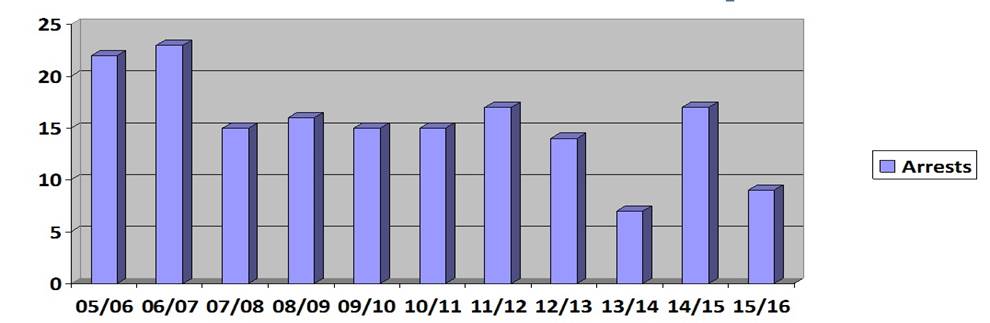
South Lake Tahoe Police Department is reporting fewer arrests this New Year’s period compared to a year ago. No arrests were made in the state line area.

From 12:01am Dec. 31 to noon Jan. 1, officers made nine arrests throughout the city. There were 17 arrests during this same time period last year. Consistent with prior years, the majority of these were for either drunk and disorderly conduct in public or driving under the influence. Some arrests also involved incidents of domestic violence and drug possession.

The totals for all three nights of SnowGlobe:

Arrests:

5 for intoxication

1 for illegal weapon (stun gun)

1 for minor in possession

1 for trespass.

Citations:

104—minor in possession of alcohol

21—ppen container

15—false IDs

4—furnishing alcohol to a minor

3—possession of narcotics

2—minor purchasing alcoholic beverage

1—possession of marijuana

1—parking violation.

There were 19 medical transports from SnowGlobe.

Statistics represent every arrest the South Lake Tahoe Police Department has made, for any type of criminal offense, during New Year’s Eve through New Year’s Day over the past decade.  Source: SLTPD

South Lake Tahoe Police Department arrests for any type of criminal offense from New Year’s Eve through New Year’s Day. Source: SLTPD


Damage from sinking land costing Calif. billions

By Scott Smith, AP

A canal that delivers vital water supplies from Northern California to Southern California is sinking in places. So are stretches of a riverbed undergoing historic restoration. On farms, well casings pop up like mushrooms as the ground around them drops.

Four years of drought and heavy reliance on pumping of groundwater have made the land sink faster than ever up and down the Central Valley, requiring repairs to infrastructure that experts say are costing billions of dollars.

This slow-motion land subsidence — more than one foot a year in some places — is not expected to stop anytime soon, experts say, nor will the expensive repairs.

“It’s shocking how a huge area is affected, but how little you can tell with your eye,” said James Borchers, a hydro-geologist, who studies subsidence and says careful monitoring is necessary to detect and address sinking before it can do major damage to costly infrastructure such as bridges and pipelines.

Land subsidence is largely the result of pumping water from the ground. As aquifers are depleted, the ground sags.

The most severe examples today are in San Joaquin Valley, where the U.S. Geological Survey in 1975 said half of the land is prone to sinking. USGS researchers later called it one of the “single largest alterations of the land surface attributed to humankind.”

A sparse mountain snowpack in California’s driest four-year span on record has forced farmers in the Central Valley, the nation’s most productive agricultural region, to rely on groundwater to irrigate their crops.

Drought has spawned a well-drilling boom with some tapping ancient aquifers 3,000 feet down.

In wet years, groundwater provides about 40 percent of water used in California, but in times of drought, groundwater can amount to 65 percent of the state’s water supply.

Decades of over-pumping have destroyed thousands of well casings and buckled canal linings. To keep water flowing through low spots, irrigation districts raise the sides of sagging canals so they can increase the water level and maintain a gravitational flow.

As a result, at least one bridge now sits below the waterline. Chris White, general manager of the Central California Irrigation District in Los Banos, said replacing it is expected to cost $2.5 million. Rebuilding another canal recently cost $4.5 million.

Putting a grand total on damage from subsidence in California is tricky because irrigation districts don’t often single out repairs required by subsidence from general upkeep, said Borchers, who estimates long-term costs as being “probably in the billions.”

Subsidence has been a problem for decades, and it’s accelerating. Last year near Corcoran, the land sank 13 inches in eight months, researchers at NASA’s Jet Propulsion Laboratory found by comparing images collected over time from satellites and airplanes.

Parts of the California Aqueduct, a massive canal that delivers water 400 miles to Southern California, also sank by nearly 13 inches, the NASA research shows.

This has cost the state of California “tens of millions of dollars” in repairs to the aqueduct in the last 40 years, and officials expect to spend that much in the future, said Ted Thomas, a spokesman for the state’s Department of Water Resources.

California became the last state in the West to regulate groundwater when Gov. Jerry Brown last year signed legislation ending a Gold Rush-era policy that generally let property owners take as much as they wanted. But local agencies have until 2040 to put groundwater management plans into effect.

Farmers and irrigation districts are not the only ones taking note of sinking land. Spokesman Greg Snapper said Pacific Gas & Electric Co. has not sustained any broken natural gas pipelines from sinking land in the Central Valley, but it monitors the lines and this year started using NASA’s satellite research as part of that effort.

A 60-mile stretch of California’s High Speed Rail track, designed to whisk passengers through the Central Valley in excess of 200 mph, will be built on a bed of rocks. This design is more forgiving and easier to maintain and repair if the land sinks than other stretches built on highway-like slabs, said Frank Vacca, the rail authority’s chief program manager.

Sinking land has stopped work on part of a historic project to return water flows to an irrigation-depleted section of the San Joaquin River. Before construction of a passageway for fish can begin, officials need to assess how fast the land will sink in the future, said Alicia Forsythe of the U.S. Bureau of Reclamation.

With a wet El Nino winter forecast, geologists also worry that subsidence in a flood control channel elsewhere on the river may cause water to pool, prompting flooding rather than flow toward the sea.

“We haven’t had to use it for a while,” said Michelle Sneed, a USGS subsidence researcher. “We’ll see how that’s going to perform this year, if it’s called upon.”


Pot industry tries to build brands

By Kristen Wyatt, AP

DENVER — Snoop Dogg has his own line of marijuana. So does Willie Nelson. Melissa Etheridge has a marijuana-infused wine.

As the fast-growing marijuana industry emerges from the black market and starts looking like a mainstream industry, there’s a scramble to brand and trademark pot products.

The celebrity endorsements are just the latest attempt to add cachet to a line of weed. Snoop Dogg calls his eight strains of weed “Dank from the Doggfather Himself.” Nelson’s yet-to-be-released line says the pot is “born of the awed memories of musicians who visited Willie’s bus after a show.”

The pot industry’s makeshift branding efforts, from celebrity names on boxes of weed to the many weed-themed T-shirts and stickers common in towns with a legal marijuana market, show the industry taking halting steps toward the mainstream.

Problem is, those weed brands aren’t much more substantial than the labels they’re printed on. Patents and trademarks are largely regulated by the federal government, which considers marijuana an illegal drug and therefore ineligible for any sort of legal protection. The result is a Wild West environment of marijuana entrepreneurs trying to stake claims and establish cross-state markets using a patchwork of state laws.

The result is that consumers have no way of knowing that celebrity-branded pot is any different than what they could get in a plastic baggie from a corner drug dealer. And people in the business are relying on a patchwork of state-level laws to try to stake claims and establish cross-state markets.

“You can’t go into federal court to get federal benefits if you’re a drug dealer,” said Sam Kamin, a University of Denver law professor who tracks marijuana law.

That doesn’t mean that the pot business isn’t trying.

Hundreds of marijuana-related patents have likely been requested by the U.S. Patent and Trademark Office, according to those who work in the industry. Exact numbers aren’t available because pending patent information isn’t public.

So far federal authorities have either ignored or rejected marijuana patent and trademark requests, as in the 2010 case of a California weed-delivery service that applied to trademark its name “The Canny Bus.”

“They haven’t issued a single patent yet. But generally speaking there is broad agreement within the patent law community that they will,” said Eric Greenbaum, director of intellectual property for Ligand Pharmaceuticals, Inc., which is seeking a patent for a strain of marijuana to treat seizures that it has developed in Minnesota.

Companies like Ligand are betting that if marijuana becomes nationally legal, they’ll be first in line to claim legal ownership of whichever type of marijuana they’ve already developed.

Pot companies are also filing state-level trademarks, thereby avoiding the snag in a federal trademark application: the requirement that the mark is used in interstate commerce, which remains off-limits for pot companies. In Colorado, for example, there are nearly 700 trade names and 200 trademarks registered that include the word “marijuana” or a synonym, Kamin said.

Marijuana producers are also claiming everything they can that doesn’t involve actual weed. So a pot company could trademark its logo, or patent a process for packaging something, without mentioning that the “something” is marijuana.

The marijuana industry certainly has been on the receiving end of legal threats from other companies that do have trademark and patent protection. Cease-and-desist letters aren’t uncommon in the mailboxes of marijuana companies, whether it’s for making a candy that looks like a non-intoxicating brand, or for selling a type of pot that includes a trademarked word or phrase in its name.

The Girl Scouts of the U.S.A., for example, says it has sent dozens of cease-and-desist letters to those selling a popular strain of pot known as Girl Scout Cookies, or another called Thin Mints.

“The use of our trademarks in connection with drugs tarnishes the Girl Scouts name,” the organization says in the letter it says it has sent to pot sellers primarily in California, Colorado and Washington.

And last year, Hershey Co. sued two marijuana companies in Colorado and Washington for selling “Reefer’s” peanut butter cups and “Dabby Patty” candies, which resembled Hershey’s Reese’s Peanut Butter Cups and York peppermint patties. Both pot companies agreed to stop selling the products and destroy any remaining inventory.

But the industry can’t use those same laws to protect its own brands.

“We’re in a new industry, where the benefits of federal protection aren’t open to us,” said John Lord, CEO of LivWell, a 10-store chain of Colorado marijuana shops that recently entered an agreement to sell Leafs By Snoop, the entertainer’s new line of marijuana.

Decades ago, Kamin said, pot smokers simply asked a black-market dealer for marijuana. These days, in those states that allow marijuana sales for either medical or recreational purposes, those smokers now may ask for a calming indica or energizing sativa strain of pot.

Which leads back to the Colorado pot shop selling Leafs By Snoop.

LivWell grows the Snoop pot alongside many other strains on its menu. But it charges up to $175 more an ounce for the Snoop brand, which is sold from behind a glittery in-store display, similar to what you’d see in a grocery store marketing a certain type of soda or soup.

“Brand differentiation is the normal progression of events,” said Lord, who wouldn’t share sales figures on the Leafs By Snoop pot but says its performance has been “outstanding.”

“Consumers will see more and more of this in the future.”


Gaines: Drone rules need to be tighter

By Jacob Pramuk, CNBC

States should take action to regulate drones when federal rules fail to address their concerns, one California lawmaker said this week.

Last week, the Federal Aviation Administration opened its consumer drone registry to keep track of the devices amid some potentially hazardous flights. While the agency has previously set other guidelines and is crafting preliminary rules for commercial use, its regulations remain unclear, contended Ted Gaines, a Republican state senator who represents Lake Tahoe.

“The action that they are taking, I don’t think fully addresses the issue,” Gaines, who has attempted to push multiple drone bills through the California Legislature, said on CNBC’s “Closing Bell.”

Read the whole story


New Year’s Eve not an easy task for cops

New Year's Eve rvelers take over Highway 50 near the state line. Photos/Kathryn Reed

New Year’s Eve revelers take over Highway 50 near the state line. Photos/Kathryn Reed

By Kathryn Reed

STATELINE – For those who came to the South Shore to party in the streets, the experience may have been a bit anticlimactic on New Year’s Eve.

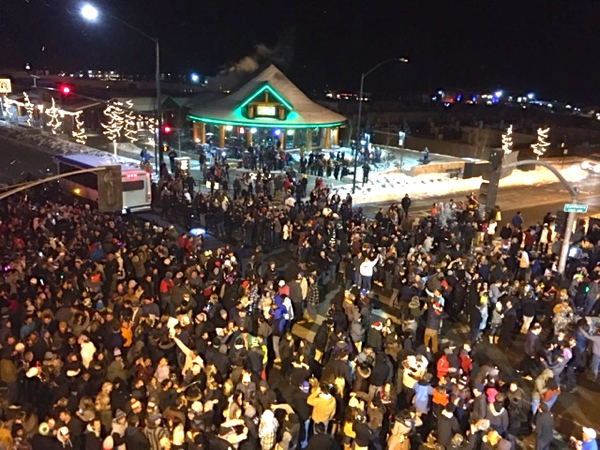
It took coaxing from less than a handful of instigators to get the crowds that had been pouring out of the Stateline casinos into the sidewalks to actually celebrate in the middle of Highway 50. This was three minutes before midnight. Law enforcement officers were joking among themselves whether this was going to be the first year since 1976 that the highway wasn’t closed.

That didn’t come to be. But it was one of the shortest closures. The single-digit temperatures undoubtedly had people seeking shelter moments after ringing in the New Year. Plus, there weren’t that many people. The whole street wasn’t even full. A few people chanted “USA” and then a few counted down from 10 to the New Year.

Douglas County Sheriff Ron Pierini said only a handful of deputies were working on that first New Year’s Eve when the highway was closed by people – not an official act by deputies. The loop road as it is today didn’t exist. People were trying to overturn the cars that got stuck in the sea of humans.

“It really turned into crap,” is how Pierini described 1977.

Crowds are minimal in Stateline for New Year's Eve 2015.

Crowds are minimal in Stateline for New Year’s Eve 2015.

A year later the loop road was built. That allowed officers to deliberately shutdown Highway 50 and still have traffic flow.

“In 1978 there were 2,000 people and we thought that was a lot of people. And we closed the road,” Pierini told Lake Tahoe News from the command post on Dec. 31.

The post isn’t in the same place each year. The non-descript location includes a table with men in uniform. Radios are their lifeline to knowing what is going on outside.

Briefings started earlier in the day and were conducted on the hour as more manpower came on board. New Year’s Eve is one of those all-hands-on-deck events.

The approach to New Year’s Eve has evolved to where it is a coordinated effort between DCSO, South Lake Tahoe Police, El Dorado County Sheriff’s Office, California Highway Patrol, Nevada Highway Patrol, South Lake Tahoe Fire Department, Tahoe Douglas Fire Protection District, and Alcohol and Beverage Control.

“We prepare for the worst case scenario,” South Lake Tahoe Police Chief Brain Uhler told Lake Tahoe News. That includes mass casualties. “We want to be prepared for anything.”

He said it’s normal after a major incident anywhere in the world that the No. 1 problem was lack of communication. The guys in Tahoe aren’t going to let that be true here.

New this year is Lake Tahoe Hard Rock had music out front. A disc jockey was spinning tunes from the balcony as a small crowd danced and others stayed warm by the fire pits.

Officers knew with this being the first year for McP’s Pub to be open at its new, larger location it might become a gathering place for revelers. This year, though, the crowds didn’t materialize there.

Driving through Stateline before midnight Uhler noticed the berms on the Nevada side. Those chunks of snow would feel like being pelted by rocks if someone starts to throw them. This was one reason some of the officers were in riot gear – it’s all about being prepared for the unexpected.

Officers were out on foot patrol in groups. Others were in plain clothes mixing in with the masses.

“It’s good to have eyes and ears among the crowd,” Uhler said.

A coordinated tactical approach is taken to ensure the safety of celebrants, innocent bystanders and officers.

There’s a place for officers on each side of the state line to get warm, grab some coffee and food.

Officers stand guard before Highway 50 is reopened shortly after New Year's.

Officers stand guard before Highway 50 is reopened shortly after the New Year.

The rowdiness, even on warmer nights, has subsided through the years. A zero tolerance of glass on the street has helped. Casinos serve drinks in plastic containers. Setting up multiple locations to book people saves on manpower being taken away from ground zero.

“The last couple of years the crowds as the casino do their thing and then go back in. It’s an older group of people,” Uhler said. “They are not causing us near the trouble as the past.”

In the 1990s the crowds peaked at 80,000. Last year Pierini estimates it was closer to 30,000. If there were that many in town last night, most stayed inside the casinos. Only a few thousand braved the cold this year.

SnowGlobe is given a ton of credit with helping take people away from the casino corridor.

But SnowGlobe is still a major issue, especially for South Lake Tahoe officers. The three-day event at the community ball field at Lake Tahoe Community College culminates New Year’s Eve. This was the first year people crashed the music festival by knocking down temporary fencing. The main stage ended sooner than the two smaller ones – another first – to allow for a staggered exit. More buses and more security this year helped law enforcement not have to deal with as much.

As the concertgoers are bused back to the transit center most then walk to their hotels in the Stateline area. Law enforcement calls this the “zombie walk” because all aren’t in great shape.

But the night isn’t over for officers after the road closure and SnowGlobe are done with. People tend to keep partying. Officers keep dealing with issues long into the morning of New Year’s Day.


17,500 earthquakes in Nevada in 2015

Cracks developed from the magnitude 7.3 1915 Pleasant Valley earthquake in alluvial soil near Lovelock. Nevada’s, largest earthquake, it was centered in Pleasant Valley, south of Winnemucca, Nevada. Photograph by Carl Stoddard, courtesy of the University of Nevada, Reno.

Cracks developed from the magnitude 7.3 Pleasant Valley earthquake in 1915. It was Nevada’s largest earthquake; located south of Winnemucca. Photo/Carl Stoddard/courtesy of UNR

By Mike Wolterbeek

More than 17,500 earthquakes were recorded in 2015 by the UNR’s Nevada Seismological Laboratory. That includes the 231 recent quakes in south Reno and the magnitude 4.8 in Caliente that shook Las Vegas in January.

“While the Reno shaking is fresh in our minds, what’s really bumping the number up from the background rates is the energetic sequence in far northwestern Nevada, the Sheldon sequence,” Graham Kent, director of the Nevada Seismological Lab said.

Through 2015 there have been 4,511 earthquakes recorded in the remote Sheldon Wildlife Refuge near Vya, east of Cedarville, Calif. The earthquake activity that began there in July 2014 has produced 234 earthquakes greater than magnitude 3.0, and 24 earthquakes of magnitude 4.0 or larger, including the largest, a magnitude 4.8 on Sept. 14 and a magnitude 4.6 just before Christmas.

That leaves more than 13,000 other Nevada and eastern California earthquakes, including swarms as well as less prolonged mainshock-aftershock sequences in Caliente, Carson City and Virginia City. Outside of the persistent Sheldon sequence, Nevada was hit with 54 magnitude 3 or greater earthquakes or about one per week.

Overall, there have been 19 earthquakes of magnitude 4.0 and larger and the university’s seismological lab has reported 160 earthquakes between magnitude 3.0 and 3.9.

“The south Reno swarm that just happened produced about 30 earthquakes in two days and about 200 more in the days that followed,” Kent said. “For our entire network, we are averaging about 50 located earthquakes a day.”

They aren’t all part of identifiable swarms like Sheldon, South Reno or Virginia City.

“Many of the earthquake clusters in the Walker Lake area in 2015 were more typical sequences and not like Sheldon that has now continued for more than a year,” Ken Smith, associate director of the Nevada Seismological Lab said. “Just as the Caliente 4.8 that startled Las Vegas in May or the 4.8 at Scotty’s Castle at Death Valley in February with their fairly extensive aftershocks, in Nevada we wouldn’t be surprised to see a significant event anywhere.”

The Nevada Seismological Lab is a public service and research department in the university’s College of Science tasked by the state to operate a monitoring network and report earthquake information for activity throughout the state. The Seismology Lab’s data are provided to the USGS, other national data centers and shared with adjacent network operators in California, Utah, Washington and Oregon.

“All of our earthquake data are fed to the USGS,” Smith said. “We work with the Nevada Department of Emergency Management, county emergency managers, FEMA and even the California Office of Emergency Services. We have special reporting requirements for magnitude 3 and higher quakes. We had 179 earthquakes of magnitude 3.0 and larger in 2015, the most of any seismic network operation in the lower 48.”

The lab operates, maintains and monitors 185 real-time seismograph stations across Nevada and along the Sierra Nevada mountain range of eastern California. The seismological lab crew has been upgrading and expanding the network, including adding 15 broadband stations in southern Nevada this year and are looking for funding to match or exceed that expansion rate in 2016.

“We’re looking to the USGS, state of Nevada and others for support to bring seismograph coverage to more of the state,” Kent said. “What we’ve done for the Vegas area already has been critical for our response capabilities in southern Nevada Despite the number of earthquakes we track – compared to other western states – support for statewide earthquake monitoring in Nevada is far below that of similar western U.S. seismic networks. That said, we’ve added new analysts and reorganized our 24/7 monitoring team to keep up with the volume. But maintaining this level of effort isn’t really sustainable without additional funding.”

Though the third most seismically active state behind California and Alaska, Nevada has not had a magnitude 7.0 earthquake in 60 years.

Mike Wolterbeek works for UNR.


USFS buries plan on transfer of ski area water rights

By Jason Blevins, Denver Post

The U.S. Forest Service will not require ski resorts to transfer water rights to the federal government as a condition of operating on public land. Instead, the agency will require ski areas to prove there is enough water to sustain skiing for the future.

In 2011, the Forest Service, which oversees 122 ski areas that count 23 million visits a year, proposed a clause in its permitting process that would require ski resorts to transfer water rights to the federal government.

The Forest Service had argued that the clause would assure the water would never be separated from the land. The agency feared that as the value of water rights climbs in the arid West, ski areas might see more economic benefit in selling water rights than in using the water for snowmaking and ski operations. The National Ski Areas Association sued the Forest Service in January 2012over what it called an illegal taking of private property.

Read the whole story