Analyst: Casino industry financial outlook looks stable

By Howard Stutz, Las Vegas Review-Journal

Count the analysts at Fitch Ratings Service as predicting 2016 to be a stable environment for most U.S. gaming operators.

Few casino openings are planned that could tip the scales in saturated gaming markets. Discretionary spending by consumers remains on an upswing. Companies saddled with a hefty long-term debt — this doesn’t include Caesars Entertainment Corp. — have taken necessary steps to address near-term maturities through refinancing efforts and other means.

That’s not to say, however, the casino business is back to the halcyon days of monthly double-digit gaming revenue increases.

Read the whole story


Tahoe real estate market sees gains in 2015

By Mark Glover, Sacramento Bee

The median price for a home in the high-end Lake Tahoe market climbed modestly in 2015, according to Nevada-based Chase International Real Estate.

The median price increased 3 percent year-over-year to $490,000. Unit sales also increased 3 percent year-over-year.

Chase said the South shore and Tahoe City areas saw the biggest increases in unit sales in 2015.

Read the whole story


Calif. budget earmarks big money for disasters

By Christine Mai-Duc, Los Angeles Times

After one of the most destructive fire seasons in California history and with an eye toward the increased potential effects of climate change, Gov. Jerry Brown has proposed spending more on fighting wildfires than the state has in more than a decade.

Brown’s $170.7 billion budget proposal includes a $719 million one-time drought package, including an extra $215 million to the state’s emergency fund for battling big blazes.

The extra cash, along with increased funding for healthy forests and bolstering levies, takes into account the “new normal” as it relates to climate change and the state’s historic drought, officials say.

Read the whole story


How Nixon changed the State of the Union

By Philip Bump, Washington Post

The Constitution, in one of its less explicit sections, mandates that the president shall “from time to time” give Congress his assessment of the state of the union, and offer ideas for what to do about it. Nearly every president has taken this literally, giving either an address (as is now customary and was first done by George Washington) or a written letter (most of the 19th century) to the House and Senate. (The only two who didn’t offer state of the union were dead before they had the chance to do so.)

Franklin Roosevelt figured out that this was a pretty good way of talking to the American people, too, and so he introduced the modern, delivered State of the Union address. Looking at the dates of the past addresses, you’ll notice that for decades presidents gave their thoughts right at the top of the year. President Obama’s 2016 address — which won’t necessarily be his last — will be on Jan. 12. That’s a relatively late date by the standards of Roosevelt, Truman, Eisenhower, Kennedy and Johnson.

But by modern standards, it’s unheard of. Beginning with Richard Nixon, State of the Union addresses moved to late in January.

Read the whole story


Farmers try political force to open Calif.’s taps

By Michael Wines and Jennifer Medina, New York Times

FIVE POINTS — The message that Maria L. Gutierrez gave legislators on Capitol Hill was anguished and blunt: California’s historic drought had not merely left farmland idle. It had destroyed Latino farm workers’ jobs, shuttered Latino businesses and thrown Latino families on the street. Yet Congress had turned a deaf ear to their pleas for more water to revive farming and farm labor.

So Latinos — the nation’s fastest-growing ethnic group, she noted pointedly — were sending a warning that politicians could not ignore.

“We created an organization that’s called El Agua Es Asunto de Todos — Water Is Everybody’s Business — so the Latino voice can be heard,” Ms. Gutierrez, who described herself as an El Agua volunteer, said in October 2013 at the meeting with lawmakers. “Don’t devastate our economy. Don’t take our jobs away.”

The group has since blanketed California with demands for more water on Spanish-language television, on the Internet, even on yard signs. But for whom it speaks is another matter: El Agua is bankrolled by more than $1.1 million from the Westlands Water District, the nation’s largest agricultural irrigation contractor, a state entity created at the behest of — and largely controlled by — some of California’s wealthiest and most politically influential farmers.

For almost five decades, Westlands has brought its farmers a torrent of water from the reservoirs and aqueducts of the federal Central Valley Project, the vast public work that irrigates half of California agriculture. Drought has reduced that torrent to drops, and El Agua is one part of Westlands’ wide-ranging effort to open the spigots again.

Read the whole story


Education technology not limited to computers

By Ian Whitaker, Las Vegas Sun

Technology in the classroom has come a long way.

What started with a simple chalkboard has evolved into projectors, computers, tablets and now robots. If you go by what you see at CES, which kicked off Tuesday in convention centers on the Strip, the beeping, booping machines are the future of technology in the classroom.

It’s not a surprise that the programmable gizmos are taking center stage given the recent obsession with improving science, technology, engineering and mathematics education.

Read the whole story


Calif. schools benefit from Powerball jackpots

By Joseph Serna, Los Angeles Times

There’s no way of telling how many people might lay claim to a $900-million Powerball jackpot Saturday night, but lottery officials insist that California schools will be among the winners.

Thanks to a California law that requires at least $1 billion of the state’s education funding to come from lottery revenues — or about 1 percent of the state’s spending — a monster-sized jackpot can inject significant cash into the education spending plan.

With each $2 Powerball ticket purchased in California, about 80 cents goes toward education. The money is divided among K-12 schools and community colleges and universities. Powerball is played in 44 states and three U.S. territories.

Read the whole story


El Niño expected to stay strong, finish wet

By Kathryn Reed

STATELINE – To the untrained eye the three images looked practically they same. They showed the El Niño pattern from 1982-83, 1997-98 and 2015-16.

The first two brought crazy weather to Northern California and Northern Nevada. It’s usually the first quarter of the year where the moisture really starts to fall.

“So far we’ve got out of this event exactly what we expected,” Sasha Gershunov, climate and meteorology researcher at Scripps Institute of Oceanography in San Diego, said of this winter’s weather phenomenon.

He was one of the speakers Jan. 8 at the annual Operation Sierra Storm conference, a gathering of television meteorologists hosted by Lake Tahoe Visitors Authority.

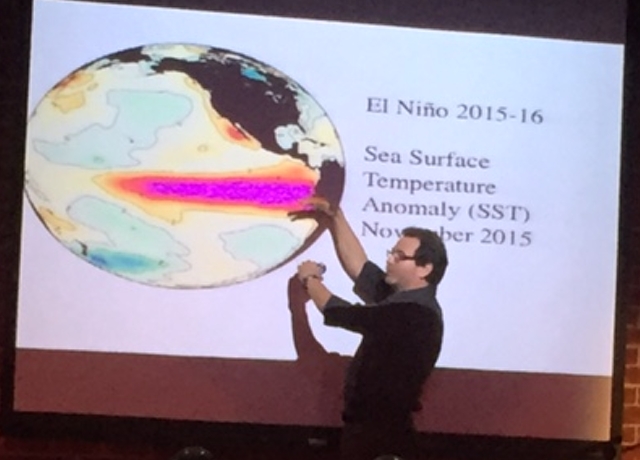
Sasha Gershunov points to the pink are that is El Niño. Photo/Kathryn Reed

Sasha Gershunov points to the pink area that is El Niño. Photo/LTN

A difference this go-round compared to the last two significant El Niños is that the world is a warmer place. This could make for a nasty situation if in March the moisture in the Sierra becomes rain on top of the snowpack. It could cause flooding as well wash away the white stuff that is needed to fill reservoirs downstream.

It’s especially concerning because the signals are for the snowy season to end on a particularly wet note, he said.

For now, the models point to this being one of the strongest El Niños on record, with no sign of slowing down any time soon.

Much of Gershunov’s talk focused on the formation of El Niños, which start off the coast of India. Warm ocean water is pushed toward Peru. He believes as long as the Earth has been in its current configuration there have been El Niños.

“It’s a dance between the atmosphere and the ocean,” he said. “Unless they act in unison, an El Niño cannot happen.”

They are cyclical, occurring about every two to seven years.

The warming of the Pacific Ocean near the equator is where an El Niño is strongest. California and Nevada are essentially experiencing the ripple effect.

“El Niño is just one thing that is going on in the atmosphere. There are several configurations a storm track can take,” Gershunov said.

When the 1982-83 El Niño hit it took weather and climate experts by surprise.

“We didn’t have the models or observations. People realized we better learn how to predict these things,” Gershunov said.

Fifteen years later the science and technology got it right, the same with this season’s El Niño.

While the science has improved through the years, there is room for improvement.

“Unless there is some sort of breakthrough, there is a prediction barrier in the spring,” Gershunov said. That’s why it isn’t until summer that meteorologists are able to forecast an El Niño for the coming winter.


Calif. budget has CTC looking for cash elsewhere

By Kathryn Reed

California’s nearly $700 million investment in Lake Tahoe is slowing down as evidenced by the governor’s proposed budget. The California Tahoe Conservancy is left out of any new funding.

“Overall, the state of California has been historically — and will continue to be — committed to the restoration of Lake Tahoe, including meeting our share of commitments to the Environmental Improvement Program,” Nancy Vogel, deputy secretary for communications for the California Natural Resources Agency, told Lake Tahoe News. “Specifically regarding the $475 million in the Proposition 1 Settlements Pot, the governor’s 2016-17 proposed state budget does not allocate additional funding for Lake Tahoe at this time since Lake Tahoe already benefits from other existing resources available in Proposition 1.”

Gov. Jerry Brown released his proposed budget this week. Haggling between those on the receiving end as well as lawmakers will occur between now and when the May revise comes out. The next fiscal year starts July 1 and requires the Legislature to approve the budget.

CTC officials were warned before the budget came out that it was being cut out of the $475 million pot it was supposed to share with four other entities. This money came from the November 2014 voter approved water bond called Proposition 1 that provides $7.5 billion for water quality, water storage, flood protection and watershed protection and restoration projects.

Brown allocated the California Natural Resources Agency funds to:

· Klamath River Agreement: $250 million

· Central Valley Project Improvement Act: $90 million

· San Joaquin River Settlements: $45 million

· Salton Sea Restoration: $80 million

· Tahoe Environmental Improvement Program: $0.
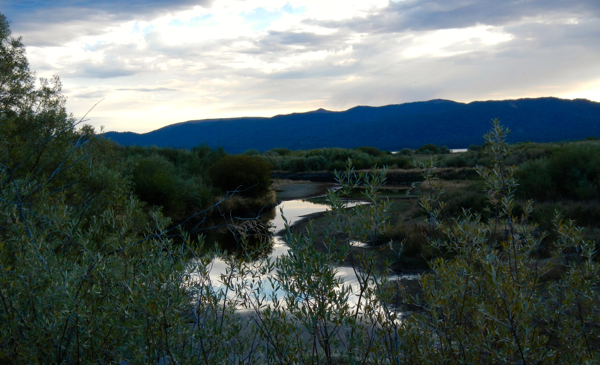
Funding for the Upper Truckee Marsh project in South Lake Tahoe is not included in the state's 2016-17 proposed budget. Photo/LTN

Funding for the Upper Truckee Marsh project in South Lake Tahoe is not included in the state’s 2016-17 proposed budget. Photo/LTN

While the Conservancy was shut out this round, it still has money – operating an annual budget of more than $20 million. It also has received Proposition 1 dollars at other times. In fact it has nearly $15 million to spend this spring. When the board meets in March it will be tasked with deciding how to spend that cash on the more than $30 million in proposals that were submitted. This money will be used to help partner agencies and won’t be money used on actual CTC property.

Chris Mertens with the CTC isn’t worried about the latest turn of events. He said there are other revenue sources for his agency – cap and trade dollars, Department of Fish and Wildlife, and CalFire to name a few.

CTC has received millions of dollars for planning and acquisitions through Propositions 12, 40 and 84, the Habitat Conservation Fund, Lake Tahoe Conservancy Account, Federal Trust Fund and  U.S. Bureau of Reclamation.

Mertens said this one source for dollars that has dried up would not mean any layoffs. He is also confident the agency will be able to secure funding for the Upper Truckee Marsh project, which is on the top of the list of needed environmental improvements.

Vogel with Natural Resources acknowledged this is a critical project, but said the Conservancy is bound to find money for it.

“The bottom line is the state has been a huge supporter of the lake and we are optimistic we will be competitive in the future,” Julie Regan with the Tahoe Regional Planning Agency told Lake Tahoe News.

Nevada a few years ago pledged $100 million for the EIP. The bond market has been such that it has not been able to sell much so those dollars have not come to fruition for the most part.

Since the EIP’s inception in 1997, about $1.8 billion has been invested in Tahoe in 450 projects:

·       $593 million from the federal government

·       $693 million from California

·       $118 million from Nevada

·       $77 million from local governments

·       $328 million from the private sector.

“It’s unfortunate that Lake Tahoe hasn’t been slated to receive funding in the governor’s proposed budget. It’s heartening to see that the proposed budget allocates $475 million to address good and vital work for the San Joaquin River, the Salton Sea, and the Klamath Basin, areas currently underfunded, but this news increases the importance of passing the Lake Tahoe Restoration Act and identifying other sustainable funding mechanisms for efforts critical to protecting and preserving Lake Tahoe,” Darcie Goodman Collins, executive director of the League to Save Lake Tahoe, told Lake Tahoe News.

One mechanism may be the federal Lake Tahoe Restoration Act. It has passed through a key House committee and now heads to a Senate committee. It would funnel $415 million to Tahoe for environmental programs.


Defendant in bear killing wants venue change

Gilbert Wetenkamp, the South Lake Tahoe man accused of killing a bear in July, is seeking to have the trial moved to the West Slope.

He was in court on Jan. 8. El Dorado County Superior Court Judge Suzanne Kingsbury said she is not inclined to grant the motion, but told Wetenkamp’s public defender that he has the right to fill out the requisite paperwork.

The trial date has been set for March 11.

In September, Wetenkamp pleaded not guilty to one misdemeanor count of unlawful taking of an animal. He is accused of shooting a black bear to death on July 9. The 2½-year-old bear was shot in the backside with buckshot from a shotgun.

The maximum penalty, if convicted, is one year in jail and a $1,000 fine.

— Lake Tahoe News staff report