Accident snarls traffic near Strawberry

A single-vehicle rollover accident is blocking the eastbound lane of Highway 50 near Strawberry.

No injuries requiring transport to a hospital were reported.

The accident occurred just before 11:50am Jan. 18. The black Jeep Wrangler is on its right side.

California Highway Patrol has no estimate when traffic will be flowing freely again in both directions.

The roads have been slushy and slick, and full of vehicles leaving Tahoe after the holiday weekend.

— Lake Tahoe News staff report


Skier in Wyo. loses gun in crash on slopes

By Mark Huffman, Jackson Hole Daily

A skier who crashed last week at Jackson Hole Mountain Resort got up and dusted himself off but left behind part of his gear: a loaded handgun.

The skier’s name was not given by resort officials or the Teton County Sheriff’s Office, but the resort said the man was a Wyomingite, though not a Jackson Hole resident. The man was reunited with his weapon when he called to say he had misplaced it.

The on-mountain firearm broke no Wyoming law or resort rules, though it did surprise people.

Read the whole story


Climate change impacting Tahoe real estate

By Anne Knowles

While signs of climate change may be everywhere around Lake Tahoe in recent years — warmer days and low snowpack, exposed piers and dry trees — the effect on real estate values is hard to see.

But it’s not hard to imagine, based on studies demonstrating the probable impact of global warming on home prices.

While the basin is vulnerable to some of the worst effects such as wildfire and higher temperatures leading to a meltdown in winter tourism, it could also be buoyed by its stronger summer season, its limited inventory of property and its easy accessibility for well-heeled visitors and investors from California.
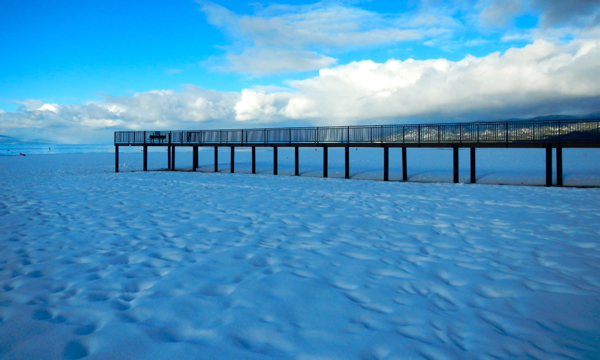
While piers are desirable to second homeowners, to day most at Lake Tahoe don't have water under them. Photo/Kathryn Reed

While piers are desirable to investors, today most at Lake Tahoe don’t have water under them. Photo/Kathryn Reed

“I’m not seeing any pushback from it yet,” said Deb Howard, owner of Deb Howard & Co. and 2014 director of the California Association of Realtors and a member of CAR’s committee on the environment. “But climate change and how we conserve and adapt is on the mind of the real estate industry.”

Currently, the market is still rebounding from the recession. Median home prices in South Lake Tahoe area, for example, have been rising for three years after six years of steady declines. In October 2015, the median sale price for a single family home was $360,000, almost exactly halfway between a recent low of $234,000 in August 2012 and the high of $489,000 in March 2006, according to the South Tahoe Association of Realtors.

In the condo market, new product is hitting the market for the first time in 30 years, including developments at Martis Camp, Tahoe Beach Club and Homewood Mountain Resort, said Sue Lowe, senior vice president and corporate broker for Chase International in Zephyr Cove and Incline Village.

“We’re overwhelmed with calls on Zalanta,” said Lowe. “We already have 18 reservations for 30 units and it’s been on the market for three weeks.”

Zalanta Resort at the Village is the rechristened Chateau at Heavenly Village project, the second phase of which will include 32 condos scheduled for completion next year.

“What drives the market now is people buying second homes,” said Carl Fair, broker-owner of Century 21 at Tahoe Paradise. “Everybody wants to buy rental properties.”

That trend, Fair told Lake Tahoe News, started with Home Away, an online rental site which now owns one-time competitor VRBO, and more recently by Airbnb, another increasingly popular vacation rental site.

In 2015, well over half the homes owned in Douglas, Washoe, Placer and El Dorado counties were second homes, according to a Tahoe Prosperity Center report called Measuring for Prosperity.

But real estate brokers say it’s higher than that.
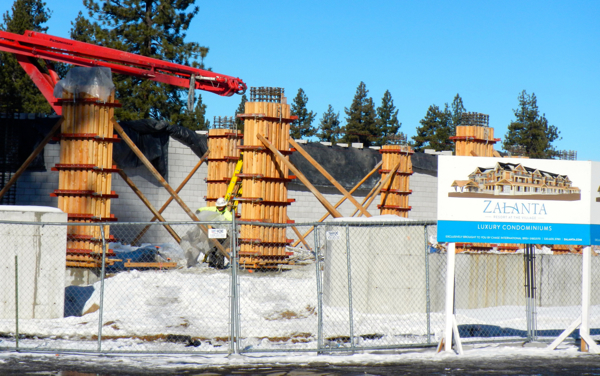
Zalanta in South Lake Tahoe will be a hotel-condo project with 32 units coming online in 2017. Photo/Kathryn Reed

Zalanta in South Lake Tahoe will be a hotel-condo project with 32 units coming online in 2017. Photo/Kathryn Reed

“It’s more like 70 to 80 percent. In Glenbrook only 10 percent of the homes are primary residences,” Lowe told Lake Tahoe News.

Some brokers think that helps insulate Lake Tahoe.

“I believe that the appeal of the mountains, and in particular, of our gorgeous lake, will only be affected by the economy and not by drought or wildfire,” said Bonnie Gaines, chief operating officer and broker with Buckingham Vacation Rentals. “The wealth of the workers in the Bay Area and now the insurgence to the work force in Reno, can only make Lake Tahoe more desirable as a getaway place for city folks.”

That, of course, remains to be seen in light of climate change.

At the high end, lack of a pier or the ability to use an existing one can reduce the price tag on a home by up to $1 million, said Lowe.

“Lack of precipitation does affect the price because it restricts lakefront homeowners’ piers,” said Lowe. “And I’ve got clients who only want a home with a pier.”

Investors may be less easily deterred, but there are increasing risks under many climate change scenarios. Wildfires, for instance, are increasing throughout the west and the wildfire season is lasting longer.

A recent report by the U.S. Forest Service found that home prices drop about 10 percent after a single, close by wildfire and 23 percent after a second.

Investors may be less risk averse than homeowners who live there, but if fires routinely reduce visitor traffic, property becomes less appealing. Tuolumne County, for example, lost an estimated $300,000 in transient occupancy taxes from the 2013 Rim Fire in Yosemite National Park, according to the SMG Consulting 2015 Tourism Outlook.

In the long term, the biggest impact could come from reduced snowpack. Snow as a percent of total precipitation has declined from 51 percent in 1910 to 36 percent now and could go to 10 percent by the end of the century, according to a UC Davis report, Tahoe: The State of Climate Change.

Ellen Hanak, a senior fellow at the Public Policy Institute of California and director of its Water Policy Center, helped write a report for the Federal Reserve on the effect of climate change on housing prices near ski resorts, which looked at Colorado, and north and south Lake Tahoe.

The report found Lake Tahoe was more vulnerable because of its lower elevation with more days above freezing.

“What was key was the share of precipitation falling as rain. Rain is not only bad for winter sports, but it ruins what snow you have,” Hanak told Lake Tahoe News. “If you look at 2050, with average rises in temperature, housing prices will drop from between 30 to 49 percent based on this one issue alone.”

But that also means other things could boost the price, like low inventory or the summer season.



Sandoval reconvening committee to study gaming issues

By Megan Messerly, Las Vegas Sun

Gov. Brian Sandoval announced today he is reconvening the Nevada Gaming Policy Committee to look into ongoing issues in the gaming industry.

The committee will bring together politicians, stakeholders from the Nevada gaming community and others to discuss issues related to daily fantasy sports, skill-based games, the state’s interactive gaming agreement and other issues.

Members will gather information and make recommendations for possible consideration by the Nevada Gaming Control Board and Gaming Commission.

Read the whole story


Barton on cutting edge with digital medicine

By Robert Glatter, Forbes

In a first, Barton Health will implement a unique digital medicine offering for treating hypertension, one of the most common chronic medical conditions in the U.S.

Referred to as Proteus Discover, the digital medicine offering incorporates an ingestible sensor – activated upon contact with stomach acid–which provides the information needed for patients and their physicians to partner on their health. This could include information related to a patient’s vital signs and the exact time the digital medicine offering was taken.

Proteus Discover, which utilizes FDA-approved technology incorporating ingestible digital sensors developed by Proteus Digital Health, represents the first commercial use of such technology after the recent success of initial clinical trials evaluating efficacy and reproducibility of the innovative monitoring technology.

Read the whole story


Suit alleges NV Energy deceived customers on solar panels

By Michelle Rindels, AP

CARSON CITY — Nevada residents with rooftop solar panels are suing NV Energy, saying the company used incentives to lure them into investing tens of thousands of dollars before conspiring with regulators to raise rates and render their systems less valuable.

Las Vegas solar panel owners John Bamforth and Stanley Schone filed a complaint in Clark County on Jan. 12, alleging the company manipulated regulators into approving higher prices that took effect Jan. 1. They’re seeking class-action status to represent other solar panel owners.

The suit argues NV Energy “acted illegally to reduce said incentives, rebates, and/or credits,” and said the plaintiffs “would never had agreed to invest in, purchase, and install a solar photovoltaic system had (they) known the defendants would act in an anticompetitive manner to restrain trade.”

An NV Energy spokeswoman said the company does not comment on litigation.

Nevada lawmakers passed a bill last spring asking energy regulators create new rates for metering, which is the process of solar panel owners selling excess power back to NV Energy. Regulators approved new rates in December that they say phase out a subsidy traditional customers pay to cover about 17,000 solar customers, and better reflect the declining cost of wholesale solar energy.

The plaintiffs allege the structure, which will raise base rates over five years and reduce the amount the utility pays to buy energy back from panels, will make it much harder to pay back their solar panel investments and is part of a conspiracy to cripple the solar market. Both said they put around $40,000 into their solar systems.

Plaintiffs say NV Energy didn’t do a scientific study on the benefits of net metering and lied about the cost of serving solar customers, although the complaint doesn’t offer further details about what plaintiffs say were knowingly false statements.

The complaints echo concerns raised at recent regulatory meetings by solar advocates, who question the premise that traditional customers are subsidizing solar customers and point to a study that found net metering provided a net financial benefit to Nevada ratepayers overall.

But regulators and NV Energy say that study, done in 2013 and 2014, doesn’t reflect current realities in the rapidly changing energy market.

They say solar customers still rely on NV Energy’s electrical infrastructure to provide consistent power at night, on cloudy days or whenever their solar panels aren’t offering enough electricity, and argue solar customers should pay their fair share to maintain the grid.


Weather hampers efforts to find missing skier

Carson May

Carson May

Dozens of people are continuing to search for Carson May, the Sugar Bowl Ski Resort instructor who has been missing since Thursday.

The 23-year-old was not working when he was last seen. He was reported missing Friday.

The search has been focused on where May’s phone “pinged” on Friday.

“It’s believed his phone battery is dead, as the phone is no longer responding. This area has had recent avalanche activity,” according to the Placer County Sheriff’s Office.

Bad weather on Sunday has grounded two helicopters. The avalanche danger is still high.

Assisting Placer with the search are members of the Tahoe Nordic Search and Rescue; Marin, Nevada and Douglas county’s search teams; and two U.S. Forest Service avalanche teams.

— Lake Tahoe News staff report


Calif. water conservation rules may be loosened

By Matt Stevens, Los Angeles Times

Water providers that have struggled in recent months to meet conservation targets could soon get some relief under the modified drought rules unveiled Friday by state regulators.

The proposed changes to California’s emergency drought regulation reward water districts for investing in new local supplies and allow for adjustments to savings goals based on a district’s climate and population growth.

Friday’s proposal also allows water providers to reduce their “conservation standards” by as much as eight percentage points. A previous plan had said that a water district’s target should drop by no more than four percentage points.

Read the whole story


Tensions mount between Nev. ranchers, feds

By Molly Hennessy-Fiske, Los Angeles Times

Gerald “Jerry” Smith grew up in Nevada and went to work for the Bureau of Land Management right after college. As a local, he figured he was uniquely suited to work with the ranchers who have long resented the federal government’s role in land management here.

It didn’t quite work out that way.

Now retired from a job as district manager for the BLM, Smith knows all about the tensions that have long defined relations between ranchers in the rural West and the federal government, which manages much of the region’s land. Those tensions have boiled over in recent days at a wildlife refuge in Oregon and are at a perpetual simmer here.

Now it is Smith’s successor as district manager, Doug Furtado, who has become the enemy for many people in the region.

Although there have been no violence or threats here, the risk is real. Federal employees in Nevada have been attacked in the past over land-use disputes — shot at, their offices and cars bombed.

Read the whole story


Brown pushes big water project amid drought

By Sharon Bernstein, Reuters

Gov. Jerry Brown warned on Thursday of near-apocalyptic water shortages if his $15 billion plan to divert water from a Northern California river for use elsewhere gets bogged down in political and environmental disputes.

The plan to remove water north of the Sacramento-San Joaquin River Delta, the fragile source of much of the state’s drinking water, is opposed by many environmentalists, but Brown insisted it was crucial in shoring up water supplies in the drought-plagued state.

The plan calls for digging a pair of tunnels under the delta. They would carry water from the Sacramento River to the state’s agricultural breadbasket as well as cities in the central and southern parts of America’s most populous state.

Read the whole story