Nev. Democratic caucus ties are luck of the draw

By Seth A. Richardson, Reno Gazette-Journal

If the Iowa Democratic caucuses showed the country one thing, it’s that sometimes it does come down to a coin flip.

Initial reports showed former Secretary of State Hillary Clinton won six precincts over Vermont Sen. Bernie Sanders that needed some form of tie breaker, resulting in a coin flip to determine who was awarded the contested delegate. Sam Lau, a spokesman for the Iowa Democratic Party, said seven coin flips were reported through the party’s reporting app, with Sanders winning six and Clinton winning one, but others may have been unreported through the party’s phone system.


However, the Nevada Democratic caucus has a similar system, only with a process more appropriate to a state with a heavy casino industry: a card draw.

Read the whole story


Tahoe City man dies in car wreck

A 31-year-old Tahoe City man was killed Saturday when the vehicle he was riding in crashed in Yuba County.

Nathan Boyd, who was in the back seat, died at the scene.

Patrick Elliott, 28, of Pike faces second-degree murder charges as well as felony driving under the influence and driving on a suspended license charges, according to the California Highway Patrol. He was transported to the hospital with minor injuries.

Officers said Elliott was driving on Highway 49 Feb. 13 at about 7:05pm when he was unable to negotiate a curve and the pickup went down a 300-foot embankment. This occurred between Camptonville and North San Juan.

Owen Megargee, 23, of Pike was also a passenger. He refused medical treatment.

— Lake Tahoe News staff report


Brown makes budget latest battleground on climate change

By Christine Mai-Duc, Los Angeles Times

Gov. Jerry Brown is looking to make good on a promise to curb California’s petroleum use by shifting away from new legislation and instead tucking his fuel-reduction goal inside the state budget.

Oil companies spent millions of dollars in 2015 to strip a controversial climate change bill of its provision slashing petroleum use in half by 2030. At the conclusion of that bruising fight, a defiant Brown stood before reporters in the Capitol and declared war.

The budget the governor submitted to the Legislature last month proposed spending a third of the state’s cap-and-trade funds, about $1 billion, on public transit, promoting electric vehicles and other programs, all with the explicit goal of cutting oil use by 50 percent by 2030. Those dollars were collected through the auction of pollution credits to companies that emit greenhouse gases.

Read the whole story


Nev. at both ends of systemic teacher-vetting problems

By Trevon Milliard, Reno Gazette-Journal

Sixth-grade teacher Terry Rauh hid a video camera in the unisex staff bathroom at Hall Elementary School in Sparks.

Las Vegas elementary school teacher Noel Lardeo was the driver in a DUI collision that forced doctors to amputate a teenage boy’s leg.

Middle school substitute Tamika Queen had sex with a 15-year-old Las Vegas student.

All of these educators had their teaching licenses revoked by the state in the last two years, and for the same reason. It wasn’t for doing something wrong, but because they were criminally convicted for it.


Read the whole story


Presidential candidates rated for stances on gaming

By Megan Messerly, Las Vegas Sun

The American Gaming Association gave only two presidential candidates, former Secretary of State Hillary Clinton and retired neurosurgeon Ben Carson, a “green light” for their stances on gaming in its voter guide released last week.

Clinton received high marks for saying casinos spur economic development and praising Las Vegas gaming employees for their hard work — despite having opposed bringing casinos to Arkansas when she was the state’s first lady.

Carson was commended for saying that gaming issues should be left up to the states, his only apparent stance on gaming.

Read the whole story


2 earthquakes rattle Mammoth Lakes

A little bit of shaking has been going on in Mammoth today.

A magnitude 3.8 earthquake was reported Feb. 15 at 7:42am and at 10:47am a 3.2 temblor was felt, according to the U.S. Geological Survey.

They were located about eight miles southeast of Mammoth Lakes.

— Lake Tahoe News staff report


Geological composition has Nev. on the move

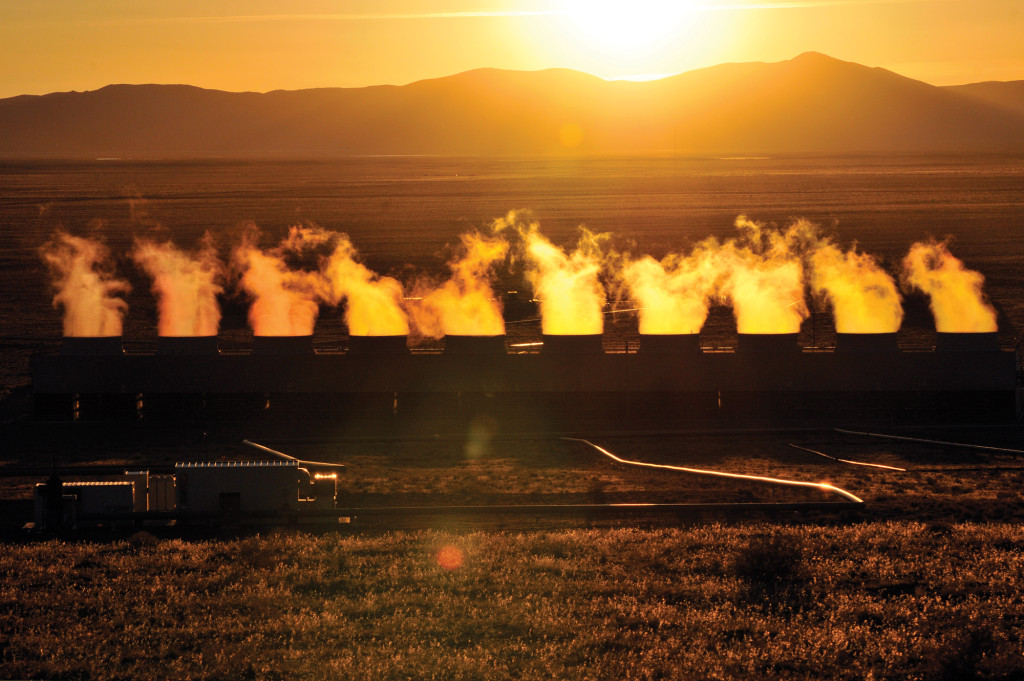
Blue Mountain geothermal taps Nevada's underground energy. Photo/Jack Hursh

Blue Mountain geothermal taps Nevada’s underground energy. Photo/Jack Hursh

By Linda Fine Conaboy

RENO – Nevada is the third most earthquake-prone state and is the fastest growing state, tectonically speaking, annually adding more area than the size of two basketball courts because of tectonic activity.

James Faulds, the state geologist for Nevada and director of the Nevada Bureaus of Mines and Geology at UNR, explained that Nevada has a greater number of mountain ranges, produces more gold, is volcanically active and has a vast supply of geothermal resources—more than any other state except for maybe Alaska.

According to Faulds, many of the state’s geothermal resources have yet to be discovered let alone mapped. This may explain, he said, why Nevada is always in hot water.

Earthquake faults, he said, allow hot water sitting deep in the earth to migrate to shallow levels, perhaps explaining why there are now close to 15 geothermal power plants in the state.

While their website states that Truckee Meadows Parks Foundation is in the business of transforming and maintaining the parks in Washoe County, the program they hosted in Reno last week went way beyond parks.

Three speakers covered all anyone needs to know about earthquakes, geothermal energy and volcanoes in Nevada. Though billed as a local event, all three speakers acknowledged that the Lake Tahoe Basin should be included in this mix, especially when the talk turns to earthquakes and volcanoes.

Although their intention was to inform and not to scare, many in the audience went away muttering about getting ahold of their agents pronto to chat about earthquake insurance. It was apparent that more than a handful were not aware that the Reno and Tahoe areas are seismically active and in fact, lie on some fairly large faults.
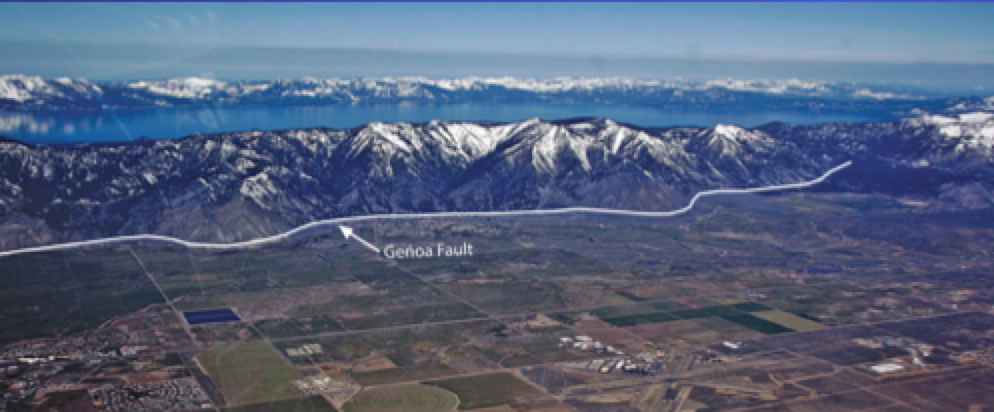
The Genoa fault is one of many near Lake Tahoe. Photo/Provided

The Genoa fault is one of many near Lake Tahoe. Photo/Provided

Geothermal energy is the only renewable energy that’s available 24/7, and the potential for large amounts of energy production in Nevada is eclipsed only by California’s generation rates, according to the Natural Resources Defense Council.

Annie Kell is the coordinator of education and outreach and a professor of seismology, among other duties, at UNR’s Mackay School of Earth Sciences and Engineering.

She said Reno averages at least six earthquakes of significant size about every 12 years.

“There are thousands of structures in Reno that would be damaged in an earthquake,” she said.

Generally, Kell said, anything built prior to 1974 is vulnerable. The average cost to upgrade the deficits in these buildings she estimates at less than $5,000.

Kell said there’s a significant fault in Incline Village, which about 500 years ago produced close to a magnitude 7 quake. She also mentioned the West Tahoe fault zone running from Meyers to Dollar Point and submerged from Emerald Bay to McKinney Bay. Another fault, she said, lies near Stateline Point laying below the Club Cal Neva, and the Genoa fault, one of the most active, could threaten the Reno-Carson urban corridor.

Most people have heard stories of a potential tsunami able to inflict huge amounts of destruction to the Lake Tahoe Basin—Kell doesn’t totally rule out the likelihood, nor does Faulds.

“A tsunami is definitely a possibility,” Faulds said. “Research shows that in the past there have been tsunami events at Lake Tahoe—probably within the last 10,000-12,000 years, which is fairly young in terms of scientific research.”

Kell strongly urged the audience to prepare now for the chance of some major earthquake damage to the entire region, saying earthquake insurance in this area of the country is definitely worth it.

She’s a proponent of being ready even though there is no evidence that an earthquake is imminent. “An emergency survival kit can be a lifesaver,” she said, suggesting it should include:

·      Food for three days

·      Pet food

·      Medical supplies

·      A power supply

·      Plan for evacuating the family

·      Securing tall and heavy items.

In case of an earthquake, Kell advised, you should always protect your head and neck. “Drop, cover and hold on,” she said. “Do not run outside, stand near windows, get on top of furniture, get out of bed, drive over bridges, light a flame or run to a doorway.”

She added that during an earthquake event, aftershocks are a real possibility.

While he’s a professional geologist, volcanoes are an area of expertise for Christopher Henry, a research geologist at the Nevada Bureau of Mines and Geology.

Henry suggested that geology doesn’t follow state boundaries, but he said good volcano sites that are not too far away and easily viewed are Lassen Peak, Sutter Buttes (on private property) and Long Valley, adjacent to Mammoth Mountain.

In addition, he said there are numerous volcano sites between Reno and Lake Tahoe, particularly north of Tahoe near Truckee. These include Mt. Disney, Squaw Peak, Martis Peak and Mt. Pluto. He added that at Dollar Point, if you look hard enough, you can find layered and ashy areas that might include volcanic bombs.

Going south, to Mammoth and Long Valley, there are huge volcanoes, what Henry called super volcanoes that created a caldera 20 miles across. He surmised this event happened about 760,000 years ago, leaving today’s Mammoth Mountain.

In the last 600,000 years, smaller eruptions have taken place and in their wake, various craters can be seen, one of which is Mono Crater. “There are all kinds of volcanic pieces to be found at the sites. But then, all rocks are pretty to me,” he grinned.

Despite what may be construed as continuous danger, scientists predict that the chance of a magnitude 7 quake under Lake Tahoe are slim—about 3 to 4 percent in the next 50 years, and actually posing less of a threat than the potential danger from forest fires or floods. However, all the experts advise to be prepared.



Record number of Americans dump U.S. passports

By Jethro Mullen, CNNMoney

More Americans than ever before are turning their backs on the United States.

The number of citizens and long-term residents cutting their official ties to Uncle Sam jumped more than 20% last year to 4,279, according to a CNNMoney analysis of the latest government data.

It’s a trend that’s been increasing in recent years. Many of those severing links are Americans living overseas who are tired of dealing with complicated tax paperwork, a headache that has worsened since new regulations came into effect.

Eighteen times as many Americans renounced their citizenship or long-term residency in 2015 compared with 2008. Last year was the third record-breaking year in a row.

Read the whole story


Officers: Drug arrest linked to S. Tahoe homicide

A West Slope man may be involved with a drug deal in South Lake Tahoe that ended with an Amador County man being shot to death.

Tevarez Lopez

Tevarez Lopez

Tevarez Lopez, 33, of Georgetown was arrested earlier this month on drug and weapons charges.

While he is not being implicated in the murder of Dennis Wright, 40, the drugs involved may be tied to Wright, according to El Dorado County sheriff’s deputies. Wright was killed Jan. 30 in the parking lot of the Beverly Lodge in South Lake Tahoe.

Officials are not releasing specifics about what might tie Lopez to the Wright case.

— Lake Tahoe News staff report


Congress gives final OK to ban local Internet taxes

By Alan Fram, AP

WASHINGTON — Congress voted Thursday to permanently bar state and local governments from taxing access to the Internet, as lawmakers leapt at an election-year chance to demonstrate their opposition to imposing levies on online service.

On a vote of 75-20, the Senate gave final congressional approval to the wide-ranging bill, which would also revamp trade laws. President Obama is expected to sign it.

“The Internet is a resource used daily by Americans of all ages,” said Senate Majority Leader Mitch McConnell, R-Ky., who brokered an agreement with a Democratic leader earlier this week that helped clear the way for passage. “It’s important that they be able to do all of this without the worry of their Internet access being taxed.”

The ban on local Internet access taxes had broad support. Even so, some lawmakers remained unhappy over its trade provisions and because the measure omitted a separate, more controversial proposal to let states force online retailers to collect sales taxes for their transactions.

Senate Minority Leader Harry Reid, D-Nev., said the bill was full of “missed opportunities and half-measures.”

Since 1998 in the Internet’s early days, Congress has passed a series of bills temporarily prohibiting state and local governments from imposing the types of monthly levies for online access that are common for telephone service. Such legislation has been inspired by a popular sentiment that the Internet should be free, along with Republican opposition to most tax proposals.

Until now, states that imposed Internet access taxes have been allowed to continue. Under the approved bill, those states would have to phase out their taxes by the summer of 2020.

Seven states — Hawaii, New Mexico, North Dakota, Ohio, South Dakota, Texas and Wisconsin — have been collecting a combined $563 million yearly from Internet access taxes, according to information gathered by the nonpartisan Congressional Research Service.

Forty-nine Republican and 26 Democratic senators backed the legislation Thursday while 17 Democrats and three Republicans voted “no.”

The House approved the compromise in December with the backing of nearly all Republicans but just 24 Democrats.

The White House did not immediately provide a statement on whether Obama would sign the measure despite lawmakers’ widespread expectations that he would. That seemed to reflect the difficult political balancing act Democrats faced between a popular ban on Internet access taxes and trade provisions many of them considered insufficient or harmful.

The legislation, especially its trade provisions, has pitted the U.S. Chamber of Commerce and other business groups supporting the bill against opponents including the AFL-CIO and other labor organizations.

Supporters say the measure would strengthen U.S. trading by improving protections for American intellectual property like copyrights and trademarks and upgrading trade law enforcement at the country’s borders.

They also cite provisions reinforcing the government’s ability to head off China and other countries from manipulating their currency to make their exports more affordable, cracking down on imported products made with child labor and accelerating investigations into companies accused of evading the payment of duties.

Democratic critics complained that its trade protections were insufficient and said negotiators who wrote the compromise weakened it significantly, including the currency manipulation language.

Democrats also disliked provisions barring trade agreements that would curb some efforts to restrict greenhouse gas emissions, a major contributor to climate change, or would force the U.S. to revamp its immigration laws.

For years, the drive in Congress to permanently bar taxes on Internet service has languished alongside another effort to empower states to require online retailers to collect state and local sales taxes for online purchases. Supporters of enhancing the collection of online sales taxes say without that, brick-and-mortar stores face a competitive disadvantage.

In hopes of gaining leverage, senators backing the collection of online state sales taxes have long linked the two efforts.

A breakthrough came this week when McConnell agreed to hold a vote this year on the online state sales tax proposal. He reached that deal with No. 2 Senate Democratic leader Dick Durbin of Illinois, a strong advocate of the separate Internet sales tax measure.

Even so, some lawmakers were upset that the sales tax measure would be considered later, with no guarantee of success.