Washoe County sales tax spike would go to schools

By Trevon Milliard, Reno Gazette-Journal

Washoe County voters have the last details of a record sales tax increase they’ll decide in November, and it wouldn’t be temporary.

The ballot question, written by a group of community leaders, requests a permanent 8.265 percent countywide sales tax, which marks a new Nevada high over Clark County’s 8.15 percent tax rate. Washoe’s current sales tax rate is 7.725 percent.

Revenue from the tax increase would go to the Washoe County School District for capital projects.

Read the whole story


Burning Man a test for medical personnel

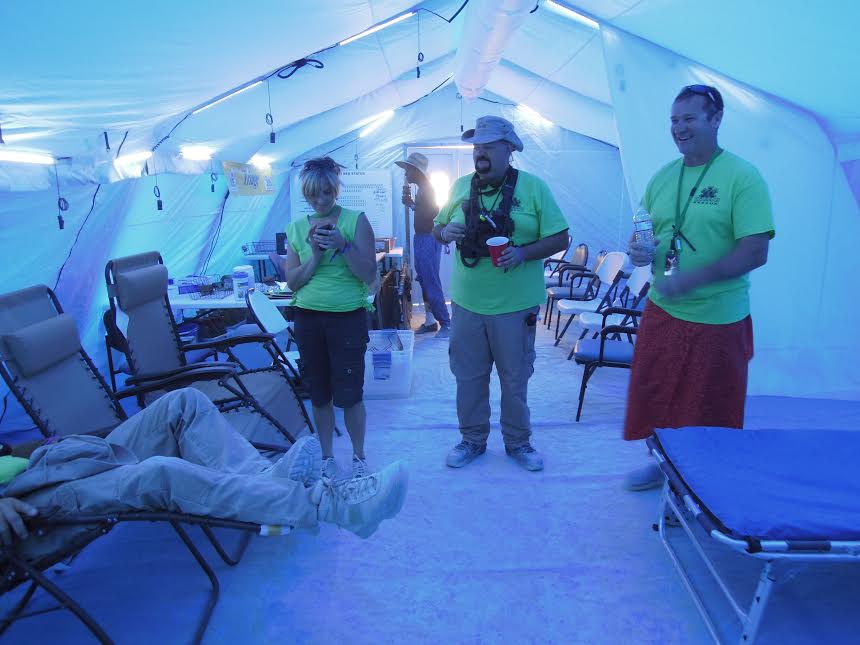
Medical staff at Burning Man contend with a variety of conditions. Photos/Gary Johnson

Medical staff at Burning Man contend with a variety of conditions. Photos/Gary Johnson

By Linda Fine Conaboy

RENO – Burning Man can be the best and the worst experience of your life — “you can die out there.”

Although Gary Johnson, an assistant professor and practicing doctor at UNR Medical School, said this with a bit of a tongue-in-cheek attitude, the doctor in him took over as he listed some of the maladies that have become familiar to the medical team he heads up.

Five years ago, the medical school asked him to become officially involved in Burning Man by providing care administered by UNR medical students; hence his nickname, G-Man or the Dusty Doctor. G-Man refers to his first name.

Even though all of the medical services are free, a trip in a helicopter provided by CareFlight can run as much as $25,000. In the hospital tent, seven doctors are on staff at all times, with nine ambulances at the ready. In 2010, they treated 4,700 people with a few of those triaged to outside medical facilities.

Some of the unique medical problems include what Johnson calls playa foot, a condition that can eat away the skin of the foot, caused by alkali dust. The remedy, he said, is easy and includes washing the feet in vinegar and water followed by lots of lotion.

Tents temporarily secured by metal rebar tend to fly away in the wind leaving the unforgiving rebar exposed. Because of this, many people each year are treated in the medical tents for wounds caused by tripping over it. It’s an easy problem to fix, Johnson said, recommending using tennis balls to cover and mark the exposed menace.

Drugs, especially ecstasy, are wildly available and can cause numerous problems. Burning Man may not be the best place for a first experience with LSD, he added.

The dust, although a vital part of the experience, must be reckoned with. You have to prepare for it, Johnson said, adding that asthmatics are particularly vulnerable in the dust. He recommends ski goggles, masks and even bandanas worn over the face.

Burning Man has become more regulated through the years.

Burning Man has become more regulated through the years.

In his humorous yet serious way, Johnson listed some basic survival tips including good hydration, lubrication and salinization. Wear your vinegar, he said, indicating the importance of the stuff. Stay off trampolines unless you’re 10; bring your own prescription drugs; avoid helicopters; and recreate within your comfort zone.

Surprisingly, despite the news stories that filter out of Burning Man each year, substance abuse-related accidents are much lower than expected—generally only about 2.5 percent of those treated.

With four satellite first aid stations, climate-controlled MASH tents, rehydration stations, X-ray, suturing and casting facilities, a limited formulary pharmacy, a basic lab and even a sanctuary where overwhelmed folks can come to talk out their problems, Johnson said Burning Man is now safer than ever.

For the newcomers, he has a few wise words: Don’t get overly ambitious with your camp; go with experienced people in an established camp for your first time out and perhaps most important, don’t stay too long.

Johnson discovered Burning Man by accident in 1992 when he and some of his Fernley High School friends decided to spend a few days camping on the playa outside of Gerlach.

“It sounded like some satanic thing in the dessert,” he laughed during his recent presentation at Mathewson-IGT Knowledge Center on the UNR campus. But satanic or not, he was intrigued enough to return the following year and said he was “totally welcome.”

Although the history of the massive event has been fairly well told, Johnson succinctly recapped its evolution, which began on Baker Beach in San Francisco in 1986, moved to Nevada in 1990, and each year becomes the state’s fourth or fifth largest city for a few days.

“It was a surreal experience then,” Johnson said. “There were no police. Those were the good old days. Burning Man is not the same as it was.” He said there was lots of sex, even more drugs and the area abounded with an ample supply of explosives.

The population on the playa doubled each year with, in Johnson’s words, weird tents and cars driving everywhere. “Thousands of people were going to the dessert. Lots of problems developed in the early days.”

Perhaps because of a freak accident in the early days—two people were run over in their tent—nowadays, the only motorized vehicles allowed to traverse the area are service vehicles or “substantially modified vehicles with interactive art,” and then, they can only drive 5 mph.

To make getting around in the huge, temporary city easier, a grid pattern was developed and street signs erected. Even with these precautions, Johnson said getting lost amid the dust and total nighttime darkness at Black Rock City is easy. For this reason he recommends carrying a GPS and a flashlight, especially at night.

The place is patrolled day and night by fire and police units. “They’re very serious out there now,” Johnson said. “Now it’s an organized city with an infrastructure and it’s become much more family friendly.”

In 2010, there were 600 registered art cars and 700 officially registered theme camps and villages. All individual camps are encouraged to be visually interesting and interactive; those offering food must be cleared by the health department, and if there’s liquor involved, camp hosts are required to card anyone partaking.

People are dressed up 24/7, although it’s considered tacky for a man to wear a shirt and no pants, he chuckled. Even though all food must be approved by the Pershing County Health Department, gifting is a good thing, he said.

The best part of Burning Man for Johnson is the art. “But the friendly, warm attitude of the people is overwhelming—it’s good. I enjoy the melting pot aspect with so many people from many different countries. It’s truly an international audience, especially among South Africans.”

After all the Burners are finally able to make their way out of the huge traffic jams created by the mass migration of campers heading home, the clean-up crew takes over, sweeping and cleaning the site meticulously. Because there are no trash cans, it’s important to take everything out.

Johnson said for him Burning Man gets better each year. “The early years were a little scary. I loved the freedom, but now, I like the organization.”



‘Excessive water users’ fine would elevate drought-shaming

By Alexei Koseff, Sacramento Bee

When Oakland A’s executive Billy Beane found himself on the East Bay Municipal Utility District’s list of its biggest water users in October, he released a statement that he was “more than displeased and embarrassed by the usage” and promised to take “immediate action” to repair irrigation and pool leaks recently discovered at his Danville home.

Welcome to a new era of “drought-shaming.” As California enters its fifth year of a historic dry period and residents buckle down to reduce urban water use by one-fourth, a novel strategy adopted by the East Bay water utility has turned the spotlight on the region’s most wasteful consumers – among them the rich and famous – and could become the basis for statewide policy.

Last month, Sen. Jerry Hill, D-San Mateo, introduced Senate Bill 814, which would require local water districts to set a definition of “excessive water use” and then fine customers by up to $500 for each hundred cubic feet, or about 748 gallons, of water above the limit when the state has declared emergency drought conditions.

Read the whole story


‘Like-farming’ a common scam on Facebook

By Kim Komando, USA Today

Facebook has changed the way people do a lot of things online. For example, you probably notice yourself reflexively clicking ‘like’ on anything your friends post on Facebook, even if it’s just to acknowledge you saw it. Scammers are taking advantage of that reflex for a dangerous scam called “like-farming.”

What is like-farming?

Like-farming is when scammers post an attention-grabbing story on Facebook for the express purpose of cultivating likes and shares. Based on the way Facebook works, the more likes and shares a post has, the more likely it is to show up in people’s News Feeds.

This gives the scammer more eyeballs for posts that trick people out of information or send them to malicious downloads. The big question, of course, is why Facebook doesn’t stop these posts before they get too big. And that’s where the real scam comes in.

Read the whole story


Sutter County a training ground for El Dorado

By Lake Tahoe News

Another former Sutter County employee is about to be on the payroll for El Dorado County.

Marco Sandoval has been Sutter’s risk manager since 2008 and will have the same title with El Dorado County. Prior to being hired by Sutter County Sandoval was in the private sector doing the same type of work.

Sandoval and Larry Combs, interim CAO for El Dorado County, worked together in Sutter County.

Combs started with El Dorado last summer in what was supposed to be a stint for less than one year. It wasn’t until January that a company was hired to find a permanent CAO. These searches often take several months.

Combs brought in Shawne Corley this year to be assistant chief administrative officer. She had that same title at Sutter for 13 years.

It was Pamela Knorr as acting CAO who recommenced Combs to the Board of Supervisors. Knorr is the human resources director for El Dorado. They knew each other through a statewide association of counties.

There was never any background check done on Knorr. She had been fired as CAO in Alpine County before getting her job with El Dorado County. She was the one responsible for doing the background check on her friend Combs.

Sutter is a really small county so even though it may seem like a lateral move with these jobs, this is a promotion because of size and complexities of issues.

Combs actually came out of retirement for this position. El Dorado County is the largest county he has worked for.


​Anticipating the next mega-quake

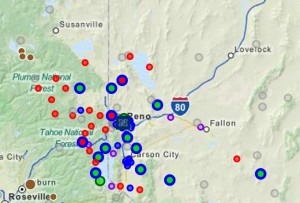
Seismic activity is normal throughout the Sierra. Map/UNR Seismology Lab

Seismic activity is normal throughout the Sierra. Map/UNR Seismology Lab

By CBS News

In March 2011 the world watched in awe and horror as a colossal tsunami ravaged eastern Japan — the result of a 9.0 magnitude earthquake.

Entire cities were washed away; millions were stranded without power or water; 15,000 died.

It was an otherworldy event that happened thousands of miles away. Thank goodness, many Americans thought, it couldn’t happen here. But it could happen here.

In fact, scientists say it’s a question of when — not if — a devastating earthquake, followed by a huge tsunami, strikes the continental United States, right in the Pacific Northwest.

“This would be like five or six Katrinas all at once, up and down from California to Canada, would be the closest thing I can think of,” said Chris Goldfinger, a paleo-seismologist at Oregon State University.

Read the whole story


Caltrans launches roadway clean water initiative

By Tony Bizjak, Sacramento Bee

California highway officials last week launched a clean water campaign, “Protect Every Drop” aimed reducing the amount of pollution that flows off of people’s cars into streams, rivers, lakes and the ocean.

“Clean water is essential for our quality of life in California, and it’s important to ‘Protect Every Drop’,” said California Department of Transportation Director Malcolm Dougherty. “Every motorist needs to do their part to keep California’s waterways clean.”

Caltrans operates storm drain systems along more than 15,000 miles of the state highway system. Roadway pollution flows through ditches and pipes into city or county storm drain systems, or directly into watersheds.

Read the whole story


New regulations skirt qualifications to teach in Nev.

By Trevon Milliard, Reno Gazette-Journal

Nevada’s emergency change to teacher licensing simplifies hiring in a state short on public school teachers, but it also opens the door to those who don’t meet basic expectations.

An emergency regulation – approved a month ago by Gov. Brian Sandoval – allows the state to immediately license teachers who’ve never taught in a classroom or tested competent in their subject matters, both of which Nevada usually requires to be a licensed teacher.

The regulation lets Nevada ignore up to a dozen of its own requirements per teacher, including that applicants show mastery of “principles and methods of teaching” and basic reading, writing and math skills.

Read the whole story


Tahoe Paradise Park’s future being finalized

TPRID meeting-1

Tahoe Paradise Resort Improvement District’s board is creating a master plan for the park with the public’s help. Photo/Jessie Marchesseau

By Jessie Marchesseau

MEYERS – After years without anything even resembling one, Tahoe Paradise Resort Improvement District has put together a master plan for Tahoe Paradise Park. Well, at least a draft of one.

The plan sets forth a number of goals and objectives not only for the purpose of managing the park more effectively, but also making it possible to apply for grants. The board presented this draft to the public at a workshop on Thursday evening where board members were looking to get input, reactions and suggestions from the community.

Large yellow posters stating the seven main goals and specific objectives relating to each were plastered on the walls of the upstairs meeting room of the California Conservation Corps. building.

The main goals are as follows:

1.     Increase community involvement, activities, and programs

2.     Conserve, protect, and enhance the park’s natural and human-made features

3.     Enhance park maintenance and appearance

4.     Enhance park governance and management

5.     Enhance financial accountability and transparency

6.     Increase revenue

7.     Establish a project development and implementation plan.

Beneath the posters were tables covered with sheets of paper, one titled with each of the 60 objectives and room for comments to be written in below.

However, with only about a dozen people in attendance March 3, the number of people offering input was significantly less than board members had anticipated and by the end of the evening, many sheets remained blank. But even with the meager turnout, it did appear both sides of the issue were represented, though perhaps not the middle ground.

Mark and Jenny Goldstein who live about a block and a half from the park attended to share their sentiments against making any changes to the park. They are concerned that the surrounding infrastructure, specifically the roads near the park, is not in good enough condition to accommodate increased traffic in and out of the park.

They also cited lack of parking, which forces cars onto nearby streets, and noise issues as reasons to curb increased usage of Tahoe Paradise Park.

“We’re trying to keep people out of our neighborhood, not bring them in,” Jenny Goldstein told Lake Tahoe News.

Mark Goldstein concurred, explaining they chose to live in Meyers because of its small-town, quiet atmosphere. If they wanted to see a band or experience traffic, they would go into South Lake.

He wants the park to stay just as it is, and feels most of the changes the board is proposing are simply a waste of time and money. He thinks erosion control, forest thinning and making the bathrooms open to the public would be the best uses for park funds.

Not everyone at the meeting, however, shared this attitude for leaving the park as is. John Dalton, a Meyers resident who also grew up in Meyers, remembers playing at Tahoe Paradise Park as a child. He would like to see it returned to what it was back then.

“I think they’re on the right track, just trying to get people back in the park,” he told Lake Tahoe News. “I don’t see anything I oppose; I’m sure there’s more that could be added,” he said of the plan’s goals and objectives.

Nina McLeod also supported the draft plan with no objection and is already planning to volunteer her time helping with implementation. She is especially fond of the idea to encourage more kids to fish in the park, especially fly fish.

“To me, it’s all good. I think the community can really benefit by being able to get out there and get to the beach,” she said.

McLeod also pointed out that even though Lake Tahoe is very close, it can be crowded in South Lake and the beaches full of tourists. Tahoe Paradise Park is “our own place,” she said, a place for people in Meyers to enjoy a day at the lake and on the beach without the crowds.

None of these attendees had opinions to offer about any of the specific goals or objectives in the plan. Rather, they had overall feelings about the plan as a whole, either good or bad. Board member Peter Nelligan said the only item he’s specifically had people comment on is the objective to start allowing dogs in the park. While the majority seems to be in favor of dogs in the park, with clean-up baggies available, others are still adamantly against it.

Some of the other objectives include building a sand volleyball court, developing a community garden, creating a park website, ensuring facilities meet ADA standards, protecting the natural environment and reviewing the master plan on an annual basis.

Nelligan said the park has been “very isolated and underutilized” for years. He is hoping the implementation of this master plan will once again make “Meyers’ best-kept secret” a family-friendly place for the community to gather and enjoy the outdoors.

The board is anticipating approval of the master plan at the next TPRID meeting on March 31, but they still hope to gather and address more community feedback in the meantime. The plan may be viewed online. Comments and suggestions may be emailed to TahoeParadisePark@gmail.com.


Legal marijuana doing what drug war couldn’t

By Christopher Ingraham, Washington Post

Legal marijuana may be doing at least one thing that a decades-long drug war couldn’t: taking a bite out of Mexican drug cartels’ profits.

The latest data from the U.S. Border Patrol shows that last year, marijuana seizures along the southwest border tumbled to their lowest level in at least a decade. Agents snagged roughly 1.5 million pounds of marijuana at the border, down from a peak of nearly 4 million pounds in 2009.

The data supports the many stories about the difficulties marijuana growers in Mexico face in light of increased competition from the north. As domestic marijuana production has ramped up in places such as California, Colorado and Washington, marijuana prices have fallen, especially at the bulk level.

Read the whole story