Vail Resorts profit tops forecasts

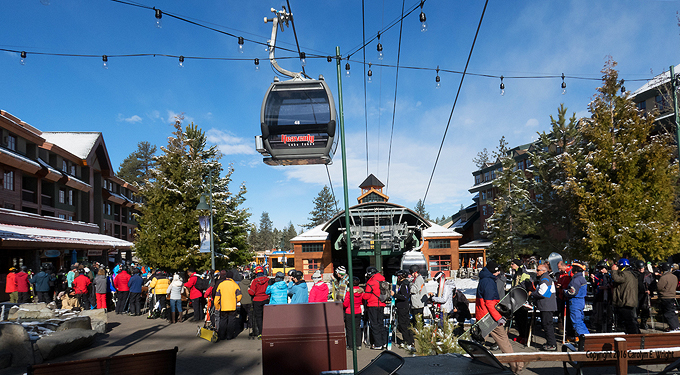
Crowds like this at Heavenly on March 8 are helping Vail Resorts be profitable this season. Photo Copyright 2016 Carolyn E. Wright

Crowds like this at Heavenly on March 8 are helping Vail Resorts’ bottom line. Photo Copyright 2016 Carolyn E. Wright

By Joshua Jamerson, Dow Jones Newswires

Vail Resorts Inc. reported better-than-expected revenue and profit in its latest quarter and boosted its quarterly dividend, as the ski-resort operator benefited from more visitors and steeper prices.

The results came amid a rebound at its three Tahoe properties, solid growth at its Colorado operations and double-digit growth at its Park City resort. The quarter through January is typically Vail’s strongest reporting period of the year. Vail also announced improvements to its resorts at Breckenridge and Vail Mountain.

Vail’s board approved a 30 percent increase in the company’s quarter dividend to 81 cents a share, up from 62.25 cents a share. The raised dividend is payable to shareholders of record as March 29.

The Broomfield-based company acquired Park City Mountain Resort in Utah in 2014, giving it the biggest ski resort in the U.S. Additionally, Vail bought a resort in Australia in June, which should help bolster its results during its typical off-season periods.

Read the whole story


STR planning to improve green waste recycling

By Kathryn Reed

South Tahoe Refuse hopes to have its green waste program revamped by this spring when people start to clean their yards after winter.

“It will be expanded to get a higher diversion percentage,” John Marchini with the South Lake Tahoe garbage company told Lake Tahoe News.

The company is still working out what exactly the program will look like.

STR services the South Shore of El Dorado and Douglas counties. In California, there is unlimited pick up, while Nevada residents pay for the number of cans used.

In the past green waste and regular garbage had been picked up on the same day but not always by the same truck. This has led to some confusion by drivers and customers.

All garbage companies in California are required to recycle 50 percent of the waste they collect – known as the diversion rate. The goal per the state is 75 percent in 2020. STR is currently at about 64 percent.

Getting more pine needles out of the landfill not only is better for the environment it helps with the diversion rate. Those bags of debris add up weight-wise much faster than recyclables like plastic.

STR is also looking to beef up its diversion of construction material and food waste to reach the higher state goal in the next four years.


Ritz building Tahoe beach house for guests

The Ritz-Carlton Lakeside is expected to be built this summer.

The Ritz-Carlton Lakeside is expected to be built this summer.

By Kathryn Reed

A private beach for Lake Tahoe Ritz-Carlton guests is close to becoming a reality.

The resort has secured the property in Tahoe Vista on which it plans to build a clubhouse of sorts this summer that would be available only for guests of the Truckee hotel.

“It is something we have been talking about for some time,” Giles Priestland, Ritz spokesman, told Lake Tahoe News. “It would be a wonderful way to have a direct connection to the lake for our guests.”

Kennedy Wilson, an international real estate investment and service firm, and its partners own the Lake Tahoe Ritz. It is KW-Northstar Ventures which has secured the Tahoe Regional Planning Agency permit and approvals from the Placer County.

KW owns what had been the Shore House bed and breakfast. That building will be demolished and a new 2,965-square-foot, two-story structure put in its place.

Paul Thompson with Placer County’s planning department said the design site approval has been issued. Now the applicant must apply for a building permit and have the improvement plans for the site approved. The latter pertains to the parking lot, landscaping and retaining wall.

A rendering of the beach house from Highway 28.

A rendering of the beach house from Highway 28.

According to TRPA, the project will help with water quality and will have improved scenic aspects. The new structure will be situated so the lake is visible when driving by on Highway 28. That is not the case with the current building.

The structure will have a changing area for guests, as well as a kitchen. It is being called a beach pavilion, with the name Ritz-Carlton Lakeside.

Only registered guests of the Ritz will be allowed to use it; not any of their friends staying elsewhere. When the bed and breakfast was in operation, the beach area was also limited to those guests.

The Ritz estimates between 20 and 30 percent of its guests go to the lake. That percentage is expected to increase to 40 with the beach house. It’s projected about 22 people on average will be there on any given summer day, with 31 people at peak periods.

While there will be parking on-site, the Ritz intends to provide a shuttle for guests and the handful of employees who will work there.

The nine tourist accommodation units and one residential unit will remain associated with the property. Any transfer of those would require TRPA approval.


Eco-conscious CEO develops alternatives to plastic packaging

By Marissa Lang, San Francisco Chronicle

Tired of struggling with hard-to-cut plastic casing, Barbara Walter bought a tool that proclaimed to do the job her scissors could not: sawing through plastic blister packs with ease.

The only problem? The device came packaged in brittle plastic casing.

Paul Tasner watched his wife struggle with the plastic in stunned silence before he burst into laughter.

“This is insane,” he thought. “Why are we packing everything in plastic?”

It’s a moment Tasner recalls often in describing his journey to create PulpWorks Inc., a for-profit company he started in 2011 with Elena Olivari, a former architect who specialized in sustainable architecture. PulpWorks seeks to replace the plastic used to package consumer products, like cosmetics and electronics, with eco-friendly packaging made from recycled paper and agricultural waste.

Read the whole story


Reno man dies while skiing at Mt. Rose

A Reno man died Sunday while skiing at Mount Rose ski resort.

Ski patrollers were unable to revive Luke Solum, 43, when they found him just after 2pm March 6 on the Galena run.

The cause of death is under investigation because it did not appear he ran into anything.

— Lake Tahoe News staff report


Pot shop owner buying SLT property

By Kathryn Reed

Tahoe Wellness Cooperative owner Cody Bass and a group of investors are about to be the owners of the property that houses the medical marijuana collective.

Bass is in escrow with Patty Olson, who for years has owned that strip of land in the Bijou Center. The corporation that was formed to buy the parcel is also purchasing the house Olson lived in until earlier this year when she moved to Reno. Bass intends to make it his home.

The building with CVS and other businesses is a separate parcel with a different owner.

“My first goal is I’m to lease the bank space. I want the city to allow me to have 800 more square feet to have the bank vault and more admin space,” Bass told Lake Tahoe News.

El Dorado Savings used to be in that location.

The need for the bank vault is to allow the co-op to be compliant with the law that requires such businesses to have certain vault compliance by 2018. The current vault is not sufficient.

Bass is working with city of South Lake Tahoe officials to make this work. He contends the wellness center is its own business and should be spun off from the co-op. The center is an entity any member of the public may access, while the collective if for people with a prescription.

The spot where Hot Gossip was is vacant. Bass envisions a tenant selling coffee, tea and superfoods going in there. To start with, it will just be beverages. The kitchen needs to be rebuilt.

Originally, an alehouse wanted to lease that space, but Bass believes that would not be a good fit with the co-op in the same center.

Down the road he foresees adding a second floor to the building. Bass’ goal, if construction is in the future, is to have it LEED certified. He believes the city should adopt a policy so new construction conforms to the U.S. Green Building Council’s guidelines.

Bass also plans to hire a security guard this summer to deal with people using his parking spaces when their destination is the nearby beach.


STR recyclables take a hit as oil prices drop

By Kathryn Reed

South Tahoe Refuse is stockpiling some of its recyclables in hopes the market changes so the value for them goes up.

Large bales of plastic are worth about $112, while a year ago they went for $230.

“The price we are receiving (for plastic) has significantly dropped – over 50 percent in the last year,” John Marchini with STR told Lake Tahoe News. “How it relates to oil is very specific to plastic. Instead of large companies using pellets from plastic bottles it is cheaper to use oil because crude is low.”

In other words, food products, including bottled water, are being packaged in plastic made without recycled material.

While many consumers are thrilled with the price of oil going down, when it does so it takes the value of plastics with it. After all, plastic is a byproduct of petroleum.

Recycling is a commodities business, and as such is subject to the whims of the market. It’s not just plastic that is fetching a low price, Marchini said it’s pretty much across the board.

“We absolutely hold on to the more valuable material and play the market. It’s similar to someone who plays the stock market,” Marchini said. Aluminum and PET plastic No. 1 are the most valuable.

He said when such fluctuations occur – and they are cyclical, though this is admittedly a huge downward swing – the recycling focus is adjusted. Something like film plastic, which includes the actual blue bag STR customers use for recycling, green-black bags for yard waste, and grocery store plastic bags, become less of a priority.

South Tahoe Refuse has an assembly line for its garbage, with workers plucking recyclables from the debris. When the blue bags are emptied onto conveyor belt all of those goods are recycled.

“The downturn in the economy in China is also affecting our recycling markets because they are the primary buyer for a lot of our materials. All of our junk mail, mixed paper goes to China,” Marchini said.

Less income from recycling inevitably affects STR’s bottom line.

“What happens with recycling revenues is that it all goes back into the operating budget to help eliminate or minimize rate increases,” Marchini said.

The largest recycler in California – rePlanet – had to close 191 recycling centers in the state, including in Placer County. In turn, nearly 300 people lost their jobs.

No jobs at STR have been lost because of the downturn. This is because the company has the same recycling goals to meet. California mandates refuse companies recycle 50 percent of the trash that is collected.

The state is upping that goal to 75 percent in 2020. STR is at about 64 percent diversion rate.

According to the Environmental Protection Agency, 34 percent of waste in the United States was recycled in 2013. This compares to 1990 when 19 percent was recycled.



Storms filling up waterways throughout Calif.

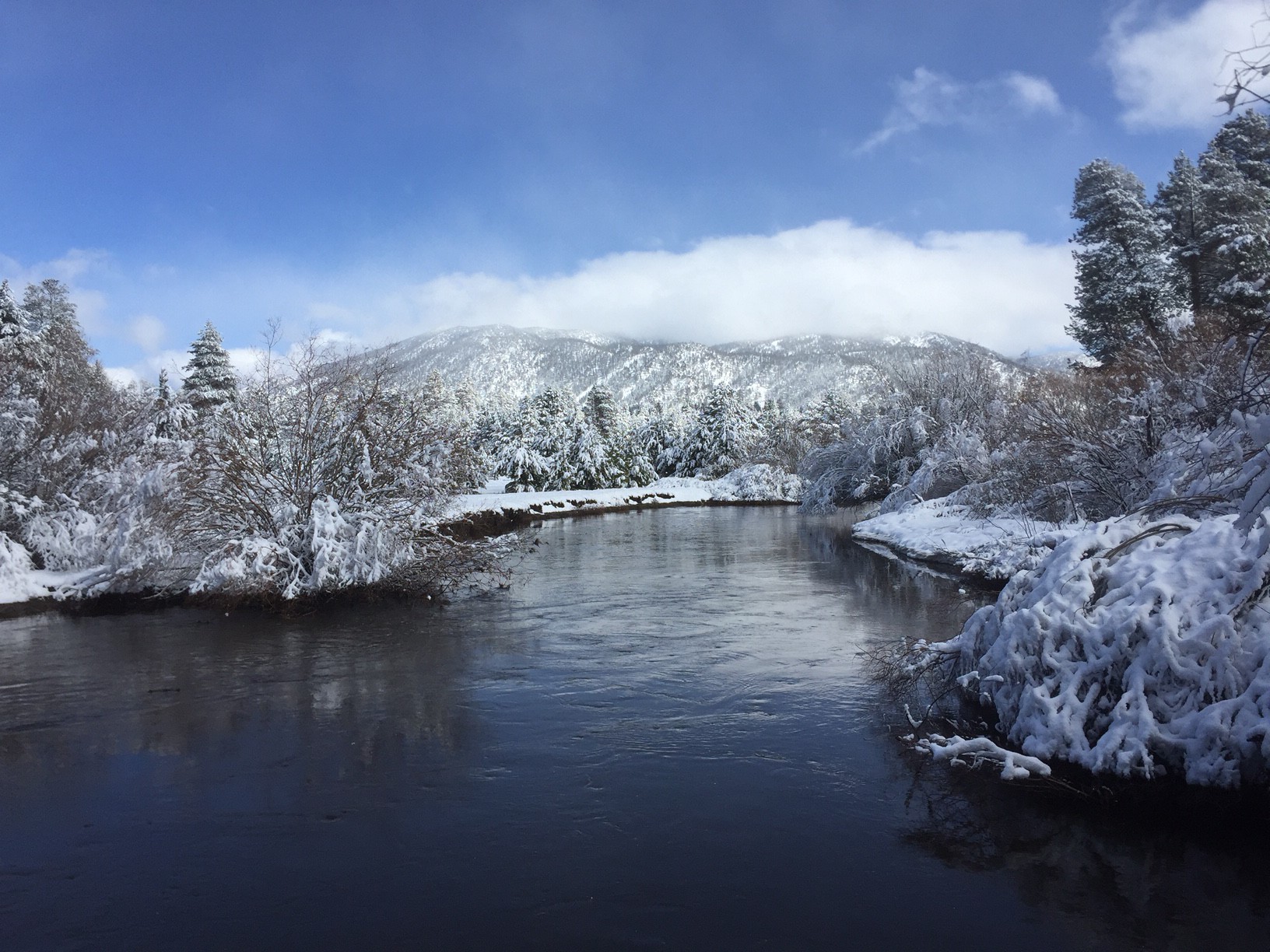
The Upper Truckee River on March 6 is higher than is has been in years. Photo/Kathryn Reed

The Upper Truckee River on March 6 is nearly full. Photo/Kathryn Reed

By Paul Rogers

This weekend’s soaking rains delivered just what drought-weary Northern California needed: billions of gallons of water pouring into the state’s major reservoirs — and more predicted for later this week.

With rain totals reaching 10 inches or more in some mountain areas, 46 of the largest reservoirs in California, closely tracked by the state Department of Water Resources, collectively added 391 billion gallons of water between Friday and Monday morning — enough for the needs of 6 million people for a year.

The reservoir list, which includes such massive lakes as Shasta, Oroville, Folsom, San Luis and New Melones, jumped in storage by 10 percent to 13.2 million acre-feet, as powerful storms pouring off the Pacific sent torrents of water surging down creeks, rivers and hillsides.

Even with that increase, however, the 46 reservoirs bumped up from 66 percent of their historic average on Friday to just 72 percent now. Like somebody with a badly overdrawn checking account, California’s lakes need a continued infusion to get back to normal.

Read the whole story


El Dorado County man confesses to 2006 murder

Nearly 10 years after shooting a man to death in El Dorado County, Eric Mehlmauer this month admitted to having committed the crime and will be going to prison for 10 years.

Tobias Kaiser and Mehlmauer were roommates in Fair Play. They were arguing about the theft of personal property that escalated into the shooting on Nov. 30, 2006. According to the El Dorado County District Attorney’s Office, the two “had a history of bad blood stemming from an illegal marijuana cultivation scheme that failed to produce expected profits.”

Investigators said Mehlmauer and several accomplices put Kaiser’s body inside a metal tank, welded it shut, and then buried it on the rental property.

The missing person investigation soon turned into a homicide investigation when a confidential witness and other evidence came to light, investigators said. But the case got cold quickly when no body was could be located.

The cold case detectives resurrected the case in 2014, which led to the arrest of Mehlmauer and an accomplice on Jan. 15, 2015. Kaiser’s body was recovered March 27, 2015.

On March 4, 2016, Mehlmauer pleaded guilty to voluntary manslaughter and admitted to a special allegation that he used a firearm in the commission of that crime. El Dorado County Superior Court Judge Ken Melikian sentenced him to 10 years in prison.

— Lake Tahoe News staff report


Truckee-Tahoe trying to be electric vehicle friendly

Screen Shot 2016-03-07 at 7.06.10 AMTahoe Regional Planning Agency, Truckee Donner Public Utility District, a consultant team, and a Plug-in Electric Vehicle Coordinating Council have partnered to accelerate the ability for electric vehicles to refuel in the Tahoe-Truckee region.

According to TRPA: Plug-in electric vehicles (PEVs) have the potential to dramatically reduce petroleum consumption and greenhouse gas emissions, and increase energy independence. The success of long-term transportation electrification depends on near-term deployment of vehicles and charging infrastructure, strategic planning addressing regional needs, and increased PEV use.

Preliminary goals:
• Increase PEV access in the Northern and Eastern Sierra.
• Establish the Tahoe-Truckee region as a PEV destination, gateway, and corridor.
• Create a comprehensive plan to increase local PEV adoption and deploy charging infrastructure.
• Proactively engage local and regional planning agencies and the community.

Project deliverables:
• PEV assessment report: includes an existing conditions report and PEV gap analysis. The regional infrastructure,
policies, programs, PEV use, and behaviors/needs will be assessed.
• Outreach strategy and sector-specific PEV toolkits: addresses funding strategies, best practices, available training,
and outreach materials. Sectors include local governments, fleet owners and operators, energy wholesalers/retailers,
vehicle dealers, Tahoe-Truckee residents and visitors, second homeowners, and tourist destinations.
• Tahoe-Truckee regional PEV readiness plan: includes a market overview, a regional siting analysis, recommendations,
next steps, and readiness action items related to permitting and planning, training, and education. Public
education workshops.