Nev. sheriff links crime hike to Calif. law to reduce prison crowding

By Ricardo Torres, Las Vegas Sun

Depopulation in California jails and gang members moving to the Las Vegas Valley might be contributing to the rise in violent crime, according to Metro Police Sheriff Joseph Lombardo.

There’s a “plethora” of reasons why the valley might be experiencing a hike, Lombardo said during an editorial meeting with the Las Vegas Sun, but Metro has had an increase of interactions with California gang members during arrests and investigations.

“That influx is directly related to, I believe, the depopulation of the prison system in California,” he said.

Read the whole story


Hispanic voters growing influence in the West

By Paige Blankenbuehler, High Country News

In the midst of the raucous and polarized presidential election, a quieter story has been at play as well: the growing political clout of Latino voters.

Nationwide, about 12 percent of the country’s eligible voting population is Hispanic — and the West is home to nearly 40 percent of those voters, far surpassing other regions. This November, Hispanic voters are projected to turn out in greater numbers than they did in 2012, with a nearly 10 percent increaseforecast by the National Association of Latino Elected Officials Educational Fund.

At the same time, the Latino voting bloc is in transition. Latino populations are getting younger, larger and more politically engaged. In the process, they promise to change Western presidential politics.

Now, not only are there more Hispanic younger voters, but an increasing percentage of them are born in the United States. That naturalized population is beginning to dominate the Latino population of voters (non-citizens can’t vote). Young Hispanics make up a larger proportion of the voting block than in other groups: 44 percent of Hispanic voters are between the ages of 18 and 35 this year, compared to 27 percent among white voters.


In Nevada, Hispanic groups are becoming more vocal on the immigration debate and about their opposition to Donald Trump, whose campaign has taken an anti-immigration stance. But their influence is complicated by the fact that the state has the largest percentage of undocumented immigrants in the country (nearly 8 percent; California comes second with just more than 6 percent), according to the Pew Research Center.

Read the whole story


Nev. judge disqualifies solar industry’s ballot measure

By Daniel Rothberg, Las Vegas Sun

A Carson City judge ruled to disqualify a ballot measure that would restore more generous rates for rooftop solar customers, a setback for solar advocates who had been aggressively campaigning for it.

In a case that represented a proxy fight between NV Energy and SolarCity, Judge James Russell sided Monday with a political action committee backed by NV Energy and undisclosed consumer groups.

The group argued that the measure, floated by SolarCity and several local companies, did not meet the requirements of a referendum because it sought to remove certain sections of a law rather than the full law. Russell said his ruling was not about the merits of solar but about what he saw as the flawed framing of the measure.

Read the whole story


Marinas on front line for lake clarity issues

By Kathryn Reed

CAMP RICHARDSON – Marina operators throughout the Lake Tahoe Basin are beginning to make a concerted, united approach to dealing with aquatic issues.

The Tahoe Marina Association is a relatively new group made up of the owners. Eleven of them gathered last week at Camp Richardson to hear a presentation from the League to Save Lake Tahoe about how marinas can keep Lake Tahoe blue. This in itself is not something that would have happened a handful of years ago based on the nonprofit’s old philosophy of thinking anything not native to the lake must be harmful — including boats and buoys.

The new thinking of working with those who are here has made for more amicable relationships – including with marinas.

Jesse Patterson, deputy director of the League, told them, “You know the good, the bad and ugly of the lake. That is why we want you involved.”

Last year four marinas participated in a training about aquatic invasive species, with more sessions planned for May. The Eyes on the Lake program is open to the general public, too. It’s all about identifying invasives and getting rid of them.

A representative from Obexer’s on the West Shore admitted it’s difficult to tell the difference between native and non-native plants.

A Sierra Boat Company employee said using the information gathered about AIS helped with their dredging application.

Stormwater flows into Lake Tahoe marinas carrying water that originated mostly off property. Photo/LTN

Stormwater flows into Lake Tahoe marinas carrying water that mostly originated off property. Photo/LTN

The idea is to focus more on invasive plants like Eurasian milfoil and curly leaf pondweed because these are often habitat for non-native fish. Eliminating the food source is easier.

Boats are a conduit for the invasives, with some marinas like Tahoe Keys being inundated with the unwanted plants.

Patterson said marinas are the perfect place for invasive plants to live because it’s still water where fine sediment comes in.

Another issue Patterson wants marinas to be cognizant of is stormwater runoff. Many marinas have pipes draining into the lake from their properties. But the water likely originated farther upland. Still, marinas are regulated and the amount of fine sediment deposited becomes their problem.

This fact was evident last July when a putrid smell was coming from Ski Run Marina. South Lake Tahoe officials were notified and it turned to be a malfunction with a weir. The city fixed the problem.

Through the League’s Pipe Keepers program marina staff can be trained to take samples during storms that are then analyzed for turbidity by the League’s people.

“Source reduction is our No. 1 goal,” Patterson said.


Calif. plan for private-sector workers moves forward

By James Rufus Koren, Los Angeles Times

California has taken a step closer to becoming the first state to make retirement savings accounts a near-universal benefit for workers with a plan that lawmakers hope will help ease an expected massive shortfall in retirement savings.

A state board Monday sent a set of recommendations to the Legislature calling for the creation of the California Secure Choice Retirement Plan — essentially a 401(k) plan operated by the state and open to private-sector workers whose employers don’t offer a retirement savings plan.

Employees of any company with at least five workers would be eligible to participate. That would cover an estimated 6.8 million workers, about a third of California’s labor force.

Read the whole story


Cave Rock project to tie up traffic all summer

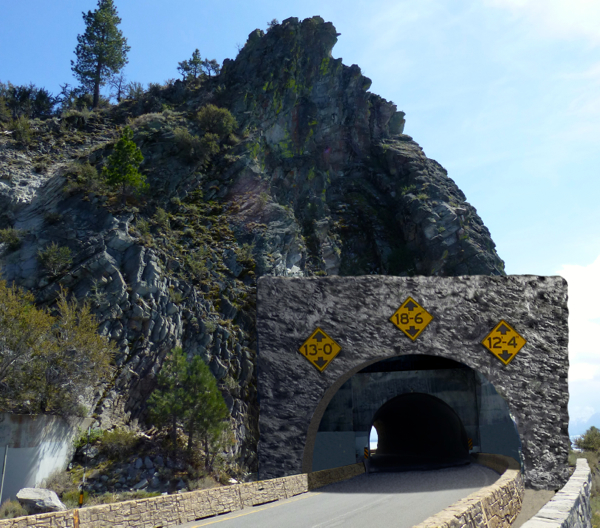
This is a rendering of what Cave Rock will look like when the work is completed. Photo/NDOT

This is a rendering of what Cave Rock will look like when the work is completed. Photo/NDOT

By Kathryn Reed

Highway 50 near Cave Rock will be reduced to one lane in each direction six days a week, including holidays, and around the clock beginning as soon as possible and lasting until the work is done in the fall.

It’s mostly about safety and a little about lake clarity.

“We are calling it a tunnel extension for simplicity. It’s almost like a bridge we are building,” Devin Cartwright, Nevada Department of Transportation engineer, told Lake Tahoe News.

He is in charge of the $5 million project that is designed to keep rocks from falling from Cave Rock onto the highway, as well as the water quality improvements taking place east of the tunnel.

Most likely the work will begin in May per Tahoe Regional Planning Agency rules, though if April is projected to be dry, exemptions could be made.

This isn’t any ordinary rock formation. For the Washoe people it is one of their most sacred places.

“NDOT invited the tribe to come up to meet with the project construction crew when they come up with a date for the start time so the tribe can talk to them to explain how it is a sacred site and not just another job,” Darrel Cruz with the tribe told Lake Tahoe News.

Cave Rock has been used by medicine men and there are other stories associated with it, Cruz said. For some people, they won’t go near the rock because of the power it holds.

The Washoe and NDOT have been meeting regularly. And while the Washoe would prefer no one touches the site, they are resigned to the fact that safety issues are a necessary reality.
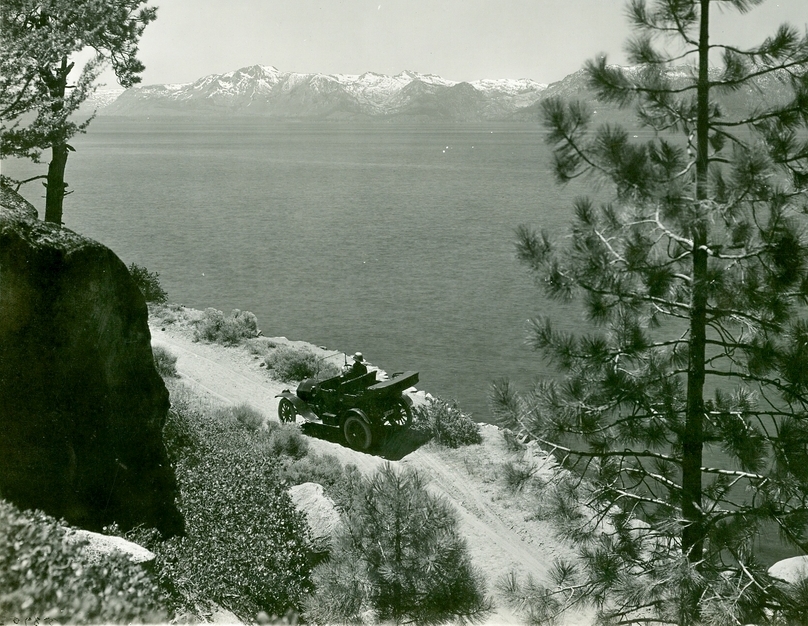
People used to drive around Cave Rock. Photo/Lake Tahoe Historical Society

People used to drive around Cave Rock. Photo/Lake Tahoe Historical Society

Sizable rocks have fallen the past couple winters that have damaged vehicles and the roadway. This project is designed to keep those rocks from reaching the road.

Temporary steel netting has been erected until the more robust solution is in place. The added benefit is that the net will act as a safety measure for workers this summer.

Cartwright said the inconsistent moisture levels because of the drought have caused more rocks to become loose and fall.

“Rapid expansion of soil causes new cracks or old ones to get bigger and things to fall,” he explained.

NDOT is also working with the state Historic Preservation Office to ensure the work is done with care.

“The exterior will be such that it blends into Cave Rock. You will see something that looks like granite or Cave Rock to the best of its ability, but it will still be square,” Cartwright said. “It will have a false surface on it made of concrete and steel so it will a have depth and texture to it like the surrounding rock.”

The tunnel will receive a face-lift of sorts. The exterior color will be closer to the natural rock. The white that has covered up graffiti will be eliminated. The goal is to make all the improvements appear as close to being original as possible, including color, patterns and texture.

The inside will be like a box. On top of it will be concrete and steel girders.

“If you imagine a set of ribs, they will run transverse to the road,” Cartwright explained. “One will be spaced about every 10 feet longitudinally. On top of there, 1 foot of concrete reinforced deck, on top of that 3 feet of pea gravel, so when rocks fall on the pea it stays loose.”

The technology comes from Japan, which has a ton of rock fall issues because of seismic activity. NDOT looked at various methods to contain the rocks, with this design seeming to be the most effective for the site and coming with the ability to be completed in one season.

The existing tunnel is 165-feet long. Sixty-two feet will be added to it.

It was in 1931 that crews first blasted through the granite monolith. It used to be one lane. Eastbound traffic went through the tunnel, while those headed west went on the outside of the tunnel by the lake. That route was eliminated after the second bore was completed in 1957.
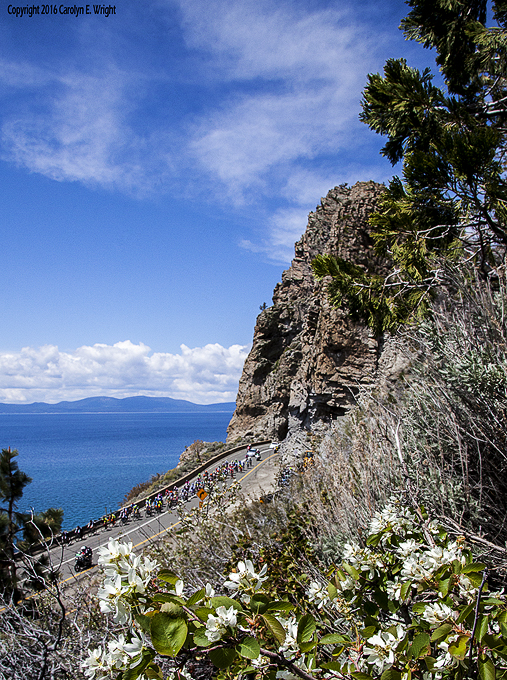
Cyclists in the Tour of California will again ride through Cave Rock in May. Photo Copyright 2016 Carolyn E. Wright

Cyclists in the Tour of California will again ride through Cave Rock in May. Photo Copyright 2015 Carolyn E. Wright

With the tunnel being 23-feet at the narrowest, there is no room to add a bike lane. However, part of the project includes improvements for cyclists.

There is a button cyclists can hit to initiate a warning to drivers. But cyclists seldom take the time to use them. The buttons will remain as a back up, but radar will be installed so the message board is automatically triggered. NDOT will be putting in changing message signs that are similar to the ones near Lakeside Inn and Kingsbury Grade.

The existing signs for cyclists and the ones warning about ice will be removed.

“When there are no bikes or ice, it will be a black sign. It won’t add clutter. When a bike rides by it, it will light up,” Cartwright said.

Temperature sensors will be installed inside the pavement on each side of the tunnel so when it gets close to freezing it will say there is ice in the tunnel. This change will mean the warning would be legitimate instead of ongoing when the threat isn’t valid.

NDOT is adding a white surface to the ground as drivers approach the tunnel and silhouettes of bikes will be stenciled in as a warning.

The tunnel will be lighted. The roadway inside the tunnel will be repaved, as will the westbound lanes of Highway 50 and the roadway median between Cave Rock and the Cave Rock State Park boat launch entrance.

During construction the work zone speed limit will be 25 mph. This will start about one-half mile before the project area. Nevada Highway Patrol will be on site to enforce people comply. People traveling east will be in a construction zone for longer because of the water quality project.

Roadside drainage inlets and sediment filtration systems will be installed along the highway for approximately one mile that starts four miles east of Cave Rock.

Noise constraints are part of the contract. If the contractor violates them, the project could be shut down.

While the work will be ongoing all except Sundays, the contractor has the authorization to work seven days. NDOT is aware there will be nine significant events such as annual cycling and running races that will be impacted. Cartwright said the size of the event would dictate whether special traffic controls would be implemented to accommodate participants.

—–

Notes:

  • NDOT is having an informational meeting about the project on April 14 from 4-7pm at Zephyr Cove Elementary School’s multipurpose room, 226 Warrior Way, Zephyr Cove. There will be a formal presentation at 5:30pm, followed by a short question and answer session. This will be an open house format meeting.


Recall for 2 EDC supervisors fails

El Dorado County Supervisors Sue Novasel and Brian Veerkamp will be keeping their jobs – at least for now.

Those who wanted to recall them could not get the necessary signatures needed to take it to the voters.

A final tactic occurred last week as robo calls were made throughout Novasel’s district, which runs from the basin to Pollock Pines, telling people about her stance on roads.

The process started last fall.

The other three supervisors, auditor-controller and district attorney still face recall challenges; they are in the signature process. Signatures are due March 31 for Supervisors Ron Mikulaco and Shiva Frentzen, and on April 12 for Michael Ranalli. For DA Vern Pierson and Auditor Joe Harn the deadline is in May.

— Lake Tahoe News staff report


Sierra snowpack below normal; better than ’15

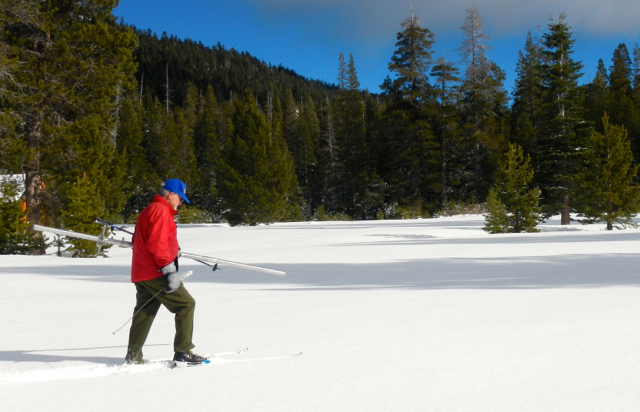
Snow has been on the ground for each of this season's snow surveys. Photo/LTN file

Snow has been on the ground for each of this season’s snow surveys. Photo/LTN file

By Lake Tahoe News

Even though there was white stuff to walk on during the final snow survey of the season today, the lack of water content will likely mean California is headed for a fifth year of drought.

The snow depth in the field by the entrance of Sierra-at-Tahoe on March 30 was 58.4 inches, with a water content of 26 inches. That amounts to 97 percent of average. Statewide the water content is at 80 percent.

While this is a dramatic difference than a year ago when Gov. Jerry Brown stood in a dirt field at Phillips Station, the odds of much more moisture adding to the snowpack are not good.

A year ago, the snowpack was 5 percent of average. This led to the governor to institute dramatic water cutbacks in an effort to conserve. Those rules remain in effect even though some areas believe the rules should be loosened because of the amount of rain that fallen in the winter and filled the reservoirs.

With longer and warmer days, the snow will begin to melt faster. Peak runoff is usually in May. Temps are supposed to be in the 50s the rest of the week, reaching nearly 60 by the end of week.

The importance of the snow lasting as long as possible is that then there is more to fill the reservoirs downstream. In normal years the snowpack accounts for about 30 percent of California’s water needs.


Climate forecast: Warmer, less reliable Truckee River

By Benjamin Spillman, Reno Gazette-Journal

An updated report on climate change that forecasts less snow in the Sierra Nevada and warmer temperatures across the Great Basin doesn’t bode well for fishing and water sports in the Truckee River.

And while average to above average mountain snow in winter 2015-16 has provided a welcome reprieve from five years of drought conditions, the long-term forecast for the remainder of the century is a different story.

The latest version of the Bureau of Reclamation’s SECURE Water Act Report forecasts a continued warming trend that threatens to undermine environmental features that make the Truckee River a vibrant place for fishing and other water sports.

The report, which has segments for several major Western river basins, says the mean annual temperature in the Truckee River Basin, an area that includes Reno, Carson City and Lake Tahoe, is expected to increase 5 to 6 degrees Fahrenheit during the 21st century.

Read the whole story


Casinos across Nevada post gains in February

By Associated Press

LAS VEGAS — State officials say Nevada gambling revenue was up 8 percent in February compared with the same month a year ago and saw across-the-board gains.

The Nevada Gaming Control Board said Wednesday that the state’s casinos won $990 million in February.

Las Vegas Strip gambling revenue grew more than 7 percent to $570 million last month. Downtown Las Vegas brought in $51 million for a 17 percent gain.

Reno casino revenue was up 7 percent to $48 million, and Stateline revenue was up 4 percent to $16 million in February.

The state collected almost $51 million in tax money based off the winnings, which is down 13 percent from the same time last year.