Judge: Climate change imperils wolverines, feds must act

By Matthew Brown, AP

BILLINGS, Mont. — The Obama administration brushed over the threat that climate change poses to the snow-loving wolverine when it denied protections for the elusive predator also known as the “mountain devil,” a federal judge ruled Monday.

U.S. District Judge Dana Christensen ordered wildlife officials to act as quickly as possible to protect the species as it becomes vulnerable to a warming planet. Wolverines need deep mountain snows to den, and scientists warn that such habitat will shrink as Earth heats up.

The ruling comes two years after the U.S. Fish and Wildlife Service rejected the views of many of its own scientists and decided not to protect the wolverine under the Endangered Species Act, saying the effects of climate change on the animals remained ambiguous.

The judge said in his 85-page order that the “time is now” to take action to protect the wolverine.

“No greater level of certainty is needed to see the writing on the wall for this snow-dependent species squarely in the path of climate change,” Christensen wrote.

The case carries potential ramifications for other species affected by global warming — including Alaska’s bearded seals, the Pacific walrus and dozens of corals — as scientists and regulators grapple with limits on computer models of climate change.

Based on those models, some wolverine researchers predict almost two-thirds of the species’ denning habitat will disappear by 2085.

Fish and Wildlife Service officials were reviewing Monday’s ruling and did not have immediate comment, agency spokeswoman Serena Baker said.

Christensen pointed to “immense political pressure” from Western states that appeared to drive the government’s decision not to protect the wolverine. He also rejected the government’s assertion that the species’ small population size and low genetic diversity pose no threat to its long-term viability.

Wolverines, a member of the weasel family, once were found throughout the Rocky Mountains and in California’s Sierra Nevada mountain range. They were wiped out across most of the U.S. by the 1930s due to unregulated trapping and poisoning campaigns.

They have since recovered in parts of the West, but not in other areas of their historical range. In the Lower 48 states, an estimated 250 to 300 wolverines survive in remote areas of Montana, Wyoming, Idaho, Oregon and Washington state, according to wildlife officials.

Individual wolverines have been documented in Colorado and California, but there has been no evidence of breeding populations in those states. Larger populations live in Alaska and Canada, and those animals were never proposed for federal protection.

Fish and Wildlife officials declared in 2013 that future temperature increases could melt snowfields occupied by wolverines in some high-elevation mountain ranges in the Lower 48. They called for increased protections to keep the species from going extinct — a conclusion backed by most outside experts and the agency’s own scientists.

The government reversed course when a Fish and Wildlife regional director in Denver overturned her staff’s recommendations to protect wolverines. Regional Director Noreen Walsh cited uncertain climate models that prevented accurate predictions of whether future den sites would be available to female animals.

Officials from Western states including Montana, Wyoming, Utah and Idaho opposed federal protections, saying the animal’s population had increased in some areas in recent decades.

The judge’s ruling sends a message to federal officials that politics don’t trump science, said Matthew Bishop with the Western Environmental Law Center, who represented some of the environmentalists who sued over the decision not to protect the wolverine.

“Our hope is that if they apply the best available science and look at the threats, they’ll make the right decision,” Bishop said.



SLT cracking down on illicit massage

By Kathryn Reed

South Lake Tahoe wants to go after storefronts that claim to do massage when in fact human trafficking and prostitution may make up the better part of their business.

The police department devised a worksheet listing potential criteria. The department in the past has regulated individual massage therapists and establishments, but stopped doing so in 2009 when the California Massage Therapy Council was created by the state. (This reporter is a certified massage therapist.)

The state issues a license that is good for two years. Therapists must prove they’ve received 500 hours of training from a certified institution.

Going forward the city will likely mandate therapists show proof of the state certification in order to obtain a business license. All therapists must have a business license even if they are an employee.

Detective Jeff Roberson, who gave a presentation to the City Council on April 5, clarified that of the 113 people in town who have a business license for massage, most are providing legitimate, therapeutic massage. And while everyone who calls himself or herself a therapist would have to adhere to the new rules, they are not designed to be onerous.

“I’m concerned about the reputation of our community and the massage industry in our town and throughout California,” Teresa Bertrand, owner of Bio Spirit Spa, told the council.

She told the electeds she welcomes more oversight.

This was the sentiment from other therapists who spoke as well.

City staff was careful not to single out any one business, though the ones advertising themselves as Asian massage inevitably were targeted. No one from those establishments spoke Tuesday. However, six owners wrote a letter to the council saying they are legit and would like the city to limit the number of establishments to lessen competition for everyone.

Asian massage is not a modality like Swedish or Thai or deep tissue.

Roberson showed images of some ads for massage in South Lake Tahoe that offer prostitution without using that word.

Some of the new rules under advisement include mandating therapists be fully clothed, that they can’t come in contact with a client’s genitals, and no condoms would be allowed at the business. None of those things would occur at an upstanding massage venue.

Roberson also expressed concern that the women working at the shady places may be doing so under duress, be cycled through from one city to the next, and are not free to leave.

He is a vice specialist and recently received specialized training in going after illicit massage parlors.

City staff will be working to come up with specifics that will be brought back to the council in the form of an ordinance.

—–

In other action:

·      The City Council continues to tweak the vacation home rental ordinance. While no action was taken Tuesday, the subcommittee will be working with those affected by the law to come up with revisions to be voted on in the future.

·      The city is going to come up with a policy regarding when opening public comments are televised, and criteria to prevent staff and others from being slandered.


Suspect in chase that caused STHS lockdown escapes

A rider abandoned his motorcycle April 5 in the Sierra Vista Apartment parking lot. Photo/Kathryn Reed

A rider abandoned his motorcycle April 5 in the Sierra Vista Apartment parking lot. Photo/Kathryn Reed

Updated 2:27pm

By Kathryn Reed

South Tahoe High School was on lockdown this morning after a high-speed chase ended near the campus.

Carson City sheriff’s deputies started the pursuit April 5 after being called to Carson Tahoe Hospital for a disturbance. The man who was there claimed to have been drugged by his roommate. He left the facility and got on a motorcycle.

About 9am Tuesday he was in Meyers, at which time the California Highway Patrol got involved.

While officers know the registered owner of the Harley Davidson that has Nevada plates, it is not confirmed this is the same person who was riding the bike so no name is being released.

The white male who is believed to be in his 50s dropped his bike in the parking lot Sierra Vista Apartments and presumably ran into one of the units. However, once officers went inside the suspect was not there and no one knows where he is.A helicopter had been circling the area in case the suspect fled, but was called off once officers believed he was holed up. The CHP does not consider him to be dangerous.

The suspect was weaving and riding with his helmet partially off, CHP Officer Angela Dean told Lake Tahoe News. She said he then ran the light at the Y.

The high school is just up the hill and that is why it was on lockdown.


Out-of-towners appreciate South Shore’s rebirth

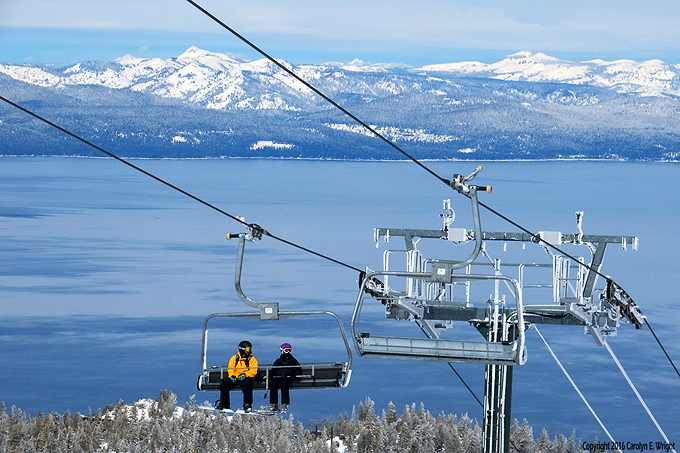
While skiing will inevitably always be Heavenly's main attraction, the resort wants to be a year-round destination just like the rest of the South Shore.  Photo Copyright 2016 Carolyn E. Wright

While skiing will inevitably always be Heavenly’s main attraction, the resort wants to be a year-round destination just like the rest of the South Shore. Photo Copyright 2016 Carolyn E. Wright

By Megan Michelson, Ski

I’m eating a vegan burger, made from scratch with green-chile pinto beans, at 
an Irish pub across the street from the Heavenly gondola, steps from the border of California and Nevada. I’ve been skiing all morning and need to refuel, and this place, McP’s Taphouse, is a ski-pole’s length from Heavenly’s groomed paradise.

The pub used to be in a dark, dingy space a few blocks down. And this spot, where I’m enjoying my burger and side of “Irish fries,” smothered in gravy, was a cavernous and depressing hole in the ground a mere 18 months ago.

For over six years, a halted construction project occupied a full city block in prime real estate neighboring the Heavenly village. It was a hollow symbol of the economic downturn, an ever-present blemish on a tourist town trying desperately to give itself a makeover. Locals took to calling it, simply, “the hole.”

“That hole in the ground was the shining star for how dysfunctional things were here,” says Heavenly’s vice president and COO, Pete Sonntag.

Eventually the south side of Lake Tahoe became known as a place where you could stay up all night playing roulette and
 sleep all day in cheap motels with in-room Jacuzzis. You could wake up hungover, eat bacon and eggs at a casino buffet, then start drinking bloody Marys at the local dive bar. Skiing wasn’t on the to-do list for many of the town’s visitors.


“There’s a sense of optimism now,” Heavenly’s Sonntag says.

Read the whole story


Prop. 47 lowers county inmate counts

By Bob Egelko, San Francisco Chronicle

A November 2014 ballot measure that reduced punishment for drug possession and low-level theft crimes lowered county jail populations by 9 percent in its first year, an effect that could increase public safety by allowing more serious criminals to be kept behind bars longer, according to a study released Wednesday.

The report by the Public Policy Institute of California gives supporters of Proposition 47 a counterargument against police and prosecutors who blamed the ballot measure for a statewide increase in crime last year. Another study earlier this month found an 8 percent increase in crimes reported in the state’s largest cities during the first six months of 2015, compared with the same period in 2014, but also found that crime rates had risen more rapidly in counties that released fewer inmates from jail under Proposition 47.

Read the whole story


Warning about summer vacation rental scams

By ABC News

Many people are back home and back to work after spring break, and some are already planning a summer vacation. Authorities are now warning, however, there are some bait-and-switch rental scams that could ruin your next vacation and your wallet.

Vacation spots across the country are being affected by scammers including the South Lake Tahoe-area where authorities say scammers have already struck 30 times this year.

“What they’re doing is they’re having you take that money and deposit it in a legitimate bank account,” investigator Dave Stevenson of the El Dorado County District Attorney’s Office told ABC News. “However, it’s a fraudulent bank account in the sense that the people then close it after they get their money and then they’re gone.”

Read the whole story


California misses water conservation target

Even though the snowpack in late March was high on Highway 88 east of Kirkwood, it isn't enough to provide California with all the water it needs. Photo/LTN

Even though the snowpack in late March was high on Highway 88 east of Kirkwood, it isn’t enough to provide California with all the water it needs. Photo/LTN

By Associated Press

Residents of drought-plagued California fell just short in February of the state’s mandated water conservation target that has forced them to let lawns turn brown, flush toilets less often and take other strict measures, officials said Monday.

Residents statewide used 23.9 percent less water in February compared to the same period in 2013. The savings were shy of the 25 percent water cuts that Gov. Jerry Brown ordered last year for users in cities and towns.

Felicia Marcus, chair of the State Water Resources Control Board, called it an “enormous effort” in saving water, despite the missed target.

“Californians rose to the occasion, reducing irrigation, fixing leaks, taking shorter showers and saving our precious water resources in all sorts of ways,” she said.

February was the ninth and final month of reporting under the governor’s 25 percent savings mandate. Californians will now be required to use at least 20 percent less water.

The state is now in the fifth year of drought, even though an El Nino weather system delivered a near-average year of rain and snow in some parts of the state.

State officials say that might impact the outcome of a workshop planned later this month to consider the best approach for conservation.

Key reservoirs in Northern California are brimming after El Nino storms drenched the region. However, Southern California saw relatively little precipitation, leaving most of its reservoirs low.

By April 1 – typically the end of California’s rain and snow season – the state was left with a nearly average snowpack and few hopes of more significant storms.

“We need people to keep saving,” Marcus said.


For tech elite a second home is the norm

By Richard Scheinin, Mercury News

CARMEL — The minute Diane Flynn leaves her Menlo Park driveway, the vacation begins. She listens to TED Talks and music, calls her daughters, and arrives in about two hours at Santa Lucia Preserve, driving up, up and up the twisting roadway, passing through stands of valley oak and coastal redwood as the vistas open up in front of her — pristine green canyons, rolling for miles — before she finally pulls into the driveway of her second home.

Santa Lucia Preserve is a gated community that doubles as a wilderness preserve on 20,000 acres adjacent to Carmel Valley and Pebble Beach. With custom homes selling for between $3.6 million and $11.8 million, it also is one of the many getaways — from the Central Coast up through Napa Valley, Sonoma County and Lake Tahoe — that lure affluent Silicon Valley families looking for summers and weekends away from the brutal work routines of the tech economy.

The National Association of Realtors reports record sales of vacation and second homes across the U.S.: roughly 21 percent of all homes sold in 2014 fell into that category. In California, where real estate prices are through the roof, second homes accounted for only 5.3 percent of all home sales in 2015, according to the California Association of Realtors. That still translates into substantial numbers in Northern California: more than $1 billion in residential home sales last year in North Lake Tahoe alone.

Read the whole story


Teen hurt in crash on Mt. Rose Highway

A 17-year-old was seriously injured this morning in a single-vehicle accident on Mount Rose Highway.

According to the Nevada Highway Patrol, the teen’s pickup was airborne for about 100 feet before hitting a tree. He was taken to Renown Medical Center in Reno with serious injuries.

The accident occurred about 8:40am April 4 near Joy Lake Road.

The cause of the crash is under investigation.

— Lake Tahoe News staff report


Resolution in FBI-Apple case prolongs larger legal battle

By Brandon Bailey, AP

SAN FRANCISCO — The FBI’s victory in breaking into a San Bernardino killer’s iPhone without Apple’s help merely prolongs a battle over how far the government can go to examine private messages, photos and other files.

“There’s a clash of values and interests that I think will continue,” said Ed Black, head of Computer and Communications Industry Association, a trade group whose members include Google, Facebook and Microsoft.

Federal prosecutors have appealed a court ruling that said Apple doesn’t have to help them extract data from another iPhone in a New York drug case. Speaking in general, the Justice Department said it will continue seeking digital evidence, “either with cooperation from relevant parties or through the court system when cooperation fails.”

After finding its own way to access files on the San Bernardino iPhone, the Justice Department said it no longer needs a court order to force Apple to remove safeguards against guessing that iPhone’s passcode. That means Magistrate Sheri Pym won’t be ruling on whether a centuries-old law, known as the All Writs Act, provided legal authority for compelling Apple’s assistance.

Some in the tech industry worry that authorities will now try to pursue a smaller company — one without the financial and legal resources that Apple had — to win a favorable legal precedent that authorities could then use to pressure other firms — including heavyweights like Apple.

“When you’re a company of five people, you don’t have a general counsel’s office. You have a card table that everyone sits and codes at,” said Morgan Reed, executive director of a tech industry group known as ACT, which represents software application developers.

Although the Justice Department repeatedly insisted that its request for Apple’s help applied only to the San Bernardino iPhone, Apple said having to rewrite its iPhone software would make all phones less secure and open the door to more demands from government authorities, both in the United States and other countries.

Tech companies say they turn over the customer data they have, when faced with a legal court order. But many companies are increasingly using encryption and other safeguards that put at least some customer data out of their reach. Companies say they’re determined to protect customers’ privacy against unwarranted intrusion.

On the flip side, today’s popular smartphones contain a wealth of information about their users — who they talk to, where they travel, what they view online — which authorities can use to prosecute suspects, unravel plots and identify accomplices.

“Every case is now a cyber investigation,” said Ed McAndrew, a former federal cybercrimes prosecutor now in private practice. “You’re going to have electronic devices and technology and online storage in virtually every case.”

State and federal authorities in several jurisdictions have confirmed they would like to get access to encrypted smartphones seized in a variety of criminal investigations. In at least a dozen pending cases, the government has cited the same All Writs Act as legal authority to compel Apple’s cooperation.

The FBI might be able to apply the same forensic technique it used with the San Bernardino iPhone, but it’s not clear if that will work with newer iPhones that have added security features, said Jonathan Zdziarski, an independent computer forensics expert. The San Bernardino iPhone was a 5C model, which largely had 2012 hardware, although it had a recent version of the iPhone software.

Late Wednesday, the FBI agreed to help an Arkansas prosecutor unlock an iPhone and iPod belonging to two teenagers accused of killing a couple. What is unclear is whether the FBI — which already had the ability to get data from some phones — is using the same techniques as in San Bernardino.

Meanwhile, the government’s authority under the All Writs Act remains in dispute. Any decision in the pending New York case will likely be appealed again, said Fred Cate, a law professor and fellow at the Indiana University Center for Applied Cybersecurity Research. “There’s no question that will be up in the air until the Supreme Court rules on it,” he added.

In the San Bernardino case, most of Apple’s biggest competitors — including Google, Facebook and Microsoft — filed court briefs on Apple’s behalf. Representatives from those companies didn’t respond to requests for comment this week. But Black, the trade group head, said companies recognize the importance access to information is to law enforcement and national security.

But he said many in the tech industry believe authorities went too far by trying to force Apple to write software that would override the security features of its own products.

Members of Congress have discussed legislation on both ends of the spectrum — either to require tech companies’ cooperation or to limit law enforcement authority to compel companies’ help. The latest case could spur Congress to act, though Black and others don’t believe that likely given legislative gridlock on other issues.

That means these battles are likely to recur in court instead.

In a statement this week, the Justice Department said, “It remains a priority for the government to ensure that law enforcement can obtain crucial digital information to protect national security and public safety.”

Apple responded by saying it will assist law enforcement in at least some ways as it has in the past. But the company added, “we will continue to increase the security of our products as the threats and attacks on our data become more frequent and more sophisticated.”