Calif. agencies eager to rebuild Kings Beach pier

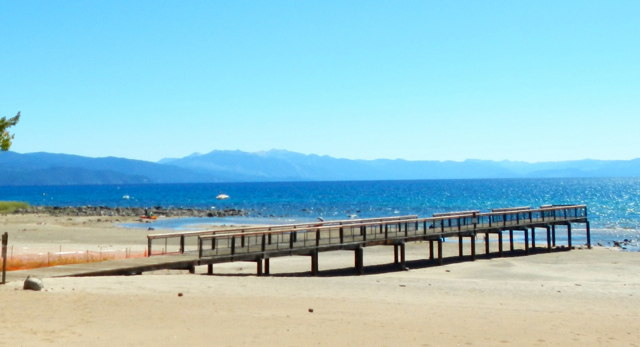
Rebuilding Kings Beach pier would ideally ensure it could be used by boaters even during a drought. Photo/LTN file

Rebuilding Kings Beach pier would ideally ensure it could be used by boaters even during a drought. Photo/LTN file

By Kathryn Reed

STATELINE – Providing more recreation access is the overriding reason to improve and extend the pier at Kings Beach, according to the landowners.

While State Parks and California Tahoe Conservancy are about to embark on the environmental process for this project, tied into it is creating an updated general plan for the Kings Beach State Recreation Area.

This 14-acre swath of lakefront last had a general plan written in 1980. That document only covers 7 acres, was 12 pages, with 1½ pages devoted to the environmental impact report. Today’s EIRs are usually at least an inch thick.

The general plan will include policies for the site. The event center is not part of the discussion other than how parking affects it. The building is owned by North Tahoe Public Utility District, however parking is on state property.

Where the pier will be rebuilt is still to be determined. Four main issues to be looked at in the environmental documents include fish habitat, scenic impacts, littoral processes and safety.

The depth and length of the pier will be dependent on where it is located and the orientation.

The plan is to have a portion be fixed on single pilings that will be attached to a floating pier. Three action alternatives are expected to be studied in the EIR/EIS that Ascent Environmental will put together.

State reps gave a presentation April 13 to the Tahoe Regional Planning Agency’s Advisory Planning Commission. The TRPA will have a say in the environmental impact statement and pier project, but not the general plan.

Lighting was one concern. The answer: only navigational lights will be on the pier.

Parking was another issue that was broached. State Parks technically closes the parking area at sunset. However, because this is used more like a community park, that policy may change.

The existing boat ramp has not been operational for years, mostly because of the water level. It’s future is also being considered.

Sue Rae Irelan with the CTC pointed out how the last time the ramp was open the town of Kings Beach looked much different. Boat trailers were parked on Highway 28. Now the highway has been improved, roundabouts added and trailer parking wouldn’t fit in.

Dredging was brought up. And while it’s possible to do so, the amount of sand that moves in and out of this section of the lake was called “dynamic” and therefore would require continual dredging.

One APC member asked about water transit. This would require a special use permit by State Parks and additional environmental review, along with more land side issues addressed.

“It would be a huge mistake to go through the process without considering a water transit option,” Steve Teshara, APC board chairman, said. As a planning consultant for the Truckee North Tahoe Transportation Management Association, he was instrumental in crafting a letter to the state agencies about water borne transit – even if it’s a shuttle and not the proposed lakewide ferry.

—–

Notes:

·      The deadline to comment on the notice of preparation is April 15.

·      More information is available online.

·      The draft environmental documents should be released in early 2017, with the final completed in summer 2017.


Calif., Nev. gas prices some of the highest in U.S.

California in March was the most expensive place to buy gasoline, with Nevada coming in third.

The national average was $2.06 per gallon. This was an increase of 33 cents from February, according to AAA.

In California the average price was $2.77 per gallon, while in Nevada it was $2.44.

Hawaii was the second highest at $2.62 per gallon.

— Lake Tahoe News staff report


Water woes divide Calif. into haves, have nots

By Tori Richards, U.S. News & World Report

LOS ANGELES — People have long predicted that California could eventually collapse into the ocean following a mega earthquake. Now, an eerily similar true-life scenario is playing out — but it’s thanks to the weather.

The Gold Rush State has sunk more than 45 feet since 1935 – something the U.S. government calls the “largest human alteration of the earth’s surface.” But earthquakes aren’t the cause. It’s happening because of excessive groundwater mining brought on by drought, and geologists say all the rain in the world won’t reverse cave-ins of dirt and rock in underground aquifers.

California is entering its fifth year of drought, with the past two years being the warmest on record. Several recent storms have dumped much needed water, but it’s barely made a dent. It will take several years of rain to bring the state out of its crisis mode regardless of how many spring showers occur. If the state gets the intense rain storms that Californians pray for, they will produce floods as the water has nowhere to go. But if the drought continues, things will just get worse.

Read the whole story


Suit: Grouse protections driven by politics, not science

By Scott Sonner, AP

Rural Nevadans suing to block the Obama administration’s sage-grouse protections say a trail of internal government documents shows politics was the driving force behind a pre-determined policy that flies in the face of its experts’ own best science.

Their latest motion filed in federal court in Reno seeks to void the protections that have severely restricted the development of millions of acres of federal land across 10 Western states.

Nevada Attorney General Adam Laxalt and lawyers for nine counties, ranchers and miners say three top Interior Department officials who dubbed themselves the “Grouseketeers” illegally sought input from conservationists outside the planning process.

They also say the U.S. Bureau of Land Management ignored its staff’s advice to reopen the process to prepare a supplemental environmental impact statement.


World’s powers worried water is running out

By Nathan Halverson, Reveal

Secret conversations between American diplomats show how a growing water crisis in the Middle East destabilized the region, helping spark civil wars in Syria and Yemen, and how those water shortages are spreading to the United States.

Classified U.S. cables reviewed by Reveal from the Center for Investigative Reporting show a mounting concern by global political and business leaders that water shortages could spark unrest across the world, with dire consequences.

Many of the cables read like diary entries from an apocalyptic sci-fi novel.

“Water shortages have led desperate people to take desperate measures with equally desperate consequences,” according to a 2009 cable sent by U.S. Ambassador Stephen Seche in Yemen as water riots erupted across the country.

On Sept. 22 of that year, Seche sent a stark message to the U.S. State Department in Washington relaying the details of a conversation with Yemen’s minister of water, who “described Yemen’s water shortage as the ‘biggest threat to social stability in the near future.’ He noted that 70 percent of unofficial roadblocks stood up by angry citizens are due to water shortages, which are increasingly a cause of violent conflict.”

Seche soon cabled again, stating that 14 of the country’s 16 aquifers had run dry. At the time, Yemen wasn’t getting much news coverage, and there was little public mention that the country’s groundwater was running out.

These communications, along with similar cables sent from Syria, now seem eerily prescient, given the violent meltdowns in both countries that resulted in a flood of refugees to Europe.

Groundwater, which comes from deeply buried aquifers, supplies the bulk of freshwater in many regions, including Syria, Yemen and drought-plagued California. It is essential for agricultural production, especially in arid regions with little rainwater. When wells run dry, farmers are forced to fallow fields, and some people get hungry, thirsty and often very angry.

The classified diplomatic cables, made public years ago by Wikileaks, now are providing fresh perspective on how water shortages have helped push Syria and Yemen into civil war, and prompted the king of neighboring Saudi Arabia to direct his country’s food companies to scour the globe for farmland. Since then, concerns about the world’s freshwater supplies have only accelerated.

It’s not just government officials who are worried. In 2009, U.S. Embassy officers visited  Nestle’s headquarters in Switzerland, where company executives, who run the world’s largest food company and are dependent on freshwater to grow ingredients, provided a grim outlook of the coming years. An embassy official cabled Washington with the subject line, “Tour D’Horizon with Nestle: Forget the Global Financial Crisis, the World Is Running Out of Fresh Water.”

“Nestle thinks one-third of the world’s population will be affected by fresh water scarcity by 2025, with the situation only becoming more dire thereafter and potentially catastrophic by 2050,” according to a March 24, 2009, cable. “Problems will be severest in the Middle East, northern India, northern China, and the western United States.”

At the time of that meeting, government officials from Syria and Yemen already had started warning U.S. officials that their countries were slipping into chaos as a result of water scarcity.

By September 2009, Yemen’s water minister told the U.S. ambassador that the water riots in his country were a “sign of the future” and predicted “that conflict between urban and rural areas over water will lead to violence,” according to the cables.

Less than two years later, rural tribesmen fought their way into Yemen’s capital, Sanaa, and seized two buildings: the headquarters of the ruling General People’s Congress and the main offices of the water utility. The president was forced to resign, and a new government was formed. Butwater issues continued to amplify long-simmering tensions between various religious groups and tribesmen, which eventually led to a full-fledged civil war.

Reveal reviewed a cache of water-related documents that included Yemen, Nestle and Saudi Arabia among the diplomatic documents made public by Wikileaks in 2010. Thomas Friedman, a columnist for The New York Times, found similar classified U.S. cables sent from Syria. Those cables also describe how water scarcity destabilized the country and helped spark a war that has sent more than 1 million refugees fleeing into Europe, a connection Friedman has continued to report.

The water-fueled conflicts in the Middle East paint a dark picture of a future that many governments now worry could spread around the world as freshwater supplies become increasingly scarce. The CIA, the State Department and similar agencies in other countries are monitoring the situation.

In the past, global grain shortages have led to rapidly increasing food prices, which analysts have attributed to sparking the Arab Spring revolution in several countries, and in 2008 pushed about 150 million people into poverty, according to the World Bank.

Water scarcity increasingly is driven by three major factors: Global warming is forecast to create more severe droughts around the world. Meat consumption, which requires significantly more water than a vegetarian or low-meat diet, is spiking as a growing middle class in countries such as China and India can afford to eat more pork, chicken and beef. And the world’s population continues to grow, with an expected 2 billion more stomachs to feed by 2050.

The most troubling signs of the looming threat first appeared in the Middle East, where wells started running dry nearly 15 years ago. Having drained down their own water supplies, food companies from Saudi Arabia and elsewhere began searching overseas.

In Saudi Arabia, the push to scour the globe for water came from the top. King Abdullah decreed that grains such as wheat and hay would need to be imported to conserve what was left of the country’s groundwater. All wheat production in Saudi Arabia will cease this year, and other water-intensive crops such as hay are being phased out, too, the king ruled.

A classified U.S. cable from Saudi Arabia in 2008 shows that King Abdullah directed Saudi food companies to search overseas for farmland with access to freshwater and promised to subsidize their operations. The head of the U.S. Embassy in Riyadh concluded that the king’s goal was “maintaining political stability in the Kingdom.”

U.S. intelligence sources are quick to caution that while water shortages played a significant factor in the dissolution of Syria and Yemen, the civil wars ultimately occurred as a result of weak governance, high unemployment, religious differences and the wars in Iraq and Afghanistan, in addition to water shortages.

For instance, the state of California has endured a record drought without suffering an armed coup to overthrow Gov. Jerry Brown.

But for less stable governments, severe water shortages are increasingly expected to cause political instability, according to the U.S. intelligence community.

In a 2014 speech, U.S. Director of National Intelligence James Clapper said food and water scarcity are contributing to the “most diverse array of threats and challenges as I’ve seen in my 50-plus years in the intel business.

“As time goes on, we’ll be confronting issues I call ‘basics’ resources – food, water, energy, and disease – more and more as an intelligence community,” he said.

These problems are not just happening overseas, but already are leading to heated political issues in the United States. In the western part of the country, which Nestle forecast will suffer severe long-term shortages, tensions are heating up as Middle Eastern companies arrive to tap dwindling water supplies in California and Arizona.

Almarai, which is Saudi Arabia’s largest dairy company and has publicly said it’s following the king’s directive, began pumping up billions of gallons of water in the Arizona desert in 2014 to grow hay that it exports back to the Middle East. Analysts refer to this as exporting “virtual water.” It is more cost effective to use the Arizona water to irrigate land in America and ship the hay to Saudi Arabia rather than filling a fleet of oil tankers with the water.

Arizonans living near Almarai’s hay operation say their groundwater is dropping fast as the Saudis and other foreign companies increase production. They are now worried their domestic wells might suffer the same fate as those in Syria and Yemen.

In January, more than 300 people packed into a community center in rural La Paz County to listen to the head of the state’s water department discuss how long their desert aquifer would last.

Five sheriff’s deputies stood guard at the event to ensure the meeting remained civil – the Arizona Department of Water Resources had requested extra law enforcement, according to county Supervisor Holly Irwin.

“Water can be a very angry issue,” she said. “With people’s wells drying up, it becomes very personal.”

Thomas Buschatzke, Arizona’s water director, defended the Saudi farm, saying it provides jobs and increases tax revenue. He added that “Arizona is part of the global economy; our agricultural industry generates billions of dollars annually to our state’s economy.”

But state officials admit they don’t know how long the area’s water will last, given the increased water pumping, and announced plans to study it.

“It’s gotten very emotional,” Irwin said. “When you see them drilling all over the place, I need to protect the little people.”

After the meeting, the state approved another two new wells for the Saudi company, each capable of pumping more than a billion gallons of water a year.

Back in Yemen in 2009, U.S. Ambassador Seche described how as aquifers were drained, and groundwater levels dropped lower, rich landowners drilled deeper and deeper wells. But everyday citizens did not have the money to dig deeper, and as their wells ran dry, they were forced to leave their land and livelihoods behind.

“The effects of water scarcity will leave the rich and powerful largely unaffected,” Seche wrote in the classified 2009 cable. “These examples illustrate how the rich always have a creative way of getting water, which not only is unavailable to the poor, but also cuts into the unreplenishable resources.”



South Shore ambulance legal sparing escalates

By Lake Tahoe News

With the threat of a lawsuit from El Dorado County, the Cal-Tahoe Joint Powers Authority board this week voted to hire an attorney.

The JPA is responsible for providing ambulance service to the California side of the South Shore. South Lake Tahoe and Lake Valley fire departments are the agencies of the JPA, each with two voting members on the board.

South Lake Tahoe agreed to staff its ambulances until July 1. The city had threatened to stop doing so this month, and to pull out of the JPA. Monetary reimbursement from the county is the catalyst to do so.

In an effort to reduce expenses, city ambulances are staffed with paramedics and emergency medical technicians. Lake Valley continues to use firefighter-paramedics.

The city made it clear it still wants out of the ambulance business.

Still to be resolved is South Lake Tahoe’s proposal it made at the meeting, which includes giving its stake in the consortium, including personnel, to the JPA. Fire Station 2 would be available to the JPA at least through 2019.

The proposal further states, “This transfer of personnel would not harm Lake Valley’s desire to run Medic 7 in their current configuration and would relieve the city from being in the ambulance transportation business. The city would still provide paramedic engine response within the city as part of this proposal and would be available as part of mutual aid.”

Other action at the April 11 meeting included:

·      Six cardiac monitors will be purchased.

·      The board is reviewing dispatch proposals from CalFire and the city with the hope the county will increase the reimbursement.


TRPA Regional Plan’s status up to appellate judges

Whether the environmental impact statement for the Tahoe Regional Planning Agency’s Regional Plan update failed to analyze how the document negatively impacts soil conservation, water quality and air quality is at the heart of legal case that is in the hands of the Ninth Circuit Court of Appeals.

Both sides of the lawsuit gave oral arguments April 12 in San Francisco.

Environmental groups believe the plan, which was adopted in December 2012, promotes more growth, including in areas not already developed. Sierra Club and Friends of the West Shore filed the lawsuit in early 2013. No one from either organization was available for comment.

TRPA won that initial lawsuit in U.S. District Court. It was then appealed.

There is no time line for the appellate court judges to make a ruling. They have Tuesday’s oral testimony, briefs, administrative record and District Court ruling to use to make their decision.

“We are confident the court will find our Regional Plan is based on sound science, planning, and analysis. It represents the best path forward for TRPA to accomplish its mandate to restore Lake Tahoe’s environment and make our communities more sustainable,” said Joanne Marchetta, executive director at TRPA, said in a statement.

— Lake Tahoe News staff report


Conner seeks equal treatment from SLT staff

By Kathryn Reed

An El Dorado County Superior Court judge inadvertently limited South Lake Tahoe Councilwoman JoAnn Conner’s interaction with city staff.

Judge Steve Bailey on April 12 said email is the only way Conner, when acting as a citizen and not an elected official, may contact any employee at the city. Prior to then she was allowed to call, even see some of them in person.

JoAnn Conner

JoAnn Conner

Jacqueline Mittelstadt, Conner’s attorney, requested the ex parte hearing. Such a hearing must be heard within 24 hours and is usually done so in more life and death situations, or something dire.

For Conner, the urgency revolved around an event she is putting on at the city’s rec center. Her contention was the city has been making it difficult for her to do her regular job.

Bailey agreed Conner should not be hindered from making a living. His answer was for Conner to be allowed to contact department heads by email as well as the city attorney and city manager.

While the expansion to department heads is new since City Manager Nancy Kerry issued an edict last fall banning Conner from interacting with anyone but herself or the city attorney, the irony is Kerry is by default the head of the recreation department. This is the sector of the city Conner regularly engages because it’s where she stages events.

Bailey cited how limiting Conner’s ability to make a living would be relegating her to a second-class citizen and that he found it “troubling” the city would dictate with whom residents could speak.

In an odd discourse, Bailey dropped the names Duane Wallace and Dave Borges, two well-known South Lake Tahoe residents, asking what if they were denied the ability to do their jobs because the city dictated who they could interact with.

(Bailey hosted a political fundraiser earlier this month for a judicial candidate at which Wallace, Borges, Conner and Mittelstadt were in attendance.)

What was missing from Tuesday’s hearing was any evidence supporting or refuting Conner’s claims. This is normal in this type of procedure, but it left Bill Chisum, outside counsel for the city, with little room to make an argument.

Documents were submitted by the city that did not appear to have been relevant at this juncture.

In Kerry’s declaration to the court she outlined how it’s true Conner is treated differently – she has her emails and requests responded to in a matter of hours instead of days, which is more customary.

The defense counsel wrote, “It is difficult to understand petitioner’s complaints when she fails to take simple acts like picking up the application packet.”

An evidentiary hearing is scheduled for late May. At that time the city’s request to have Mittelstadt dismissed because of a conflict of interest will also be heard.

The whole legal brouhaha started last year with the other four council members censuring Conner as well as the city manager’s ruling to limit Conner’s access to staff. These decisions came about because city staff felt harassed by Conner; and others – including her council colleagues – were tired of verbal abuse.

The judge on Tuesday told Conner not to harass anyone, not to destroy city property, no stalking and more than a half dozen other no-no’s when it came to her behavior.


Rockslide blocks Hwy. 50 near Meyers

Rockfall covers Highway 50 near Echo Summit on April 12. Photo/Julie Threewit

Rockfall covers Highway 50 near Echo Summit on April 12. Photo/Julie Threewit

Highway 50 is expected to be open by 8pm Tuesday after large boulders fell from the mountainside.

Julie Threewit of Meyers described it as “significant.” Her 4Runner was barely able to make it past the rock debris. She said two rocks were the size of a small car.

The slide occurred about 6pm April 12 just beyond the split for Echo Road.

“I have great respect for the stretch of highway,” Threewit told Lake Tahoe News.

According to the California Highway Patrol, no vehicles were damaged nor people injured.

— Lake Tahoe News staff report


La Niña prediction bad news for Calif.

By Eric Holthaus, Slate

With a monstrous and record-setting El Niño on the wane, the implications of its disastrous worldwide consequences are starting to settle in. But there’s new evidence that, on its heels, a potentially strong La Niña could emerge later this year—bringing with it a renewed stretch of extreme weather.

Last week, the National Multi-Model Ensemble, a blend of the most reliable seasonal forecasts available, showed the clearest signal yet that tropical Pacific waters will cool rapidly over the next six months, likely ushering in La Niña conditions.

La Niñas are typically bad news for California, and this coming winter shouldn’t be any different: All seven components of the NMME are pointing toward a below-normal start to this winter’s rainy season there, and continued pressure from global warming will ensure that storing snow will be especially challenging this year too.

Read the whole story