Dems line up behind McClintock challenger

By Susan Wood

More than 60 people packed a Lake Tahoe Community College room Thursday night to hear Bob Derlet, a Democrat running for the 4th Congressional district, provide a better prescription for government.

He’s running against Rep. Tom McClintock, an Elk Grove Republican who’s been in the seat since 2008 and logged 22 years in the California Legislature before that, having started at age 26 in the Assembly.

When asked by Lake Tahoe News how he plans to unseat an entrenched McClintock when others like retired military officer Charlie Brown failed, Derlet amped up his tone.

“I think people are tired of McClintock. It’s time for a change. This is going to be the most dramatic election we’ll remember in a lifetime, and we’re gonna do it,” Derlet, 66, of El Dorado Hills said as if he’s part of a Democratic movement as a whole.

This race in particular may be difficult. The 4th District is large, encompassing the Sierra Nevada from Truckee to the Sequoia National Forest including Alpine, Amador, Calaveras, El Dorado, Mariposa and Tuolumne, with portions of Fresno, Madera, Nevada and Placer counties. The sprawling region can be a bit overwhelming to a Democrat because it’s half Republican voters, 35 percent Democrat and 15 percent declined to state.

“We’ve got to go after that 15 percent,” Derlet said.
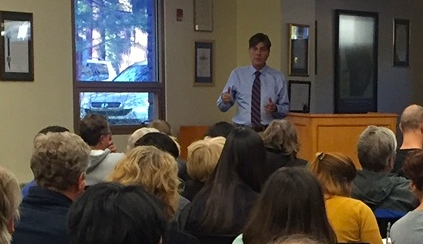
Bob Derlet wants to be the next congressman to represent the California side of Lake Tahoe. Photo/Susan Wood

Bob Derlet wants to represent the California side of Lake Tahoe in Congress. Photo/Susan Wood

There may be a light at the end of the tunnel. The June 7 primary is non-partisan in California, so the two top vote-getters will move on to the Nov. 8 general election – and that will be the real race, Derlet contends. The only other opponent in the primary is Democrat Sean White.

Statistics aside, South Lake Tahoe resident and environmental advocate John Friedrich told Derlet he believes it is “unconscionable” Lake Tahoe, Yosemite and other areas of the Sierra Nevada Mountain Range are represented in the federal government by “a Grade A climate change denier.”

To that, Derlet pledged the global warming phenomenon as a larger priority, joining education, wage equity, consumer rights, Social Security protection, women’s issues and especially health care as other focuses. On the latter, the long time physician admitted to Lake Tahoe News after the April 21 meeting that more work needs to be done on the Affordable Care Act with a monetary shift from administrative to care, but having millions insured when they weren’t before is testimony in itself to good federal policy.

But he spoke to the core of the Tahoe audience when he lauded climate change as “up there” in priorities.

“If global warming is not a priority, what’s the alternative?” he asked.

The South Tahoe Chapter of the Citizens’ Climate Lobby, Tahoe Area Sierra Club and LTCC Ecology Club sponsored the town hall meeting.

Derlet’s occasional declaration brought out cheers and applause from the issues-friendly audience. The cheerleading session made up for the lack in substance in how to address the change that he believes needs to occur.

Some attendees echoed the passion, with one man suggesting using McClintock’s failed natural resources management policies to edge out the career politician.

Another appeared concerned about the Democratic Party, believing it’s divided.

“I think after the conventions, people will come together,” Derlet insisted.

Albeit friendly to his cause, the audience came across more informed than most and at times pressed Derlet to step up the campaign. One person reminded Derlet afterward that he should have asked for money.

In recognizing he’s a little-known candidate, Derlet told Lake Tahoe News his campaign will ramp up soon with signs, more gatherings such as this one and messages in the media.

At age 8, Derlet’s first job involved selling newspapers at the very busy corner of Santa Monica and Vine boulevards in Hollywood. Later in life, he became a physician, eventually leading him to the Me-Wuk Indian Health Center in Tuolumne City. It was there he heard the plights of his patients that prompted him to get into politics.

“I care about people. They need to be protected,” he said.

Derlet comes across with a pleasant, mild-mannered approach. Some would like to see him become a little more aggressive.

“I think he needs to go after McClintock,” resident Kim Carr said after the meeting.

She’s worried about the traditionally low losing rate of incumbents.

“He’s going to have to work hard to get his name out. That’s the dilemma we’re in,” she said.

But there is a bright side.

“I think people are tired of do nothing politics. I think the fact the Republican Party is having a hard time getting behind its candidates with so many factions helps (Derlet’s run),” she added.

Most concurred it’s an interesting time for politics.

“I think the entire election system could be thrown in the air, and anything could happen,” longtime local Laurel Ames said.


Court: Calif. students have no ‘right’ to quality education

By Bob Egelko, San Francisco Chronicle

A divided state appeals court ruled Wednesday that California’s anemic level of school funding does not violate students’ constitutional right to an education of “some quality” because no such right exists.

The 2-1 decision by the First District Court of Appeal in San Francisco upheld a judge’s dismissal of a suit filed by some of the state’s major participants in public education — school boards and administrators, the California Teachers Association and State PTA, and nine school districts, including San Francisco and Alameda. The plaintiffs argued that a state that trails nearly every other state in per-pupil spending, staffing and student achievement violates California’s 1879 constitutional guarantee of a school system that encourages “the promotion of intellectual … improvement.”

Similar suits have been filed in other states, and a majority have been successful, with courts in at least six states finding that their school finance systems violated students’ rights. The San Francisco court said the right to a public education, guaranteed by the California Constitution, does not include a right to any particular level of educational quality or funding.

Read the whole story


NV Energy among top companies to install solar

By Jessica Garcia, Reno Gazette-Journal

NV Energy has been named as one of the select group of energy companies that connected the most megawatts of solar energy to the power grid in the United States in 2015, earning a spot on the annual Top 10 utility solar lists compiled by the Smart Electric Power Alliance, formerly the Solar Electric Power Association.

In survey results released this month, NV Energy ranked No. 7 among investor-owned utilities.

The company had added 224 megawatts of installed solar capacity in 2015 alone. The 2015 listings are the fourth time that NV Energy has made SEPA’s Top 10 list.

Read the whole story


Cameras around Tahoe change fight against wildfires

By Scott Sonner, AP

A growing network of cameras trained on the mountains around Lake Tahoe is changing the way crews fight Western wildfires by allowing early detection that triggers quicker, cheaper, more tactical suppression than traditional war-like operations, experts said Wednesday.

The high-definition cameras can be operated remotely to pan, tilt and zoom in the search for the first wisps of smoke in remote areas, said Graham Kent, director of the Nevada Seismological Laboratory.

Equipped with real-time and time-lapse imagery, the cameras piggyback on an existing network that detects earthquakes, Kent told the annual meeting of the Seismological Society of America in Reno.

Last summer, a half-dozen of the hazard cameras at Tahoe were credited with the discovery of six fires and provided early intelligence on more than 25, Kent said.

“The old style of firefighting is like storming the beach at Normandy, but if you can get on a fire early, with special tools, then it becomes more like a special forces situation,” Kent said. “Firefighting is going to become much more tactical.”

He said he’s currently working with firefighters in Idaho and Montana to develop similar networks.

Frank Vernon, a research geophysicist at the Scripps Institution of Oceanography at UC San Diego, began developing the “virtual fire lookout towers” in 2002 when he and others built a large-scale, wireless network in Southern California.

It now includes more than 64 fixed mountaintop cameras in 16 remote locations across San Diego, Riverside and Imperial counties.

“Working with partners to provide this technology to the community is vitally important as extreme drought conditions, warmer weather and more frequent Santa Ana wind events have all contributed to increased wildfire activity and longer fire seasons each year in Southern California,” Vernon said.

The multi-hazard function of the cameras is especially valuable to communities such as Lake Tahoe and Reno that border wildlands,

“The big three for us are floods, fires and earthquakes,” said Kyle West, safety and training manager in Reno. The city is located in Washoe County, where officials recently updated their hazard mitigation plan.

Kent said officials hope to have more than 20 of the cameras up and operating by the end of this year.

“The notion of fire cameras has been out there for 20 years. But they were mostly closed circuit, analogue systems with poor resolution,” Kent said.

The video feeds are available to state, local and federal firefighters and can be viewed by the public on the AlertTahoe website.

UNR scientists are working on technology to use “machine vision — to teach computers to spot the fires without humans,” Kent said.

“We’re sort of crowd-sourcing lookout towers,” he said. “Anybody in this room, if they are feeling anxious or just have a premonition, they can go onto AlertTahoe, right click on the camera pane and see the time lapse. We could have hundreds of people searching for fires at any one time — people who are just basically concerned.”


Wildfires no longer confined to one season

By New York Times

The first Alaska wildfire of 2016 broke out in late February, followed by a second there just eight days later.

New Mexico has had 140 fires this year, double the number in the same period last year, fueled by one of the warmest, driest winters on record.

And on the border of Arizona and California this month, helicopters dumped water on flames so intense that they jumped the Colorado River, forcing the evacuation of two recreational-vehicle parks.

Fires, once largely confined to a single season, have become a continual threat in some places, burning earlier and later in the year, in the United States and abroad. They have ignited in the West during the winter and well into the fall, have arrived earlier than ever in Canada, and have burned without interruption in Australia for almost 12 months.

Read the whole story


Cadre of people working to keep Tahoe clean

By Kathryn Reed

A whole lot of trash talk was going on Wednesday afternoon in South Lake Tahoe.

Those tasked with cleaning up after the rest of us spoke about how the plastic bag ban in the city is working, trash left out for animals to rummage through is still a problem, and that Tahoe does have a bit of a garbage problem.

South Tahoe Refuse in 2014 took in 10 tons of film plastic – the category plastic bags fall into. In 2015, that number fell to 6.6 tons.

While the South Shore garbage company is seeing fewer grocery store bags since the city implemented the ban, there has been an increase in reusable plastic bags – the thicker ones. The value of them is next to nothing when it comes to STR recycling them. Some stores have gone to paper only, like BevMo and Ross.

An advantage to paper is that it breaks down and the money is slightly better as a commodity.

Jeanne Lear with STR explained that to reuse plastic the original item must be shredded, washed, dried, made into pellets and then repurposed.

She said Coca-Cola is developing plant-based bottle to try to get away from using fossil fuels.

Marilee Movius with the League to Save Lake Tahoe touched on the five large masses of plastic floating in the oceans, with the biggest being off the Pacific Coast. Plastic isn’t biodegradable. It just breaks apart into tiny pieces that animals can ingest, and litters the land and waterways.

Her mantra is to not only reduce, reuse and recycle, but to also redesign and refuse. The latter means bringing a bottle, bag, utensils and other items so they are used multiple times instead of being discarded after one use.

The League has also been instrumental in hosting cleanup days throughout the basin – mainly at beaches.

Also at the April 20 talk at Lake Tahoe Community College were reps from Clean Tahoe and Tahoe Regional Planning Agency.

Catherine Cecchi of Clean Tahoe, a nonprofit operating on the California side of the South Shore, last year collected 490 cubic yards of litter that had been illegally dumped. Her crews pick up trash in neighborhoods and along the roads. Mattresses and appliances are often abandoned.

In 2015, Clean Tahoe dealt with more than 600 animal–trash incidents.

“It’s a major problem,” Cecchi said. It’s locals, tourists, owners and renters, single family and multi-family, as well as commercial entities that are putting out trash before pick up day or having dumpsters overflow.

Devin Middlebrook with TRPA spoke about the collaborative effort under way called Take Care. It’s aimed at those who don’t have common sense manners – the ones leaving trash behind, throwing cigarette butts off ski lifts or grinding them into the sand and leaving them on the beach, and not picking up after their dogs. The messages are clever, like “Nobody wants to see your dirty butt” and “If it’s your dog, then it’s your doody”.

—–

Notes:

·      Earth Day is being celebrated April 23 at Bijou Community Park in South Lake Tahoe from 10am-3pm.

·      Dump Day is June 4. For $5, people may unload a pickup worth of trash at South Tahoe Refuse.

·      Report litter issues to Clean Tahoe online.

·      More info about the Take Care campaign is online.

·      The League to Save Lake Tahoe is having a community cleanup day near Heavenly Village on April 22. Go online for details and to sign up.


Study: Teen e-cigarette use on the rise

By Sabrina Tavernise, New York Times

WASHINGTON — E-cigarette use continued to rise among young teenagers and preteens in the United States last year, according to federal data, but cigarette smoking overall did not increase, suggesting that, at least so far, fears that the devices would hook a new generation on traditional cigarettes have not come to pass.

Experts said it was too soon to answer the essential question about e-cigarettes: Will they cause more or fewer people to smoke? But the broad trend in youth cigarette smoking has been down in recent years, and researchers have been taking note of that.

About 5 percent of middle-school students reported using e-cigarettes in 2015, up from about 4 percent in 2014, according to data from the Centers for Disease Control and Prevention. That is a substantial increase from 2011, when less than 1 percent of middle schoolers used the devices.

Read the whole story


Squaw faces community opposition to expansion

By Brad Branan, Sacramento Bee

Squaw Valley CEO Andy Wirth knows how to stay calm under pressure.


Since coming to Squaw in 2010 to lead the resort in its “next phase of growth,” Wirth made the decision to buy Alpine Meadows, the ski resort just south of Squaw. He introduced a plan to link the resorts with a gondola next to the federally protected Granite Chief Wilderness. Wirth’s plans for Squaw Valley include a substantial increase in residential and overnight housing, new bars and restaurants and a 108-feet-tall, 90,000-square-foot “mountain adventure center.”

Costs are difficult to estimate because the project will be built over 25 years by developers who will buy rights to the land from Squaw, Wirth said. Squaw Valley’s goal is to bring more skiers to the mountain, not make money from real estate, he added.

More than 300 people and several agencies commented on an environmental review of the project, and most were critical, said Tom Mooers, executive director of Sierra Watch, a nonprofit that has been a leading critic of Wirth and the project. The Placer County Board of Supervisors will eventually be asked to sign off on the project.

Read the whole story


No solution to West Shore paving problem

El Dorado County does not have a permanent solution for the road-resurfacing debacle on the West Shore.

County staff and Supervisor Sue Novasel last week met with more than 60 frustrated residents of the Tahoma area about the crumbling roads. The chip seal work done last fall on 21 miles of roads didn’t seal.

The material is sticky and is being spread by vehicles into neighborhoods. It’s also getting into the fur of animals and inadvertently being transported into homes.

Officials still don’t know why the project failed . That is in large part why a solution has not been found.

Earlier this year the county said slurry seal would fix the problem. That is now off the table. Without a solution, there is no time line to fix the problem.

While the roads continue to deteriorate, the county will have sweepers out more often to pick up the debris as well as sanders to cover the sticky oil.

— Lake Tahoe News staff report


Report: Reno air quality getting worse

Reno tied for 11th-most polluted city in the nation for short-term particle pollution in a study done by the American Lung Association.

Compared to the 2015 State of the Air report, Reno has seen an increase in short-term particle pollution. That report covered 2011-13, while the 2016 report is for 2012-14. The 2016 report also found year-round particle pollution levels significantly higher than the previous report.

Many of these spikes in Reno were directly linked to wildfires.

Researchers said increased heat, changes in weather patterns, drought and wildfires are all related to climate change, which has contributed to the extraordinarily high numbers of days with unhealthy particle pollution in some cities, including Reno.

“The 2016 State of the Air report finds unhealthful levels of ozone in Reno, putting our local citizens at risk for premature death and other serious health effects such as asthma attacks and cardiovascular harm. And, since we have such high levels of year-round particle pollution, our citizens face increased risk for lung cancer,” Frankie Vigil, executive director of the American Lung Association in Reno, said in a statement. “Across the nation, the report found continued improvement in air quality, but more than half of the people in the United States live in counties that have unhealthful levels of either ozone or particle pollution.”

The report focuses on ozone pollution and particle pollution. The report analyzes particle pollution through average annual particle pollution levels and short-term spikes in particle pollution.


“Particle pollution is made of soot or tiny particles that come from coal-fired power plants, diesel emissions, wildfires and wood-burning devices. These particles are so small that they can lodge deep in the lungs and trigger asthma attacks, heart attacks and strokes, and can even be lethal,” said Vigil. “Year-round particle pollution levels have dropped thanks to the cleanup of coal-fired power plants and the retirement of old, dirty diesel engines.”

— Lake Tahoe News staff report