NorCal towns lack resources to handle oil train fires, spills

By Jane Braxton Little, Sacramento Bee

BNSF Railway trains carrying crude oil and other hazardous materials rumble through this Lassen County community every day – past homes, churches and a scant block from the downtown commercial center.

If a tank car were to derail and explode, Westwood Fire Chief Forest Duerksen would take the only action he’s equipped for: Evacuation. Of all 1,000 residents.

Rural officials like Duerksen have been worried for decades about the chlorine, ammonia, propane and crude oil transported through their Northern California communities by BNSF and Union Pacific Railroad. But a dramatic surge in production in oil fields in the Midwest and Canada increased the volume from about 10,000 railroad tank cars in 2008 to nearly half a million in 2014. In 2015, the U.S. Energy Information Agency reported a 1,700 percent increase in crude oil transportation by rail.

The trains would run through Roseville, downtown Sacramento, West Sacramento, downtown Davis, Dixon and other cities. East of Roseville, the route is uncertain. Trains could arrive via Donner Summit, Feather River Canyon, or through the Shasta and Redding areas.

Read the whole story


Calif. jurors misusing Internet could face fines

By Sudhin Thanawala, AP

Jurors who threaten to derail trials by researching them on Google or posting comments about them on Twitter are often dismissed with nothing more than a tongue-lashing from a judge.

But that may soon change in California. Legislation supported by state court officials would authorize judges in some counties to fine jurors up to $1,500 for social media and Internet use violations, which have led to mistrials and overturned convictions around the country.

As jurors and judges have become more technology savvy in recent years, the perils of jurors playing around with their smartphones have become a mounting concern, particularly in technology-rich California. A 2011 state law made improper electronic or wireless communication or research by a juror punishable by contempt.

Supporters of the latest California measure say a potential fine would give teeth to existing prohibitions against social media and Internet use and simplify the process for holding wayward jurors accountable.

“It’s disruptive of the judicial process, and there ought to be a fairly simple and convenient way for a judge to sanction a juror based on the order that the judge has given,” said Assemblyman Rich Gordon, D-Menlo Park, who authored the legislation.

But critics question whether it will have any practical effect on jurors who are constantly on sites such as Facebook and Twitter and suggest judges vet the social media activity of potential jurors before seating them.

“If you have an Internet addict who just can’t psychologically stop, you may want to excuse that person,” said Paula Hannaford-Agor, who studies juries at the National Center for State Courts.

Brian Walsh, a judge in the Silicon Valley county of Santa Clara, said a fine could also change the dynamic between judges and juries.

“You want to present the jurors’ obligations to serve as an inviting opportunity to participate in the democratic process,” he said. “One could consider it counterproductive to be laying out all the penalties a juror can incur if they blow it.”

It is not clear exactly how many times juror social media or Internet use has affected trials. But anecdotal evidence suggests it is more than sporadic.

Eric Robinson, co-director of the Press Law and Democracy Project at Louisiana State University, said he used to track cases of juror social media or Internet misconduct using news accounts and other sources, but there were so many “it got to be more trouble than it was worth.”

“Those are the ones we hear about,” he said. “I’m sure it happens a lot more.”

An Arkansas court in 2011 threw out a death row inmate’s murder conviction in part because of Tweets. One said “Choices to be made. Hearts to be broken.” Another said “It’s over” less than hour before the jury announced its verdict.

A New Jersey appeals court in 2014 tossed the heroin possession conviction of two men after a juror was accused of searching the defendants’ names online and finding information about their criminal records.

A California appeals court in January cited juror Internet research in throwing out a fraud conviction against an investment firm CEO. The juror looked up a case involving an accountant the defendant blamed for the fraud.

Judges warn jurors against using social media and the Internet, and have the power to hold them in contempt if they violate those rules.

Greg Hurley, a lawyer who studies juries at the National Center for State Courts, said he is unaware of any state that fines jurors outside the contempt process.

California judges say the contempt process can be time consuming and is rarely invoked. A juror facing contempt has a right to an attorney, and the court could get bogged down in a lengthy formal hearing. So judges often opt to replace a wayward juror with an alternate to keep the proceedings moving.

“Historically, contempt has been something judges are told, ‘Don’t do,'” said J. Richard Couzens, a retired judge from California’s Placer County who now rotates through courts around the state. “You have to follow so many rules to institute a contempt process.”

Couzens, a member of the judicial committee that recommended the fines legislation, said he dismissed a juror years ago in a theft case for using a cellphone to figure out the value of a stolen item.

The fine would be similar to a traffic citation, making it relatively easy to dispense, Couzens said.

Judges could mention it when warning jurors against Internet and social media use, said Steve Austin, presiding judge in California’s Contra Costa County.

“At the very least with the sanction, it would be a good thing you’d be able to tell the jurors,” he added.

The legislation initially called for giving all state judges the power to fine wayward jurors. But it was scaled back after legislators expressed concern that it could dissuade potential jurors from serving.

The bill now authorizes the judiciary to select some county courts for a five-year pilot program, which a legislative analysis said could save participating courts money. It is before the full assembly.



Comments sought on Squaw-Alpine gondola

Tahoe National Forest is about to begin the environmental review process for the proposed Squaw Valley to Alpine Meadows gondola.

In September, the Forest Service received the application from Squaw Valley Ski Holdings to install, operate, and maintain an aerial ropeway system connecting Squaw Valley and Alpine Meadows ski areas. This proposal also included an alteration to current avalanche mitigation techniques including the installation of Gazex exploders.

If the gondola were approved, it would require an amendment to an existing special use permit for Alpine Meadows Ski Area. The proposal is consistent with the resort’s master development plan. The Forest Service said it passed the screening criteria for consideration to use National Forest System lands and amend the existing permit consistent with Forest Service land use regulations.

A full description of the project, including maps, is available online.

The purpose of the scoping period is for interested parties to provide early and meaningful participation on this project and to learn more about the project. Respondents should include: (1) name, address, telephone number, and organization represented, if any; (2) reference the “Squaw Valley to Alpine Meadows Base-to-Base Gondola Project” and (3) specific facts, concerns or issues, and supporting reasons why they should be considered.

Written comments must be submitted via mail to scoping_comment@squawalpinegondola-eis.com.

Two public meetings will be held on May 9 to gather comments on the scope of the project. Both meetings will be at the Resort at Squaw Creek, Monument Peak Room, 400 Squaw Creek Road, Olympic Valley. The first meeting will be from 2-4pm and the second from 6-8pm. These meetings will be held jointly with Placer County regarding their analysis of the project under the California Environmental Quality Act. Representatives from the Tahoe National Forest, Squaw Valley Ski Holdings, LLC, and Placer County will be present to answer questions and provide additional information on this project.


Ballot measure would end NV Energy monopoly

By Michelle Rindels, AP

A proposed ballot measure called the Energy Choice Initiative aims to deregulate electrical service in Nevada, opening up the market to providers other than NV Energy — the sole provider in most parts of the state. Here’s how it came about and what it could mean for consumers.

Nevada laws allow investor-owned utility companies to be monopolies in their service territories. The governor-appointed members of the Nevada Public Utilities Commission act as a substitute for the competitive forces of the market, approving or rejecting rate changes so companies like NV Energy can make a reasonable profit but aren’t gouging customers.

The regulated monopoly model has emerged over the past century as the state sought to make it worth companies’ while to bring expensive electrical infrastructure to Nevada, but critics say the model is outdated as it becomes cheaper to generate energy and as renewable energy sources become more mainstream.

The initiative petition would enshrine in the Nevada Constitution the right for customers to choose their energy provider and to produce their own power to sell to others. It directs the Nevada Legislature to pass laws authorizing an open, competitive electricity market by mid-2023.

The proposed constitutional amendment notes that lawmakers don’t need to deregulate electricity transmission or distribution. That means businesses and homes might buy electricity from different providers, but a single company could control all of the power lines in a given service territory.

Several major Nevada companies have tried to leave NV Energy’s network in recent years and make or find their own power. They include Wynn Resorts, MGM Resorts and Las Vegas Sands, which consume massive amounts of electricity at their 24/7 casinos and might be able buy cheaper power on wholesale markets.

The Public Utilities Commission allows the companies to leave the grid but is charging them one-time “exit fees” of $86.9 million for MGM, $15.7 million for Wynn and $23.9 million for Sands, with the potential of additional fees in the future.

Regulators say big companies’ departures could leave the broader customer base stuck with the bill for infrastructure that takes decades to pay off, and was built assuming big companies — which account for 7 percent of the utility’s customer base — would keep paying into the system.

The companies have challenged the fees but so far haven’t prevailed.

A PAC called Nevadans for Affordable, Clean Energy Choices filed the initiative petition in February, but the group has not identified its backers and isn’t required to disclose its donors until May 24. Among the companies who have recently pushed to leave the monopoly, MGM Resorts officials say they are not associated with the initiative, while Wynn Resorts officials say the company hasn’t taken a position on the measure or contributed to the PAC.

Representatives for the Las Vegas Sands declined to comment when asked whether they supported the ballot measure or donated to the affiliated PAC.

Electric carmaker Tesla and data storage company Switch have publicly supported the measure, saying it fits in line with their company values and would create opportunities in renewable energy.

NV Energy is not fighting the measure. CEO Paul Caudill says the company wants what’s best for Nevada and is willing to “work in a constructive fashion” on the issue of deregulation.

Lawmakers laid the groundwork to deregulate Nevada’s electrical utilities in the late 1990s and early 2000s.

But as Nevada worked toward that goal, instability emerged in neighboring California’s newly deregulated electrical markets. Electrical bills spiked and power shortages led to rolling blackouts during the energy crisis in 2000 and 2001.

Amid fears deregulation was too risky, then-Gov. Kenny Guinn halted the project in Nevada.

Petition supporters need to gather about 55,000 valid signatures from Nevada voters to qualify the measure for the November ballot. The deadline to submit the signatures to the counties for verification is June 21.

If the measure meets the signature threshold, it must prevail on the 2016 and 2018 ballots before it becomes part of the state constitution.

PAC lawyer Matt Griffin says the petition has been well-received, but couldn’t say how many signatures it’s gathered yet.

The measure comes at a time when Nevada consumers are especially tuned in to energy issues. Regulators approved higher rates last year for customers with rooftop solar panels, and solar companies that laid off workers because of the change are supporting a separate, widely publicized ballot measure to reverse the rate change.

Deregulation has taken different forms in the numerous states that have pursued it, and experts say it can be a good or a bad thing for consumers depending on how it’s executed. Opening up an electricity market can drive competition and lower prices, or it can come with new problems, such as exposing customers more directly to rate hikes and enabling the rise and ultimate collapse of companies, like that of energy giant Enron.

The proposed constitutional amendment is vague and gives the Legislature wide latitude on how it develops a deregulated structure.

Rebecca Wagner, an energy consultant and former member of the Public Utilities Commission, says she would like proponents to offer more specifics about how they’d go about deregulation before she could say whether it’s the right way to go.


Wet weather in forecast for most of the week

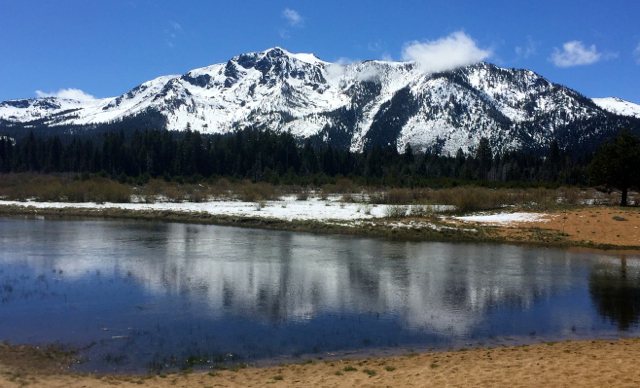
A fresh coat of snow on Mount Tallac after Friday's storm. Photo/LTN

A fresh coat of snow on Mount Tallac after Friday’s storm. Photo/LTN

By Marcella Corona, Reno Gazette-Journal

It’s going to be a cold and wet spring this week with some snowfall expected on Monday in Reno, a forecaster said.

Friday’s storm, which dropped several inches of snow on the Sierra, was only the beginning. Three storms could hit the Reno-Tahoe area through next weekend, meteorologist Scott McGuire, of the National Weather Service, said on Saturday.

“It was a pretty powerful late spring storm that moved through the region yesterday,” McGuire said. “It dropped quite a bit of snow in the sierra and decent rain in other areas.”

Read the whole story


Caltrans ready to work in Placer, Nevada counties

Caltrans has a slew of projects planned for this construction season in Placer and Nevada counties.

Projects range from highway maintenance to multi-million dollar improvements. They include:

  • Interstate 80 (CHP Inspection Station) – A $585,000 project to rehabilitate the Donner CHP Truck Inspection Facility in Truckee just north of Interstate 80, including new roofing and siding, as well as repair a water system. Completion is expected in 2017.
  • Highway 89 (Wildlife Crossing) – A $2.2 million project to construct a paired (two tunnels) wildlife crossing under Highway 89 eight miles north of Truckee as well as erect wildlife barrier fencing to reduce the incidence of wildlife/vehicle collisions on this section of highway through the Tahoe National Forest. Highway 89 Stewardship Team members will also conduct a three-year evaluation of project outcomes.  Completion is expected in December 2016.
  • Highway 89 (Pedestrian Tunnel) – A $14 million project constructing a pedestrian tunnel next to the vehicle tunnel (nicknamed the “Mousehole”) on Highway 89 just east of Truckee will continue work to complete the tunnel, build sidewalks and install landscaping to afford pedestrians safe access along Highway 89 under the Union Pacific railroad.  Completion is expected in 2016.


Other work that will intermittently impact highway traffic this season includes replacement of guardrail and damaged fences, culvert rehabilitation and ongoing maintenance activities.

Up-to-date traffic information is available online.


SLT Public Works — the backbone of the city

Azril Kalik with South Lake Tahoe explains snowplow operations. Photo/Kathryn Reed

Azril Kalik with South Lake Tahoe explains snowplow operations. Photo/Kathryn Reed

By Kathryn Reed

South Lake Tahoe would not function without the Public Works Department. Employees do the little things like change light bulbs, the medium work such as maintaining the parks, and the big stuff – snow removal, fleet maintenance and erosion control.

In terms of staff, it is the largest in the city.

Some of the department’s responsibilities include:

·      Maintaining and plowing 258 miles of roads

·      115 lane miles of curbs and gutters

·      29 miles of storm drain pipe

·      13 miles of drainage channel

·      1,800 drainage structures and basins

·      More than 7,000 signs/stakes

·      125,519 feet of bike paths/shared use trails

·      35 acres of landscaping

·      Interior/exterior of 33 buildings, equaling 226,000 square feet

·      348 acres at Lake Tahoe Airport

·      Entire fleet – nearly 250 vehicles.

Managers from the various sectors of Public Works gave an overview last week to members of the Citizens Academy. The free seven-week course is designed to give residents a better understanding about how the city works as well as an opportunity to ask questions of staff. (This reporter is part of the current class.)

“We don’t really repair anything, we restore stuff,” Alan Johnson, maintenance manager for facilities said. This goes for the buildings – some are older than the city, which turned 50 last year.

The same could be said of the aging fleet of vehicles, especially the snow removal equipment. The oldest is from 1970. Even so, the goal still remains to clear every street within 24 hours of a storm.

“There’s a misconception that the gate stops the berms,” Azril Kalik, who manages streets and snow, said. “We work 12-hour shifts until the snow is gone.”

The city’s fleet includes:

·       Airport – 19 vehicles, average age 21 years

·       Parks and Recreation – 43 vehicles, average age 18 years

·       Public Works – 97 vehicles, average age 17 years

·       Fire – 19 vehicles, average age 12 years

·       Other/admin – 11 vehicles, average age 11 years

·       Police – 60 vehicles, average age 9 years.

The department is also the lead on many projects in the city ranging from Bijou Bike Park to Lakeview Commons to stormwater installations.

“A lot of what we do is invisible,” explained Jason Burke, who heads the stormwater division.

This is because so many of the vaults collecting sediment are underground. These are in place so the water reaching Lake Tahoe is as clean as possible.

What gets built though – whether it’s with local, state or federal dollars – eventually is the city’s responsibility to maintain it. That is a key factor officials have to ponder before accepting grant funding – will the city be able to afford the maintenance and operation?

In listening to the general public’s needs, the department launched a work order request form on the city’s website so people can ask for a pothole or something else to be fixed. This is intended to be more convenient and efficient for everyone.

In the last year the department has gone through a reorganization that has employees being cross trained and a succession plan created so as upper managers leave-retire the younger staff will be able to apply for those jobs. Seasonal employees have been hired full time to make all of this work more efficiently in terms of time and money.


2016 on path to be hottest on record

By Tom Randall, Bloomberg

The Earth is warming so fast that it’s surprising even the climate scientists who predicted this was coming.

Last month was the hottest March in 137 years of record keeping, according to data released by the National Oceanic and Atmospheric Administration. It’s the 11th consecutive month to set a new record, and it puts 2016 on course to set a third straight annual record.

Now, it might seem premature to talk about setting a new yearly record after just three months of data, but these months have been such an extreme departure from the norm that Gavin Schmidt, who directs NASA’s Goddard Institute for Space Studies, has already made the call.

Read the whole story


Sandoval may not attend GOP convention

By Megan Messerly and Cy Ryan, Las Vegas Sun

Gov. Brian Sandoval he isn’t certain he’ll attend the Republican National Convention this summer in Cleveland, joining a line of Republican politicians who have expressed reservations about attending the convention or have said they’ll skip it altogether.

Sandoval spoke at the national convention in 2012 in Tampa and 2004 in New York City, and called the opportunities “an honor,” but he says he hasn’t received an invitation to appear on the podium this convention.

Read the whole story


Price of college to drop for some Tahoe residents

The final approval to reinstate the Good Neighbor Policy – at least on a limited basis – between California and Nevada became a reality this week.

The board of regents for the Nevada System of Higher Education gave the green light, which came months after both governors signed off on the deal. The new policy should be in place by fall.

“This Interstate Attendance Agreement reduces the cost of attending Lake Tahoe Community College for the Nevada residents in the Tahoe basin by 46 percent, a savings of over $3,500 per year for a full-time student,” Lake Tahoe Community College President Kindred Murillo told Lake Tahoe News. “For California residents, it means a reduced cost for attending Western Nevada College, as this is especially important because WNC provides some programs LTCC does not. This ensures additional access for students, and less duplication of programs.”

Until 2011, there had been a policy in place that allowed Nevada basin residents to attend LTCC at California rates, plus a small fee. Nevada did away with that law. Much of it had to do with politics, which is also the reason the two states took so long to come to another agreement.

— Lake Tahoe News staff report